Quick Brief: The Electric Ford Ranger EV Powertrain
Before mapping out a charging strategy, it helps to know exactly what you're plugging into. The electric Ford Ranger EV — built on the same body-on-frame T3 platform as the next-generation F-150 Lightning — is expected to carry a usable battery pack in the range of 85–98 kWh (final chemistry and capacity TBD at launch), targeting an EPA-estimated range of approximately 250–300 miles depending on trim and drivetrain. Peak DC fast-charge capability is anticipated around 150–170 kW, consistent with Ford's current BEV architecture.
Because this is an announced/preliminary model as of early 2026, the figures below use Ford's published platform data and F-150 Lightning benchmarks as the closest proxy. We'll update with confirmed specs the moment Ford releases them.
Charging Levels Explained: How Fast Will the Electric Ford Ranger EV Gain Range?
The single most common point of confusion for new EV owners is the difference between kW (kilowatts) and kWh (kilowatt-hours). Think of it this way: kWh is the size of your battery (energy capacity, like gallons in a fuel tank), while kW is the rate at which energy flows in (power, like the flow rate of a gas pump nozzle). A 90 kWh battery charged at 10 kW takes roughly 9 hours; at 150 kW, the same battery fills much faster — but only up to the point where the charge curve tapers.
| Level | Voltage / Amperage | Power (kW) | Miles of Range Added per Hour | 0–100% Time (Est.) |
|---|---|---|---|---|
| Level 1 (120V household) | 120V / 12A | ~1.4 kW | ~3–4 mi/hr | ~64 hours |
| Level 2 (240V home/public) | 240V / 40–48A | 9.6–11.5 kW | ~25–32 mi/hr | ~8–10 hours |
| DC Fast Charge | 400V+ / up to 400A | Up to ~150–170 kW (peak) | ~250–350 mi/hr (peak) | 10–80% in ~30–35 min |
Home Charger Installation: Electrical Requirements, Costs & Panel Upgrades
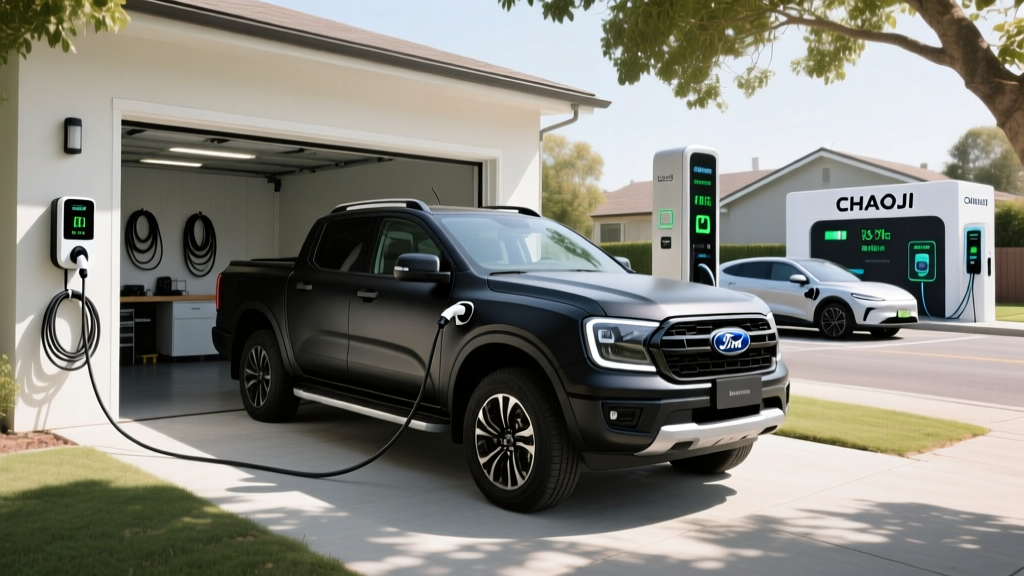
For daily driving, a Level 2 home charger on a 240V circuit is the practical standard. Most electric Ranger EV owners will want a 48-amp charger, which requires a dedicated 60-amp circuit (electrical code requires the circuit to be rated at 125% of the continuous load: 48A × 1.25 = 60A).
Electrical Requirements at a Glance
- Voltage: 240V (split-phase, same as a dryer or oven circuit)
- Amperage: 48A continuous draw on a 60A breaker (for 11.5 kW output)
- Wire gauge: 6 AWG copper (or 4 AWG aluminum) for runs up to ~50 feet; thicker gauge for longer runs
- Circuit: Dedicated — cannot share with other appliances
- GFCI protection: Required by NEC 2020+ for EV receptacles (some chargers have built-in GFCI)
Do You Need a Panel Upgrade?
This is the most overlooked cost in EV home charging. If your home has a 100-amp main service panel (common in homes built before the 1990s), adding a 60-amp EV circuit may exceed your panel's capacity — especially if you're already running electric heat, an electric oven, and a dryer. A licensed electrician will perform a load calculation per NEC Article 220 to determine if your panel can handle the additional draw.
If a panel upgrade is needed — typically from 100A to 200A — expect to pay $1,500–$3,500 for the upgrade alone, on top of the charger circuit installation.
| Component | Low-End | Typical | High-End |
|---|---|---|---|
| Level 2 EVSE equipment (40–48A smart charger) | $350 | $550 | $750 |
| Electrician labor (circuit run, outlet or hardwire, permit pull) | $400 | $800 | $1,500 |
| Permit & inspection | $50 | $150 | $300 |
| Panel upgrade (if needed: 100A → 200A) | $0 (not needed) | $0–$2,000 | $3,500 |
| TOTAL | $800 | $1,500–$3,500 | $6,050 |
How much does it cost to install a home EV charger? For most homeowners with an adequate 200A panel and a garage within 30 feet of the panel, expect $1,200–$2,200 all-in (equipment + electrician + permit). Older homes needing a panel upgrade can see $3,000–$6,000. Always get at least two quotes from licensed electricians and confirm the quote includes permit and inspection.
Safety & Code Considerations
- Hardwired vs. plug-in: A NEMA 14-50 receptacle offers portability (take the charger when you move), but hardwired installations eliminate the GFCI breaker requirement at the panel (many EVSEs have internal GFCI) and are generally more reliable long-term.
- Outdoor rating: If your charger will be mounted outside, ensure it carries a NEMA 4 (weatherproof) rating — not just NEMA 3R.
- Cable management: A 25-foot cable is standard; opt for 18–20 feet if your charge port and panel are close to avoid tripping hazards.
- Utility rebates: Many utilities offer $250–$500 rebates for Level 2 installations, and some offer time-of-use (TOU) rate plans that slash overnight charging costs. Check with your local utility before installing.
Connector Compatibility: NACS, CCS1 & Adapter Realities
Ford made a pivotal decision in 2023: all new Ford EVs would adopt the North American Charging Standard (NACS) — commonly called the Tesla connector — as their native charge port. The electric Ford Ranger EV is expected to ship with a NACS port, giving it direct access to the Tesla Supercharger network (now the largest and most reliable DC fast-charging network in the U.S.) without an adapter.
| Connector | Native or Adapter? | Networks Available | Notes |
|---|---|---|---|
| NACS (Tesla) | Native (expected) | Tesla Supercharger, Electrify America (new stations), EVgo, many others | Smaller, lighter connector; no CCS latch mechanism |
| CCS1 | Adapter required (NACS-to-CCS) | Electrify America, EVgo, ChargePoint DC stations with CCS cables | Legacy CCS stations still widespread; carry an adapter for road trips |
| CHAdeMO | Not supported | Nissan Leaf network remnants | Effectively deprecated in the U.S. as of 2025 |
| J1772 (Level 2 AC) | Adapter included (NACS-to-J1772) | Public Level 2 stations, hotels, workplaces | Ford typically includes this adapter with the vehicle |
Which connector/charger is compatible with my EV? The electric Ford Ranger EV's native NACS port covers the vast majority of DC fast-charging and Level 2 scenarios. For legacy CCS-only public chargers, keep a NACS-to-CCS adapter (~$150–$250) in the truck. For home Level 2, a NACS-equipped wall connector (like the Tesla Wall Connector or Ford-branded equivalent) plugs in directly.
Public Charging Networks: Where and What It Costs
With a NACS port, the electric Ford Ranger EV taps into the Tesla Supercharger network — over 6,000 stations and 30,000+ stalls in North America as of early 2026, with V3 (250 kW) and V4 stalls widely available. Ford's BlueOval Charge network also aggregates access to Electrify America, EVgo, and ChargePoint through the FordPass app.
Charging Time Examples for the Electric Ford Ranger EV
Using a projected ~90 kWh usable battery and ~280 miles of EPA range:
- Tesla V3 Supercharger (250 kW, NACS): 10–80% in approximately 30–35 minutes (~190 miles added). Peak rate limited by the truck's ~150–170 kW max acceptance.
- Electrify America 150 kW CCS stall (with adapter): 10–80% in approximately 35–40 minutes.
- Public Level 2 (7.2–19.2 kW): A full charge in 5–12 hours — useful for overnight hotel stops or all-day workplace charging.
- Level 1 (120V emergency/top-up): ~3–4 miles per hour. A 10-hour overnight session adds roughly 30–40 miles — enough for short commutes if Level 2 isn't available.
Cost to Charge the Electric Ford Ranger EV: Home vs. Public vs. Gas
How much does charging cost per mile vs gas? Let's run the numbers using the projected efficiency of the electric Ranger EV. A body-on-frame electric truck of this size is expected to achieve roughly 2.5–2.8 kWh per mile (approximately 120–135 MPGe combined, per fueleconomy.gov benchmarks for similar vehicles).
| Scenario | Rate | Cost per Mile | Cost for 300-Mile Trip |
|---|---|---|---|
| Home charging (off-peak TOU rate) | $0.09/kWh | $0.24 | $72.00 |
| Home charging (standard rate) | $0.15/kWh | $0.40 | $120.00 |
| Tesla Supercharger (average) | $0.30/kWh | $0.80 | $240.00 |
| Electrify America / EVgo DC | $0.38/kWh | $1.01 | $303.00 |
| Gas Ranger (23 MPG combined, $3.40/gal) | $3.40/gallon | $0.15 × 10 = $1.48 | $443.48 |
The takeaway: home-charged electricity is dramatically cheaper than gas, even at standard residential rates. A 300-mile trip on off-peak home power costs roughly $72 vs. $443 in a gas Ranger. Public DC fast charging narrows the gap significantly — and on some networks can approach or exceed gas costs per mile. The economic case for an electric truck is overwhelmingly dependent on reliable, affordable home charging.
Recommended Level 2 Chargers for the Electric Ford Ranger EV
These chargers all feature native NACS connectors (or are available in NACS), deliver sufficient power for the Ranger EV's onboard charger, and have proven reliability records.
Tesla Wall Connector (NACS)
- Power output: Up to 11.5 kW (48A on 60A circuit)
- Connector: Native NACS
- Cable length: 24 feet
- Smart features: Wi-Fi, OTA updates, power-sharing with second unit, load management
- Price: ~$425
- Best for: Ford EV owners wanting the simplest NACS-native setup
Ford Connected Charge Station (NACS)
- Power output: Up to 11.5 kW (48A)
- Connector: Native NACS
- Cable length: 25 feet
- Smart features: FordPass integration, scheduled charging, energy tracking, OTA
- Price: ~$600–$800 (may be included with vehicle purchase)
- Best for: Seamless FordPass ecosystem integration
ChargePoint Home Flex (NACS version)
- Power output: Up to 12 kW (50A on 60A circuit) — configurable via DIP switches
- Connector: NACS (2024+ models)
- Cable length: 23 feet
- Smart features: Wi-Fi, app scheduling, Alexa, flexible amperage from 16–50A
- Price: ~$550–$650
- Best for: Homes where a 60A circuit isn't available (can be set to 32A on a 40A circuit)
Emporia Vue Level 2 EV Charger
- Power output: Up to 11.5 kW (48A)
- Connector: NACS (available in 2025+ production)
- Cable length: 24 feet
- Smart features: Integration with Emporia home energy monitor, solar-aware charging, TOU scheduling
- Price: ~$400
- Best for: Budget-conscious buyers who want energy monitoring
Federal Tax Credits & Incentives for Home Charging Equipment
Under IRS §30D and the Alternative Fuel Vehicle Refueling Property Credit (§30C), you may be eligible for a 30% tax credit on home EV charger equipment and installation, up to $1,000. However, this credit has geographic restrictions — it applies only if you live in a qualifying census tract (generally non-urban or low-income communities). Check the IRS website or consult a tax professional to confirm eligibility before purchasing.
Many states and utilities also offer rebates for Level 2 charger installations — ranging from $200 to $1,000. These stack with the federal credit in most cases but vary by jurisdiction. Contact your local utility and state energy office for current programs.
Frequently Asked Questions
How fast will each charging level add range to the electric Ford Ranger EV?
Level 1 (120V) adds roughly 3–4 miles per hour — adequate only for overnight top-ups or emergencies. Level 2 (240V, 48A) adds approximately 25–32 miles per hour, fully recharging overnight. DC fast charging at 150+ kW can add up to 190 miles in 30 minutes (10–80%), though the charge curve tapers significantly above 80% SoC.
How much does it cost to install a home EV charger for the electric Ford Ranger EV?
Expect $1,200–$2,200 for a standard installation with a 200-amp panel and short wire run. Costs escalate to $3,000–$6,000 if your home requires a panel upgrade from 100A to 200A service. Always get a load calculation from a licensed electrician before committing.
Which connector is compatible with the electric Ford Ranger EV?
The Ranger EV is expected to use a native NACS (Tesla-style) connector for both AC Level 2 and DC fast charging. This gives direct access to Tesla Superchargers and the growing NACS-equipped public network. For legacy CCS-only chargers, carry a NACS-to-CCS adapter (~$150–$250).
How much does charging cost per mile compared to a gas Ford Ranger?
At home off-peak rates ($0.09/kWh), the electric Ranger EV costs approximately $0.24/mile — about one-sixth the cost of a gas Ranger at $1.48/mile (23 MPG, $3.40/gallon). Public DC fast charging ($0.30–$0.38/kWh) raises costs to $0.80–$1.01/mile, narrowing but not eliminating the savings gap.
What electrical upgrades might I need for a Level 2 home charger?
The most common upgrade is a panel replacement from 100A to 200A service ($1,500–$3,500) if your existing panel can't accommodate a new 60-amp dedicated circuit. You may also need a wire upgrade if the run from panel to garage exceeds 50 feet. A licensed electrician's load calculation will determine exact needs. Always defer final electrical specifications to a licensed professional.
Can I use a portable Level 1 charger as my primary charging solution?
Technically yes, but practically no. At ~1.4 kW and 3–4 miles per hour, a full charge of a ~90 kWh battery takes over 60 hours. If your daily driving is under 30 miles and you can leave the truck plugged in for 10+ hours nightly, Level 1 can work — but it's a poor long-term solution for a truck this size. Budget for a Level 2 installation.
Does the electric Ford Ranger EV support vehicle-to-home (V2H) or vehicle-to-load (V2L)?
Ford has pioneered V2L/V2H through the F-150 Lightning's Pro Power Onboard and Home Integration System. The electric Ranger EV is expected to offer V2L capability (powering tools, appliances, or a campsite from the truck's battery), though full V2H bidirectional charging — feeding power back into your home during an outage — depends on both vehicle hardware and a compatible home energy management system. Ford has not confirmed full V2H for the Ranger EV as of early 2026.
Sources: EPA fueleconomy.gov, IRS.gov §30C Refueling Property Credit, Ford Motor Company press materials. All specs for the electric Ford Ranger EV are preliminary/estimated based on announced platform data and comparable Ford BEV products. Final specifications, pricing, and availability subject to change. Consult a licensed electrician for home charging installation and a tax professional for credit eligibility.