If you are shopping for electric cars with 300 mile range, the sticker number is only half the equation. The other half—how you will actually keep that 75–100 kWh battery full day to day—determines whether EV ownership feels effortless or frustrating. A 310-mile EPA rating means little if your home electrical panel cannot support a Level 2 charger, or if you are paying $0.48/kWh at public DC fast stations every week.
This guide walks through the charging infrastructure reality behind today's long-range EVs: the Hyundai Ioniq 6 (361 mi EPA), Tesla Model 3 Long Range (341 mi), Chevrolet Equinox EV (319 mi), and similar models in the 300+ mile bracket. We cover exact install costs, electrical requirements, connector compatibility, and per-mile charging economics for 2026.
How Fast Will Each Charging Level Add Range?
Before comparing chargers, you need the distinction between kW (kilowatts) and kWh (kilowatt-hours) locked in. kW measures power—the rate of energy delivery, like water pressure from a hose. kWh measures energy—the total amount stored in your battery, like gallons in a tank. A 75 kWh battery charged at 7.5 kW takes roughly 10 hours from empty. The same battery at 150 kW DC fast charging can reach 80% in about 25 minutes.
| Level | Voltage | Power (kW) | Miles of Range per Hour | Best For |
|---|---|---|---|---|
| Level 1 | 120V AC | 1.0–1.4 kW | 3–5 mi/hr | Overnight top-up, PHEVs, emergency |
| Level 2 (Home) | 240V AC | 7.2–11.5 kW | 25–44 mi/hr | Daily home charging, full overnight refill |
| Level 2 (Public) | 208–240V AC | 6.6–19.2 kW | 22–70 mi/hr | Workplace, shopping, destination |
| DC Fast (CCS/NACS) | 400–800V DC | 50–350 kW | 150–1,000+ mi/hr (peak) | Road trips, rapid top-ups |
For a typical 300-mile-range EV with an ~80 kWh battery, Level 1 charging is essentially useless for full refills (16+ hours). Level 2 at 11.5 kW replenishes 0–100% in about 7 hours—ideal for overnight. DC fast charging peaks high but tapers significantly above 80% State of Charge (SoC) to protect battery health, which is why manufacturers quote 10–80% times rather than 0–100%.
Home Charger Installation: Electrical Requirements and Costs
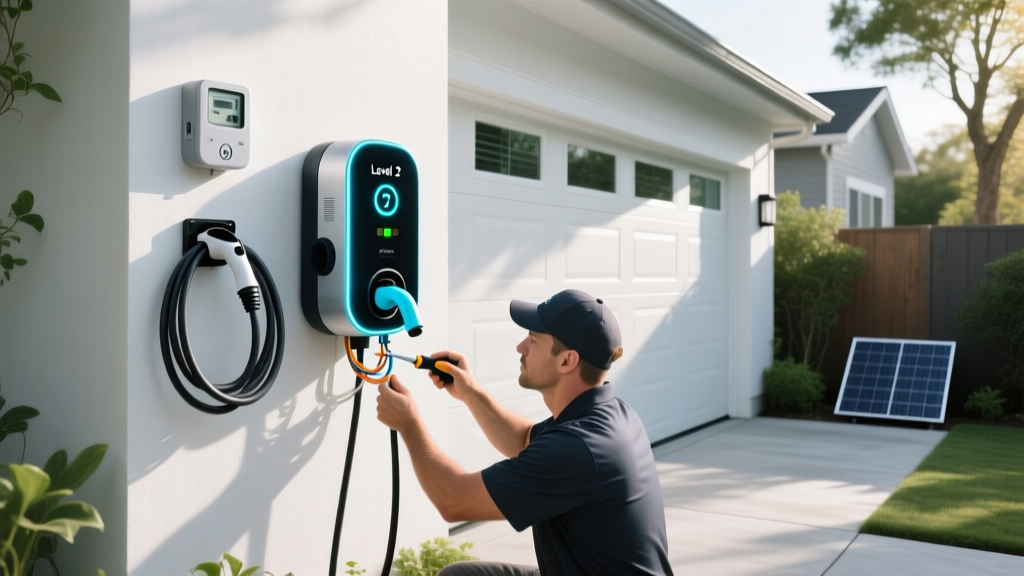
Installing a Level 2 home charger is the single biggest infrastructure decision for any long-range EV buyer. Most 300-mile EVs benefit from a 40-amp or 48-amp circuit, which requires a 240V dedicated line from your electrical panel.
Electrical Panel and Circuit Requirements
A 48-amp charger (like the Tesla Wall Connector or ChargePoint Home Flex) draws 48A continuous, which per National Electrical Code (NEC) requires a 60-amp breaker (continuous loads must be on circuits rated 125% of the draw). Your home's main panel must have enough spare capacity—typically 200 amps total for modern homes—to accommodate this new load alongside your existing appliances.
Homes built before 1990 often have 100-amp or 150-amp panels. Adding a 60-amp EV circuit to a maxed-out 100-amp panel will require a panel upgrade to 200 amps, which is a significant additional cost. Even some 200-amp panels lack physical breaker spaces, requiring a sub-panel installation.
Installation Cost Breakdown
| Component | Simple Install (Panel Nearby) | Complex Install (Long Run / Panel Upgrade) |
|---|---|---|
| Level 2 Charger (Hardware) | $350–$600 | $350–$600 |
| Electrician Labor | $400–$800 | $1,200–$2,500 |
| Permit & Inspection | $50–$200 | $100–$300 |
| Panel Upgrade (if needed) | N/A | $1,500–$3,500 |
| Conduit, Wire, Misc. | $100–$300 | $300–$800 |
| Total | $900–$1,900 | $3,450–$7,700 |
The wide range reflects real variables: a garage charger mounted 10 feet from a 200-amp panel with spare breaker slots is the low end. A charger on the far side of the house requiring 60+ feet of conduit through finished walls, plus a panel upgrade, hits the high end. Always get at least two quotes from licensed electricians and confirm they pull a local permit—unpermitted EV charger work can void home insurance and cause issues at resale.
Federal and Utility Incentives
Under IRS §30C, you may claim a federal tax credit of up to 30% of home charging equipment and installation costs, capped at $1,000. This credit has income and census-tract eligibility requirements. Many utilities also offer rebates of $200–$500 for Level 2 charger installation or discounted time-of-use (TOU) rates. Check with your local utility before installing.
Connector Compatibility: NACS, CCS, and CHAdeMO
The North American charging connector landscape consolidated significantly through 2025–2026. Here is where things stand:
| Connector | Brands Using It (Native) | Notes |
|---|---|---|
| NACS (J3400) | Tesla, Ford, GM, Rivian, Volvo, Polestar, Hyundai/Kia (2025+) | Now the dominant standard; access to Tesla Supercharger network |
| CCS1 | VW, BMW, Mercedes, Stellantis, some legacy Hyundai/Kia | Still widely available; adapters to NACS increasingly offered |
| CHAdeMO | Nissan Leaf (legacy only) | Effectively discontinued for new vehicles; stations declining |
If you buy a 2026 model-year EV from Ford, GM, Rivian, Hyundai, or Kia, it will almost certainly ship with a native NACS port. Volkswagen Group and BMW models still use CCS1, but both brands have announced NACS transitions for upcoming models. CCS-to-NACS adapters (typically $150–$250) are available for accessing Tesla Superchargers with a CCS-port vehicle.
For home Level 2 charging, the connector matters less—most home chargers are available in both NACS and CCS (J1772) variants, and adapters are inexpensive. For DC fast charging on road trips, native NACS gives the broadest network access in 2026.
Charging Time Examples: 10–80% for 300-Mile EVs
Long-range EVs carry larger batteries, which means longer fill times at any given power level. Here are realistic 10–80% charging times for popular 300+ mile models, based on manufacturer data and independent testing:
| Vehicle | Battery (kWh, Usable) | Peak DC Rate | 10–80% Time | Architecture |
|---|---|---|---|---|
| Hyundai Ioniq 6 SE LR | 77.4 kWh (NMC) | ~240 kW | ~18 min | 800V E-GMP |
| Tesla Model 3 LR AWD | ~75 kWh (NMC) | ~250 kW | ~25 min | 400V |
| Chevy Equinox EV RS | ~85 kWh (NMC) | ~150 kW | ~35 min | 400V Ultium |
| Kia EV6 GT-Line LR | 77.4 kWh (NMC) | ~240 kW | ~18 min | 800V E-GMP |
| Ford Mustang Mach-E ER | ~91 kWh (NMC) | ~150 kW | ~38 min | 400V |
Two things to note. First, peak kW is not sustained kW. A vehicle that peaks at 240 kW at 15% SoC will taper to 150 kW by 50% and below 60 kW past 80%. The 10–80% time reflects the area under the entire charge curve, not just the peak number. Second, 800-volt architectures (Hyundai/Kia E-GMP, Porsche, Lucid) sustain higher power deeper into the charge session, which is why a 77 kWh Ioniq 6 charges faster than a 91 kWh Mach-E despite the smaller battery.
At home on a 48A / 11.5 kW Level 2 charger, expect a full charge (10–100%) for any of these vehicles in roughly 7–9 hours—easily completed overnight.
Charging Cost Per Mile: Home vs. Public vs. Gas
The economics of charging a 300-mile-range EV depend almost entirely on where you charge. Home charging on a utility time-of-use plan is dramatically cheaper than public DC fast charging, and both are typically cheaper than gasoline on a per-mile basis.
| Scenario | Rate | Efficiency Assumption | Cost Per Mile |
|---|---|---|---|
| Home (off-peak TOU) | $0.09/kWh | 3.0 mi/kWh (avg 300-mi EV) | $0.030 |
| Home (standard rate) | $0.16/kWh | 3.0 mi/kWh | $0.053 |
| Public Level 2 | $0.25/kWh | 3.0 mi/kWh | $0.083 |
| DC Fast (Electrify America) | $0.43/kWh | 3.0 mi/kWh | $0.143 |
| DC Fast (Tesla Supercharger) | $0.30/kWh | 3.0 mi/kWh | $0.100 |
| Gasoline (30 MPG, $3.40/gal) | $3.40/gal | 30 MPG | $0.113 |
| Gasoline (22 MPG, $3.40/gal) | $3.40/gal | 22 MPG | $0.155 |
At home on off-peak rates, a 300-mile EV costs roughly 3 cents per mile—about one-quarter the cost of an efficient gas car. Even on standard residential rates, you are paying 5 cents per mile. The savings erode at public DC fast chargers, where rates of $0.35–$0.48/kWh can push EV per-mile costs above a fuel-efficient hybrid. This is why home charging access is the single most important economic factor in EV ownership.
For a driver covering 12,000 miles per year with 80% home charging at $0.12/kWh and 20% DC fast at $0.38/kWh, annual fuel cost is approximately $2,064. A comparable 28 MPG gas car at $3.40/gallon spends $1,457. Wait—the EV costs more? Not quite: that gas figure ignores maintenance (oil changes, transmission fluid, brake pad replacement from friction braking vs. regen). Factor in the EPA's MPGe data and total cost calculators, and the EV typically saves $400–$800/year when home charging dominates.
Recommended Home Level 2 Chargers for Long-Range EVs
For owners of 300-mile-range EVs, a quality Level 2 charger should deliver at least 40 amps (9.6 kW) to ensure overnight replenishment of a large battery. Here are top picks across budgets, all hardwired or NEMA 14-50 plug compatible:
Tesla Wall Connector (Gen 4)
- Power: Up to 48A / 11.5 kW (240V)
- Connector: Native NACS (J1772 adapter included)
- Cable: 24 ft
- Smart Features: Wi-Fi, OTA updates, load sharing (multiple units on one circuit), Power Sharing
- Price: ~$425
- Best For: NACS-equipped vehicles, Tesla ecosystem, multi-EV households
ChargePoint Home Flex
- Power: Up to 50A / 12 kW (240V, adjustable)
- Connector: J1772 (NACS adapter available separately)
- Cable: 23 ft
- Smart Features: Wi-Fi, app scheduling, Alexa integration, flexible amperage settings
- Price: ~$550
- Best For: CCS/J1772 vehicles, renters who may move (adjustable amperage fits different panels)
Emporia Vue Smart EV Charger
- Power: Up to 48A / 11.5 kW (240V)
- Connector: J1772 (NACS version available)
- Cable: 24 ft
- Smart Features: Wi-Fi, solar integration, energy monitoring via Emporia Vue panel
- Price: ~$400
- Best For: Solar owners, budget-conscious buyers wanting smart features
Grizzl-E Smart
- Power: Up to 40A / 9.6 kW (240V)
- Connector: J1772 or NACS
- Cable: 24 ft
- Smart Features: OCPP-compatible, app control, adjustable amperage
- Price: ~$450
- Best For: Cold climates (rated to -40°F), outdoor installs, ruggedness
All four chargers carry NEMA 4 (outdoor) ratings and support hardwired or plug-in installation. Hardwired is preferred for 48A+ units—a NEMA 14-50 receptacle is rated for 50A but continuous draw should not exceed 40A on a plug, meaning a 48A charger needs hardwiring on a 60A breaker for full output.
Safety, Electrical Code, and Installation Best Practices
EV charging is a high-draw, long-duration electrical load—unlike a dryer or oven that cycles on and off, a Level 2 charger may run at full amperage for 6–8 hours straight. This makes proper installation non-negotiable.
- Dedicated circuit: Your EV charger must be on its own dedicated breaker—never shared with other appliances.
- GFCI protection: NEC 2020 and later requires GFCI (Ground Fault Circuit Interrupter) protection for all EV charging outlets. Hardwired chargers with built-in ground fault protection may satisfy this without a GFCI breaker.
- Outdoor rating: If your charger is outdoors, ensure both the unit and the receptacle (if plug-in) carry a NEMA 4 or NEMA 4X weather-resistance rating. Use an in-use cover for NEMA 14-50 outlets.
- Wire gauge: A 60A circuit requires 6 AWG copper wire (THHN in conduit) or 4 AWG aluminum. Do not let an electrician undersize wire for cost savings.
- Permit and inspection: Every jurisdiction requires a permit for new 240V circuits. The inspection verifies wire gauge, breaker sizing, grounding, and GFCI compliance. Skip the permit at your own risk—unpermitted work can trigger insurance denial after an electrical fire.
Real-World Range Reality for 300-Mile EVs
EPA Sticker vs. Real-World Range: The EPA range figure on a window sticker assumes a mixed driving cycle at moderate temperatures. In practice, expect:
- Highway driving (70–80 mph): 15–25% less than EPA. A 341-mile Model 3 LR may deliver 260–290 miles at sustained interstate speeds.
- Cold weather (below 30°F): 20–35% reduction. Battery chemistry slows, cabin heating draws energy. A 361-mile Ioniq 6 may net 240–280 miles in freezing conditions.
- Combined worst case (cold + highway + hills): Up to 40% reduction. Plan charging stops conservatively in winter road-trip scenarios.
- City / mild weather: Often exceeds EPA by 5–10% thanks to regenerative braking.
For official EPA range and MPGe figures, always cross-check fueleconomy.gov before purchasing.
This is why a home Level 2 charger matters so much for 300-mile EVs. Even if real-world range drops to 250 miles in winter, you start every morning with a full charge—effectively eliminating range anxiety for daily driving. DC fast charging handles road trips, where the 10–80% times above translate to a 20–35 minute break every 200–250 miles.
Frequently Asked Questions
How much does it cost to install a home EV charger?
A straightforward Level 2 installation (panel nearby, no upgrade needed) costs $900–$1,900 including the charger, electrician labor, permit, and materials. If your home needs a panel upgrade to 200 amps or the charger is far from the panel, expect $3,500–$7,700. Get multiple quotes and always require a permit and inspection.
How fast will each charging level add range to my 300-mile EV?
Level 1 (120V) adds 3–5 miles per hour—impractical for a full refill. Level 2 (240V, 48A) adds 30–44 miles per hour, filling a large battery overnight in 7–9 hours. DC fast charging adds 150–1,000+ miles per hour at peak, but tapers significantly above 80% SoC, making 10–80% in 18–38 minutes realistic depending on the vehicle and charger.
Which connector and charger is compatible with my EV?
2026 models from Tesla, Ford, GM, Rivian, Hyundai, and Kia use the NACS (J3400) connector. Volkswagen, BMW, and Mercedes still use CCS1. CHAdeMO is limited to legacy Nissan Leafs. For home Level 2 charging, most chargers are available in both connector types, and adapters cost $20–$50. For DC fast charging, native NACS provides the broadest network access.
How much does charging cost per mile compared to gas?
Home charging at off-peak rates (~$0.09/kWh) costs about 3 cents per mile—roughly one-quarter the cost of a 30 MPG gas car at $3.40/gallon. Standard home rates (~$0.16/kWh) yield about 5 cents per mile. Public DC fast charging at $0.35–$0.48/kWh costs 12–16 cents per mile, approaching or exceeding gas costs. Maximizing home charging is the key to EV savings.
What electrical upgrades might I need for a home charger?
The most common upgrade is a panel replacement from 100A to 200A service ($1,500–$3,500) if your existing panel lacks capacity. You may also need a sub-panel if breaker spaces are full, or a service upgrade from the utility if your transformer cannot handle the added load. An electrician will perform a load calculation (NEC Article 220) to determine if your panel can support a 60A EV circuit.
Do I need a smart charger, or is a basic unit fine?
A basic charger works fine for charging, but smart features add real value: scheduled charging during off-peak utility hours (saving 30–50% on electricity), energy monitoring, and load-sharing for multi-EV households. The $100–$150 premium for a smart charger typically pays for itself within a year through TOU optimization.