What kWh Per Mile Actually Means for Your EV
If you've ever glanced at an EV's window sticker and seen "kWh/100 mi" listed alongside MPGe, you've encountered the single most important efficiency metric in electric driving. While gas cars measure fuel economy in miles per gallon, electric vehicles measure energy consumption in kilowatt-hours per mile — or more commonly, kWh per 100 miles.
Here's the critical distinction: kWh (kilowatt-hours) measures energy — the total amount of electricity your battery stores and your motor consumes. kW (kilowatts) measures power — the rate at which electricity flows, whether from a charger into your battery or from your battery to the motor. Confusing these two is the most common EV literacy gap. Think of it this way: kWh is like gallons of gas in your tank; kW is like the flow rate of the pump filling it.
The average EV in 2026 consumes between 0.25 and 0.40 kWh per mile (or 25–40 kWh/100 mi) under mixed driving conditions. A highly efficient sedan like the Tesla Model 3 Highland might sip 0.24 kWh/mi on the highway, while a heavy electric truck like the Rivian R1T can consume 0.48 kWh/mi or more, especially under load or in cold weather.
Understanding your vehicle's kWh-per-mile figure is essential because it directly determines two things: your real-world range and your cost per mile to charge. Let's break down both, along with everything you need to know about charging infrastructure.
EV Efficiency Benchmarks: kWh Per Mile by Vehicle Class
Efficiency varies dramatically by vehicle weight, aerodynamics, tire choice, and thermal management. Below are real-world consumption figures compiled from fueleconomy.gov EPA data and independent road testing for popular 2026 model-year EVs.
| Vehicle | Battery (kWh usable) | EPA Range (mi) | kWh/100 mi (EPA) | kWh per Mile | Real-World Highway Note |
|---|---|---|---|---|---|
| Tesla Model 3 LR AWD | 75 (NMC) | 363 | 24 | 0.24 | Expect ~0.27 at 75 mph |
| Hyundai Ioniq 6 SEL | 77.4 (NMC) | 361 | 25 | 0.25 | Expect ~0.28 at 75 mph |
| Chevrolet Equinox EV RS | 85 (NMC) | 319 | 31 | 0.31 | Expect ~0.35 at 75 mph |
| Ford Mustang Mach-E GT | 91 (NMC) | 290 | 34 | 0.34 | Expect ~0.38 aggressive driving |
| Rivian R1T Dual-Motor | 106 (NMC) | 328 | 38 | 0.38 | Expect ~0.44 towing |
| GMC Sierra EV Denali | 200 (NMC) | 440 | 48 | 0.48 | Expect ~0.55 cold/hwy |
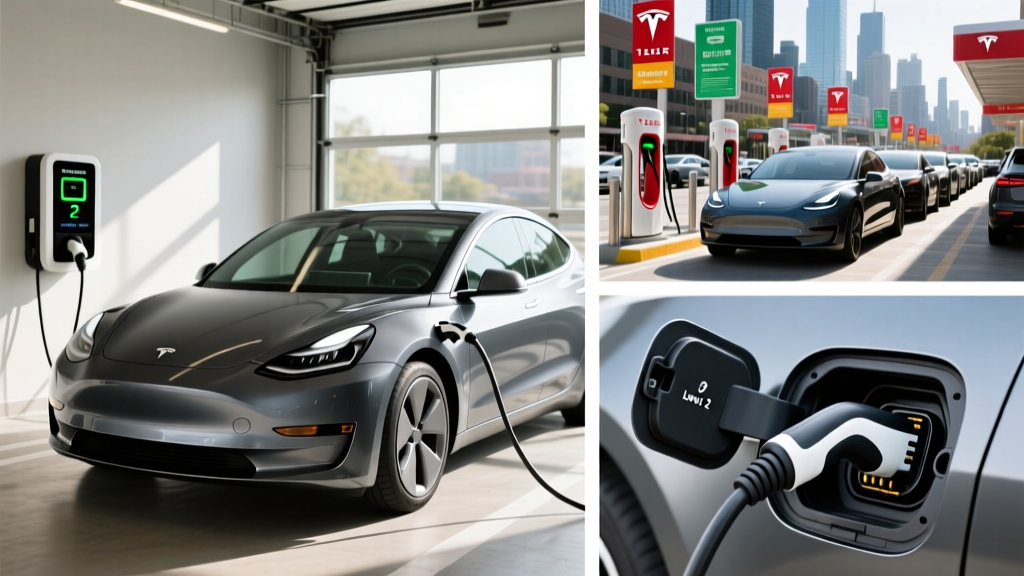
Charging Levels Explained: kW Speeds and Miles Added Per Hour
Your EV's kWh-per-mile figure becomes practically useful when paired with charging speeds. Every charger delivers power measured in kW. To calculate how fast you'll add range, divide the charger's kW output by your vehicle's kWh/mi consumption.
Example: A 11.5 kW Level 2 charger feeding a Hyundai Ioniq 6 (0.25 kWh/mi) adds roughly 11.5 ÷ 0.25 = 46 miles of range per hour.
| Level | Voltage / Amps | Power (kW) | Miles Added Per Hour* | Typical Use Case |
|---|---|---|---|---|
| Level 1 | 120V / 12A | 1.4 kW | 3–5 mi/hr | Emergency / overnight trickle |
| Level 2 (basic) | 240V / 32A | 7.7 kW | 22–31 mi/hr | Home daily charging |
| Level 2 (high-power) | 240V / 48A | 11.5 kW | 33–46 mi/hr | Home / workplace fast top-up |
| DC Fast (50 kW) | 400V+ DC | 50 kW | ~150–200 mi/hr | Older public stations |
| DC Fast (150 kW) | 400V+ DC | 150 kW | ~450–600 mi/hr | Highway corridor charging |
| DC Fast (250–350 kW) | 800V DC | 250–350 kW | ~750–1,200 mi/hr | Ultra-fast (Ioniq 5, Taycan, etc.) |
*Miles per hour ranges reflect vehicle efficiency from 0.25 kWh/mi (efficient sedan) to 0.40 kWh/mi (heavy SUV/truck). Actual speed also depends on battery state of charge, temperature, and charge-curve taper.
A crucial reality check on DC fast charging: peak kW is not sustained kW. A vehicle rated for 250 kW peak charging will only sustain that rate between roughly 10–40% state of charge. Above 80%, charging speed tapers dramatically to protect the battery cells. A "10–80% in 18 minutes" claim typically means the full 80–100% top-off could take an additional 20–25 minutes.
How Much Does It Cost to Install a Home EV Charger?
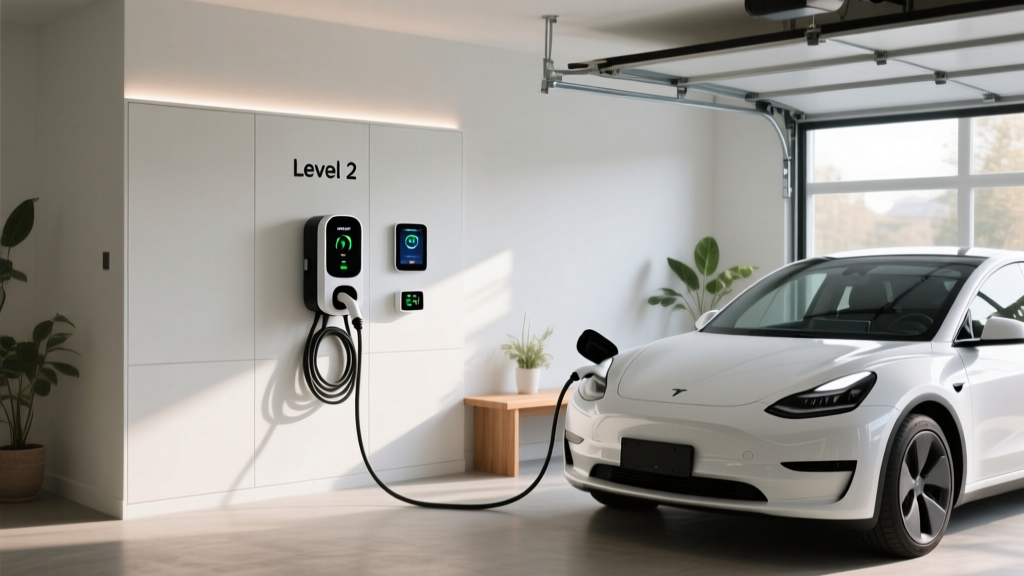
Home Level 2 charging is where most EV owners do 80–90% of their charging. Installation costs vary enormously based on your home's electrical panel capacity, the distance from panel to charger location, and local permit requirements.
| Component | Low Estimate | High Estimate | Notes |
|---|---|---|---|
| Level 2 Charger (hardware) | $350 | $750 | 32A–48A smart chargers; Wi-Fi enabled |
| Electrical Permit | $50 | $250 | Varies by municipality; required in most jurisdictions |
| Electrician Labor (basic install) | $400 | $1,200 | Short run from 200A panel, NEMA 14-50 or hardwired |
| Electrical Panel Upgrade (if needed) | $1,500 | $4,000 | 100A → 200A service upgrade for older homes |
| Conduit / Trenching (long runs) | $200 | $1,500 | Detached garages or chargers far from panel |
| Total (no panel upgrade) | $800 | $2,200 | Typical scenario for modern 200A homes |
| Total (with panel upgrade) | $2,300 | $6,000 | Common for pre-1990 homes with 100A service |
The single biggest variable is your electrical panel. A Level 2 charger drawing 48A requires a dedicated 60A circuit (NEC code requires continuous loads to use only 80% of circuit capacity). If your home has a 200A panel with spare capacity, installation is straightforward. If you have a 100A panel — common in homes built before 1990 — you'll likely need a service upgrade before adding a 60A circuit, since your panel may already be near capacity with HVAC, electric range, and dryer loads.
Some homeowners opt for a 32A charger on a 40A circuit, which can avoid a panel upgrade while still delivering ~7.7 kW — enough to fully recharge most EVs overnight. Always have a licensed electrician perform a load calculation before deciding.
Connector Compatibility: NACS, CCS1, and CHAdeMO
The connector landscape has shifted dramatically since Tesla opened its North American Charging Standard (NACS) to the industry. As of the 2026 model year, nearly all new EVs sold in North America ship with a native NACS charge port. CCS1 (Combined Charging System) is being phased out on new vehicles but remains on 2022–2024 models still on the road. CHAdeMO is effectively discontinued for new vehicles but persists at some older public stations.
| Connector | Brands Using It (Native) | Adapter Needed? |
|---|---|---|
| NACS (Tesla standard) | Tesla, Ford, GM, Rivian, Volvo, Polestar, Hyundai, Kia, BMW, Mercedes-Benz | CCS1-to-NACS adapter for older CCS vehicles; none for native NACS |
| CCS1 | Remaining 2022–2024 models (VW ID.4 early builds, older Mach-E, Ioniq 5 early builds) | NACS-to-CCS1 adapter needed for Tesla Supercharger access |
| CHAdeMO | Nissan Leaf (discontinued), Mitsubishi Outlander PHEV | Limited adapter options; network shrinking |
For home Level 2 charging, all vehicles use the J1772 connector — or a NACS connector that includes J1772 signaling. Most NACS-equipped vehicles include a J1772-to-NACS adapter in the box for compatibility with older Level 2 public chargers. When purchasing a home charger, verify whether it ships with a NACS plug or a J1772 plug, and buy accordingly.
Cost Per Mile: EV Charging vs. Gasoline
The economic case for EVs hinges on the cost per mile to "fuel" the vehicle. This is where your EV's kWh-per-mile figure meets real electricity pricing. Below is a comparison across common charging scenarios versus a typical gasoline car.
| Scenario | Energy Cost | Vehicle Efficiency | Cost Per Mile |
|---|---|---|---|
| Home charging (off-peak TOU rate) | $0.09/kWh | 0.28 kWh/mi (avg EV) | $0.025/mi |
| Home charging (standard residential rate) | $0.16/kWh | 0.28 kWh/mi | $0.045/mi |
| Public Level 2 (ChargePoint, workplace) | $0.25/kWh | 0.28 kWh/mi | $0.070/mi |
| DC Fast Charging (Electrify America) | $0.48/kWh | 0.28 kWh/mi | $0.134/mi |
| Gasoline car (30 MPG combined) | $3.30/gallon | 30 MPG | $0.110/mi |
| Gasoline car (22 MPG, truck/SUV) | $3.30/gallon | 22 MPG | $0.150/mi |
The takeaway: home charging on an off-peak rate is roughly 4× cheaper per mile than gasoline. Even at standard residential rates, EVs cost about half what a 30 MPG gas car costs per mile. The economics flip only when you rely exclusively on expensive public DC fast chargers — at $0.48/kWh, an EV's fuel cost can exceed that of an efficient gas car.
This is why home charging access is the single most important financial variable in EV ownership. If you can install a Level 2 charger at home, your annual fuel savings at 12,000 miles/year range from $900 (vs. 30 MPG gas) to $1,500 (vs. 22 MPG truck).
For current federal incentive information, the IRS §30D Clean Vehicle Credit offers up to $7,500 for qualifying new EVs, subject to MSRP caps ($55,000 for sedans, $80,000 for SUVs/trucks), buyer income limits ($150K single / $300K joint), and critical-mineral/battery-sourcing requirements. Always verify current-year eligibility with a tax professional before purchasing.
Charging Time Examples: 10–80% for Common Battery Sizes
How long does it actually take to charge? Below are estimated 10–80% charging times for representative EV battery sizes across charging levels. Note that charging time depends on the vehicle's onboard charger capacity (for Level 2) and its maximum DC charge rate.
| Battery Size | Example Vehicle | Level 2 (11.5 kW) | DC Fast (150 kW) | DC Fast (250+ kW) |
|---|---|---|---|---|
| 60 kWh (usable) | Chevrolet Equinox EV | ~3.6 hours | ~28 min | ~22 min (if 150 kW max) |
| 77 kWh (usable) | Hyundai Ioniq 6 | ~4.6 hours | ~25 min | ~18 min (800V architecture) |
| 82 kWh (usable) | Tesla Model 3 LR | ~4.9 hours | ~28 min | ~22 min (250 kW peak) |
| 106 kWh (usable) | Rivian R1T Large Pack | ~6.4 hours | ~38 min | ~32 min |
| 200 kWh (usable) | GMC Sierra EV Denali | ~12.2 hours | ~60 min | ~35 min (350 kW capable) |
Preconditioning matters: vehicles like the Tesla Model 3 and Hyundai Ioniq 6 actively warm the battery when you navigate to a DC fast charger, enabling peak charge rates immediately upon arrival. Without preconditioning (common when arriving at a charger without routing through the nav system), the battery may accept only 40–60 kW for the first 5–10 minutes until cells reach optimal temperature — adding significant time, especially in cold weather.
Recommended Home Level 2 Chargers
After testing dozens of Level 2 units across multiple EVs and home electrical configurations, these chargers consistently deliver reliable performance, smart features, and build quality.
Emporia Level 2 EV Charger
- Power Output: 48A / 11.5 kW (hardwired) or 40A / 9.6 kW (NEMA 14-50)
- Connector: J1772 (NACS adapter included with most 2026 EVs)
- Cable Length: 24 ft
- Smart Features: Wi-Fi, energy monitoring via Emporia app, solar integration, scheduling
- Price: ~$399 (hardwired version)
- Best For: Budget-conscious buyers who want energy monitoring and solar-aware scheduling
ChargePoint Home Flex
- Power Output: Configurable 16A–50A / 3.8–12 kW (NEMA 14-50 or hardwired)
- Connector: J1772 or NACS (NACS version available)
- Cable Length: 23 ft
- Smart Features: Wi-Fi, ChargePoint app scheduling, Alexa integration, flexible amperage dial
- Price: ~$549 (J1772) / ~$599 (NACS)
- Best For: Homes where amperage needs to be dialed down to avoid panel upgrades
Tesla Wall Connector
- Power Output: 48A / 11.5 kW (hardwired, 60A circuit required)
- Connector: NACS native (J1772 adapter available separately)
- Cable Length: 24 ft
- Smart Features: Wi-Fi, OTA updates, power sharing between two units on one circuit, Tesla app integration
- Price: ~$450
- Best For: Tesla owners or multi-Tesla households wanting power sharing
Grizzl-E Smart
- Power Output: 40A / 9.6 kW (NEMA 14-50) or 48A / 11.5 kW (hardwired)
- Connector: J1772 or NACS
- Cable Length: 24 ft
- Smart Features: Wi-Fi, OCPP compatibility, adjustable amperage, extreme-cold rated (-40°C)
- Price: ~$499
- Best For: Cold-climate installations and outdoor mounting in harsh conditions
Safety, Code, and Electrical Requirements
EV charging involves sustained high-current draw — often for 6–10 hours straight. This places it in a different safety category than intermittent appliance use. The National Electrical Code (NEC) treats EV charging as a continuous load, meaning the circuit must be rated for 125% of the charger's maximum amperage.
- 48A charger → 60A circuit (minimum, hardwired installation required above 40A in most jurisdictions)
- 40A charger → 50A circuit (NEMA 14-50 outlet acceptable)
- 32A charger → 40A circuit (NEMA 14-50 or NEMA 6-50 outlet)
Key safety considerations:
- Dedicated circuit: Your EV charger must have its own dedicated breaker — never shared with other appliances.
- GFCI protection: NEC 2020 and later requires GFCI protection for outdoor EV outlets. Some chargers have built-in GFCI, which can create nuisance trips when paired with a GFCI breaker. Check with your electrician on the best configuration.
- Outdoor rating: If mounting outdoors, ensure the charger carries a NEMA 4 or IP65 rating for weather resistance. Most quality chargers (ChargePoint, Tesla, Grizzl-E) meet this standard.
- NEMA 14-50 outlet quality: Not all 14-50 receptacles are equal. Electricians and EV owners consistently recommend commercial-grade outlets (Hubbell, Bryant) over residential-grade for the sustained thermal load of EV charging. A cheap $10 outlet can overheat and melt under continuous 40A draw.
- Permit and inspection: Most jurisdictions require an electrical permit and inspection for EV charger installation. Skipping this can void your homeowner's insurance coverage in the event of an electrical fire.
Frequently Asked Questions
How much does it cost to install a home EV charger?
Expect $800–$2,200 for a straightforward installation in a home with a 200A electrical panel and a short wire run. If your home needs a panel upgrade from 100A to 200A service, total costs typically range from $2,300–$6,000 including equipment, labor, permit, and the panel upgrade itself. The charger hardware itself runs $350–$750 for a quality 32A–48A smart unit.
How fast will each charging level add range?
Level 1 (120V) adds roughly 3–5 miles per hour — adequate only for plug-in hybrids with small batteries or emergency trickle charging. Level 2 (240V, 32A–48A) adds 22–46 miles per hour depending on your vehicle's efficiency and the charger's amperage. DC fast charging at 150 kW can add 200+ miles in 20 minutes for efficient sedans, though actual speed depends on battery size, state of charge, and temperature.
Which connector and charger is compatible with my EV?
For 2025–2026 model-year EVs, most brands now use the NACS connector. Older 2022–2024 models may have CCS1. For home Level 2 charging, all vehicles accept J1772 (or NACS with J1772 signaling). Check your vehicle's charge port and purchase a home charger with the matching plug — or ensure the appropriate adapter is included.
How much does charging cost per mile compared to gas?
Home charging at off-peak rates ($0.09/kWh) costs roughly $0.025 per mile for an average EV — about 4× cheaper than a 30 MPG gas car at $3.30/gallon ($0.11/mi). At standard residential rates ($0.16/kWh), EV charging costs ~$0.045/mi, still roughly half the cost of gas. Only exclusive reliance on public DC fast charging ($0.48/kWh) pushes EV costs above efficient gas vehicles at ~$0.134/mi.
What electrical upgrades might I need for a home charger?
The most common upgrade is a panel capacity increase from 100A to 200A service, required when your existing panel lacks spare capacity for a 40A–60A dedicated circuit. Your electrician will perform a load calculation considering all existing circuits (HVAC, range, dryer, water heater). Some homes may also need conduit runs for detached garages or trenching for long wire distances, adding $200–$1,500 to the project. If you're reluctant to upgrade your panel, a lower-amperage 32A charger (on a 40A circuit) can sometimes fit within existing capacity.