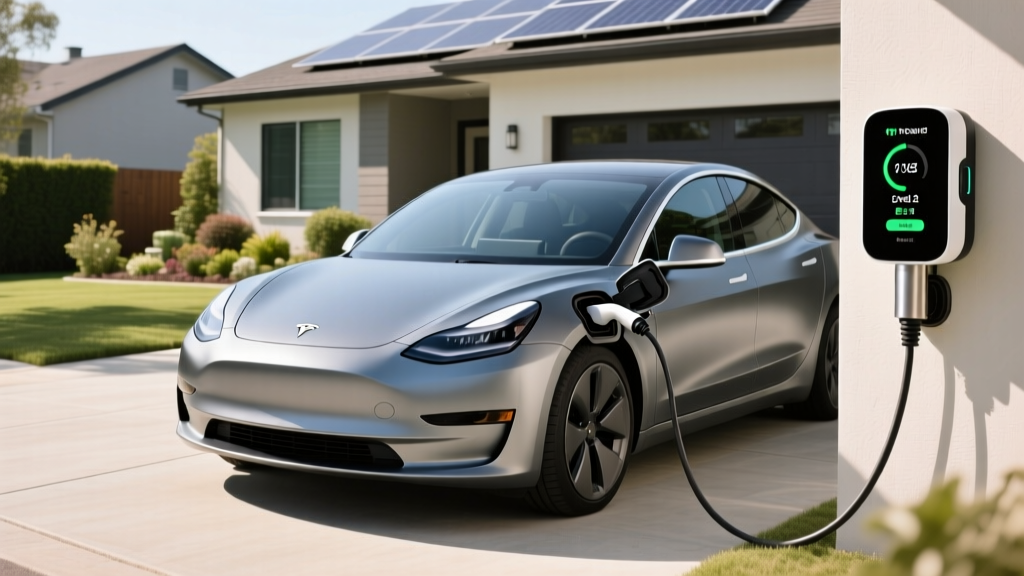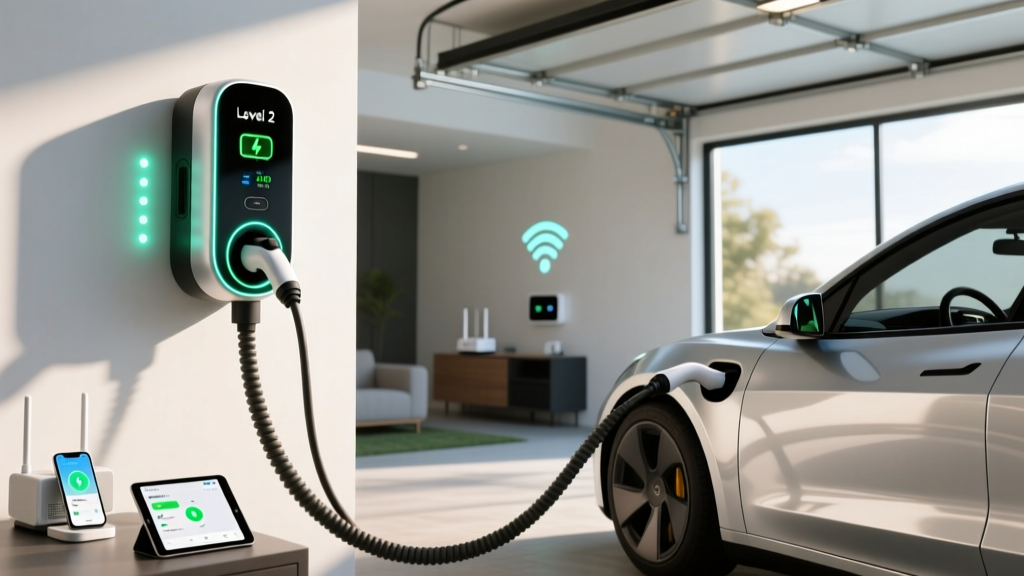
Most EV owners do 80% or more of their charging at home. A Level 2 electric car home charging station adds 25–44 miles of range per hour, meaning a typical overnight session fully replenishes a daily commute and then some. But installation costs vary wildly depending on your home's electrical panel, the distance from panel to garage, and local permit requirements. This guide breaks down exactly what it takes to set up home charging in 2026, from electrical specs to charger picks to real cost-per-mile math.
Charging Levels Explained: kW, Miles Per Hour, and Real Charge Times
Before sizing a home charger, understand the three charging levels and the critical distinction between kW (kilowatts — the rate of power delivery) and kWh (kilowatt-hours — the total energy stored in your battery). Think of kW as the speed of water flowing through a hose and kWh as the total gallons in the bucket. A 48-amp Level 2 charger delivers 11.5 kW of power; a typical EV battery holds 60–100 kWh of energy.
| Level | Voltage | Max Power (kW) | Miles of Range/Hour | Typical Use |
|---|---|---|---|---|
| Level 1 | 120V AC | 1.0–1.4 kW | 3–5 mi/hr | Overnight trickle; PHEV top-ups |
| Level 2 | 240V AC | 7.2–19.2 kW | 25–44 mi/hr (at 11.5 kW) | Primary home charging |
| DC Fast | 400–800V DC | 50–350 kW | 150–300+ mi/hr (peak) | Road trips; public stations |
For context, a Tesla Model Y Long Range (75 kWh usable battery, EPA 310-mile range) charging on a 48-amp, 11.5 kW Level 2 station gains roughly 37 miles of range per hour. A full 10–80% session takes about 5.5 hours. That same car on a 250 kW DC fast charger peaks at around 250 kW but tapers significantly above 50% state of charge; expect 10–80% in roughly 25–28 minutes in real-world conditions.
How Much Does It Cost to Install a Home EV Charger?
The total installed cost of a Level 2 electric car home charging station ranges from roughly $800 on the low end (panel nearby, no upgrade needed) to $4,500+ for older homes requiring a service panel upgrade. Here's the honest breakdown:
| Component | Low End | High End | Notes |
|---|---|---|---|
| Level 2 Charger (hardware) | $350 | $750 | 40A–48A smart chargers; NACS or J1772 |
| Electrician labor | $400 | $1,800 | Depends on run length, conduit, drywall work |
| Permit & inspection | $50 | $300 | Varies by municipality |
| Electrical panel upgrade (if needed) | $1,500 | $3,500 | 100A to 200A service upgrade for older homes |
| Total (no panel upgrade) | $800 | $2,850 | Most homes built after 2000 |
| Total (with panel upgrade) | $2,300 | $4,500+ | Homes with 100A service or full panels |
When You'll Need a Panel Upgrade
A 48-amp EV charger draws 48 amps continuously. Per NEC (National Electrical Code) rules, continuous loads can only use 80% of a circuit's rated capacity, so a 48A charger requires a dedicated 60-amp breaker. Your electrician will perform a load calculation on your existing panel to determine if there's enough spare capacity. Homes with 200-amp service and moderate existing loads (electric range, dryer, HVAC) usually have room. Homes with 100-amp service or panels already near capacity will need an upgrade — typically to 200A or, in some cases, a secondary sub-panel dedicated to EV charging.
Some homeowners opt for a 40-amp charger on a 50-amp breaker to avoid a panel upgrade. This delivers 9.6 kW (about 31 miles of range per hour) — enough for most daily driving — and is a legitimate cost-saving strategy worth discussing with your electrician.
Electrical Requirements: Voltage, Amperage, and Safety Code
A proper Level 2 installation is not a DIY project. Here's what the job requires:
- Voltage: 240V AC (same as an electric dryer or oven circuit)
- Amperage: Dedicated circuit — 50A breaker (for 40A charger) or 60A breaker (for 48A charger)
- Wiring: 6 AWG copper (50A) or 4 AWG copper (60A), run in conduit where exposed
- GFCI protection: Required by NEC 2020 and later for garage and outdoor receptacles; hardwired chargers may have GFCI built into the unit
- Hardwired vs. plug: Hardwired units eliminate the NEMA 14-50 receptacle, reduce points of failure, and avoid the NEC GFCI breaker nuisance-trip issues some owners experience with receptacle-based setups
- Outdoor rating: If your parking spot is outside, specify a NEMA 4-rated (weatherproof) charger enclosure
Always pull a permit. A licensed electrician will handle this, and the inspection ensures the installation meets code — which matters for insurance claims, home resale, and fire safety. According to NFPA's National Electrical Code, EV charging circuits have specific requirements updated in recent code cycles.
Connector Compatibility: NACS, CCS1, and CHAdeMO in 2026
The connector landscape has consolidated significantly. Here's where things stand for the 2026 model year:
| Connector | Brands Using It (2026 MY) | Home Charger Availability |
|---|---|---|
| NACS (Tesla/J3400) | Tesla, Ford, GM, Rivian, Hyundai, Kia, Volvo, Polestar, and most major OEMs | Widely available; native NACS chargers from Tesla, Emporia, Autel |
| CCS1 (J1772 combo) | VW, BMW, some remaining Stellantis models | Widely available; J1772/CCS chargers from ChargePoint, Grizzl-E |
| CHAdeMO | Discontinued (legacy Nissan Leaf only) | Essentially unavailable for new home units |
If you buy a NACS-equipped EV (the majority of 2026 models), you have two paths for home charging: a native NACS wall connector, or a J1772 charger with a J1772-to-NACS adapter (roughly $100–$170). For future-proofing, a native NACS charger is the cleaner choice. If your household has mixed EVs — say, a Ford Mustang Mach-E (NACS) and a VW ID.4 (CCS1) — a J1772 charger with adapters for each vehicle is the most flexible setup.
Charging Cost Per Mile: Home vs. Public vs. Gas
Home charging is where EV ownership economics shine. Here's the real math:
| Scenario | Rate | Cost per kWh | Cost per Mile* |
|---|---|---|---|
| Home (national avg. residential) | Off-peak / standard | $0.12–$0.17 | $0.036–$0.051 |
| Home (California, TOU off-peak) | Overnight EV rate | $0.09–$0.13 | $0.027–$0.039 |
| Public Level 2 (network) | Per-session or per-kWh | $0.25–$0.49 | $0.075–$0.147 |
| DC Fast Charging (public) | Per-kWh or per-minute | $0.35–$0.65 | $0.105–$0.195 |
| Gas vehicle (30 MPG, $3.40/gal) | — | — | $0.113 |
*Based on an EV efficiency of 3.3–3.5 miles per kWh (typical for a mid-size crossover like the Tesla Model Y or Hyundai Ioniq 5). Source: fueleconomy.gov efficiency ratings.
At the national average residential electricity rate of ~$0.16/kWh, home charging costs roughly $0.048 per mile — about 58% less than fueling a 30-MPG gas car at $3.40/gallon. Over 12,000 miles of annual driving, that's a fuel savings of roughly $780 per year. If your utility offers a time-of-use (TOU) EV rate with off-peak pricing below $0.10/kWh, the savings widen further.
One nuance: DC fast charging at public stations can exceed the cost of gasoline per mile. If you rely primarily on DCFC (no home or workplace charging), the economic case for an EV weakens considerably. Home charging is where the math works.
Best Home EV Chargers for 2026: Power, Features, and Price
These are the Level 2 chargers that deliver reliable performance, smart features, and solid build quality based on sustained real-world use:
Emporia Vue Level 2 Smart Charger
- Power: 48A / 11.5 kW (hardwired, 60A breaker)
- Connector: NACS (J3400) native; J1772 version available
- Cable length: 24 ft
- Smart features: Wi-Fi, energy monitoring via Emporia app, solar integration, TOU scheduling
- Price: ~$399
- Best for: Solar homeowners wanting granular energy tracking
Tesla Wall Connector
- Power: 48A / 11.5 kW (hardwired, 60A breaker)
- Connector: NACS native; J1772 version also available
- Cable length: 24 ft
- Smart features: Wi-Fi, OTA firmware updates, load sharing (pair two units on one circuit), Power-Share with Tesla Powerwall
- Price: ~$475
- Best for: Tesla owners; households with two Teslas (load sharing)
ChargePoint Home Flex
- Power: Configurable 16A–50A / up to 12 kW (NEMA 14-50 or hardwired)
- Connector: J1772 (CCS-compatible with adapter)
- Cable length: 23 ft
- Smart features: Wi-Fi, app-based scheduling, Alexa/Google integration, flexible amperage settings to match your circuit
- Price: ~$549–$649
- Best for: CCS1 vehicles; homes where adjustable amperage avoids panel upgrades
Grizzl-E Smart
- Power: 40A / 9.6 kW (NEMA 14-50 or hardwired)
- Connector: J1772
- Cable length: 24 ft
- Smart features: Wi-Fi, OCPP-compatible, adjustable amperage, built in Canada with -40°F cold-weather rating
- Price: ~$449
- Best for: Cold-climate durability; budget-conscious buyers needing solid output
A critical buying note: match your charger's amperage to your EV's onboard charger capacity. A Hyundai Ioniq 5 accepts up to 10.9 kW on Level 2, so a 48A (11.5 kW) charger maxes it out. A Toyota bZ4X accepts only 6.6 kW — paying for a 48A charger provides no additional speed benefit over a 32A unit.
Tax Credits and Incentives for Home Charger Installation
The federal Alternative Fuel Vehicle Refueling Property Credit (IRC §30C) was reinstated and modified under recent legislation. As of 2026, eligible taxpayers can claim up to 30% of the cost of home EV charging equipment and installation, capped at $1,000. However, eligibility is geographically restricted: the property must be located in a qualifying low-income or rural census tract, per IRS guidelines. Check your census tract eligibility before counting on this credit.
Additionally, many utilities offer rebates of $250–$500 for installing a smart Level 2 charger, and some states (California, Colorado, Massachusetts, New York) have separate incentive programs. Consult your local utility's EV program page and your tax professional for specifics.
Frequently Asked Questions
Can I just plug into a regular 120V outlet?
Yes, but Level 1 charging at 1.4 kW adds only 3–5 miles of range per hour. For a 75 kWh battery, a full charge from empty takes over 50 hours. Level 1 works for plug-in hybrids with small batteries (10–18 kWh) or EVs driven fewer than 30 miles daily. For full battery EVs with regular use, Level 2 is strongly recommended.
Do I need a Tesla charger for a Tesla?
No. Any NACS (J3400) connector charger works with Tesla vehicles. The Tesla Wall Connector is excellent but not exclusive. Third-party NACS chargers from Emporia, Autel, and others deliver identical charging speeds.
Will charging at home increase my electric bill significantly?
Driving 12,000 miles per year at 3.3 mi/kWh uses roughly 3,636 kWh annually. At $0.16/kWh, that's about $582 per year — or $48.50 per month. Most owners offset this entirely by eliminating gasoline purchases ($1,300–$1,500/year at 30 MPG and $3.40/gallon).
Is it safe to charge an EV in the rain or with an outdoor charger?
Yes. Level 2 chargers rated NEMA 4 or NEMA 4X are designed for outdoor use, including rain, snow, and dust. The connector and vehicle inlet are engineered to be weather-sealed during charging. Never use an indoor-rated charger outdoors, and ensure your electrician installs a weatherproof cover on any outdoor receptacle.
How long does installation take?
The physical installation by a licensed electrician typically takes 2–6 hours for a straightforward run (panel in garage, short wire distance). Complex installations involving long conduit runs, trenching, or panel upgrades may take a full day or require multiple visits. Factor in 1–3 weeks for permit approval and inspection scheduling in most jurisdictions.
What if I rent or live in a condo?
Renters and condo owners face additional hurdles: landlord or HOA approval, shared electrical infrastructure, and limited parking-adjacent outlets. Some states have "right to charge" laws that limit HOA restrictions on EV charger installation. Portable Level 2 chargers (with NEMA 14-50 plugs) offer a semi-permanent solution if a 240V outlet is accessible.