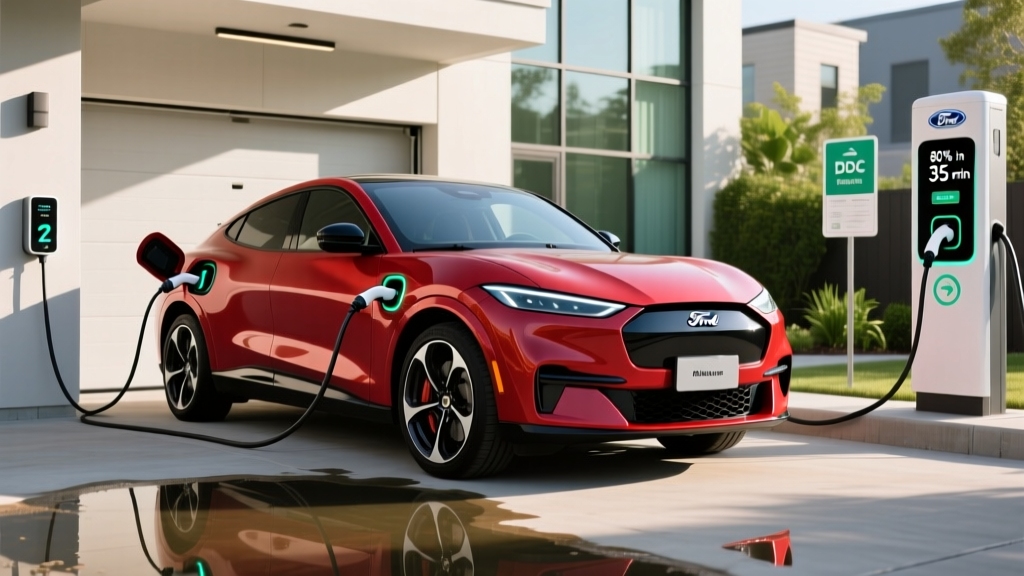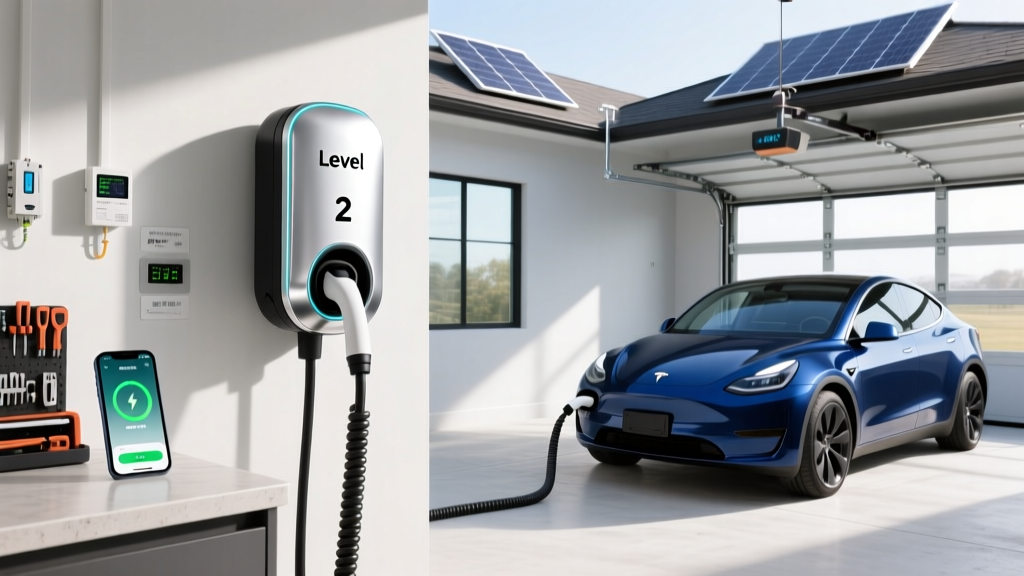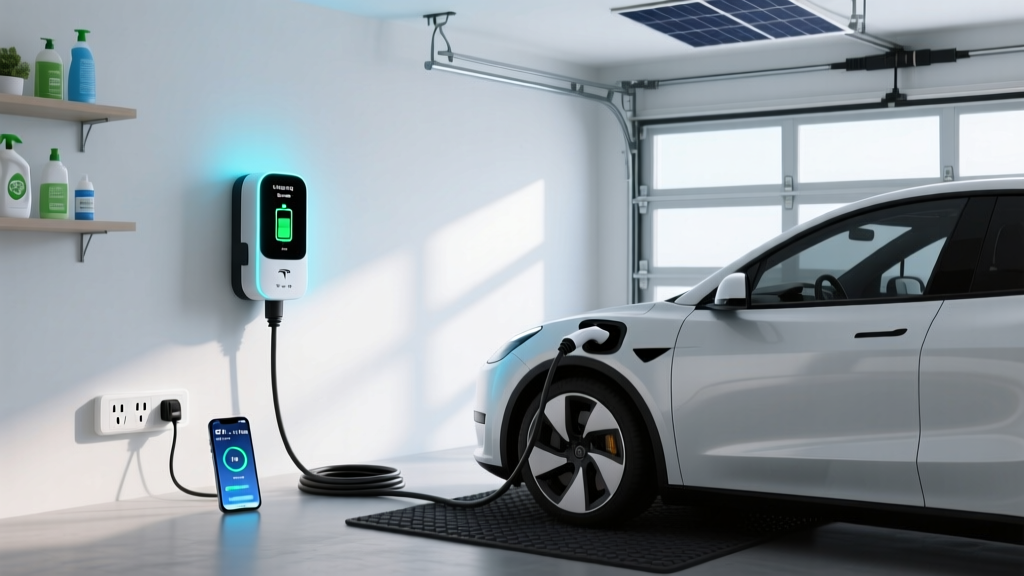
If you're buying a battery-electric vehicle in 2026, the single most important upgrade isn't on the car — it's in your garage. Over 80% of EV charging happens at home, and a properly sized Level 2 station turns an EV from a "where can I plug in?" problem into a car that's always full when you need it. This guide walks through exactly what electric car home charging requires: the electrical work, the equipment, the connectors, the cost per mile, and the panel gotchas that catch older-home buyers off guard.
How Fast Each Charging Level Actually Adds Range
Before talking hardware, the vocabulary. kW (kilowatts) is power — how fast energy flows into the battery. kWh (kilowatt-hours) is energy — the size of the battery tank. A 75 kWh battery charged at 10 kW takes roughly 7.5 hours from empty to full (minus taper near the top). Mixing these up is the most common EV mistake, and it's why some buyers order a "7 kW charger" expecting it to add "7 kWh of range" per hour. It doesn't — it adds 7 kW of power, which translates to roughly 25 miles of range per hour in a midsize sedan.
| Level | Voltage | Power (kW) | Miles of Range per Hour | Typical Use |
|---|---|---|---|---|
| Level 1 | 120V | 1.0 – 1.4 kW | 3 – 5 mi/hr | Emergency top-ups, PHEVs |
| Level 2 (home) | 240V | 7.2 – 11.5 kW | 25 – 44 mi/hr | Daily home charging |
| Level 2 (public/commercial) | 240V | 11.5 – 19.2 kW | 40 – 70 mi/hr | Workplaces, apartments |
| DC Fast | 400–800V DC | 50 – 350 kW peak | 150 – 1,200 mi/hr (peak) | Road trips |
Sources: fueleconomy.gov, EPA. Range/hour assumes ~3.5 mi/kWh efficiency; actual varies by vehicle.
Real-world translation: A Tesla Model Y (75 kWh usable) plugged into a 48-amp (11.5 kW) Level 2 wall connector goes from 20% to 100% overnight in about 6 hours. The same car on a 120V Level 1 outlet gains roughly 30 miles in 10 hours — enough for a PHEV, not a BEV commuter doing 60+ miles a day.
How Much Does It Cost to Install a Home EV Charger?
There is no single number because the cost is almost entirely driven by your home's existing electrical panel and the distance from that panel to where the charger will mount. A straightforward install in a 2020s-built home with a 200-amp panel and a garage-side mounting point might cost $500–$900 all-in. A 1970s ranch with a 100-amp panel, aluminum wiring, and a detached garage can easily push past $2,500–$4,000 when a panel upgrade and trenching are required.
| Component | Typical Range | Notes |
|---|---|---|
| Level 2 charger hardware | $400 – $750 | 32A–48A Wi-Fi-enabled units |
| Electrician labor (2–6 hrs) | $400 – $1,500 | Varies by run length, conduit, drywall work |
| Permit & inspection | $75 – $300 | Required in most jurisdictions |
| Electrical panel upgrade (if needed) | $1,500 – $3,500 | 100A → 200A service; common in pre-1990 homes |
| Utility service upgrade (rare) | $2,000 – $5,000 | Only if utility drop itself is insufficient |
| Total (typical, no panel upgrade) | $900 – $2,300 | Most 2000s+ homes |
| Total (with panel upgrade) | $2,500 – $5,500 | Older homes, high-draw panels |
What Determines Your Install Price
- Panel capacity: A 48-amp charger requires a 60-amp dedicated circuit (NEC 125% continuous-load rule). If your panel is near its rated capacity with HVAC, electric oven, and dryer already on it, you'll need an upgrade — or a lower-amperage charger.
- Run length: Every foot of 6-gauge copper (for 48A) and conduit adds cost. A panel on the opposite side of the house from the garage can double labor.
- Hardwired vs. NEMA 14-50 outlet: Hardwired units allow 48A continuous and avoid the NEC 2023+ GFCI-breaker requirement for receptacles (~$150 extra for a 50A GFCI breaker). Most licensed EV electricians now recommend hardwired.
- Permit jurisdiction: Some cities bundle EV install permits with general electrical; others have dedicated EV-charging permits with faster review.
Before hiring, get at least two quotes from electricians who list EV charging as a specialty. Ask specifically: "Do I need a panel load calculation, and what's the 125% continuous-load circuit size for the charger I want?"
What Electrical Upgrades Might My Home Need?
A licensed electrician will perform a load calculation (NEC Article 220) to determine whether your panel can absorb a new 40A–60A continuous load. Three common outcomes:
- Panel has headroom. You have a 200A panel with existing loads summing to ~140A. A 48A charger (60A breaker) fits cleanly. Install proceeds as quoted.
- Panel is near capacity. You have a 150A or 200A panel but existing loads (heat pump, electric range, dryer, EV charger) push past 80% of rating. Options: upgrade to a 200A or 400A panel, or install a smart load-management device (e.g., Emporia Smart SPAN, Enel X JuiceBox load-share) that throttles the charger when other big loads kick on — often a $300–$600 solution that avoids a $2,500 panel upgrade.
- Service is undersized. Older homes with 100A service almost always need a panel + utility service upgrade before adding a 48A EV charger. Budget $3,000–$5,000.
Safety and code non-negotiables: The circuit must be dedicated (no shared outlets), the breaker must be sized at 125% of the charger's continuous draw (48A charger = 60A breaker), outdoor installations require a weather-rated (NEMA 4) enclosure, and any receptacle-based install must use a GFCI breaker per NEC 2023+. Do not use extension cords or adapter chains not rated for continuous EV loads — they overheat.
Which Connector Is Compatible With My EV?
The connector landscape consolidated significantly between 2024 and 2026. The North American Charging Standard (NACS), pioneered by Tesla and now adopted by Ford, GM, Rivian, Hyundai/Kia, BMW, Mercedes, Volvo, and most other major OEMs, is the de facto standard for new 2025–2026 BEVs. The older CCS1 (Combined Charging System) connector still lives on many 2020–2024 models, and CHAdeMO is effectively legacy (Nissan Leaf, older Mitsubishi).
| Connector | Brands Using It (2026) | Adapter Options |
|---|---|---|
| NACS (Tesla-style) | Tesla, Ford, GM, Rivian, Hyundai, Kia, Genesis, BMW, Mercedes, Volvo, Polestar, Lucid (2025+) | N/A — native standard |
| CCS1 | VW ID.4 (through 2024), older Audi e-tron, legacy BMW i4/iX, older Hyundai Ioniq 5 | CCS1→NACS adapter ($150–$250); required for Tesla Supercharger access |
| CHAdeMO | Nissan Leaf (all years), Mitsubishi Outlander PHEV (older) | Limited; no NACS adapter widely available |
Source: Manufacturer press sites, SAE J3400 (NACS).
Buyer rule of thumb: If you're buying a 2025+ model-year EV from a major OEM, it almost certainly has NACS. Match your home charger to the car's inlet — do not rely on adapters for daily home charging (they add resistance, heat, and a failure point).
Home Charger Equipment Picks for 2026
We evaluate home chargers on four axes: sustained power output, cable length (25 feet is the new minimum for most garages), smart features (Wi-Fi scheduling, utility demand-response, load sharing), and build quality (NEMA 4 rating for outdoor, cable management).
Tesla Wall Connector (Gen 3 / NACS)
- Max output: 11.5 kW (48A on 60A circuit)
- Connector: Native NACS
- Cable length: 24 ft
- Smart features: Wi-Fi, OTA updates, Power Share (load balancing with up to 6 units), Access control via Tesla app
- Price: ~$475
- Best for: Tesla and NACS-native owners; cleanest ecosystem integration
ChargePoint Home Flex (NACS or CCS1)
- Max output: 12 kW (50A adjustable down to 16A to fit panel)
- Connector: Available in NACS and CCS1 pigtails
- Cable length: 24 ft
- Smart features: Wi-Fi, Alexa, utility demand-response programs, adjustable amperage via app
- Price: ~$550–$650
- Best for: Homes with panel constraints — the adjustable amperage is a genuine install-saver
Emporia Level 2 EV Charger
- Max output: 11.5 kW (48A)
- Connector: NACS and CCS1 versions
- Cable length: 24 ft
- Smart features: Deep integration with Emporia Vue home energy monitor, solar-aware scheduling, Time-of-Use automation
- Price: ~$400 (frequently on sale)
- Best for: Solar-home owners and budget-conscious installs; best energy-tracking in class
Grizzl-E Smart (NACS)
- Max output: 10 kW (40A)
- Connector: NACS
- Cable length: 24 ft
- Smart features: Wi-Fi, OCPP-compatible (works with many utility programs), extreme cold rating (-40°F)
- Price: ~$450
- Best for: Cold-climate and outdoor installs; built in Canada for harsh conditions
A note on amperage matching: Your EV's onboard charger caps what it can accept. The Ford F-150 Lightning Extended Range and Rivian R1T have 19.2 kW onboard chargers — they benefit from a 80A circuit / 64A continuous charger. Most sedans and crossovers (Tesla Model Y, Hyundai Ioniq 5, Chevrolet Equinox EV) top out between 10.5 and 11.5 kW onboard, so a 48A charger is sufficient. Buying a 64A charger for a car with an 11.5 kW onboard charger wastes money.
How Much Does Charging Cost Per Mile vs. Gas?
This is where the EV math usually wins — but the margin depends heavily on your electricity rate and whether you use time-of-use (TOU) pricing. The national average residential rate in early 2026 is about $0.17/kWh (EIA data), but California and New England homeowners pay $0.28–$0.35/kWh at peak, while Pacific Northwest and Texas customers can find off-peak rates under $0.09/kWh.
| Scenario | Rate / Price | Vehicle Efficiency | Cost Per Mile |
|---|---|---|---|
| Home off-peak (TOU) | $0.11/kWh | 3.5 mi/kWh (e.g., Model Y) | $0.031 |
| Home average rate | $0.17/kWh | 3.5 mi/kWh | $0.049 |
| Home high-cost region (peak) | $0.32/kWh | 3.5 mi/kWh | $0.091 |
| Public Level 2 (network) | $0.35/kWh | 3.5 mi/kWh | $0.100 |
| DC fast charging (350 kW) | $0.52/kWh | 3.5 mi/kWh (derated at high SoC) | $0.149 |
| Gasoline, 28 MPG compact | $3.25/gal | 28 MPG | $0.116 |
| Gasoline, 19 MPG truck | $3.25/gal | 19 MPG | $0.171 |
Gas price: EIA weekly average, regular unleaded, Feb 2026. Public/DCFC prices from Electrify America and EVgo posted rates.
The honest takeaway: At home on off-peak rates, an EV costs roughly one-quarter to one-third as much per mile as a gas car. On peak residential rates or frequent DC fast charging, the gap narrows — and DCFC can actually exceed gasoline per mile. This is why home charging access is the economics; public-only EV ownership often breaks even with a fuel-efficient hybrid.
Charging Time Examples: What to Expect for Common Battery Sizes
Real charging time depends on battery size (kWh), charger power (kW), state of charge (SoC), and battery temperature. Manufacturers quote "10–80%" times because the last 20% tapers dramatically to protect cell health — often taking as long as the first 70%.
| Vehicle | Battery (usable kWh) | Level 2 (11.5 kW) 0–100% | Level 2 (7.2 kW) 0–100% |
|---|---|---|---|
| Chevrolet Equinox EV | 85 kWh | ~7.5 hours | ~12 hours |
| Tesla Model Y Long Range | 75 kWh | ~6.5 hours | ~10.5 hours |
| Hyundai Ioniq 5 | 77.4 kWh | ~7 hours | ~11 hours |
| Ford F-150 Lightning Ext. Range | 131 kWh | ~7 hours (at 19.2 kW onboard) | ~18 hours |
| Toyota Prius Prime (PHEV) | 13.6 kWh | ~1.5 hours | ~2 hours |
Cold-weather caveat: Below ~40°F, lithium-ion batteries accept charge more slowly until they warm up. A preconditioned battery (car warms itself while plugged in, scheduled via app) charges at or near rated speed. An un-preconditioned battery at 20°F may accept only 30–50% of peak power for the first 15–30 minutes. Always schedule departure preconditioning in winter.
Federal Incentives and Utility Rebates That Offset Install Cost
The federal IRS §30C Alternative Fuel Vehicle Refueling Property Credit covers 30% of home EV charging equipment and installation, up to $1,000, for equipment placed in service. Eligibility is tied to census-tract criteria (the property must be in a qualifying low-income or non-urban tract) — many suburban and urban homeowners do not qualify, so check the IRS lookup before counting on the credit.
Beyond federal, many utilities offer direct rebates ($250–$750 common) for installing a smart Level 2 charger that participates in demand-response programs, and some (e.g., SMUD, ConEdison, PG&E) offer dedicated EV TOU rates that cut off-peak electricity by 40–60%. Call your utility's EV desk before buying hardware — some will send a free or discounted charger in exchange for enrollment.
FAQ: Electric Car Home Charging
Do I need a permit to install a home EV charger?
Yes, in almost every U.S. jurisdiction. The permit ensures the work is inspected for NEC compliance — dedicated circuit, correct breaker sizing, proper grounding, and GFCI protection on receptacles. Permit cost typically runs $75–$300. Skipping the permit can void home insurance coverage for electrical fires and complicate a future home sale.
Can I just plug into a regular 120V outlet?
For a BEV, Level 1 (120V) adds only 3–5 miles of range per hour — roughly 40 miles overnight. That's fine for a plug-in hybrid (which has a 13–40 kWh battery and shorter electric-only range), but impractical for a 75+ kWh BEV unless your daily driving is under 30 miles and you're patient. Level 1 also runs at lower efficiency and keeps the battery at partial SoC longer, which can slightly accelerate degradation.
Should I hardwire the charger or install a NEMA 14-50 outlet?
Hardwired is the current best practice for three reasons: it allows full 48A continuous draw, it avoids the NEC 2023+ requirement for a ~$150 GFCI breaker on 50A receptacles, and it eliminates the outlet as a potential heat/failure point. A NEMA 14-50 outlet is useful only if you plan to move the charger between homes or want a portable unit as backup.
Will a home charger work with any EV I buy in the future?
If you install a NACS-connector charger in 2026, it will be compatible with the overwhelming majority of new EVs sold going forward. CCS1 vehicles can use a passive adapter, but adapters are not ideal for daily use. If you own a legacy CHAdeMO vehicle (Nissan Leaf), you'll likely want a dedicated CHAdeMO-capable charger or plan to rely on public charging.
How long do home EV chargers last?
Quality Level 2 chargers (Tesla, ChargePoint, Emporia, Grizzl-E) carry 3-year warranties and typically last 8–12 years. The most common failure points are the cable/connector (from repeated bending or UV exposure) and Wi-Fi modules. Indoor-installed units routinely outlast the car they're bought for.