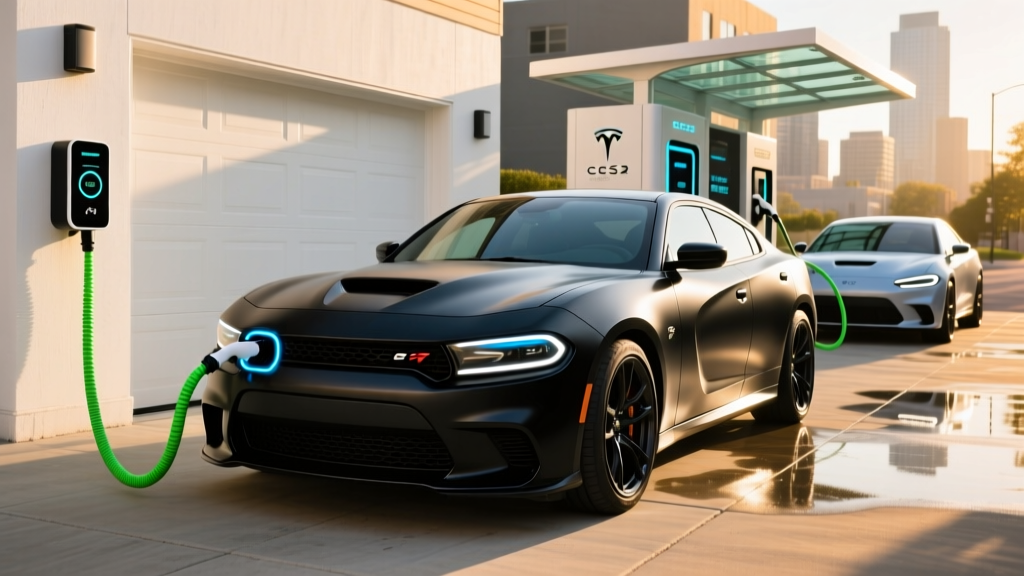
The 2026 Dodge Charger Daytona EV marks Stellantis's first serious entry into the electric muscle car segment. Built on the STLA Large platform with an 800V-capable architecture (currently operating at 400V in initial trims), the Charger Daytona R/T and Scat Pack demand specific charging strategies to maximize their 100.5 kWh (usable) battery packs. Whether you're plugging in at home or relying on public DC fast chargers, understanding the exact kW rates, connector requirements, and real-world charging curves is essential before you sign the paperwork.
This guide breaks down every charging scenario for the 2026 Charger Daytona lineup, from Level 1 trickle charging to 150 kW DC fast charging, with exact times, costs, and equipment recommendations based on EPA data and manufacturer specifications.
Charging Levels Explained: What the Charger Daytona Supports
The 2026 Dodge Charger Daytona uses a CCS1 (Combined Charging System) connector for all AC and DC charging in North America. Here is how each charging level performs with the Charger's 100.5 kWh usable battery:
| Charging Level | Power (kW) | Voltage / Amperage | Miles of Range Added per Hour | 10–80% Time (100.5 kWh Battery) |
|---|---|---|---|---|
| Level 1 (120V household) | 1.4 kW | 120V / 12A | ~4–5 miles | ~50+ hours (impractical) |
| Level 2 (240V home/public) | 11.5 kW (onboard max) | 240V / 48A | ~35–40 miles | ~6.5–7 hours |
| DC Fast Charging | Up to 150 kW peak | 400V architecture | ~250–300 miles (peak rate) | ~27–32 minutes |
Key distinction: kW (kilowatts) measures power — the rate at which energy flows into the battery. kWh (kilowatt-hours) measures energy capacity — how much the battery holds. The Charger Daytona's 11.5 kW onboard charger limits AC charging speed regardless of how powerful your home wall connector is. A 48A Level 2 station delivering 11.5 kW will max out the car's AC acceptance; a 60A or 80A station won't charge it any faster.
Real-World Charging Note: The 150 kW DC fast-charging peak is not sustained across the entire 10–80% session. Expect peak rates between 10–40% State of Charge (SoC), tapering to ~100 kW by 60% SoC and ~50 kW approaching 80%. The 27-minute 10–80% claim assumes battery preconditioning is active and ambient temperatures are between 65–85°F. In cold weather (below 40°F), add 10–15 minutes to your expected fast-charge time unless the car has been preconditioned via the Dodge app.
Home Level 2 Charger Installation: Requirements and Costs
For daily charging, a Level 2 home station is the practical standard. The Charger Daytona's 11.5 kW onboard charger means you need a 240V circuit rated for at least 60A (to deliver 48A continuous, per the National Electrical Code's 80% rule for continuous loads).
Electrical Requirements
- Circuit: Dedicated 60A breaker, 240V, using 6 AWG copper wire (or 4 AWG aluminum)
- Panel capacity: Your main electrical panel must have at least 60A of spare capacity. Most modern 200A panels can accommodate this; older 100A or 150A panels in homes built before 1990 may require a service upgrade.
- Permit: Required in virtually all US jurisdictions for new 240V circuits. Your electrician will pull this.
- GFCI protection: The 2023 NEC revision requires GFCI protection for EV charging outlets in garages. A hardwired wall connector (no plug) may bypass this requirement in some jurisdictions — confirm with your local inspector.
- Outdoor rating: If installing outside, the unit must carry a NEMA 4 (weatherproof) rating.
| Cost Component | Typical Range | Notes |
|---|---|---|
| Level 2 Charger (hardware) | $400 – $750 | 48A smart chargers; see equipment picks below |
| Electrician labor (standard install) | $600 – $1,500 | Assumes panel is within 30 ft of install location |
| Electrical permit | $50 – $200 | Varies by municipality |
| Panel upgrade (if needed) | $1,500 – $3,500 | Upgrading from 100A/150A to 200A service |
| Total (no panel upgrade) | $1,050 – $2,450 | Most homes with 200A service |
| Total (with panel upgrade) | $2,550 – $5,950 | Older homes needing service upgrade |
Federal incentive: The IRS §30C Alternative Fuel Vehicle Refueling Property Credit offers up to $1,000 (30% of equipment and installation cost, capped at $1,000) for home charger installation, subject to census-tract eligibility requirements. Confirm your address qualifies before purchasing. This is separate from the §30D vehicle purchase credit.
Which Connector and Charger Is Compatible with the Charger Daytona?
The 2026 Dodge Charger Daytona uses the CCS1 (Combined Charging System) connector, the standard adopted by most non-Tesla automakers in North America. However, the charging landscape has shifted significantly with Ford, GM, Rivian, and others adopting NACS (Tesla's connector). Dodge has not announced a NACS transition for the Charger Daytona as of the 2026 model year.
| Connector Type | Charger Daytona Compatibility | Network Access | Adapter Needed? |
|---|---|---|---|
| CCS1 | Native — built-in | Electrify America, EVgo, ChargePoint, Ionity | No |
| NACS (Tesla) | Not native | Tesla Supercharger network (CCS-equipped stalls) | Yes — CCS-to-NACS adapter (~$200–$250) |
| CHAdeMO | Not compatible | Largely discontinued in US | N/A |
| J1772 (AC only) | Native — upper portion of CCS | All Level 2 public stations | No |
Tesla Supercharger access: Tesla has opened select Supercharger stalls to non-Tesla CCS vehicles via the "Magic Dock" built-in adapter or via a third-party CCS-to-NACS adapter. However, availability remains limited to specific urban and highway corridor locations. For road-trip planning in the Charger Daytona, Electrify America's 350 kW-capable stations remain the primary DC fast-charging backbone, though the car will cap at 150 kW regardless of the station's maximum output.
Charging Cost Per Mile: Charger Daytona vs. Gas V8
The Charger Daytona Scat Pack's EPA-estimated efficiency is approximately 2.0–2.3 kWh per mile (combined). Let's compare real-world charging costs against the gas-powered Charger R/T (5.7L HEMI, ~19 MPG combined).
| Scenario | Cost per kWh / Gallon | Cost per Mile (EV) | Cost per Mile (Gas V8, 19 MPG) |
|---|---|---|---|
| Home charging (off-peak utility rate) | $0.13/kWh | $0.28 | $0.19 (at $3.60/gal) |
| Home charging (peak / standard rate) | $0.22/kWh | $0.47 | $0.19 (at $3.60/gal) |
| Public Level 2 (ChargePoint, etc.) | $0.35/kWh | $0.75 | $0.19 (at $3.60/gal) |
| DC Fast Charging (Electrify America) | $0.48/kWh | $1.03 | $0.19 (at $3.60/gal) |
The honest math: At off-peak home rates, the Charger Daytona costs roughly $0.28 per mile — slightly more than a gas V8 at current fuel prices. The cost advantage of EV charging depends heavily on your utility rate and time-of-use plan. If you can charge overnight at $0.10–$0.13/kWh, you save meaningfully. If you rely on public DC fast charging for most of your miles, the Charger Daytona will cost significantly more per mile than its gas counterpart. This is a performance-oriented EV with a 100.5 kWh battery; efficiency is not its primary selling point.
Full charge cost at home: 100.5 kWh × $0.13/kWh = $13.07 for a full battery (0–100%). At $0.22/kWh, that rises to $22.11.
Best Level 2 Home Chargers for the Charger Daytona (2026 Picks)
Since the Charger Daytona's onboard charger caps at 11.5 kW (48A at 240V), any Level 2 station rated for 48A or higher will fully utilize the car's AC charging capability. Here are three proven options:
ChargePoint Home Flex (48A config)
- Power output: Up to 12 kW (50A circuit, 40A continuous) or 11.5 kW (60A circuit, 48A continuous)
- Connector: J1772 (CCS-compatible for AC)
- Cable length: 23 ft
- Smart features: Wi-Fi, app scheduling, utility integration, Alexa
- NEMA rating: NEMA 4 (indoor/outdoor)
- Price: ~$550–$650
Emporia Vue Level 2 Charger
- Power output: Up to 11.5 kW (48A)
- Connector: J1772
- Cable length: 24 ft
- Smart features: Wi-Fi, energy monitoring, solar integration, load management
- NEMA rating: NEMA 4
- Price: ~$400–$500
Wallbox Pulsar Plus (48A)
- Power output: Up to 11.5 kW (48A)
- Connector: J1772
- Cable length: 25 ft
- Smart features: Wi-Fi + Bluetooth, app control, Power Sharing (dual-unit load balancing)
- NEMA rating: NEMA 4X
- Price: ~$550–$700
Our pick: The Emporia Vue offers the best value at under $500, with robust energy monitoring that pairs well with solar systems. The ChargePoint Home Flex remains the most widely recommended for its proven reliability and broad utility demand-response program compatibility. All three are hardwired or NEMA 14-50 plug-in capable; hardwired installations avoid the GFCI breaker requirement in many jurisdictions.
DC Fast Charging on the Road: What to Expect
The Charger Daytona's 150 kW peak DC fast-charging rate places it behind competitors like the Hyundai Ioniq 5 (240 kW) and Porsche Taycan (270 kW on 800V architecture), but it remains adequate for highway road trips when planned correctly.
Typical DC fast-charge session (10–80% SoC):
- 10–40% SoC: ~140–150 kW sustained → approximately 10 minutes
- 40–60% SoC: ~100–120 kW → approximately 8 minutes
- 60–80% SoC: ~50–70 kW taper → approximately 12 minutes
- Total 10–80%: approximately 27–32 minutes (with preconditioning)
Without battery preconditioning (e.g., pulling into a charger without navigating to it via the car's built-in route planner), expect the peak rate to be 80–100 kW initially, adding 5–10 minutes to the session. Always use the Dodge app or in-car navigation to route to a charger — this triggers thermal preconditioning of the battery pack.
Cold-weather impact: Below 32°F, lithium-ion cells accept charge more slowly due to increased internal resistance. Without preconditioning, peak rates may drop to 60–80 kW. With proper preconditioning, expect 10–15% longer sessions compared to summer rates. According to fueleconomy.gov, cold temperatures can reduce EV range by 20–30% at 20°F with cabin heating active, which compounds charging-frequency needs on winter road trips.
2026 Dodge Charger Daytona: Key Charging Specs at a Glance
| Specification | Charger Daytona R/T | Charger Daytona Scat Pack |
|---|---|---|
| Usable battery capacity | 100.5 kWh (NMC) | 100.5 kWh (NMC) |
| EPA range (estimated) | ~317 miles | ~260 miles |
| Onboard AC charger | 11.5 kW | 11.5 kW |
| Peak DC fast charge | 150 kW | 150 kW |
| 10–80% DC fast charge | ~27–32 min | ~27–32 min |
| Connector | CCS1 | CCS1 |
| Horsepower | 496 hp | 670 hp |
| 0–60 mph | 4.7 sec | 3.3 sec |
| Base MSRP | ~$59,595 | ~$73,590 |
| Battery/powertrain warranty | 8 yr / 100,000 mi | 8 yr / 100,000 mi |
Real-world range caveat: The Scat Pack's wider tires, higher output, and sport-tuned suspension reduce efficiency significantly. Expect ~210–230 miles of real-world highway range (75 mph, moderate temperatures) and as low as ~170–185 miles in cold weather with cabin heat. The R/T's 317-mile EPA figure translates to approximately 250–270 miles highway in fair conditions. These figures are based on the vehicle's efficiency profile and comparable STLA Large platform testing — always confirm final EPA numbers at fueleconomy.gov when available.
Safety and Code Considerations
- Dedicated circuit: Your Level 2 charger must be on a dedicated breaker — no sharing with other appliances. The NEC requires this for all EVSE (Electric Vehicle Supply Equipment).
- GFCI: The 2023 NEC (Article 625.54) requires GFCI protection for receptacles used for EV charging. Hardwired units are generally exempt, which is one reason many electricians prefer hardwired installations.
- Cable management: Use a cable holster or retractor to keep the charging cord off the garage floor, reducing trip hazards and cord damage from being driven over.
- Ventilation: Unlike Level 1, Level 2 charging does not require special garage ventilation, but ensure the charger's enclosure isn't blocked by stored items that could trap heat.
- UL listing: Only purchase chargers with UL (Underwriters Laboratories) or ETL certification. Avoid uncertified imports from marketplace sellers — they may not meet US electrical code and can void insurance coverage in the event of a fire.
Frequently Asked Questions
How much does it cost to install a home EV charger for the Dodge Charger Daytona?
A standard Level 2 installation with a 60A circuit, no panel upgrade, and a hardwired 48A charger typically costs between $1,050 and $2,450, including equipment, electrician labor, and permit fees. If your home requires a panel upgrade from 100A or 150A to 200A service, add $1,500–$3,500. The IRS §30C credit can offset up to $1,000 of the total if your census tract qualifies.
How fast will each charging level add range to the Charger Daytona?
Level 1 (120V) adds roughly 4–5 miles per hour — impractical for a 100.5 kWh battery. Level 2 (240V at 48A) adds approximately 35–40 miles per hour, fully replenishing the battery overnight in 7–9 hours. DC fast charging at 150 kW peak can add approximately 150 miles in 15 minutes under ideal conditions (low SoC, preconditioned battery, moderate temperature).
Which connector is compatible with the Charger Daytona?
The 2026 Charger Daytona uses CCS1 natively for both AC (J1772 upper portion) and DC fast charging. Tesla Supercharger access requires a CCS-to-NACS adapter and is limited to Supercharger stalls equipped with the Magic Dock or designated for non-Tesla vehicles. CHAdeMO is not compatible.
How much does charging cost per mile compared to a gas V8 Charger?
At home off-peak rates ($0.13/kWh), the Charger Daytona costs approximately $0.28 per mile, compared to roughly $0.19 per mile for a gas V8 Charger at $3.60/gallon and 19 MPG. The EV's cost advantage depends entirely on your electricity rate — at $0.22/kWh or higher, or when using public DC fast chargers ($0.48/kWh), the gas car is cheaper per mile. The EV's value proposition centers on performance and instant torque, not fuel-cost savings.
What electrical upgrades might I need for a home charger?
Homes with 200A electrical service and available breaker slots typically need no upgrades beyond a new 60A dedicated circuit. Homes with 100A or 150A service, common in houses built before 1990, may require a panel upgrade to 200A — a $1,500–$3,500 job. Additionally, if the run from the panel to the charger location exceeds 50 feet, wire gauge must be increased (from 6 AWG to 4 AWG copper), adding $200–$400 in materials. Your licensed electrician will assess these factors during a site visit.
Does the Charger Daytona qualify for the $7,500 federal EV tax credit?
Eligibility for the IRS §30D Clean Vehicle Credit depends on multiple factors: the vehicle's MSRP must not exceed $55,000 for sedans (the Charger Daytona R/T at ~$59,595 may exceed this cap), buyer income must fall below $150,000 (single) or $300,000 (joint), and battery critical-mineral and component sourcing requirements must be met. As of 2026, Stellantis has not confirmed full credit eligibility for all Charger Daytona trims. The credit can now be transferred to the dealer at point of sale as a purchase-price reduction. Consult a tax professional and verify current eligibility on the IRS website before purchasing.