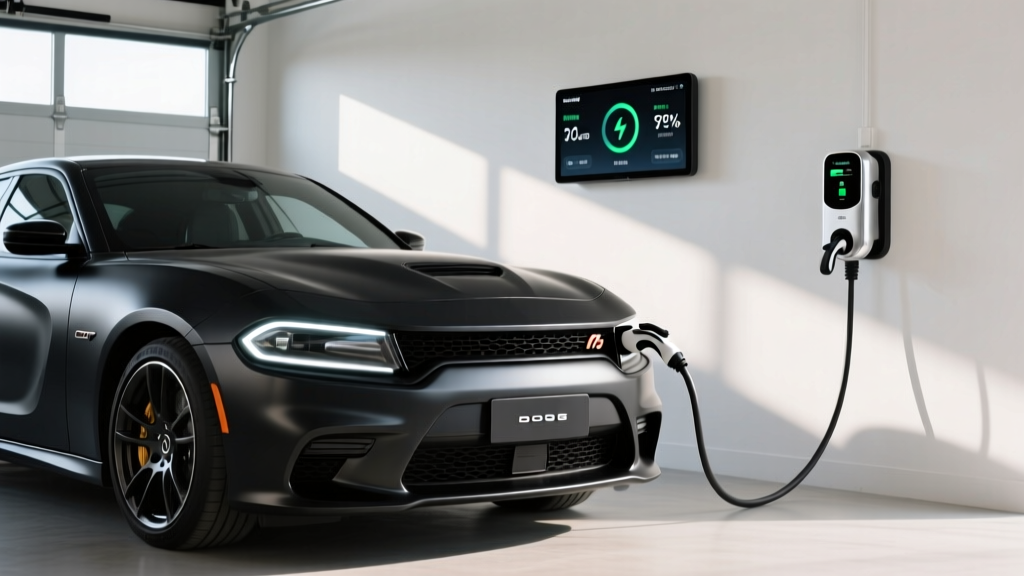
The Dodge Charger Daytona has redefined what an electric muscle car can be, packing up to 670 horsepower and a 100.5 kWh battery into a platform that channels its Charger heritage. But owning this EV means understanding its charging ecosystem — from the 800-volt architecture enabling blistering DC fast-charge speeds to the home Level 2 setup you'll rely on for daily driving. This guide breaks down every charging scenario for the Dodge Charger electric car, with real numbers, real costs, and real-world expectations.
Dodge Charger Daytona EV: Battery and Charging Specs at a Glance
Before we get into charging logistics, here's the hardware you're working with. The Charger Daytona Scat Pack and R/T trims share the same battery pack but differ in power output and efficiency.
| Specification | Charger Daytona R/T | Charger Daytona Scat Pack |
|---|---|---|
| Battery (usable) | 100.5 kWh | 100.5 kWh |
| Chemistry | NMC (nickel-manganese-cobalt) | NMC |
| Architecture | 800V | 800V |
| EPA Range | 317 miles | 260 miles |
| Real-World Range (highway/cold) | ~250–280 miles | ~210–235 miles |
| Peak DC Fast Charge | ~220 kW | ~220 kW |
| 10–80% DCFC Time | ~27 minutes | ~27 minutes |
| Level 2 Acceptance Rate | ~11.5 kW (48A) | ~11.5 kW (48A) |
| Connector (MY2025+) | CCS1 (NACS adapter available) | CCS1 (NACS adapter available) |
| Horsepower | 496 hp | 670 hp |
| 0–60 mph | 4.7 sec | 3.3 sec |
| Base MSRP | $59,595 | $74,595 |
| Battery Warranty | 8 years / 100,000 miles | 8 years / 100,000 miles |
Understanding Charging Levels: How Fast Can You Add Range?
Charging speed is measured in kilowatts (kW) — the rate of power delivery — while your battery capacity is measured in kilowatt-hours (kWh), the total energy stored. Confusing these two is the most common EV literacy mistake. Think of kW as the size of the water hose and kWh as the size of the tank.
| Level | Voltage / Amperage | Power (kW) | Miles Added per Hour | Best For |
|---|---|---|---|---|
| Level 1 | 120V / 12A | ~1.4 kW | ~4–5 mi/hr | Emergency / overnight trickle |
| Level 2 (Home) | 240V / 48A | ~11.5 kW | ~35–40 mi/hr | Daily home charging |
| Level 2 (Public) | 240V / 32–80A | 7.7–19.2 kW | ~25–55 mi/hr | Workplace, shopping, hotels |
| DC Fast Charge | 400–800V DC | 50–350 kW | ~150–600+ mi/hr (peak) | Road trips, rapid top-ups |
For the Charger Daytona's 100.5 kWh battery, Level 1 charging is impractical as a primary method — a full charge would take roughly 72 hours. Level 2 at 11.5 kW will refill the pack from near-empty to full in approximately 9 hours, making it ideal for overnight charging. DC fast charging at the car's ~220 kW peak can add roughly 140 miles of range in 15 minutes under optimal conditions, though the charge curve tapers significantly above 80% State of Charge (SoC).
Home Charger Installation: Electrical Requirements and Costs
Charging the Dodge Charger electric car at home means installing a 240-volt Level 2 station on a dedicated circuit. Here's what that involves and what it costs.
Electrical Requirements
- Circuit: Dedicated 60-amp breaker (to deliver 48 amps continuous, per NEC 80% rule)
- Wire: 6 AWG copper (THHN in conduit) or 4 AWG aluminum, run from panel to charger location
- Outlet or hardwire: NEMA 14-60 receptacle or direct hardwire (hardwire preferred for 48A+ units)
- Panel capacity: Minimum 200-amp service recommended; older 100-amp panels will likely require an upgrade
Installation Cost Breakdown
| Component | Low Estimate | High Estimate | Notes |
|---|---|---|---|
| Level 2 Charger (Equipment) | $400 | $750 | Smart Wi-Fi-enabled 48A unit |
| Electrical Labor | $500 | $1,500 | Depends on run length, wall type, conduit |
| Materials (wire, conduit, breaker) | $150 | $400 | Longer runs = more copper cost |
| Permit & Inspection | $50 | $250 | Varies by municipality |
| Panel Upgrade (if needed) | $1,500 | $3,000 | 100A → 200A service upgrade |
| Total (no panel upgrade) | $1,100 | $2,900 | Most typical installs |
| Total (with panel upgrade) | $2,600 | $5,900 | Older homes |
Some utility companies offer rebates of $250–$500 for Level 2 charger installation, and certain states provide additional incentives. Check your local utility and the Alternative Fuels Data Center state incentive database for current programs.
Which Connector Does the Charger Daytona Use?
The 2025–2026 Dodge Charger Daytona ships with a CCS1 (Combined Charging System) inlet. However, Stellantis has announced a transition to NACS (the Tesla-standard connector) for future model years, and a CCS-to-NACS adapter is available for accessing Tesla Supercharger stations.
| Connector | Network Access | Adapter Needed? | Notes |
|---|---|---|---|
| CCS1 (native) | Electrify America, EVgo, ChargePoint, Ionity | No | Standard on MY2025–2026 Charger Daytona |
| NACS (Tesla Supercharger) | Tesla Supercharger network (17,000+ stalls in US) | Yes — CCS-to-NACS adapter (~$200–$250) | Stellantis-approved adapter required; verify firmware compatibility |
| CHAdeMO | Limited legacy stations | Not practical | CHAdeMO is effectively discontinued in the US; no adapter recommended |
For road trips, carrying a CCS-to-NACS adapter dramatically expands your charging options. The Tesla Supercharger network remains the most reliable public DC fast-charging infrastructure in the US, with consistent uptime and plug-and-charge billing. Electrify America stations support CCS1 natively and can deliver up to 350 kW — though the Charger Daytona will peak around 220 kW regardless of the station's maximum output.
DC Fast Charging: Real-World Speeds and the Charge Curve
The Charger Daytona's 800-volt architecture is its charging secret weapon. Higher voltage means the car can accept more power at lower current, reducing heat and enabling faster sustained charging. Here's what that looks like in practice:
- 10–30% SoC: Peak ~220 kW, adding roughly 3.5 miles per minute
- 30–60% SoC: Sustained ~180–200 kW, still adding ~3 miles per minute
- 60–80% SoC: Taper to ~120–150 kW, adding ~2 miles per minute
- 80–100% SoC: Sharp taper to ~40–60 kW; avoid charging past 80% on road trips
For a 100.5 kWh battery, the difference between a 150 kW and a 350 kW station matters enormously. At 150 kW (sustained average ~120 kW accounting for taper), a 10–80% session delivers about 70 kWh in roughly 35 minutes. At a 350 kW station where the car can use its full 220 kW peak (sustained average ~170 kW), that same session takes roughly 25 minutes. Plan your road-trip stops around high-power stations whenever possible.
Cost to Charge: Home vs. Public vs. Gas Comparison
One of the strongest ownership arguments for the Dodge Charger electric car is fuel cost savings — but the math depends heavily on where and when you charge.
| Scenario | Rate ($/kWh) | Cost for Full Charge (100.5 kWh) | Cost per Mile (R/T, 317 mi) |
|---|---|---|---|
| Home — Off-Peak (utility time-of-use) | $0.09 | $9.05 | $0.029 |
| Home — Standard Residential Average | $0.16 | $16.08 | $0.051 |
| Public Level 2 (ChargePoint, workplace) | $0.25–$0.35 | $25.13–$35.18 | $0.079–$0.111 |
| DC Fast Charge (Electrify America) | $0.35–$0.55 | $35.18–$55.28 | $0.111–$0.174 |
| Tesla Supercharger (with adapter) | $0.28–$0.40 | $28.14–$40.20 | $0.089–$0.127 |
Cost per Mile: Charger Daytona EV vs. Gas V8 Equivalent
| Vehicle | Energy Source | Efficiency | Cost per Mile |
|---|---|---|---|
| Charger Daytona R/T (home charging, $0.16/kWh) | Electricity | ~3.0 mi/kWh | $0.051 |
| Charger Daytona R/T (DCFC, $0.45/kWh avg) | Electricity | ~3.0 mi/kWh | $0.150 |
| 2023 Dodge Charger R/T 5.7L V8 (gas) | Gasoline ($3.50/gal) | 19 MPG combined | $0.184 |
| 2023 Dodge Charger Scat Pack 6.4L V8 (gas) | Gasoline ($3.50/gal) | 16 MPG combined | $0.219 |
Even at public DC fast-charging rates, the electric Charger Daytona undercuts its gas V8 predecessors on a per-mile basis. At home off-peak rates, the savings are dramatic — roughly one-sixth the cost of the old 5.7L Hemi. Over 15,000 miles per year, home charging saves approximately $2,000–$2,800 annually versus the gas-powered Charger R/T, according to fueleconomy.gov methodology.
Recommended Home Charging Equipment
These Level 2 chargers are well-suited to the Charger Daytona's 11.5 kW acceptance rate. Each recommendation includes power output, connector type, cable length, and smart features.
Emporia Vue Level 2 Charger
- Power: 48A / 11.5 kW (240V, hardwired)
- Connector: CCS1 (J1772 + CCS combo)
- Cable: 24 ft
- Smart Features: Wi-Fi, app scheduling, energy monitoring, utility integration
- Price: ~$400
- Why: Best value for a 48A hardwired unit; excellent energy tracking pairs well with the Charger's large battery
ChargePoint Home Flex
- Power: Up to 50A / 12 kW (240V, NEMA 14-50 or hardwired)
- Connector: CCS1 (J1772 adapter included)
- Cable: 23 ft
- Smart Features: Wi-Fi, app scheduling, Alexa integration, flexible amperage dip-switch
- Price: ~$550
- Why: Proven reliability, adjustable amperage (set to 48A for the Charger), wide service network
Tesla Wall Connector (with CCS adapter)
- Power: 48A / 11.5 kW (240V, hardwired)
- Connector: NACS native; CCS1 adapter required for Charger Daytona
- Cable: 24 ft
- Smart Features: Wi-Fi, over-the-air updates, Power Sharing for multi-unit installs
- Price: ~$475 (charger) + ~$200 (CCS adapter)
- Why: Future-proof if Stellantis transitions to NACS; excellent build quality; useful if household also has a Tesla
Safety, Electrical Code, and Installation Best Practices
EV charging draws sustained high current for hours — this is fundamentally different from any other household appliance. Cutting corners on installation creates fire risk and may void your homeowner's insurance coverage.
- Dedicated circuit: The Level 2 charger must be on its own dedicated breaker — never shared with other outlets or appliances.
- GFCI protection: NEC 2020 and later requires GFCI (Ground Fault Circuit Interrupter) protection for EV charging outlets. Hardwired units may have built-in GFCI; confirm with your electrician.
- Outdoor rating: If your charger is installed outdoors or in an unconditioned garage, ensure the unit carries a NEMA 4 (weather-resistant) rating. The ChargePoint Home Flex and Emporia Vue both qualify.
- Permit and inspection: Most jurisdictions require an electrical permit for EV charger installation. The inspection ensures code compliance and protects you in the event of an insurance claim. Budget $50–$250 for the permit fee.
- Load calculation: A licensed electrician should perform a NEC Article 220 load calculation to verify your panel can handle the added 48A continuous draw. This is non-negotiable for safety.
Frequently Asked Questions
How much does it cost to install a home EV charger for the Dodge Charger Daytona?
Expect $1,100–$2,900 for a typical installation (equipment, electrician labor, materials, and permit) if your electrical panel has sufficient capacity. Homes needing a 100A-to-200A panel upgrade should budget $2,600–$5,900 total. Always get a load calculation from a licensed electrician before purchasing equipment.
How fast will each charging level add range to the Charger Daytona?
Level 1 (120V) adds roughly 4–5 miles per hour — essentially unusable for the 100.5 kWh pack. Level 2 at 48A/240V adds approximately 35–40 miles per hour, fully recharging overnight in about 9 hours. DC fast charging at ~220 kW peak can add roughly 140 miles in 15 minutes, with a 10–80% session taking approximately 27 minutes at a 250+ kW station.
Which connector and charger is compatible with my Charger Daytona?
The 2025–2026 Charger Daytona uses a CCS1 inlet natively, compatible with Electrify America, EVgo, and ChargePoint DC fast chargers. For Tesla Supercharger access, you'll need a Stellantis-approved CCS-to-NACS adapter (~$200–$250). CHAdeMO is not supported and is effectively obsolete in the US market.
How much does charging cost per mile versus gas?
At the US residential average of $0.16/kWh, the Charger Daytona R/T costs about $0.051 per mile to drive — roughly one-quarter the cost of a gas V8 Charger at $3.50/gallon. Even at public DC fast-charging rates of $0.45/kWh, the EV costs ~$0.15/mile versus $0.18–$0.22/mile for the gas equivalents. Home off-peak rates as low as $0.09/kWh push the cost below $0.03/mile.
What electrical upgrades might I need?
The most common upgrade is a panel capacity increase from 100A to 200A service ($1,500–$3,000), required when your existing panel lacks headroom for a 60A breaker. You may also need a new conduit run from the panel to the garage or driveway, which adds $200–$800 depending on distance and wall construction. Homes with 200A+ service and a nearby panel typically need only the circuit, wire, and charger.
Does the Dodge Charger Daytona qualify for the federal EV tax credit?
The federal §30D tax credit offers up to $7,500, but eligibility depends on MSRP caps ($55,000 for sedans — the Charger Daytona exceeds this), buyer income limits, and battery critical-mineral sourcing requirements. As of 2026, the Charger Daytona's MSRP above the cap likely disqualifies it from the new-vehicle credit. A point-of-sale transfer option exists for eligible vehicles. Consult the IRS clean vehicle credit page and a tax professional for your specific situation.
Should I precondition the battery before DC fast charging?
Yes. Entering a charging stop into the Charger Daytona's navigation system triggers battery preconditioning — warming or cooling the pack to the optimal temperature window for fast charge acceptance. Without preconditioning, a cold battery may accept only 50–80 kW instead of the 220 kW peak, adding 15–20 minutes to your stop. This is especially critical in winter or early-morning driving.