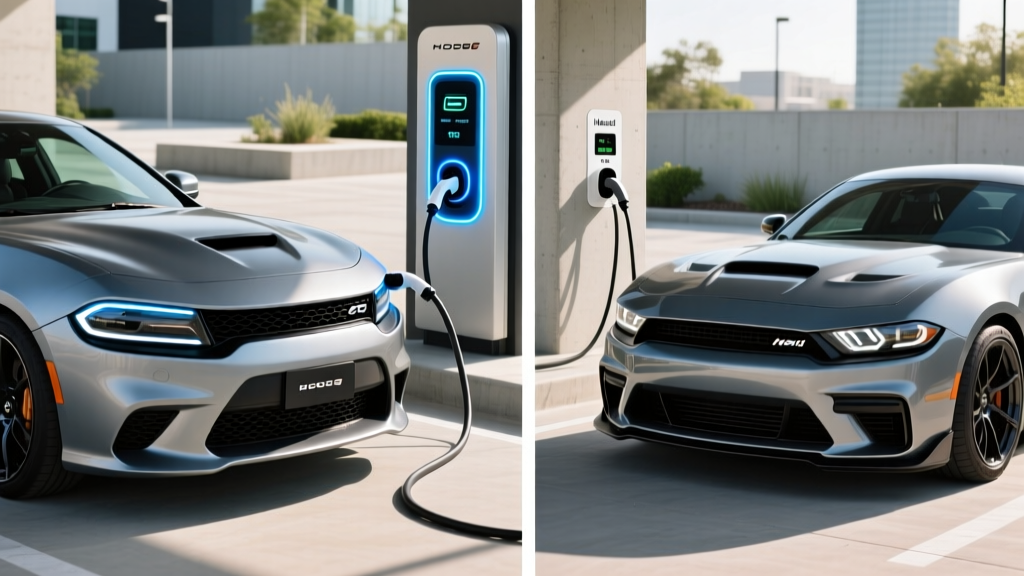
The Dodge Charger Daytona EV marks a radical pivot: a muscle car icon trading its supercharged 6.2L HEMI for an 800-volt electric architecture. For buyers cross-shopping the electric Daytona against a used Hellcat—or anyone wondering whether Dodge's first EV can tap into Tesla's Supercharger network—the charging picture is more nuanced than a simple plug-and-go. This guide breaks down exactly how the Charger Daytona charges at home and on the road, what it costs per mile versus a Hellcat, and what you'll need in your garage to make it work.
The Dodge Charger Daytona EV: Charging Hardware at a Glance
Stellantis has confirmed the 2026 Charger Daytona R/T and Scat Pack will use the NACS (North American Charging Standard) connector natively. That's significant: it means direct access to Tesla's Supercharger network—now the largest and most reliable DC fast-charging system in North America—without an adapter. The Daytona's 800V architecture enables peak DC fast-charging rates of up to 175 kW, with Stellantis quoting a 10–80% charge time of approximately 27 minutes under optimal conditions.
| Specification | R/T | Scat Pack |
|---|---|---|
| Battery Capacity (usable) | ~100 kWh (NMC) | ~100 kWh (NMC) |
| EPA Range (est.) | ~317 miles | ~260 miles |
| Peak DC Fast Charge | 175 kW | 175 kW |
| 10–80% DCFC Time | ~27 min | ~27 min |
| Level 2 AC Charge (onboard) | 11.5 kW | 11.5 kW |
| Connector | NACS (native) | NACS (native) |
| Architecture | 800V | 800V |
| Base MSRP | $51,990 | $59,990 |
Real-world caveat: The 27-minute 10–80% figure assumes battery preconditioning and a stall capable of delivering sustained power. In practice, the charge curve tapers significantly above 80%—expect a full 10–100% session to take closer to 45–50 minutes. Cold-weather charging without preconditioning can add 10–15 minutes to these times.
Charging Levels Explained: How Fast Does Each Add Range?
Understanding the three charging levels is essential before you budget for equipment or plan road trips. Here's the critical distinction: kW (kilowatts) measures power—the rate of energy delivery. kWh (kilowatt-hours) measures energy—the total capacity of the battery. Think of kW as the width of a pipe and kWh as the size of the tank you're filling.
| Level | Voltage / Power | Miles of Range Added/Hour | Typical Use Case |
|---|---|---|---|
| Level 1 | 120V / 1.4 kW | 3–5 miles | Emergency top-ups; overnight trickle |
| Level 2 (Home/Public AC) | 240V / 7.7–11.5 kW | 25–44 miles | Daily home charging; destination charging |
| DC Fast Charging | 400–800V / 50–350 kW | 150–300+ miles (in 20–30 min) | Road trips; rapid top-ups |
For the Charger Daytona's ~100 kWh battery, Level 1 charging is effectively useless for regular use—it would take over 70 hours for a full charge. Level 2 is the workhorse: at 11.5 kW, a full charge from 0–100% takes roughly 9–10 hours, which is ideal for overnight sessions. DC fast charging at 175 kW peak gets you from 10–80% in under 30 minutes on a compatible Supercharger V3 or Electrify America stall.
Home Charger Installation: Electrical Requirements and Costs
Installing a Level 2 home charger is the single most impactful upgrade for EV ownership. For a 100 kWh battery like the Daytona's, you'll want a charger capable of delivering at least 48 amps (11.5 kW) to fully utilize the car's onboard charger.
Electrical Requirements
- Circuit: Dedicated 60-amp breaker (for a 48A continuous-draw charger, NEC requires a circuit rated at 125% of continuous load)
- Wire: 6 AWG copper (or 4 AWG aluminum) for runs up to 50 feet; larger gauge for longer runs
- Outlet vs. hardwired: NACS wall connectors are typically hardwired; CCS/J1772 chargers may use a NEMA 14-50 receptacle
- Panel capacity: Your main electrical panel must have spare capacity. A 200-amp panel is standard in most homes built after 2000, but older homes with 100-amp service will likely need a panel upgrade
| Component | Typical Range | Notes |
|---|---|---|
| Level 2 Charger (Equipment) | $400–$700 | 48A smart charger, NACS or J1772 |
| Electrician Labor | $600–$2,000 | Depends on run length, wall type, conduit |
| Permit & Inspection | $50–$300 | Varies by municipality |
| Panel Upgrade (if needed) | $1,500–$3,500 | 100A → 200A service upgrade |
| Total (no panel upgrade) | $1,050–$3,000 | Most homes with 200A service |
| Total (with panel upgrade) | $2,550–$6,500 | Older homes or high-load panels |
Panel upgrade reality check: If your home was built before 1990 or you already have high-draw appliances (electric range, dryer, HVAC), your panel may be near capacity. An electrician will perform a load calculation per NEC Article 220. Don't skip this—overloading a panel is a fire hazard, and insurers may deny claims for unpermitted work.
Safety & Code Considerations
- GFCI protection: NEC 2020 and later require GFCI protection for EV receptacles (not hardwired units). Hardwired chargers with built-in ground-fault protection satisfy this requirement.
- Outdoor rating: If your charger is mounted outside, ensure it carries a NEMA 4 or IP65 rating for weather resistance.
- Cable management: A 25-foot cable is standard and sufficient for most driveways; 18-foot cables are lighter but limit parking flexibility.
- Utility rebates: Many utilities offer $200–$500 rebates for Level 2 charger installation. Check with your local provider—some require installation by a certified contractor and a separate meter for EV charging to qualify for off-peak rates.
Supercharger Access: Connector Compatibility & the NACS Shift
The Dodge Charger Daytona's native NACS port is its biggest charging advantage. Here's how connector compatibility breaks down across the current EV landscape:
| Connector | Brands Using It | Network Access |
|---|---|---|
| NACS (native) | Tesla, Ford, GM, Rivian, Dodge (Daytona), Volvo, Polestar | Tesla Supercharger (direct), Electrify America (adapters rolling out) |
| CCS1 | Hyundai, Kia, VW, BMW, Mercedes, Stellantis (non-Daytona EVs) | Electrify America, EVgo, ChargePoint (CCS stalls) |
| CHAdeMO | Nissan Leaf (legacy) | Limited; being phased out at most networks |
For Charger Daytona owners, the Supercharger network means access to over 25,000 stalls across North America with industry-leading uptime (~97% per Tesla's reports). V3 Superchargers deliver up to 250 kW, and V4 stalls support up to 350 kW—though the Daytona's 175 kW peak means you won't fully utilize V4 hardware.
Adapter note: If you own a CCS-equipped EV and want Supercharger access, Tesla sells a CCS-to-NACS adapter (~$250). Conversely, Dodge may offer a NACS-to-CCS adapter for Electrify America compatibility—confirm with your dealer at purchase, as adapter availability varies by model year.
EPA estimates are ~317 miles (R/T) and ~260 miles (Scat Pack). In real-world highway driving at 70+ mph, expect approximately 80–85% of the EPA figure—roughly 250–270 miles for the R/T and 210–220 miles for the Scat Pack. In freezing temperatures (below 30°F), range can drop an additional 15–25% due to battery resistance and cabin heating demands. Plan road-trip charging stops accordingly.
Charging Cost vs. Hellcat Gas Cost: The $/Mile Breakdown
This is where the Daytona EV vs. Hellcat comparison gets stark. The Hellcat's 6.2L supercharged V8 returns an EPA-rated 15 MPG combined (12 city / 21 highway). The Daytona's efficiency is estimated at roughly 2.5–3.0 miles per kWh depending on driving style.
| Scenario | Daytona EV (Cost/Mile) | Hellcat (Cost/Mile) | Savings per 1,000 Miles |
|---|---|---|---|
| Home Charging (off-peak, $0.13/kWh) | $0.048 | — | — |
| Home Charging (peak, $0.22/kWh) | $0.081 | — | — |
| Public DCFC ($0.40/kWh avg.) | $0.147 | — | — |
| Gasoline ($3.60/gal, 15 MPG) | — | $0.240 | — |
| Daytona home (off-peak) vs. Hellcat | $0.048 | $0.240 | $192 |
| Daytona DCFC vs. Hellcat | $0.147 | $0.240 | $93 |
At 12,000 miles per year, home-charging the Daytona at off-peak rates saves roughly $2,300 annually versus fueling a Hellcat. Even relying entirely on public DC fast charging, you'd still save about $1,100 per year. Over five years, that's $5,500–$11,500 in energy savings—before factoring in the Hellcat's higher insurance premiums, more frequent maintenance (oil changes, supercharger belt service, brake wear from a heavier, harder-driven car), and steeper depreciation.
Tax credit note: Under current IRS §30D rules, the Charger Daytona may qualify for up to $7,500 in federal tax credits, subject to MSRP caps ($55,000 for sedans), buyer income limits ($150K single / $300K joint), and battery critical-mineral sourcing requirements. The credit can be transferred to the dealer at point of sale for an instant price reduction. Confirm eligibility with your tax professional before purchase.
Recommended Home Chargers for the Charger Daytona
Since the Daytona uses a native NACS connector, your best options are NACS-compatible wall units. Here are three proven picks:
Tesla Wall Connector (NACS)
- Power Output: Up to 11.5 kW (48A) on a 60A circuit
- Connector: Native NACS
- Cable Length: 24 feet
- Smart Features: Wi-Fi, over-the-air updates, load sharing with Powerwall, access control
- Price: ~$475
- Verdict: The default choice for NACS vehicles. Reliable, fast, and seamlessly integrates with Supercharger account. Load-sharing feature is useful if you have a limited panel.
Emporia Vue Level 2 Charger (NACS adapter available)
- Power Output: Up to 11.5 kW (48A)
- Connector: J1772 with included NACS adapter (2026 model)
- Cable Length: 24 feet
- Smart Features: Energy monitoring via Emporia Vue panel integration, scheduled charging, solar-aware charging
- Price: ~$399 (charger) + adapter
- Verdict: Best for homes with solar panels or Emporia energy monitoring. The real-time energy dashboard helps optimize charging during off-peak or solar-production hours.
ChargePoint Home Flex (NACS configuration)
- Power Output: Up to 12 kW (50A) on a 60A circuit; adjustable down to 16A
- Connector: NACS (2026 configuration)
- Cable Length: 23 feet
- Smart Features: App scheduling, Alexa integration, amperage adjustment for panel-constrained homes
- Price: ~$599
- Verdict: The adjustable amperage is the standout feature. If your panel can't support a full 60A circuit, you can dial the Flex down to 32A or 40A without buying a different unit. Excellent for older homes.
Charging Time Examples: What to Expect with a 100 kWh Battery
The Charger Daytona's ~100 kWh battery is one of the largest in its class. Here's how long common charging scenarios take:
- 10–80% on a 175 kW DCFC (optimal): ~27 minutes. Sustained rate averages ~120–130 kW due to charge-curve taper above 60%.
- 10–80% on a Tesla V3 Supercharger (250 kW capable): ~27–30 minutes (Daytona is limited to 175 kW peak).
- 20–80% on Level 2 at 11.5 kW (home): ~5.2 hours. Ideal for overnight charging on a time-of-use plan.
- 0–100% on Level 2 at 11.5 kW: ~9 hours. Useful for ensuring a full battery before a long road trip.
- Level 1 (120V, 1.4 kW) emergency top-up: ~3–4 miles of range per hour. A 12-hour overnight session adds only ~40 miles. Not viable for daily use.
Preconditioning matters: The Daytona's thermal management system can warm or cool the battery before you arrive at a DCFC if you set it as your navigation destination. This can shave 5–10 minutes off a 10–80% session in cold weather. Always navigate to your charger rather than just driving there.
Frequently Asked Questions
Can the Dodge Charger Daytona use Tesla Superchargers?
Yes. The 2026 Charger Daytona has a native NACS connector, which is the same physical standard used by Tesla Superchargers. You can pull up to any V3 or V4 Supercharger stall and plug in directly—no adapter required. Access is managed through the Dodge/Stellantis app or the Tesla app, depending on the network integration agreement in place at time of purchase.
How much does it cost to install a home EV charger?
For most homes with a 200-amp electrical panel, expect to pay $1,050–$3,000 total (equipment, electrician labor, and permit). If your home needs a panel upgrade from 100A to 200A service, add $1,500–$3,500, bringing the total to $2,550–$6,500. Always get a load calculation from a licensed electrician before committing.
Is charging an EV cheaper than gas for a Hellcat?
Significantly. Home charging the Daytona at off-peak rates (~$0.13/kWh) costs about $0.048 per mile. Fueling a Hellcat at $3.60/gallon and 15 MPG costs $0.240 per mile—roughly 5x more. Over 12,000 miles per year, that's a $2,300 annual savings with the EV.
What electrical upgrades might I need for a Level 2 charger?
You'll need a dedicated 60-amp circuit with 6 AWG copper wire. If your panel is already near capacity (common in older homes with electric heat, dryer, and range), you may need a panel upgrade to 200A service. A licensed electrician will perform a NEC Article 220 load calculation to determine this. Some utilities offer rebates for panel upgrades when paired with EV charger installation.
Which connector does the Charger Daytona use?
The 2026 Charger Daytona uses the NACS (North American Charging Standard) connector natively—the same plug used by Tesla vehicles. This gives it direct access to the Supercharger network. For CCS-based public chargers (Electrify America, EVgo), check whether Dodge provides a NACS-to-CCS adapter with the vehicle or as a dealer accessory.
How fast will a Level 2 charger add range to the Daytona?
At the Daytona's maximum 11.5 kW onboard charge rate, a Level 2 charger adds approximately 38–44 miles of range per hour. A full overnight charge (8–10 hours) easily replenishes the entire ~100 kWh battery from near-empty.
The Dodge Charger Daytona EV represents a genuine inflection point for American muscle—700+ horsepower, 800V architecture, and native Supercharger access. Whether it's the right choice over a used Hellcat depends on your priorities: the Daytona wins decisively on running costs, daily usability, and charging infrastructure access. The Hellcat wins on sound, nostalgia, and zero charging-planning required. For the data-driven buyer, the numbers lean electric.