If you've been searching for dodge chargers 2023 and wondering whether Dodge finally went electric, the answer arrived with the 2024 Dodge Charger Daytona EV — Stellantis's first battery-electric muscle car. Now entering its second model year for 2026, the Charger Daytona replaces the HEMI V8 with a 100.5 kWh battery pack, up to 670 horsepower (Scat Pack), and an EPA-estimated range of up to 317 miles (R/T trim). But owning an EV muscle car means rethinking how you "fill up." This guide covers everything Charger Daytona owners and prospective buyers need to know about home charging installation, public DC fast charging, connector compatibility, and real cost-per-mile numbers.
Dodge Charger Daytona EV: Battery and Charging Specs at a Glance
Before wiring up your garage, here's exactly what you're working with. The Charger Daytona uses a 400-volt architecture with a 100.5 kWh (gross) lithium-ion NMC battery pack. Understanding the difference between kW (kilowatts — the rate of power flow, like water pressure) and kWh (kilowatt-hours — total energy stored, like gallons in a tank) is essential. Your battery holds ~93 kWh of usable energy; your charger delivers energy at a rate measured in kW.
| Spec | R/T | Scat Pack |
|---|---|---|
| Battery (gross / usable) | 100.5 kWh / ~93 kWh | 100.5 kWh / ~93 kWh |
| EPA Range | 317 miles | 260 miles |
| Max DC Fast Charge Rate | ~175 kW peak | ~175 kW peak |
| 10-80% DC Fast Charge Time | ~27 minutes | ~27 minutes |
| Level 2 (AC) Max Acceptance | 11 kW (48A) | 11 kW (48A) |
| Horsepower | 496 hp | 670 hp |
| 0-60 mph | 4.7 sec | 3.3 sec |
| Base MSRP (2025) | $59,595 | $73,590 |
Charging Levels Explained: How Fast Does Each Level Add Range?
The Charger Daytona supports three charging tiers. Here's what each delivers in practical terms for a 100.5 kWh pack:
| Level | Voltage / Power | Range Added per Hour | Best Use Case |
|---|---|---|---|
| Level 1 (120V) | 120V / 1.4-1.9 kW | ~3-5 miles/hr | Emergency / trickle top-off only |
| Level 2 (240V) | 240V / 7.2-11.5 kW | ~25-40 miles/hr | Daily home & workplace charging |
| DC Fast Charging | 400V+ / up to 175 kW | ~600+ miles/hr (peak) | Road trips, rapid top-ups |
Level 1 uses a standard 120V household outlet. At 1.4 kW, a full charge from empty would take roughly 66 hours — impractical for daily use but adequate for plugging in overnight to recover 30-40 miles of range if you drive short distances.
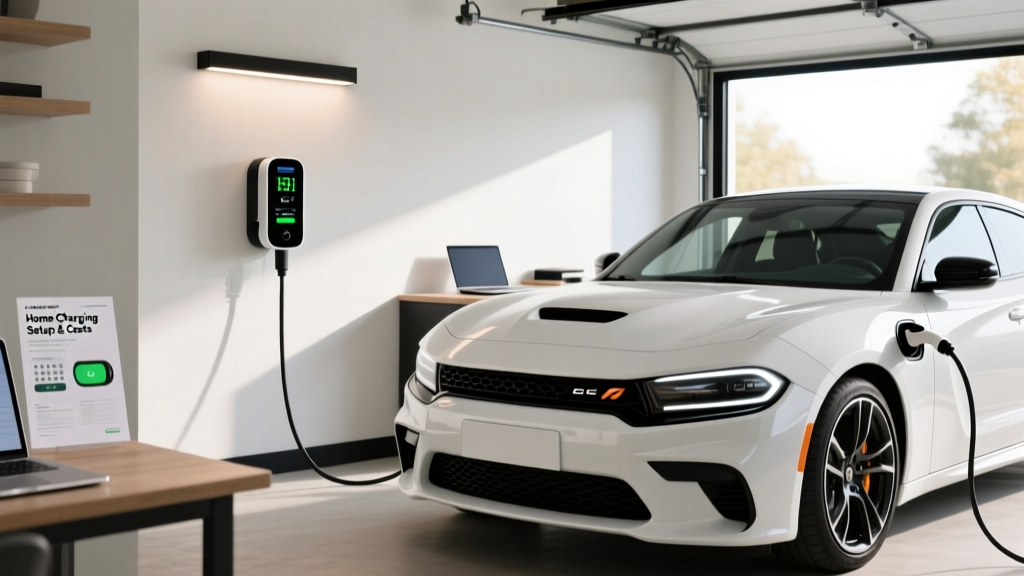
Level 2 is where most Charger Daytona owners will do 90% of their charging. A 240V circuit delivering 48 amps (11.5 kW) can fully replenish the 93 kWh usable battery in roughly 9-10 hours — ideal for overnight charging. The car's onboard charger maxes out at 11 kW, so installing a 48-amp charger matches the vehicle's capability.
DC Fast Charging bypasses the onboard charger entirely, sending DC power straight to the battery. The Charger Daytona peaks at approximately 175 kW on a compatible station, charging from 10-80% in about 27 minutes. Note that charging speed tapers significantly above 80% SoC to protect battery health — a 10-90% session will take considerably longer than a 10-80% session.
Home Charger Installation: Electrical Requirements, Costs, and Panel Upgrades
This is the question every new EV owner asks: How much does it cost to install a home EV charger? The answer depends heavily on your home's electrical panel capacity and the distance from panel to garage.
Electrical Requirements for the Charger Daytona
To charge at the car's maximum Level 2 rate of 11 kW, you need:
- Circuit: Dedicated 60-amp breaker (continuous loads require the circuit to be rated 125% above the charger's amperage — a 48A charger needs a 60A breaker)
- Wire: 6 AWG copper (or 4 AWG aluminum) for runs up to ~50 feet; thicker gauge for longer runs
- Voltage: 240V (same as a dryer or oven circuit)
- Amperage delivered to charger: 48 amps continuous
If you opt for a lower-amperage charger (e.g., 32A / 7.7 kW), a 40-amp breaker with 8 AWG wire suffices — potentially avoiding a panel upgrade.
Installation Cost Breakdown
| Component | Simple Install (panel nearby) | Complex Install (long run / panel upgrade) |
|---|---|---|
| Level 2 Charger (hardware) | $400 - $750 | $400 - $750 |
| Electrician labor (2-4 hrs simple / 6-10 hrs complex) | $500 - $1,200 | $1,500 - $3,500 |
| Electrical permit | $50 - $200 | $50 - $200 |
| Panel upgrade (100A → 200A, if needed) | N/A | $1,500 - $3,500 |
| Conduit, wiring, misc. materials | $100 - $300 | $300 - $800 |
| Total Estimated Cost | $1,050 - $2,450 | $3,750 - $8,750 |
Panel upgrade reality check: Homes built before 2000 often have 100-amp or 150-amp service panels. Adding a 60-amp EV circuit alongside existing loads (HVAC, electric range, dryer) may exceed your panel's capacity. A licensed electrician should perform a load calculation per NEC Article 220 before installation. If an upgrade to 200A service is required, budget an additional $1,500-$3,500 and expect 1-2 days of work including utility coordination.
Many utility companies offer rebates of $250-$500 for Level 2 charger installation, and some states offer additional incentives. Check with your local utility and the Alternative Fuels Data Center state incentive database for current programs.
Safety and Code Considerations
- Dedicated circuit: NEC requires a dedicated circuit for EV charging — no sharing with other outlets or appliances.
- GFCI protection: The 2020 NEC (Article 625.54) requires GFCI protection for receptacles used for EV charging. Hardwired chargers may have different requirements depending on local code adoption.
- Outdoor rating: If your charger is mounted outside or in an exposed carport, ensure it carries a NEMA 4 (weatherproof) rating.
- Permit: Most jurisdictions require an electrical permit and inspection for new 240V circuits. Skipping this can void home insurance coverage for electrical fires.
Connector Compatibility: NACS, CCS, and What the Charger Daytona Uses
Which connector is compatible with the Dodge Charger Daytona? For the 2024-2026 model years, the Charger Daytona ships with a CCS1 (Combined Charging System) port for both Level 2 AC and DC fast charging. However, Stellantis has announced a transition to the NACS (North American Charging Standard / Tesla connector) for future model years, aligning with the broader industry shift.
| Connector | Description | Networks Supported | Charger Daytona (2024-2026) |
|---|---|---|---|
| CCS1 | SAE standard, 7-pin + 2 DC pins | Electrify America, EVgo, ChargePoint, most non-Tesla networks | ✓ Native port |
| NACS (Tesla) | Compact Tesla-designed connector, adopted industry-wide starting 2025 | Tesla Supercharger network + growing OEM adoption | Adapter required (CCS→NACS) |
| CHAdeMO | Legacy Japanese DC standard | Limited; being phased out | ✗ Not compatible |
| J1772 | AC-only connector (Level 1 & 2) | All Level 2 public stations | ✓ Via CCS inlet (J1772 is upper portion of CCS1) |
Practical advice: With a CCS1 port, the Charger Daytona can access Electrify America, EVgo, and ChargePoint DC fast chargers natively. To access Tesla Superchargers (now open to non-Tesla vehicles at many locations), you'll need a CCS-to-NACS adapter — available from Tesla and third-party manufacturers for roughly $150-$250. As more networks add NACS cables through 2026-2027, adapter needs will decrease.
Charging Cost: Per-Mile Electricity vs. Gasoline
How much does charging cost per mile vs gas? This is where the Charger Daytona EV makes a compelling economic argument over the discontinued 5.7L HEMI V8 Charger, which averaged roughly 19 MPG combined.
| Charging / Fueling Scenario | Cost | Cost per Mile (EV) | Cost per Mile (Gas) |
|---|---|---|---|
| Home charging (off-peak, $0.13/kWh avg) | $0.13/kWh | $0.025/mile | $0.184/mile ($3.50/gal) |
| Home charging (peak, $0.22/kWh avg) | $0.22/kWh | $0.042/mile | $0.184/mile ($3.50/gal) |
| Public Level 2 ($0.25-$0.49/kWh) | $0.37/kWh avg | $0.070/mile | $0.184/mile ($3.50/gal) |
| DC Fast Charging ($0.35-$0.65/kWh) | $0.48/kWh avg | $0.091/mile | $0.184/mile ($3.50/gal) |
At the national average electricity rate of ~$0.16/kWh (U.S. EIA) and an efficiency of ~1.9 kWh/mile for the Scat Pack, home charging costs roughly $0.030 per mile — an 83% reduction compared to the old HEMI at $3.50/gallon gasoline. Even exclusive DC fast charging at highway rates remains cheaper per mile than gasoline in most U.S. markets.
Charging time examples for the Charger Daytona's 93 kWh usable battery:
- 10-80% at home (48A / 11.5 kW): ~5.5 hours
- 10-80% at DC fast charger (175 kW peak): ~27 minutes
- 10-80% at 50 kW DC charger: ~75 minutes
- 20-80% at Electrify America 350 kW station (capped at ~175 kW): ~25 minutes
Remember: the charging curve is not linear. The Charger Daytona will pull peak power (up to ~175 kW) between roughly 10-40% SoC, then taper progressively. Charging from 80-100% on DC fast charging is painfully slow and wasteful — save the last 20% for home Level 2 charging.
Recommended Home Level 2 Chargers for the Charger Daytona
Since the Charger Daytona's onboard charger maxes at 11 kW (48A), there's no benefit to installing a charger rated above 48 amps. Here are proven units that match the car's capability:
ChargePoint Home Flex
- Power: Up to 12 kW (50A) — configurable down to 16A
- Connector: J1772 (CCS compatible for AC charging)
- Cable length: 23 feet
- Smart features: Wi-Fi, app scheduling, Alexa, energy tracking
- NEMA rating: NEMA 4 (indoor/outdoor)
- Price: ~$550-$650
Verdict: Best all-rounder. Amperage flexibility avoids panel upgrades in some homes.
Emporia Vue + Level 2 Charger
- Power: Up to 11.5 kW (48A)
- Connector: J1772
- Cable length: 24 feet
- Smart features: Solar integration, whole-home energy monitoring, scheduled charging
- NEMA rating: NEMA 4
- Price: ~$400-$500 (charger); $100-$200 more with Emporia Vue panel monitor
Verdict: Best value with solar awareness. Pairing with the Vue monitor enables automatic load management.
Wallbox Pulsar Plus
- Power: Up to 11.5 kW (48A)
- Connector: J1772
- Cable length: 25 feet
- Smart features: Wi-Fi + Bluetooth, app control, Power Sharing (two chargers on one circuit)
- NEMA rating: NEMA 4
- Price: ~$500-$600
Verdict: Compact, well-built, ideal for tight garages. Power Sharing feature suits two-EV households.
Tesla Wall Connector (with J1772 adapter)
- Power: Up to 11.5 kW (48A)
- Connector: NACS native; J1772 adapter included (2025+ models)
- Cable length: 24 feet
- Smart features: Wi-Fi, OTA updates, load sharing, access control
- NEMA rating: NEMA 3R (outdoor rated)
- Price: ~$450-$500
Verdict: Excellent hardware at a competitive price. Best for households planning a future NACS-native vehicle alongside the Charger Daytona.
Federal Tax Credit and Incentives for Home Charging Equipment
The IRS §30C Alternative Fuel Vehicle Refueling Property Credit offers up to $1,000 (30% of cost, capped) for qualified home EV charging equipment installed in eligible census tracts. This covers the charger hardware and installation labor — but eligibility depends on your home's location in a qualifying low-income or non-urban census tract. Check the AFDC §30C page for the latest tract map.
For the vehicle itself, the Charger Daytona's MSRP (starting at $59,595 for the R/T) falls below the IRS §30D sedan cap of $55,000... only if configured in base trim. Higher trims and the Scat Pack ($73,590) exceed the cap. Additionally, §30D has buyer income limits ($150K single / $300K joint), critical mineral sourcing requirements, and battery component rules that change annually. Consult a tax professional and the IRS clean vehicle credits page before relying on the credit.
Frequently Asked Questions
What electrical upgrades might I need for a home Charger Daytona charger?
If your home has a 200-amp electrical panel with available capacity (determined by a NEC Article 220 load calculation), you likely only need a new 60-amp double-pole breaker, wiring, and the charger itself. Homes with 100-amp or 150-amp panels, or panels already near capacity from electric HVAC, range, and dryer loads, may require a panel upgrade to 200A ($1,500-$3,500) or a smart load-management device like the Emporia Vue that dynamically reduces charger amperage when other loads spike.
Can I use a Tesla Supercharger with my Dodge Charger Daytona?
Not natively — the 2024-2026 Charger Daytona uses a CCS1 port, while Tesla Superchargers use NACS. However, a CCS-to-NACS adapter ($150-$250) enables access to Tesla Supercharger stalls that have been opened to non-Tesla vehicles. Tesla's "Magic Dock" built-in adapter at select Supercharger stations also allows CCS vehicles to charge without a separate adapter. Availability varies by station — check the Tesla app for compatible locations.
How long does a full charge take at home?
From near-empty (~10% SoC) to 100% on a 48A / 11.5 kW Level 2 charger, expect approximately 9-10 hours. Most owners charge from 20-80% daily, which takes roughly 5-6 hours. Charging to 100% regularly accelerates NMC battery degradation; reserve full charges for road trip mornings.
Is DC fast charging bad for the Charger Daytona battery?
Occasional DC fast charging is fine — the battery management system actively manages temperature and limits charge rate to protect cell health. However, exclusive DC fast charging over years will accelerate degradation compared to primarily Level 2 charging. Stellantis warranties the battery for 8 years / 100,000 miles with a capacity retention threshold of 70%. Real-world data from similar NMC packs suggests 10-15% degradation over 100,000 miles with mixed charging habits.
Does the Charger Daytona support vehicle-to-home (V2H) or vehicle-to-load (V2L)?
As of the 2026 model year, the Charger Daytona does not offer V2H or V2L functionality. This means you cannot use the vehicle's battery to power home appliances during an outage or run external devices. Stellantis has not announced plans to add bidirectional charging to this platform.
How much does it cost to install a home EV charger if I already have a 240V outlet?
If you have an existing 240V NEMA 14-50 outlet (common for dryers or RV hookups) in your garage or nearby, you can use a plug-in Level 2 charger without new wiring — saving $500-$1,500 in electrician costs. However, the outlet must be on a dedicated 50-amp breaker, and you should have an electrician verify the circuit's condition and capacity before relying on it for daily EV charging. A plug-in charger with a NEMA 14-50 plug (like the ChargePoint Home Flex) limits you to 40A continuous (9.6 kW) rather than the hardwired 48A (11.5 kW) maximum.