The Real Cost of a Tesla Home Charger: What You'll Actually Pay
If you've ordered a Tesla or any NACS-equipped EV, the next question is almost always: how much will it cost to charge at home? The cost of a Tesla home charger isn't just the price of the wall unit — it's the combined total of the charging equipment, electrical labor, potential panel upgrades, and local permits. In 2026, most homeowners spend between $1,200 and $3,800 for a complete Level 2 Tesla Wall Connector installation, though that range can swing dramatically based on your home's electrical infrastructure.
This guide breaks down every line item, explains charging speeds in concrete terms, and shows you exactly what to expect before you call an electrician.
Understanding Charging Levels: kW, kWh, and Miles Per Hour
Before calculating cost, you need to understand the three charging levels available to EV owners. The critical distinction: kW (kilowatts) measures power — how fast energy flows into your battery. kWh (kilowatt-hours) measures energy — the total capacity of your battery, like gallons in a fuel tank. Never confuse the two.
| Level | Voltage | Max Power (kW) | Miles of Range Added Per Hour | Typical Use Case |
|---|---|---|---|---|
| Level 1 | 120V AC | 1.0–1.4 kW | 3–5 mi/hr | Overnight trickle; PHEVs; emergency backup |
| Level 2 | 240V AC | 7.2–19.2 kW | 23–58 mi/hr | Daily home charging; destination charging |
| DC Fast | 400–800V DC | 50–350+ kW | 150–800+ mi/hr (peak) | Road trips; Superchargers; highway corridors |
For a Tesla Model Y Long Range (75 kWh usable battery, EPA 320 miles), a Level 2 Tesla Wall Connector at 11.5 kW adds roughly 44 miles of range per hour. A full 10–80% charge takes about 5.5 hours. A Level 1 outlet on a standard 120V circuit would need roughly 60 hours for the same session — which is why Level 2 home installation is the practical standard for BEV owners.
Real-world charging note: The "miles per hour" figures above assume optimal conditions. In cold weather (below 32°F / 0°C), battery preconditioning is required to reach peak charge rates. Without it, Level 2 speeds may drop 10–20%, and DC fast charging can slow significantly until the battery warms.
Breaking Down the Cost of Tesla Home Charger Installation
The total cost of installing a Tesla Wall Connector at home splits into four categories: the charger unit itself, electrician labor, electrical materials beyond the charger, and local permits. Here's what each line item looks like in 2026:
| Cost Component | Low Estimate | High Estimate | Notes |
|---|---|---|---|
| Tesla Wall Connector (unit) | $420 | $475 | Gen 3 Wall Connector; 24ft cable, Wi-Fi enabled |
| Electrician labor (2–6 hrs) | $600 | $1,800 | Depends on run length, conduit, accessibility |
| Electrical materials (wire, conduit, breaker) | $150 | $600 | Longer runs from panel to garage increase cost |
| Permit & inspection | $50 | $300 | Varies by municipality; some jurisdictions waive for EV |
| Total (no panel upgrade) | $1,220 | $3,175 | Most homeowners land between $1,500–$2,200 |
| Electrical panel upgrade (if needed) | $1,500 | $4,000+ | 100A to 200A service upgrade; older homes common |
The panel upgrade wildcard: If your home has a 100-amp electrical panel — common in homes built before the 1990s — adding a 60-amp dedicated circuit for a Tesla Wall Connector may exceed your panel's capacity. Upgrading to a 200-amp panel adds $1,500 to $4,000+ to the project. Always request a load calculation from your electrician before committing. Some utility companies offer rebates of $200–$500 for panel upgrades tied to EV adoption.
Electrical Requirements for the Tesla Wall Connector
The Tesla Gen 3 Wall Connector supports up to 48 amps of continuous draw, which requires a 60-amp dedicated circuit (NEC code requires circuits rated at 125% of continuous load). Key specs:
- Voltage: 240V AC (split-phase, standard US residential)
- Amperage: 48A continuous / 60A breaker (can be configured lower: 40A, 32A, 24A, 16A)
- Max power output: 11.5 kW at 48A (or 9.6 kW at 40A, 7.7 kW at 32A)
- Wire gauge: 6 AWG copper for 60A; 8 AWG for 40A (varies by run length and local code)
- Circuit: Must be dedicated — no sharing with other appliances
If your panel can't support a 60-amp circuit, the Wall Connector can be configured to 40A or 32A during setup, which still delivers strong overnight charging for most drivers.
Connector Compatibility: NACS, CCS, and Adapters
As of 2026, Tesla's North American Charging Standard (NACS) has become the dominant connector in the US, adopted by Ford, GM, Rivian, Hyundai, and most major automakers. But if you're driving a non-Tesla EV with a CCS1 port, you'll need an adapter to use a Tesla Wall Connector.
| EV Brand (2026 Models) | Native Connector | Tesla Wall Connector Compatible? | Adapter Needed? |
|---|---|---|---|
| Tesla (all models) | NACS | Yes — native | No |
| Ford (F-150 Lightning, Mustang Mach-E) | NACS (2025+) | Yes — native | No |
| GM (Equinox EV, Blazer EV, Silverado EV) | NACS (2025+) | Yes — native | No |
| Rivian (R1T, R1S) | NACS (2025+) | Yes — native | No |
| Hyundai / Kia (Ioniq 5, EV6, EV9) | NACS (2026+) | Yes — native | No (2026 models); CCS-to-NACS adapter for 2024–25 |
| VW (ID.4), BMW (iX), older CCS EVs | CCS1 | With adapter | Yes — CCS-to-NACS adapter ($150–$250) |
| Nissan Leaf (older models) | CHAdeMO | Not practical | No reliable adapter exists |
Tesla sells a CCS-to-NACS adapter (approximately $199) that allows CCS-equipped vehicles to charge on a Tesla Wall Connector. Third-party adapters from brands like Lectron and A2Z are also available. Note: CHAdeMO vehicles (primarily older Nissan Leafs and Mitsubishi Outlander PHEVs) cannot practically use a Tesla Wall Connector.
For a universal home setup that serves any EV, consider a charger with a J1772 connector and a separate NACS adapter — or install two dedicated circuits if you have multiple EVs.
Cost Per Mile: Home Charging vs. Gas vs. Public DC Fast
The financial case for home charging rests on one metric: cost per mile. Here's how it stacks up across scenarios for a Tesla Model Y (efficiency: ~27 kWh/100mi, or roughly 3.7 mi/kWh):
| Charging Scenario | Cost per kWh | Cost per Mile (Model Y) | Annual Cost (12,000 mi) |
|---|---|---|---|
| Home Level 2 — national avg electricity | $0.17/kWh | $0.046 | $552 |
| Home Level 2 — off-peak / time-of-use rate | $0.09/kWh | $0.024 | $288 |
| Tesla Supercharger (DC fast, avg US) | $0.35/kWh | $0.095 | $1,140 |
| Electrify America / 3rd-party DC fast | $0.48/kWh | $0.130 | $1,560 |
| Gas equivalent (28 MPG combined, $3.40/gal) | — | $0.121 | $1,452 |
Even at national average electricity rates, home Level 2 charging costs roughly one-third of gasoline per mile. With time-of-use (TOU) rates and off-peak scheduling, the savings widen dramatically. According to fueleconomy.gov, the 2026 Tesla Model Y Long Range achieves 122 MPGe combined — translating to roughly $550 in annual electricity costs at average rates, versus $1,450+ for a comparable 28-MPG gas crossover.
When home charging makes financial sense:
- You have access to a garage, carport, or driveway with panel proximity
- Your utility offers TOU rates or EV-specific off-peak plans
- You drive 10,000+ miles per year (savings compound faster)
- Your electrical panel has capacity for a 40–60A dedicated circuit
Charging Time Examples: What to Expect Overnight
Charging speed depends on your vehicle's onboard charger capacity and the Wall Connector's output. Here are real-world 10–80% charge times for common 2026 EVs using a Tesla Wall Connector at 11.5 kW (48A):
- Tesla Model 3 Long Range (75 kWh usable): ~4.5 hours (10–80%)
- Tesla Model Y Long Range (75 kWh usable): ~4.5 hours
- Ford F-150 Lightning Extended Range (131 kWh usable): ~8 hours at 11.5 kW (vehicle accepts up to 19.2 kW with upgraded onboard charger)
- Rivian R1T Dual-Motor (106 kWh usable): ~6.5 hours
- Hyundai Ioniq 5 (77.4 kWh usable, 2026 NACS): ~5 hours (vehicle caps AC at 10.9 kW)
For context, most EV owners charge from 20–30% remaining to 80% each night — a session that typically takes 3–4 hours at Level 2. The car's battery management system slows charging above 80% to protect long-term battery health, so scheduling charges to 80% is both faster and better for battery longevity.
Recommended Home Charger Equipment
The Tesla Wall Connector isn't your only option — though for Tesla and NACS-native vehicles, it's the most integrated choice. Here's a comparison of top home chargers for 2026:
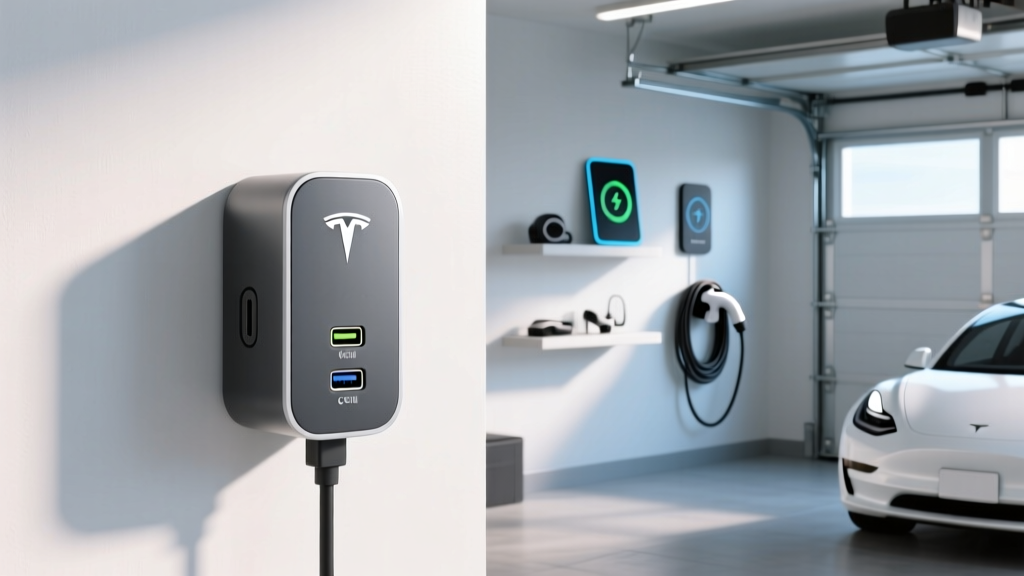
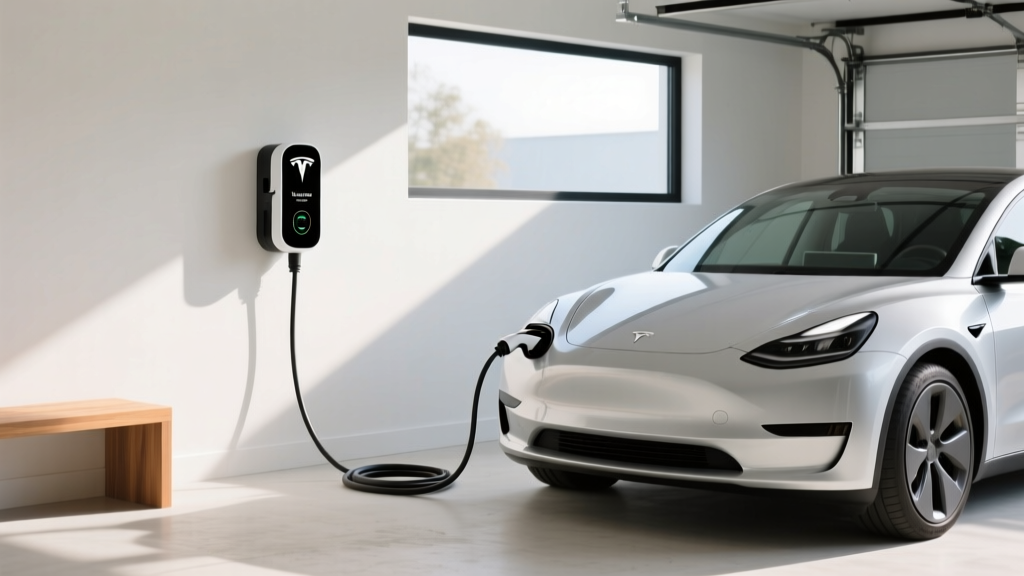
Tesla Gen 3 Wall Connector
- Price: $420–$475
- Power output: Up to 11.5 kW (48A at 240V)
- Connector: NACS (native Tesla plug)
- Cable length: 24 feet
- Smart features: Wi-Fi, OTA firmware updates, load sharing (pair two units on one circuit), power metering via Tesla app
- Best for: Tesla owners; NACS-native EVs; clean Tesla ecosystem integration
ChargePoint Home Flex
- Price: $549–$599
- Power output: Up to 12 kW (50A at 240V) — configurable from 16A to 50A
- Connector: J1772 (NACS adapter included or available separately)
- Cable length: 23 feet
- Smart features: Wi-Fi, Alexa integration, scheduling, energy tracking, works with any EV
- Best for: Multi-EV households; CCS/J1772 vehicles; renters who may move
Emporia Level 2 EV Charger
- Price: $349–$399
- Power output: Up to 11.5 kW (48A at 240V)
- Connector: J1772 (NACS version available)
- Cable length: 24 feet
- Smart features: Wi-Fi, detailed energy monitoring, solar integration, TOU scheduling, works with Emporia home energy monitors
- Best for: Budget-conscious installers; solar-panel owners; energy-data enthusiasts
Grizzl-E Smart
- Price: $499–$549
- Power output: Up to 10 kW (40A at 240V)
- Connector: J1772 or NACS
- Cable length: 24 feet
- Smart features: Wi-Fi, OCPP protocol, adjustable amperage, extreme-weather rated (-40°F to +122°F), rugged aluminum enclosure
- Best for: Cold-climate installations; outdoor mounting; durability-focused buyers
Safety, Code, and Permit Considerations
EV charger installation is electrical work governed by the National Electrical Code (NEC) and enforced by your local Authority Having Jurisdiction (AHJ). Key requirements:
- Dedicated circuit: Your Wall Connector must be on its own circuit — it cannot share with a dryer, oven, or HVAC system. This prevents overloads.
- GFCI protection: NEC 2020 and later require Ground-Fault Circuit Interrupter (GFCI) protection for outdoor receptacles and many indoor EV installations. The Tesla Wall Connector has built-in GFCI protection, but your electrician will verify compliance.
- Outdoor rating: If mounting outdoors, ensure the unit is NEMA 3R or NEMA 4 rated. The Tesla Wall Connector is rated for indoor and outdoor use (NEMA 4).
- Permit required: Most jurisdictions require an electrical permit for a new 240V circuit. Permit fees range from $50 to $300. Skipping the permit risks insurance claim denials and code violations during a home sale.
- Inspection: After installation, your locality may require an inspection before the circuit is energized. Your electrician typically coordinates this.
Hire a licensed electrician — preferably one with EV charger installation experience. Ask for a load calculation, a written quote with line-item breakdowns, and confirmation that they'll pull the required permit. NFPA's NEC guidelines are the baseline, but local amendments vary.
Federal Tax Credit and Utility Rebates for Home Charging
The federal Alternative Fuel Vehicle Refueling Property Credit (IRS §30C) was reinstated and modified under recent legislation. For 2026, eligible taxpayers can claim up to $1,000 (30% of equipment + installation costs, capped at $1,000) for home EV charger installation. However, eligibility is restricted to properties located in eligible census tracts (typically low-income or non-urban areas). Check your eligibility on irs.gov before counting on this credit.
Beyond federal incentives, many utilities offer direct rebates for Level 2 charger installation:
- Pacific Gas & Electric (PG&E): Up to $750 rebate for residential EV charger + TOU enrollment
- Southern California Edison (SCE): Up to $1,500 for panel upgrade + charger in income-eligible programs
- Xcel Energy (CO/MN): $500–$1,000 rebate for smart Level 2 charger installation
- ConEdison (NY): Up to $700 rebate through SmartCharge NY program
These programs change frequently — verify current offerings with your utility before purchasing equipment.
Frequently Asked Questions
How much does it cost to install a Tesla home charger?
Total installed cost ranges from $1,220 to $3,175 for most homes without a panel upgrade. The Tesla Wall Connector unit itself costs $420–$475. Electrician labor ($600–$1,800), materials ($150–$600), and permits ($50–$300) make up the rest. Homes needing a 200A panel upgrade should budget an additional $1,500–$4,000.
How fast will a Tesla Wall Connector charge my car?
At its maximum 11.5 kW output (48A), the Tesla Wall Connector adds approximately 44 miles of range per hour to a Model Y. A typical overnight session from 20% to 80% takes about 4–5 hours for most Tesla vehicles. Actual speed depends on your vehicle's onboard charger capacity and battery state of charge.
Can I use a Tesla Wall Connector with a non-Tesla EV?
Yes, if your EV has a NACS charge port (2025+ Ford, GM, Rivian, and 2026+ Hyundai/Kia models) or you use a CCS-to-NACS adapter ($150–$250). Vehicles with CHAdeMO ports (older Nissan Leaf) cannot practically use a Tesla Wall Connector.
What electrical upgrades might I need?
The most common upgrade is a panel capacity increase from 100A to 200A service, needed when your existing panel lacks capacity for a new 60A dedicated circuit. Other potential upgrades include replacing outdated wiring (aluminum to copper), adding a sub-panel if your main panel is full, or upgrading your utility service drop. Always get a professional load calculation first.
Is a permit required to install a home EV charger?
In most US jurisdictions, yes. Installing a new 240V circuit requires an electrical permit and potentially a post-installation inspection. Permit costs range from $50 to $300. Skipping the permit can void home insurance coverage and create problems during a home sale.
How much does charging at home cost versus gas?
At the US average electricity rate of $0.17/kWh, charging a Tesla Model Y at home costs roughly $0.046 per mile — about 62% less than a 28-MPG gas car at $3.40/gallon ($0.121/mile). With off-peak TOU rates ($0.09/kWh), the cost drops to $0.024/mile, an 80% savings versus gasoline.