If you've been searching "do they still make Dodge Chargers", the answer in 2026 is a definitive yes — but the Charger has gone electric. The Dodge Charger Daytona EV replaces the legendary HEMI V8 with a dual-motor, all-wheel-drive electric powertrain delivering up to 670 horsepower and a 0–60 mph time in the low 3-second range. Whether you're considering the R/T trim or the high-output Scat Pack, understanding how to charge this 100+ kWh battery platform is essential before you take delivery.
This guide covers everything you need to know about charging the Dodge Charger Daytona EV at home and on the road — from Level 1 trickle charging to DC fast charging, installation costs, connector compatibility, and equipment picks for 2026.
Charging Levels Explained: How Fast Will Each Level Add Range?
Electric vehicle charging is measured in kW (kilowatts), which represents the rate of power delivery — think of it as how fast water flows through a hose. Your battery capacity is measured in kWh (kilowatt-hours), which is the total energy stored — the size of the tank. The Charger Daytona's usable battery capacity is approximately 100.5 kWh (NMC chemistry), so the charging speed directly determines how long you're plugged in.
| Charging Level | Voltage / Amperage | Power (kW) | Miles of Range Added per Hour | 10–80% Charge Time |
|---|---|---|---|---|
| Level 1 (Standard Outlet) | 120V / 12A | ~1.4 kW | ~3–4 miles/hr | ~55+ hours |
| Level 2 (Home / Public AC) | 240V / 48A | ~11.5 kW | ~28–33 miles/hr | ~7–8 hours |
| Level 2 (Max onboard acceptance) | 240V / 40A | ~9.6 kW | ~24–28 miles/hr | ~8.5–9 hours |
| DC Fast Charging (Peak) | 400V+ architecture | ~200 kW (peak) | ~200+ miles in ~20 min | ~25–30 minutes |
For daily driving, Level 2 home charging is the standard. Most EV owners plug in overnight and wake up to a full charge. Level 1 is only practical as a backup or for PHEVs with small batteries — with a 100+ kWh pack like the Charger Daytona's, it's an emergency-only option.
Home Charger Installation: Electrical Requirements and Costs
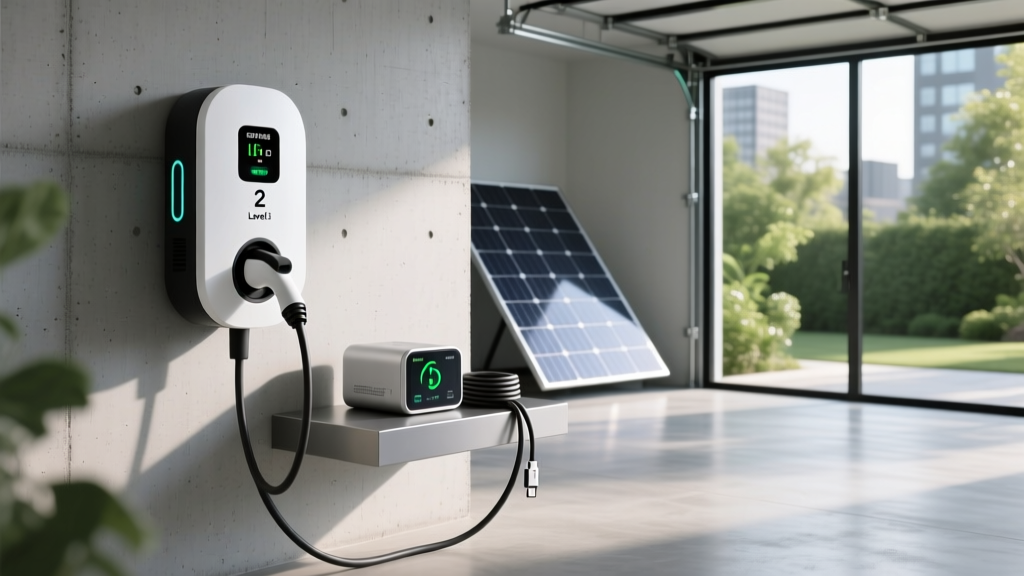
Installing a dedicated Level 2 home charger is the single most impactful upgrade for EV ownership. Here's what's involved electrically and financially for a 2026 installation.
Electrical Requirements
- Circuit: A dedicated 240V circuit, typically 50A or 60A breaker (to support 40A or 48A continuous charging load — NEC requires the breaker to be rated at 125% of continuous load)
- Wire gauge: 6 AWG copper for 50A circuits; 4 AWG for 60A circuits (varies by run length and local code)
- Panel capacity: Most modern 200A panels can accommodate a 50–60A EV circuit. Older homes with 100A panels may need a panel upgrade to 200A, which is a significant added cost
- Permit: Required in virtually all US jurisdictions for new 240V circuits — your electrician will pull this
- GFCI protection: NEC 2020/2023 requires GFCI protection for EV charging outlets in garages; hardwired chargers may have this built in
Installation Cost Breakdown
| Cost Component | Low Estimate | High Estimate | Notes |
|---|---|---|---|
| Level 2 Charger Equipment | $350 | $750 | Smart Wi-Fi chargers, 32A–48A |
| Electrician Labor (install) | $400 | $1,200 | Depends on panel-to-garage distance, wall type |
| Materials (wire, conduit, breaker) | $100 | $400 | Longer runs = more wire cost |
| Permit & Inspection | $50 | $250 | Varies by municipality |
| Panel Upgrade (if needed) | $1,500 | $4,000+ | 100A → 200A upgrade; not always required |
| Total (no panel upgrade) | $900 | $2,600 | Most homes with 200A panels |
| Total (with panel upgrade) | $2,400 | $6,600+ | Older homes or high-load panels |
Always hire a licensed electrician and have the work permitted and inspected. Unpermitted electrical work can void your homeowner's insurance and create fire risk. According to NECA, a proper installation should include a dedicated circuit, correct breaker sizing, and a load calculation.
Which Connector Does the Dodge Charger Daytona Use?
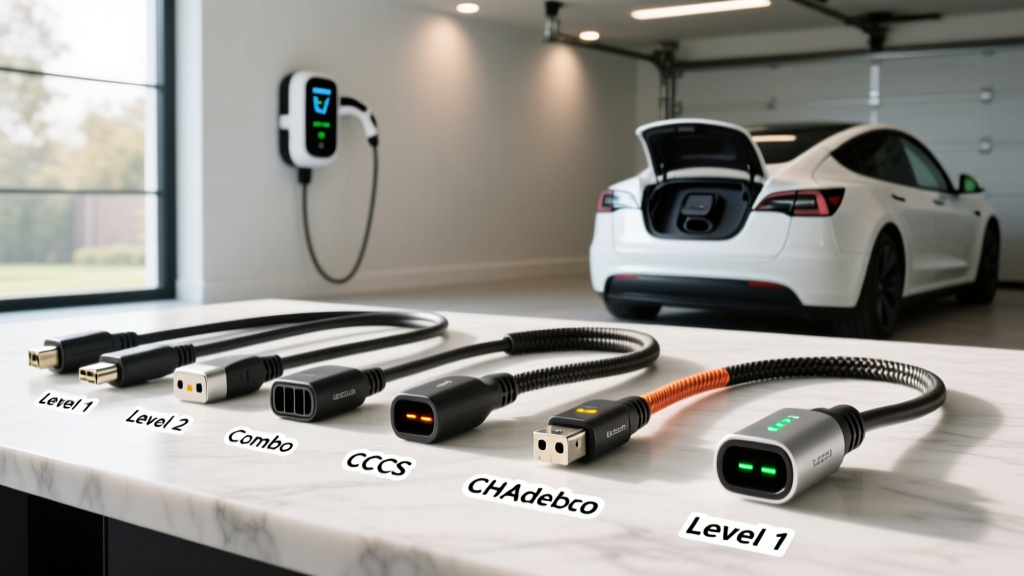
The 2026 Dodge Charger Daytona EV is equipped with the CCS1 (Combined Charging System) connector for DC fast charging and a standard J1772 inlet for Level 1 and Level 2 AC charging. This is important because the EV industry is mid-transition to the NACS (North American Charging Standard) connector pioneered by Tesla.
| Charging Scenario | Connector Needed | Native or Adapter? | Network Access |
|---|---|---|---|
| Home Level 2 (240V) | J1772 | Native | Any Level 2 home charger |
| Public Level 2 (AC) | J1772 | Native | ChargePoint, EVgo, public stations |
| DC Fast Charging (non-Tesla) | CCS1 | Native | Electrify America, EVgo, Ionity |
| Tesla Supercharger (NACS) | NACS | CCS-to-NACS adapter required | Tesla Supercharger network (with adapter) |
Adapter situation: Stellantis has indicated that CCS-to-NACS adapters will be available for the Charger Daytona, enabling access to Tesla's Supercharger network — the largest and most reliable DC fast-charging network in the US with over 25,000 stalls. Budget approximately $150–$250 for a quality adapter from an authorized supplier. As of 2026, new Tesla Supercharger stalls increasingly include native CCS cables, but a NACS adapter still maximizes your options.
For the legacy CHAdeMO connector (used by the Nissan Leaf and older vehicles): this is effectively a dead standard in North America. The Charger Daytona does not support CHAdeMO, and no adapter exists. This won't affect your ownership experience — CHAdeMO stations are being phased out.
Cost to Charge: EV Electricity vs Gasoline Per Mile
One of the Charger Daytona EV's strongest ownership arguments is fuel cost savings over its gasoline predecessors. Here's how the numbers break down in 2026.
| Charging Scenario | Cost per kWh | Cost per Mile | Cost to Add 200 Miles |
|---|---|---|---|
| Home (off-peak utility rate) | $0.10–$0.14 | $0.03–$0.05 | $6.70–$9.40 |
| Home (average US rate) | $0.16–$0.18 | $0.05–$0.06 | $10.70–$12.00 |
| Public Level 2 (ChargePoint, etc.) | $0.25–$0.40 | $0.08–$0.13 | $16.70–$26.70 |
| DC Fast Charging (Electrify America) | $0.35–$0.55 | $0.12–$0.18 | $23.40–$36.70 |
| Gasoline Equivalent (25 MPG combined, $3.50/gal) | — | $0.14 | $28.00 |
Key takeaway: Home charging at off-peak rates delivers the most dramatic savings — roughly 70–75% less per mile than gasoline. Even public DC fast charging can be competitive with or cheaper than premium gasoline, depending on your local utility and network pricing. According to fueleconomy.gov, the Charger Daytona's combined MPGe is estimated around 85–95 MPGe depending on trim.
If you have access to time-of-use (TOU) utility rates, scheduling charging between midnight and 5 AM can reduce your per-kWh cost substantially. Many smart chargers (see recommendations below) support scheduled charging to automate this.
Recommended Level 2 Home Chargers for the Charger Daytona
Here are three proven Level 2 chargers well-suited to the Charger Daytona's ~100 kWh battery, with specific specs and pricing current for 2026.
ChargePoint Home Flex
- Power Output: Up to 11.5 kW (48A) on a 60A circuit; configurable down to 16A
- Connector: J1772 (NACS version also available for 2026)
- Cable Length: 23 feet
- Smart Features: Wi-Fi, app scheduling, energy tracking, Alexa integration
- Price: ~$599–$649
- Best For: Flexible amperage settings if your panel is tight on capacity
Emporia Level 2 EV Charger
- Power Output: Up to 11.5 kW (48A) on a 60A circuit
- Connector: J1772
- Cable Length: 24 feet
- Smart Features: Wi-Fi, app control, energy monitoring, solar integration, TOU scheduling
- Price: ~$399–$449
- Best For: Budget-conscious buyers who want smart features and solar pairing
Wallbox Pulsar Plus (48A)
- Power Output: Up to 11.5 kW (48A) on a 60A circuit
- Connector: J1772 (NACS version available)
- Cable Length: 25 feet
- Smart Features: Wi-Fi + Bluetooth, app scheduling, power sharing (dual charger setups), eco-smart mode
- Price: ~$549–$649
- Best For: Compact form factor and dual-charger garage setups
For the Charger Daytona's large battery, I recommend a 48A charger on a 60A dedicated circuit whenever your panel allows. At 48A / 11.5 kW, you'll add roughly 30 miles of range per hour — enough to fully replenish a daily commute overnight. If your panel is constrained, the ChargePoint Home Flex's adjustable amperage lets you set it to 32A or 40A without replacing hardware.
Safety, Code, and Installation Best Practices
EV charging involves sustained high-current draw — often 8+ hours at maximum amperage. This is fundamentally different from short-burst appliances like a dryer. Proper installation is non-negotiable.
- Dedicated circuit: Your EV charger must have its own dedicated breaker — never share a circuit with other appliances
- Hardwired vs plug-in: Hardwired installations (no plug) are generally safer for 48A+ chargers because they eliminate the NEMA 14-50 receptacle as a potential failure point. If using a NEMA 14-50 outlet, ensure it's an industrial-grade receptacle (Hubbell, Bryant) — cheap residential-grade outlets have been linked to melting under sustained EV loads
- GFCI: Required for receptacle-based installations in garages per NEC. Hardwired chargers often include internal ground-fault protection
- Outdoor rating: If your charger will be mounted outside, ensure it carries a NEMA 4 (or IP65+) weatherproof rating. All three chargers recommended above are rated for outdoor use
- Cable management: A 23–25 foot cable is ideal for most garages. Avoid extension cords — they're unsafe for sustained EV charging loads
- Inspection: Your local building department should inspect the completed installation. This protects your home insurance coverage and ensures code compliance
DC Fast Charging on Road Trips: What to Expect
The Charger Daytona supports DC fast charging at up to approximately 200 kW peak on the CCS1 connector. In real-world road-trip conditions, here's what that translates to:
- 10–80% charge time: Approximately 25–30 minutes at a 200+ kW capable station
- Peak vs sustained rate: You'll see peak speeds between roughly 10–50% state of charge. Above 60%, the charge curve tapers significantly — this is normal battery management to protect cell longevity
- Cold weather impact: Below 40°F, expect 15–25% slower charging speeds unless you precondition the battery (navigate to a charger using the car's built-in nav, which warms the battery en route)
- Station compatibility: Electrify America, EVgo, and select ChargePoint DC stations support the CCS1 connector natively. For Tesla Superchargers, you'll need the CCS-to-NACS adapter mentioned above
For road trip planning, use apps like A Better Routeplanner (ABRP) or PlugShare to map charging stops. With ~260–317 miles of real-world range depending on trim and conditions, most drivers will stop every 2.5–3.5 hours — which aligns well with typical rest-stop timing.
Frequently Asked Questions
Do they still make Dodge Chargers with a gas engine?
The previous-generation Dodge Charger with the 5.7L and 6.4L HEMI V8 was discontinued after the 2023 model year. For 2026, the Charger is offered exclusively as the battery-electric Charger Daytona. Stellantis has hinted at a potential inline-six turbocharged "Hurricane" engine variant in the future, but as of 2026, the production Charger is fully electric.
How much does it cost to install a home EV charger?
For most homes with an existing 200A electrical panel, expect to pay between $900 and $2,600 total (charger + electrician + permit + materials). If your home requires a panel upgrade from 100A to 200A, add $1,500–$4,000+. Always get a load calculation from a licensed electrician first.
How fast will each charging level add range?
Level 1 (120V) adds roughly 3–4 miles per hour — impractical for a 100+ kWh battery. Level 2 (240V, 48A) adds approximately 28–33 miles per hour. DC fast charging can add 150–200+ miles in 20–30 minutes at a 200 kW station.
Which connector/charger is compatible with my Charger Daytona?
The Charger Daytona uses a J1772 inlet for AC charging (Level 1 and 2) and a CCS1 inlet for DC fast charging. To access Tesla Superchargers, you'll need a CCS-to-NACS adapter (~$150–$250).
How much does charging cost per mile vs gas?
Home charging at average US electricity rates costs roughly $0.05–$0.06 per mile — about 60% less than gasoline at $3.50/gallon and 25 MPG. Off-peak home rates can push this below $0.04/mile. Public DC fast charging ranges from $0.12–$0.18/mile, which is comparable to or slightly above gasoline depending on local fuel prices.
What electrical upgrades might I need?
The most common upgrade is a panel capacity increase from 100A to 200A, needed in older homes. You may also need a new breaker slot, upgraded service wire from the utility, or a sub-panel in an attached garage if the main panel is far from the charger location. A licensed electrician will perform a load calculation to determine exactly what's required per NEC standards.
Is there a tax credit for home charger installation?
The federal Alternative Fuel Vehicle Refueling Property Credit (IRC §30C) was reinstated and offers up to 30% of the cost of home EV charging equipment and installation, capped at $1,000. However, eligibility depends on whether you live in a qualifying census tract (typically lower-income or rural areas). Check the IRS §30C page for current eligibility maps and rules. State and utility rebates may also apply — many utilities offer $200–$500 rebates for smart charger installation.
The Dodge Charger Daytona EV is a legitimate performance machine that happens to be electric. With proper home charging infrastructure — a 48A Level 2 charger on a dedicated 60A circuit — you'll enjoy the convenience of waking up to a full "tank" every morning and fuel costs that are a fraction of what the old HEMI demanded. Plan your electrical work carefully, invest in quality equipment, and the Charger Daytona's charging experience will match its straight-line performance.