If you own a Tesla Cybertruck — or you're shopping for one — you've likely seen forum threads and YouTube videos touting a "DIY Cybertruck range extender." Some claim you can add 30, 50, or even 100 miles of range with aftermarket battery packs, auxiliary fuel cells, or software hacks. Here's the reality: there is no safe, legal, or warranty-preserving way to bolt extra battery capacity onto a Cybertruck at home. What you can do is dramatically improve your usable daily range and road-trip efficiency through smart charging infrastructure, battery management, and understanding how Tesla's 123 kWh pack actually delivers its EPA-rated miles.
This guide cuts through the hype and gives you the exact numbers on charging levels, home installation costs, connector compatibility, and cost-per-mile calculations — so you can squeeze every practical mile out of your Cybertruck without voiding your warranty or risking a garage fire.
Cybertruck Range by the Numbers: What You're Working With
Before chasing range extenders, let's establish the baseline. The 2025 Tesla Cybertruck is available in three trims with distinct range profiles:
| Trim | Battery (usable) | Chemistry | EPA Range | Real-World Highway (~70 mph) | 0–60 mph | Base MSRP |
|---|---|---|---|---|---|---|
| Long Range AWD | ~123 kWh | NMC | 340 mi | ~270–290 mi | 4.1 sec | $79,990 |
| Cyberbeast | ~123 kWh | NMC | 320 mi | ~250–270 mi | 2.6 sec | $99,990 |
| RWD (announced) | ~123 kWh (est.) | NMC | 250 mi (est.) | ~200–220 mi (est.) | ~6.5 sec (est.) | $60,990 (announced) |
This is why the "DIY range extender" search exists — owners feel the gap between sticker and reality. But the fix isn't bolting on batteries. It's optimizing how you charge, when you charge, and how you manage the pack you already have.
Why a DIY Battery Range Extender Won't Work on the Cybertruck
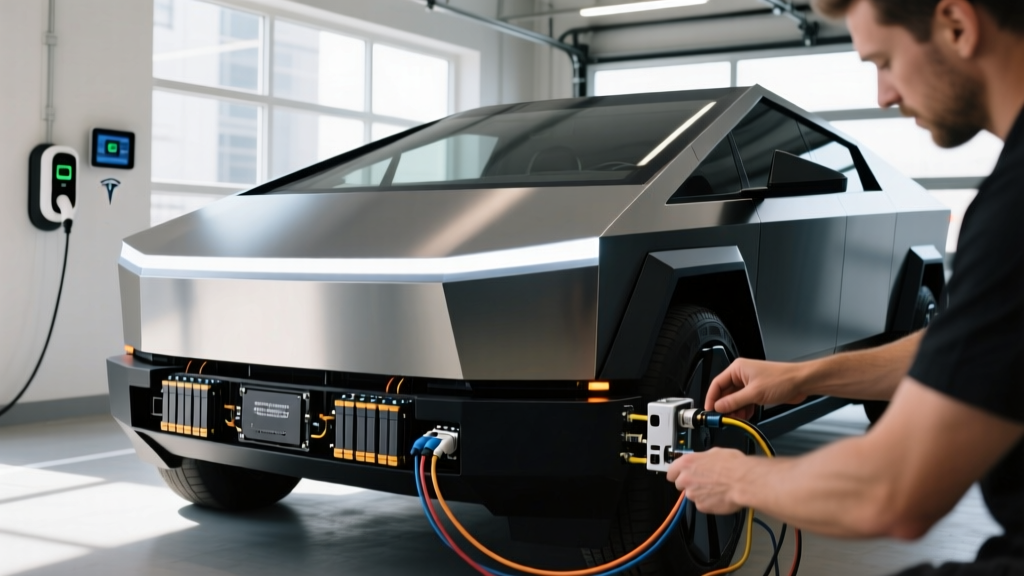
Tesla's structural battery pack is integrated into the vehicle's exoskeleton. The 123 kWh pack uses 4680-format NMC cells arranged in a structural tray that contributes to the truck's torsional rigidity. Here's why aftermarket range extension is a dead end:
- Warranty void: Any modification to the high-voltage system immediately voids Tesla's 8-year/120,000-mile battery and drive unit warranty. That's up to $20,000+ in replacement coverage you're throwing away.
- BMS incompatibility: Tesla's Battery Management System is calibrated for the specific cell count, thermal profile, and voltage window of the factory pack. Adding cells in parallel or series would confuse the BMS, potentially triggering fault codes or shutdowns.
- Safety risk: NMC cells require precise thermal management. An improperly integrated auxiliary pack is a fire hazard — especially in a vehicle that sees off-road vibration and temperature swings.
- No legal pathway: There is no CARB or EPA certification process for aftermarket EV battery additions. Your vehicle would technically be non-compliant for registration in California and states that follow CARB rules.
Tesla did announce a Range Extender option for the Cybertruck — an auxiliary battery pack that fits in the bed, adding an estimated 130+ miles. However, as of early 2026, this remains unreleased and Tesla has not confirmed availability or pricing. If and when it ships, it will be a factory-integrated, warranty-covered solution.
Charging Levels Explained: How Fast Can You Replenish That 123 kWh Pack?
The most effective "range extender" you can install isn't on the truck — it's in your garage. Understanding charging speeds is critical when you're dealing with a battery this large.
Key distinction: kW (kilowatts) measures power — the rate of energy delivery. kWh (kilowatt-hours) measures energy — the total capacity of your battery. Think of kW as the width of a hose and kWh as the size of the bucket.
| Level | Voltage | Power (kW) | Miles Added/Hour | 10–80% Time (123 kWh) | Typical Use |
|---|---|---|---|---|---|
| Level 1 | 120V | 1.0–1.4 kW | ~3–5 mi/hr | ~65+ hours | Emergency/top-up only |
| Level 2 | 240V | 7.2–19.2 kW | ~22–58 mi/hr | ~5–12 hours | Daily home/workplace charging |
| DC Fast (V3 Supercharger) | 400V DC | Up to 250 kW | ~750+ mi/hr (peak) | ~30–35 min | Road trips |
| DC Fast (V4 Supercharger) | 800V DC | Up to 350 kW | ~1,000+ mi/hr (peak) | ~20–25 min (est.) | Next-gen road trips |
Home Charger Installation: Costs, Electrical Requirements, and Panel Upgrades
For a 123 kWh battery, Level 1 charging is effectively useless — it would take nearly three full days to charge from 10–80%. A proper Level 2 home setup is essential. Here's what that involves:
Electrical Requirements for Cybertruck Home Charging
The Cybertruck accepts up to 17.2 kW on Level 2 AC charging (using its onboard charger). To get close to that maximum, you need a 240V circuit rated at 80 amps (a 100A breaker, since NEC requires circuits to be loaded to no more than 80% of breaker rating for continuous loads). However, most homeowners install a 60A circuit / 48A charger, which delivers ~11.5 kW and adds roughly 35 miles per hour — sufficient for overnight replenishment.
| Component | Basic Install (48A/60A circuit) | Full-Power Install (80A/100A circuit) | Notes |
|---|---|---|---|
| Level 2 Charger (hardwired) | $400–$700 | $500–$800 | Tesla Wall Connector, ChargePoint, Emporia |
| Electrical Permit | $50–$250 | $100–$350 | Varies by municipality |
| Electrician Labor (standard) | $500–$1,500 | $800–$2,500 | Depends on panel-to-garage distance |
| Panel Upgrade (if needed) | N/A (200A panel usually sufficient) | $1,500–$4,000 | Required if you have a 100A or 150A main panel |
| Conduit/Wiring Materials | $100–$400 | $200–$600 | Longer runs = higher cost |
| Total Estimated Cost | $1,050–$2,850 | $3,100–$8,250 | Before any utility rebates |
Do You Need a Panel Upgrade?
This is the make-or-break cost variable. Most modern homes built after 2000 have a 200-amp main service panel, which can typically support a 60A EV circuit alongside existing loads. But if your home has a 100A or 150A panel — common in older construction — adding a high-amperage EV circuit may require a panel upgrade to 200A or even 400A. This alone can cost $1,500–$4,000+.
Pro tip: Ask your electrician to perform a load calculation (NEC Article 220) before committing. Some utility companies offer free or discounted load assessments. If you're close to capacity, a smart panel or load-management device (like the Emporia VUE with automatic load shedding) can let you add an EV circuit without a full panel upgrade.
Connector Compatibility: NACS, CCS, and the Adapter Question
The Cybertruck uses the NACS (North American Charging Standard) connector — Tesla's proprietary plug that has become the de facto industry standard. Here's how connector compatibility breaks down across the charging ecosystem:
| Connector Type | Used By | Cybertruck Compatible? | Adapter Needed? |
|---|---|---|---|
| NACS (Tesla) | Tesla (all models), Ford, GM, Rivian, Volvo, others (2025+) | Yes — native | No |
| CCS1 | Hyundai, Kia, VW, BMW, legacy non-Tesla EVs | Yes | Tesla CCS Adapter (included with Cybertruck) |
| CHAdeMO | Nissan Leaf, Mitsubishi (legacy) | Technically, with third-party adapter | Yes — $200–$400 aftermarket |
| J1772 (Level 2 AC) | All non-Tesla EVs for AC charging | Yes | Tesla J1772 Adapter (included) |
For home Level 2 charging, the Tesla Wall Connector uses a native NACS plug — no adapter required. If you install a third-party charger with a J1772 plug (like many ChargePoint or Emporia units), you'll use the J1772 adapter that ships with the Cybertruck. This is seamless but adds a step each time you plug in.
Recommended Home Chargers for the Cybertruck
Given the Cybertruck's 17.2 kW onboard AC charging capability, here are chargers that maximize your home setup:
Tesla Wall Connector (Gen 4)
- Power: Up to 19.2 kW (80A circuit)
- Connector: Native NACS
- Cable Length: 24 ft
- Smart Features: Wi-Fi, OTA updates, Power Sharing (link multiple units), Tesla app integration
- Price: ~$475
- Verdict: Best overall for Cybertruck — native plug, full power, seamless app control
Emporia Level 2 EV Charger
- Power: Up to 11.5 kW (48A / 60A circuit) or 19.2 kW (80A model)
- Connector: J1772 (use Tesla adapter) or NACS version available
- Cable Length: 24 ft
- Smart Features: Energy monitoring via Emporia VUE, solar integration, scheduling, load management
- Price: ~$400–$600
- Verdict: Best for solar owners and energy-tracking enthusiasts
ChargePoint Home Flex (NACS)
- Power: Up to 12 kW (50A circuit) — does not reach Cybertruck max
- Connector: NACS (2025+ model) or J1772
- Cable Length: 23 ft
- Smart Features: Alexa integration, scheduling, ChargePoint network account, energy reports
- Price: ~$550–$700
- Verdict: Solid choice if you use ChargePoint public network and want unified app
Grizzl-E Smart (United Chargers)
- Power: Up to 11.5 kW (48A) — adjustable down for weaker panels
- Connector: J1772 or NACS (2025+)
- Cable Length: 24 ft
- Smart Features: OCPP-compatible, works with multiple apps, adjustable amperage, outdoor-rated (NEMA 4)
- Price: ~$450–$550
- Verdict: Best budget pick — rugged, adjustable, and Canadian-built
Cost to Charge: Home vs. Public vs. Gas — Real $/Mile Numbers
One of the most compelling arguments against chasing a DIY range extender is that your existing battery is already cheap to fill — if you charge smart. Here's a breakdown using the Cybertruck's ~123 kWh usable capacity and an efficiency of approximately 2.0 kWh/mile (real-world highway, per fueleconomy.gov data):
| Charging Scenario | Rate ($/kWh) | Cost for Full Charge (123 kWh) | Cost Per Mile (340 mi range) | Annual Cost (12,000 mi) |
|---|---|---|---|---|
| Home — Off-Peak TOU | $0.08–$0.12 | $9.84–$14.76 | $0.03–$0.04 | $360–$480 |
| Home — Standard Rate | $0.14–$0.18 | $17.22–$22.14 | $0.05–$0.07 | $600–$840 |
| Tesla Supercharger (avg.) | $0.28–$0.36 | $34.44–$44.28 | $0.10–$0.13 | $1,200–$1,560 |
| Electrify America / Third-Party DC | $0.35–$0.50 | $43.05–$61.50 | $0.13–$0.18 | $1,560–$2,160 |
| Gas Truck (F-150 4WD, 18 MPG avg.) | $3.40/gal | — | $0.19 | $2,267 |
Even at public DC fast-charging rates, the Cybertruck costs less per mile than a comparable gas truck. At home off-peak rates, you're spending roughly one-fifth what a gas truck owner spends per mile. That's the real "range extender" — making every mile cheaper, not adding more expensive ones.
Battery Care Strategies That Actually Preserve Your Range
Rather than trying to add capacity, focus on preserving the 123 kWh you have. NMC batteries degrade based on heat, charge extremes, and cycle count. Here's how to maximize long-term range retention:
- Daily charge limit: 80%. Tesla recommends this for NMC packs. Charging to 100% daily accelerates degradation. Reserve 100% for road trips.
- Avoid frequent DC fast charging. Occasional Supercharging is fine, but daily high-power DC sessions increase cell wear. Home Level 2 is gentler.
- Precondition before fast charging. The Cybertruck's navigation will automatically precondition the battery when you route to a Supercharger. If you're manually initiating a charge, precondition via the app for 15–20 minutes to bring the pack to optimal temperature — this can shave 5–10 minutes off your 10–80% time.
- Don't let SoC sit at extremes. Avoid leaving the truck parked at 100% or below 10% for extended periods (days). If storing, set to 50%.
- Monitor State of Health (SoH). The Cybertruck's service menu displays estimated battery degradation. Most NMC packs lose 5–10% capacity over the first 100,000 miles, then plateau. Tesla's warranty guarantees 70% retention at 8 years / 120,000 miles.
Safety and Electrical Code: What Your Installation Must Include
Whether you hire an electrician or are considering a DIY charger install (the charger unit itself, not a battery modification), these code and safety requirements are non-negotiable:
- Dedicated circuit: Your Level 2 charger must be on its own dedicated breaker — not shared with other appliances. A 60A charger needs a 60A (or larger) breaker with no other loads on that circuit.
- GFCI protection: NEC 2020 and later requires GFCI protection for EV charging outlets (not hardwired units in some jurisdictions). Hardwired installations often bypass this requirement, which is one reason electricians prefer hardwiring.
- Outdoor rating: If your charger is mounted outdoors or in an unconditioned garage, it must carry a NEMA 4 or NEMA 4X rating for weather resistance. All recommended chargers above meet this standard.
- Wire gauge: A 60A circuit requires minimum 6 AWG copper wire (THHN in conduit) or 4 AWG NM-B cable. An 80A circuit requires 4 AWG copper or 3 AWG aluminum. Your electrician will calculate based on run length and voltage drop.
- Permit and inspection: Every jurisdiction requires an electrical permit for new EV circuits. The work must be inspected and signed off. Skipping this risks insurance denial in the event of an electrical fire. Per NECA guidelines, unpermitted electrical work is a leading cause of residential fire claims being denied.
Frequently Asked Questions
How much does it cost to install a home EV charger for a Cybertruck?
A standard 48A/60A Level 2 installation typically costs $1,050–$2,850 including equipment, labor, and permit. If you want the Cybertruck's full 17.2 kW AC rate (80A circuit), expect $3,100–$8,250, especially if a panel upgrade is needed. Utility rebates can offset $200–$1,000 depending on your provider.
How fast will each charging level add range to my Cybertruck?
Level 1 (120V) adds roughly 3–5 miles per hour — impractical for a 123 kWh pack. Level 2 at 48A adds ~35 miles per hour, replenishing a full charge overnight in 8–10 hours. DC fast charging at 250 kW can add 170+ miles in 15 minutes at peak rate, though the 10–80% session takes ~30–35 minutes due to charge-curve taper.
Which connector is compatible with the Cybertruck?
The Cybertruck natively uses NACS (Tesla's connector) for both AC and DC charging. It also ships with a CCS1 adapter for non-Tesla DC fast chargers and a J1772 adapter for non-Tesla Level 2 stations. CHAdeMO compatibility requires an expensive third-party adapter and is increasingly irrelevant as networks transition to NACS/CCS.
How much does charging cost per mile vs. gas?
At home off-peak rates ($0.08–$0.12/kWh), the Cybertruck costs $0.03–$0.04 per mile. A comparable gas truck (F-150 at 18 MPG) costs ~$0.19/mile at $3.40/gallon. Even on public Superchargers ($0.28–$0.36/kWh), the Cybertruck runs $0.10–$0.13 per mile — still 30–50% cheaper than gas.
What electrical upgrades might I need for a Cybertruck charger?
If your home has a 200A main panel, you likely need only a new dedicated breaker and wiring run. Homes with 100A or 150A panels may require a panel upgrade ($1,500–$4,000) to safely support a 60A or 80A EV circuit. A load-management device can sometimes avoid a full upgrade by dynamically limiting charger draw when other household loads are high.
Is Tesla's official Cybertruck Range Extender available?
As of early 2026, Tesla has not released the auxiliary battery range extender that was announced alongside the Cybertruck. It was projected to add 130+ miles of range by occupying a portion of the bed. No pricing, availability date, or installation details have been confirmed. Monitor Tesla's Cybertruck page for updates.
Bottom line: There is no viable DIY battery range extender for the Cybertruck. The real path to maximizing your range is a proper Level 2 home charging setup, disciplined battery management (80% daily limit, preconditioning, avoiding DC fast-charge dependency), and understanding that the EPA sticker assumes conditions you'll rarely match perfectly. Invest the $1,000–$3,000 you'd spend chasing aftermarket hacks into a quality home charger installation instead — and enjoy the cheapest cost-per-mile in the full-size truck segment.