The Shift Toward Autonomous Detached Power Hubs
For decades, the detached garage was merely a storage space or a workshop, typically wired for a few 15-amp lighting circuits and perhaps a single 20-amp outlet for power tools. Today, the rapid adoption of electric vehicles (EVs) is fundamentally transforming these outbuildings into high-capacity energy hubs. However, installing a Level 2 EV charger in a detached garage presents unique infrastructure challenges—primarily the distance from the main home's electrical panel and the need for underground trenching. As we look toward the future of residential EV infrastructure, the industry is moving away from simple underground wire runs and toward localized microgrids, bi-directional power flow, and AI-driven load management. According to the U.S. Department of Energy, optimizing home charging infrastructure is critical for grid stability, and detached structures are at the forefront of this decentralized energy revolution.
Trenching and Conduit: Future-Proofing the Underground Run
The most daunting aspect of a detached garage EV charger installation is bridging the gap between the main house and the outbuilding. Traditionally, this involved renting a trencher, digging a 24-inch deep trench, laying Schedule 40 PVC, and pulling copper wire. The future of underground electrical runs is far less invasive and significantly more robust.
Horizontal Directional Drilling (HDD)
Landscaping destruction is a major deterrent for homeowners. The industry is increasingly adopting Horizontal Directional Drilling (HDD) for residential EV runs. Originally used for commercial fiber-optic and municipal water installations, mini-HDD rigs can now bore a narrow, 2-inch pathway beneath driveways, patios, and pristine lawns without disturbing the surface. While HDD adds roughly $15 to $25 per linear foot to the installation cost compared to traditional trenching, it preserves hardscaping that would otherwise cost thousands to repair.
Smart Conduit and Oversized Pathways
Future-proofing the physical pathway is just as important as the wire inside it. Electricians are now recommending a minimum of 1.5-inch to 2-inch Schedule 80 PVC conduit, even if the current EV charger only requires a 60-amp circuit (which typically uses 6 AWG or 4 AWG copper wire). By installing oversized conduit and a pull-string, homeowners can easily upgrade to 100-amp or 150-amp circuits in the future to support dual-charger setups or heavy-duty electric trucks like the Chevrolet Silverado EV without re-digging the yard. Furthermore, emerging smart conduit technologies feature integrated moisture and fault-detection sensors that alert homeowners via smartphone apps if underground water intrusion threatens the electrical run.
Solar Canopies and Localized Battery Storage
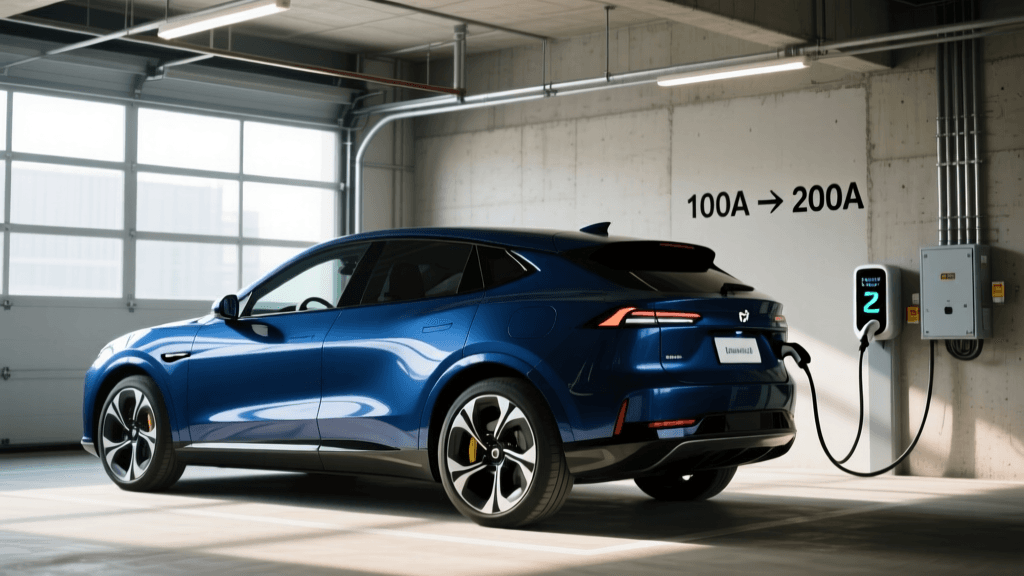
Running a 100-amp subpanel to a detached garage often requires a costly main house electrical service upgrade (from 200A to 320A), which can cost upwards of $4,000. The future trend circumvents the main grid entirely by turning the detached garage into an autonomous power island.
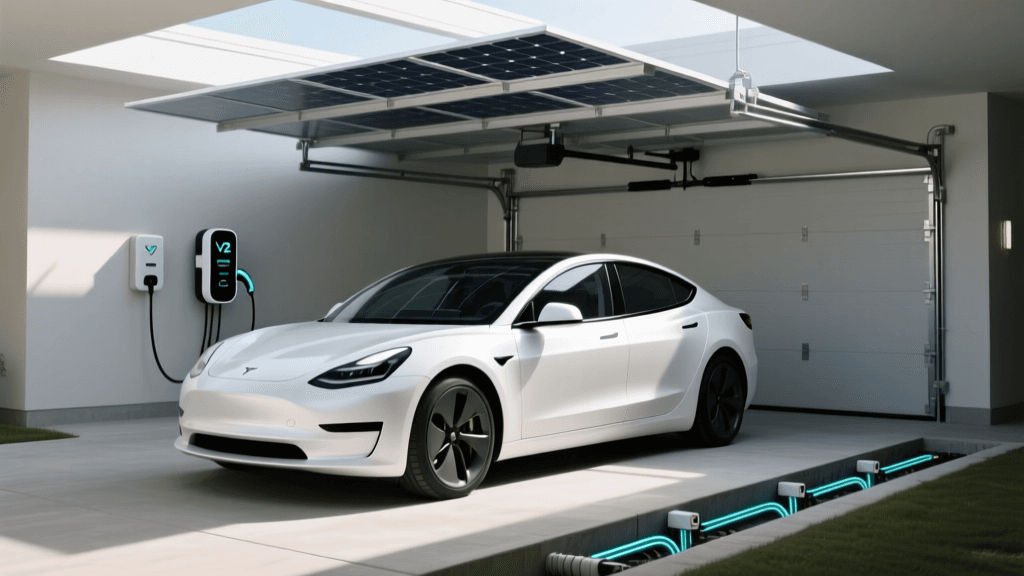
Solar carports and integrated canopy roofs are replacing traditional asphalt shingles on detached garages. By pairing a 5kW to 8kW solar array with a localized battery system like the Tesla Powerwall 3 or Generac PWRcell, the detached garage generates, stores, and dispenses its own EV charging power. The Solar Energy Industries Association (SEIA) notes that solar-plus-storage deployments are accelerating, particularly in outbuildings where running heavy-gauge wire from the main house is cost-prohibitive. Enphase Energy's IQ microinverters and bidirectional IQ System Controllers now allow these detached setups to operate in "island mode," providing off-grid EV charging even during neighborhood blackouts.
Vehicle-to-Grid (V2G) and the Garage as a Power Plant
Perhaps the most disruptive future trend for detached garages is Vehicle-to-Grid (V2G) and Vehicle-to-Home (V2H) technology. Modern EVs possess massive battery capacities—ranging from 75 kWh to over 130 kWh. Instead of merely drawing power, the EV parked in the detached garage can act as a backup generator for the main house.
According to research by the National Renewable Energy Laboratory (NREL), Vehicle-Grid Integration (VGI) will be a cornerstone of future residential energy resilience. To achieve this, the detached garage must be wired with a bi-directional charging hub and an Automatic Transfer Switch (ATS). Vehicles like the Ford F-150 Lightning and Hyundai Ioniq 5 are already capable of bi-directional charging. By installing a smart subpanel in the detached garage, the EV can automatically route stored battery power back through the underground conduit to the main home's critical circuits during a grid failure. This transforms the detached garage EV installation from a mere convenience into a vital home resilience asset.
Comparison Chart: 2024 Detached Garage Installation Strategies
| Installation Strategy | Estimated Cost (2024) | Grid Reliance | Future-Proof Rating |
|---|---|---|---|
| Standard 60A Hardwired Trench (PVC & Copper) | $2,500 - $4,500 | High | Moderate |
| Oversized Conduit w/ HDD Boring & Fiber-Optic Leak Detection | $4,000 - $6,500 | High | High |
| Solar Canopy + Enphase Battery Storage (Island Capable) | $18,000 - $28,000 | Low (Net-Zero) | Excellent |
| Bi-Directional V2H Hub (SPAN Panel + ATS) | $8,000 - $14,000 | Grid-Supportive / Backup | Superior |
Smart Panels and AI Load Management
When wiring a detached garage, the physical wire is only half the equation; the distribution panel is the brain. The future belongs to smart electrical panels like the SPAN Drive+ or Schneider Electric Wiser Energy systems. These panels replace traditional breaker boxes with AI-driven, circuit-level load management.
If a homeowner is charging an EV in the detached garage while simultaneously running the central AC, the electric oven, and the pool heater, a smart panel can dynamically throttle the EV charger's amperage to prevent tripping the main breaker. This AI load shedding eliminates the need for expensive main service upgrades. Furthermore, these smart panels integrate seamlessly with solar inverters and home batteries, allowing homeowners to set rules via a smartphone app—such as "only charge the EV using excess solar generation" or "discharge the EV battery to the main house if grid prices exceed $0.30/kWh."
Cost Projections and ROI for the Next Decade
While the upfront costs of advanced detached garage installations are higher than basic trenching, the return on investment (ROI) is shifting from simple convenience to energy arbitrage and home protection. A standard 60-amp underground run will always be the baseline, but as Time-of-Use (TOU) electricity rates become more aggressive, the ability to store cheap, off-peak solar power in a detached garage battery—and use it to charge an EV or power the home during peak hours—will yield massive savings.
Moreover, homes equipped with V2H-ready detached garages and solar canopies are seeing a premium in real estate valuations. Buyers are increasingly looking for turnkey EV infrastructure and climate-resilient backup power. Investing in oversized conduit, smart panels, and bi-directional readiness today ensures that the detached garage is not just a place to park, but a cornerstone of the modern, electrified smart home.
Conclusion
Installing an EV charger in a detached garage is no longer just about digging a ditch and pulling copper wire. The future of outbuilding electrification lies in autonomous microgrids, non-invasive directional boring, and bi-directional power flows that turn your vehicle into a home-saving backup generator. By planning for oversized conduit, integrating smart load-management panels, and considering localized solar storage, homeowners can future-proof their detached garages against the rapidly evolving landscape of electric mobility and decentralized energy.