Buying an electric vehicle is only half the equation. The other half — where, how fast, and how cheaply you charge — determines whether EV ownership feels effortless or frustrating. If you've been searching for a dc charger for electric vehicle use, you've likely encountered a maze of acronyms: kW, kWh, NACS, CCS1, Level 2, DC fast charging. This guide cuts through the confusion with exact numbers, real-world costs, and the installation realities that manufacturers rarely mention.
We'll cover every charging tier, what electrical work your home actually needs, which plug fits your car, what you'll pay per mile compared to gas, and which chargers are worth your money in 2026.
Charging Levels Explained: Level 1, Level 2, and DC Fast Charging
Before comparing equipment, you need to understand the three charging tiers. The critical distinction: kW (kilowatts) measures power — how fast energy flows into your car. kWh (kilowatt-hours) measures energy — the total capacity of your battery. A 75 kWh battery charged at 7 kW takes roughly 10 hours from empty; at 150 kW, it takes under 30 minutes to 80%.
| Level | Voltage | Max Power (kW) | Miles of Range per Hour | Typical Use Case |
|---|---|---|---|---|
| Level 1 | 120V AC | 1.0–1.4 kW | 3–5 mi/hr | Overnight trickle; emergency top-up |
| Level 2 | 240V AC | 3.3–19.2 kW | 14–75 mi/hr | Daily home & workplace charging |
| DC Fast (DCFC) | 400–900V DC | 50–350 kW | 150–1,200+ mi/hr (peak) | Road trips & rapid top-ups |
Level 1 uses a standard household 120V outlet. It's fine for plug-in hybrids with small batteries (10–20 kWh) or EV owners who drive under 30 miles daily. But a 75 kWh battery would take 50+ hours from empty — impractical for most BEV owners.
Level 2 is the backbone of home charging. Running on 240V (like an electric dryer), it delivers 7–11 kW from a typical 40–48 amp circuit, adding 25–40 miles of range per hour. Most EV owners charge overnight on Level 2 and wake up with a full battery.
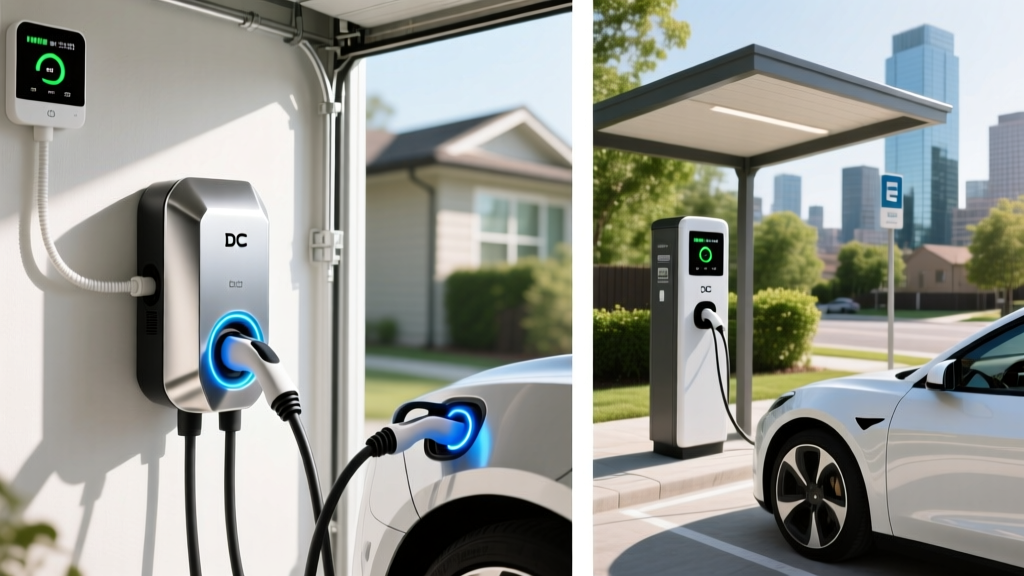
DC Fast Charging (DCFC) bypasses the car's onboard charger entirely, feeding DC current directly into the battery at much higher power. This is what you find at Tesla Superchargers, Electrify America, and EVgo stations. A dc charger for electric vehicle use at public stations can add 150–250 miles in 15–25 minutes, depending on the vehicle's peak acceptance rate and battery state of charge.
Real-World Charging Note: Peak DC fast-charge rates (e.g., 250 kW) are sustained only between roughly 10–40% state of charge. Above 80%, the charge curve tapers sharply to protect the battery. A "10–80% in 18 minutes" claim assumes battery preconditioning and optimal temperatures — expect 25–35 minutes in cold weather or without preconditioning.
Home Charger Installation: Electrical Requirements, Costs, and Panel Upgrades
A Level 2 home charger is the single biggest quality-of-life upgrade for EV ownership. But installation costs vary dramatically depending on your home's electrical infrastructure. Here's what determines the final bill:
Core electrical requirements: A typical 48-amp Level 2 charger requires a dedicated 60-amp, 240V circuit (the National Electrical Code requires circuits rated at 125% of continuous load — so 48A continuous draw needs a 60A breaker). Smaller 32-amp chargers need a 40-amp circuit.
Key variables affecting cost:
- Distance from panel to charger location: Every foot of 6-gauge copper wire adds $8–$15 in materials and labor. A charger mounted 10 feet from the panel costs far less than one 80 feet away in a detached garage.
- Panel capacity: Most homes need a 200-amp main panel to support a 60-amp EV circuit alongside existing loads (HVAC, electric range, dryer). Older homes with 100-amp panels often need a panel upgrade — this is the budget-killer many guides omit.
- Permitting: Most jurisdictions require an electrical permit ($50–$300) and a final inspection. Skipping this voids insurance coverage for electrical fires.
- Conduit and trenching: If running wire to a detached garage or through a concrete slab, trenching and conduit add $500–$2,000+.
| Component | Simple Install (Same wall as panel) | Moderate Install (20–50 ft run) | Complex Install (Panel upgrade + long run) |
|---|---|---|---|
| Level 2 Charger Equipment | $350–$700 | $350–$700 | $350–$700 |
| Electrician Labor | $300–$600 | $600–$1,500 | $1,500–$3,000 |
| Electrical Permit | $50–$150 | $50–$200 | $100–$300 |
| Panel Upgrade (if needed) | — | — | $1,500–$4,000 |
| Conduit / Trenching | $0–$100 | $100–$500 | $500–$2,000 |
| Total Estimated Range | $700–$1,550 | $1,100–$2,900 | $3,950–$10,000 |
Pro tip: Before committing to a charger, hire an electrician for a panel-load calculation ($100–$200, often credited toward installation). This determines whether your existing panel can handle the additional load or whether you need an upgrade. Some utilities offer rebates of $250–$1,000 that offset panel upgrades when paired with EV charger installation.
Safety and Code Considerations
Your installation must meet NEC (National Electrical Code) requirements and local amendments:
- Dedicated circuit: Your EV charger must have its own breaker — no sharing with other appliances.
- GFCI protection: NEC 2020 and later require GFCI (Ground Fault Circuit Interrupter) protection for all 240V EV charging outlets. Hardwired chargers with built-in ground-fault protection may satisfy this requirement without a GFCI breaker.
- Outdoor rating: If installing outside, the charger must carry a NEMA 4 (weatherproof) rating. Look for UL or ETL listing — these indicate third-party safety certification.
- Hardwired vs. plug-in: A NEMA 14-50 outlet gives you flexibility to unplug and move the charger, but hardwired installations avoid the GFCI breaker requirement in some jurisdictions and eliminate a potential failure point.
Connector Compatibility: NACS, CCS1, and CHAdeMO
The EV industry has undergone a massive connector consolidation. As of 2026, here's where things stand:
| Connector | Brands Using It | DC Fast-Charge Availability |
|---|---|---|
| NACS (Tesla / J3400) | Tesla, Ford, GM, Rivian, Volvo, Polestar, Nissan (2025+), Honda (2026+), Fisker, Lucid | Tesla Supercharger network (20,000+ US stalls), plus growing third-party networks |
| CCS1 | Hyundai, Kia, BMW, Volkswagen, Audi, Porsche, Mercedes-Benz, Stellantis, Subaru | Electrify America, EVgo, ChargePoint, Ionity (Europe) |
| CHAdeMO | Nissan Leaf (pre-2025), Mitsubishi Outlander PHEV (legacy) | Declining — most networks prioritize CCS/NACS |
Adapter situation: If you drive a CCS1-equipped EV, adapters to access Tesla Superchargers (now open to non-Tesla vehicles via the "Open Supercharger" program) are available from Tesla ($199) and third parties. Ford and GM owners with native NACS ports can access the full Supercharger network directly. CHAdeMO owners face the most limited public-charging future — plan accordingly if buying used.
For home Level 2 charging, virtually all chargers use a J1772 connector (or NACS for newer Teslas and adopters). If you buy a J1772 Level 2 charger and later switch to a NACS-equipped vehicle, a J1772-to-NACS adapter (~$99–$150) solves the problem. The reverse also works: Tesla's Mobile Connector and Wall Connector now ship with J1772 adapters.
Charging Cost per Mile: EV vs. Gas in 2026
Charging cost is where EV ownership delivers its most tangible savings — but the numbers depend heavily on where and when you charge.
| Scenario | Rate | EV Efficiency | Cost per Mile |
|---|---|---|---|
| Home charging (off-peak, national avg.) | $0.13/kWh | 3.0 mi/kWh (avg EV) | $0.043 |
| Home charging (peak / high-cost state like CA) | $0.30/kWh | 3.0 mi/kWh | $0.100 |
| Public Level 2 (ChargePoint, EVgo) | $0.25–$0.49/kWh | 3.0 mi/kWh | $0.083–$0.163 |
| DC Fast Charging (public, $0.35–$0.55/kWh) | $0.45/kWh avg | 3.0 mi/kWh | $0.150 |
| Tesla Supercharger (member pricing) | $0.25–$0.35/kWh | 3.0 mi/kWh | $0.083–$0.117 |
| Gasoline car (28 MPG combined, $3.40/gal) | $3.40/gal | 28 mi/gal | $0.121 |
| Gasoline car (22 MPG combined, $3.40/gal) | $3.40/gal | 22 mi/gal | $0.155 |
The takeaway: Home off-peak charging is 3–4× cheaper per mile than gasoline. Even public DC fast charging at $0.45/kWh costs roughly the same as a 28 MPG gas car. The economics break down only if you rely exclusively on premium-priced public fast chargers — a scenario that affects apartment dwellers without home charging more than suburban homeowners.
For a driver covering 12,000 miles per year, home off-peak charging costs roughly $516/year in electricity. A comparable 28 MPG gas car at $3.40/gallon costs $1,457/year in fuel — a $941 annual savings. Over five years, that's $4,700 in fuel savings alone, before factoring in reduced maintenance (no oil changes, less brake wear from regenerative braking).
DC Fast Charging Times: What to Expect for Common Battery Sizes
Charging time depends on battery capacity (kWh), the charger's peak power output (kW), and the vehicle's charge curve. Here are realistic 10–80% estimates for popular 2026 EVs with battery preconditioning active:
| Vehicle | Battery (kWh usable) | Peak DC Rate (kW) | 10–80% Time |
|---|---|---|---|
| Tesla Model Y Long Range | 75 kWh | 250 kW | ~22 min |
| Hyundai Ioniq 5 (84 kWh pack) | 77.4 kWh | 240 kW (800V) | ~18 min |
| Ford F-150 Lightning Extended Range | 131 kWh | 150 kW | ~41 min |
| Chevrolet Equinox EV | 85 kWh | 150 kW | ~30 min |
| Kia EV6 GT-Line (84 kWh pack) | 77.4 kWh | 240 kW (800V) | ~18 min |
| BMW iX xDrive50 | 105.2 kWh | 200 kW | ~34 min |
| Nissan Ariya (91 kWh pack) | 87 kWh | 130 kW | ~38 min |
Why these numbers matter: The Hyundai Ioniq 5's 800-volt architecture allows sustained high-power charging that 400V vehicles can't match. A 150 kW peak rate sounds impressive on paper, but sustained delivery across the 10–80% window determines actual wait time. Vehicles with 800V systems (Ioniq 5, EV6, Porsche Taycan, Audi e-tron GT) consistently beat their 400V competitors by 5–10 minutes in real-world fast-charge sessions.
Source: EPA efficiency data from fueleconomy.gov; manufacturer-confirmed charge rates from respective press sites.
Recommended Home EV Chargers for 2026
These are the chargers we recommend based on power output, reliability, smart features, cable length, and value. All are UL-listed and support either J1772 or NACS connectors.
Best Overall: ChargePoint Home Flex
- Power Output: Up to 11.5 kW (48A) on a 60A circuit; configurable down to 16A for smaller panels
- Connector: J1772 (NACS adapter included for 2026 models)
- Cable Length: 23 feet
- Smart Features: Wi-Fi, app scheduling, energy tracking, Alexa integration, over-the-air updates
- Price: ~$599 (before incentives)
- Best For: Most homeowners wanting a reliable, flexible smart charger
Best for Tesla / NACS Owners: Tesla Wall Connector
- Power Output: Up to 11.5 kW (48A) on a 60A circuit
- Connector: Native NACS (J1772 adapter available)
- Cable Length: 24 feet
- Smart Features: Wi-Fi, power-sharing with a second Wall Connector (ideal for two-EV households), automatic software updates
- Price: ~$475
- Best For: Tesla owners and drivers of NACS-equipped Ford, GM, Rivian, or Volvo vehicles
Best Budget Option: Emporia Level 2 EV Charger
- Power Output: Up to 11.5 kW (48A)
- Connector: J1772
- Cable Length: 24 feet
- Smart Features: Wi-Fi, app-based scheduling, solar integration with Emporia energy monitors, real-time cost tracking
- Price: ~$399
- Best For: Budget-conscious buyers who still want smart features and solar optimization
Best Premium / High-Power: Grizzl-E Smart
- Power Output: Up to 10 kW (40A) on a 50A circuit
- Connector: J1772 or NACS
- Cable Length: 24 feet
- Smart Features: OCPP-compatible (works with utility demand-response programs), adjustable amperage, extreme cold-weather rating (-40°F)
- Price: ~$549
- Best For: Cold-climate owners and those participating in utility EV programs
Federal incentive note: The IRS §30D alternative fuel vehicle refueling property credit covers 30% of home charger equipment and installation costs, up to $1,000, for installations in eligible census tracts. Check current eligibility at irs.gov — census-tract qualification excludes many suburban areas, and the credit is non-refundable.
Public DC Fast Charging: Networks, Reliability, and What to Know
When you can't charge at home, public DC fast chargers fill the gap. Here's the current landscape:
Tesla Supercharger Network: The gold standard for reliability. Over 20,000 US stalls, 98%+ uptime, seamless plug-and-charge billing. Now open to non-Tesla NACS-equipped vehicles (Ford, GM, Rivian, and others). CCS vehicles can access select Superchargers via a Tesla-provided adapter, though stall availability for non-Teslas remains limited at many locations.
Electrify America: The largest non-Tesla DC fast-charging network, with 4,000+ stalls. Supports CCS1 at up to 350 kW. Reliability has improved since 2024 but still trails Tesla — expect 85–92% uptime. Pricing averages $0.35–$0.55/kWh depending on location and subscription tier.
EVgo: 3,500+ public fast-charging stalls, primarily in urban areas. Offers both CCS1 and NACS connectors at newer stations. Pricing typically $0.30–$0.48/kWh. Partners with GM and Amazon for new station buildouts.
ChargePoint: Primarily Level 2, but expanding DC fast-charging presence. Best for workplace and retail charging. App shows real-time availability and pricing.
According to NHTSA and industry data, public charging infrastructure continues expanding rapidly, with over 200,000 public charging ports (all levels) operational across the US as of early 2026. The biggest complaint remains reliability, not availability — always have a backup charging option mapped for road trips.
Frequently Asked Questions
How much does it cost to install a home EV charger?
A straightforward Level 2 installation (charger mounted near the electrical panel, no panel upgrade) typically costs $700–$1,550 including equipment, labor, and permit. A moderate run of 20–50 feet costs $1,100–$2,900. If your home needs a 200-amp panel upgrade, expect $3,950–$10,000 total. Always get a panel-load calculation first.
How fast will each charging level add range?
Level 1 (120V) adds 3–5 miles per hour. Level 2 (240V, 48A) adds 25–40 miles per hour depending on vehicle efficiency. DC fast charging adds 150–1,200+ miles per hour at peak rates, but this rate tapers significantly above 80% state of charge — expect a realistic 10–80% fill in 18–40 minutes depending on the vehicle.
Which connector/charger is compatible with my EV?
Check the fueleconomy.gov listing for your specific model year. As of 2026: Tesla, Ford, GM, Rivian, Volvo, Polestar, Honda, and Nissan (new models) use NACS. Hyundai, Kia, BMW, Volkswagen, Porsche, and Mercedes-Benz use CCS1. For home Level 2, most J1772 chargers work with all vehicles via adapters.
How much does charging cost per mile vs gas?
Home off-peak charging at $0.13/kWh costs about $0.043/mile — roughly one-third the cost of a 28 MPG gas car at $3.40/gallon ($0.121/mile). Even public DC fast charging at $0.45/kWh ($0.150/mile) is comparable to or cheaper than most gas vehicles. The savings are largest for high-mileage drivers charging primarily at home.
What electrical upgrades might I need?
Homes with a 100-amp main panel almost certainly need an upgrade to 200 amps ($1,500–$4,000) to safely support a 48-amp EV charger alongside HVAC, kitchen appliances, and other loads. Homes with 200-amp panels usually have sufficient capacity, but a load calculation confirms this. Older wiring (pre-1980 aluminum, knob-and-tube) may also require replacement in the circuit path.
Can I install a DC fast charger at home?
Technically, products like the Electrify America HomeFlex and a few commercial-grade DC units exist, but they require 480V three-phase power — something virtually no residential property has. The equipment alone costs $15,000–$40,000, and the electrical service upgrade would add $10,000–$50,000+. For 99.9% of homeowners, a Level 2 charger (11.5 kW) is the practical ceiling and charges overnight for a fraction of the cost.
Do I need a smart charger, or is a basic one fine?
A basic non-smart charger works perfectly for charging. Smart features — app scheduling, utility demand-response enrollment, energy-cost tracking, solar integration — are valuable if your utility offers time-of-use rates or EV-specific rebates. If you charge on a flat-rate plan and don't need scheduling, a simple $300–$400 charger like the Grizzl-E (non-smart version) delivers the same electrons at lower cost.