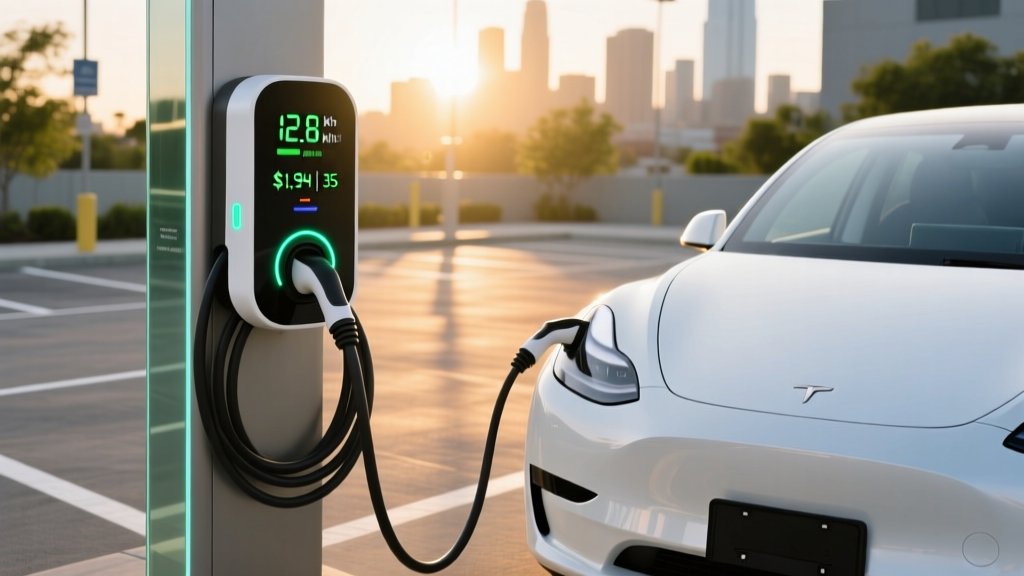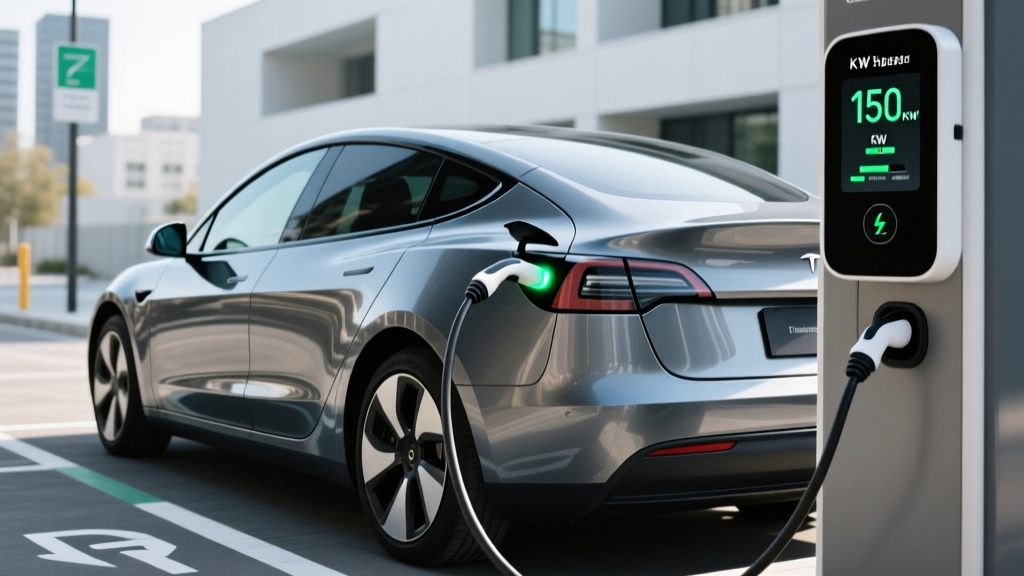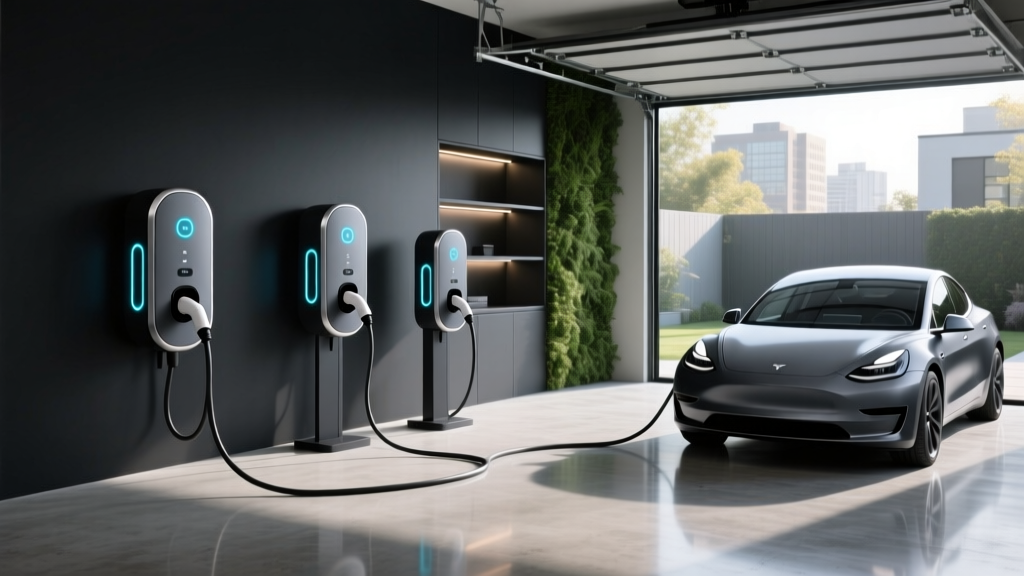
If you've spent months choosing the perfect EV, the last thing you want is a blinding white plastic charging brick bolted to your dark-painted garage wall. A dark gray charger blends into modern interiors, resists visible scuffs, and still delivers the fast Level 2 speeds most EV owners rely on daily. Below, we break down the best dark gray home EV chargers available in 2026, the electrical work required to install one, what each charging level actually delivers in miles per hour, and exactly what you'll pay per mile compared to gas.
Understanding EV Charging Levels: Speeds That Actually Matter
Before picking a charger, you need to understand the three charging tiers and how they translate to real miles added to your battery. The distinction between kW (power — the rate of energy flow) and kWh (energy — your battery's capacity) is the single most important concept in EV ownership. A 48-amp Level 2 charger delivers up to 11.5 kW of power; your 75 kWh battery stores energy. Think of kW as the width of the hose and kWh as the size of the bucket.
| Level | Voltage | Max Power (kW) | Miles of Range Added Per Hour | Typical Use Case |
|---|---|---|---|---|
| Level 1 | 120V AC | 1.4–1.9 kW | 3–5 miles | Overnight trickle, PHEVs, low-mileage drivers |
| Level 2 | 240V AC | 7.2–19.2 kW | 20–60 miles | Daily home charging, the standard for BEVs |
| DC Fast Charge | 400–800V DC | 50–350 kW | 150–1,000+ miles (equivalent rate) | Road trips, 10–80% in 18–40 min |
For most BEV owners driving 30–50 miles daily, a 40-amp (9.6 kW) or 48-amp (11.5 kW) Level 2 home charger fully replenishes overnight use in 2–4 hours. DC fast charging is for road trips, not daily use — frequent 350 kW sessions accelerate battery degradation.
How Much Does a Home EV Charger Installation Really Cost?
The hardware is often the cheapest part. The real variable is your home's electrical panel and the distance from panel to garage. Here's the breakdown based on 2026 national averages from licensed electricians:
| Component | Typical Cost Range | Notes |
|---|---|---|
| Level 2 Charger (hardware) | $350–$700 | Smart Wi-Fi models cost more |
| Electrician labor (standard install) | $500–$1,500 | Short run from panel, same wall |
| Electrical permit | $50–$200 | Varies by municipality |
| Panel upgrade (if needed) | $1,500–$4,000 | 100A to 200A service upgrade |
| Long wire run (50+ ft) | $300–$800 extra | Detached garages cost significantly more |
| Total (no panel upgrade) | $900–$2,400 | Most common scenario |
| Total (with panel upgrade) | $2,400–$6,400 | Older homes with 100A service |
Panel upgrade reality check: Homes built before 2000 frequently have 100-amp electrical panels. Adding a 48-amp EV charger (which requires a 60-amp dedicated circuit per NEC 80% continuous-load rule) may leave insufficient headroom for dryers, ranges, and HVAC. A licensed electrician must perform a load calculation before installation. Don't skip this — it's a fire-safety issue, not a bureaucratic one.
Best Dark Gray Home EV Chargers: 2026 Equipment Picks
Not every manufacturer offers a dark gray or matte-black finish. Here are the top-performing dark gray Level 2 chargers we recommend, with exact specs:
ChargePoint Home Flex (Dark Gray)
- Power Output: Up to 11.5 kW (48A) on a 60A circuit, adjustable down to 16A
- Connector: NACS (Tesla) native; J1772 adapter included for CCS/legacy vehicles
- Cable Length: 23 feet
- Smart Features: Wi-Fi, scheduling, Alexa/Google integration, energy tracking, utility off-peak automation
- Price: ~$549
- Best For: Flexible amperage for homes with limited panel capacity
Wallbox Pulsar Plus (Matte Black/Dark Gray)
- Power Output: Up to 11.5 kW (48A) or 9.6 kW (40A) versions
- Connector: NACS or J1772 configurations available
- Cable Length: 25 feet
- Smart Features: Wi-Fi + Bluetooth, Power Sharing (daisy-chain two units on one circuit), solar integration
- Price: ~$499–$649
- Best For: Two-EV households, solar-panel owners
Tesla Wall Connector (Black/Dark Gray)
- Power Output: Up to 11.5 kW (48A)
- Connector: NACS native; J1772 adapter (~$200) sold separately
- Cable Length: 24 feet
- Smart Features: Wi-Fi, OTA updates, power sharing between multiple Wall Connectors, load management
- Price: ~$450
- Best For: Tesla owners who want native NACS without adapters
Emporia Vue Level 2 Charger (Dark Charcoal)
- Power Output: Up to 11.5 kW (48A)
- Connector: J1772 standard; NACS adapter available
- Cable Length: 24 feet
- Smart Features: Integrates with Emporia whole-home energy monitor, solar-aware charging, time-of-use scheduling
- Price: ~$399
- Best For: Budget-conscious buyers who want whole-home energy visibility
Connector Compatibility: NACS, CCS1, and CHAdeMO Explained
As of 2026, the North American Charging Standard (NACS) — originally Tesla's proprietary connector — has become the dominant plug. Ford, GM, Rivian, Hyundai, Kia, BMW, and most major automakers now ship EVs with native NACS ports. CCS1 (the Combined Charging System) is still found on older models from VW, some Stellantis vehicles, and pre-2025 Hyundai/Kia EVs. CHAdeMO is effectively legacy, surviving only on the Nissan Leaf and a handful of older models.
| Connector | Native Vehicle Brands | Adapter Needed? |
|---|---|---|
| NACS (Tesla) | Tesla, Ford, GM, Rivian, Hyundai, Kia, BMW, Volvo, Polestar, Mercedes-Benz, Lucid, Subaru | No — standard on most 2025+ EVs |
| CCS1 | VW ID.4 (pre-2026), older Stellantis, some 2024 Hyundai/Kia | CCS-to-NACS adapter (~$100–$200) for Tesla Superchargers |
| CHAdeMO | Nissan Leaf (all years), Mitsubishi Outlander PHEV (older) | Limited public DC infrastructure; no viable NACS adapter |
Adapter guidance: If you drive a CCS1-equipped EV and want to use Tesla Superchargers (the largest and most reliable DC fast-charging network), you'll need a CCS-to-NACS adapter. Tesla sells an official adapter, and third-party options from Lectron and A2Z are widely available. For home Level 2 charging, a J1772-to-NACS adapter (~$50–$100) lets any NACS charger work with a CCS vehicle.
Cost to Charge Per Mile: EV vs. Gas in 2026
Charging economics depend entirely on where and when you charge. Here's the real math, using the national average electricity rate of ~$0.17/kWh and a gas price of ~$3.40/gallon:
| Scenario | Rate ($/kWh) | Cost for 75 kWh Battery (0–100%) | Cost Per Mile (at 3.5 mi/kWh) |
|---|---|---|---|
| Home — off-peak utility rate | $0.09–$0.13 | $6.75–$9.75 | $0.026–$0.037 |
| Home — standard residential rate | $0.15–$0.20 | $11.25–$15.00 | $0.043–$0.057 |
| Public Level 2 (ChargePoint, etc.) | $0.25–$0.40 | $18.75–$30.00 | $0.071–$0.114 |
| DC Fast Charge (Electrify America, EVgo) | $0.35–$0.55 | $26.25–$41.25 | $0.10–$0.157 |
| Gas car (28 MPG combined, $3.40/gal) | — | — | $0.121 |
The takeaway: Home charging at off-peak rates costs roughly 3–4 cents per mile — about one-quarter the cost of gas. Even standard home rates beat gas. But exclusive reliance on DC fast charging can actually exceed gas costs per mile. This is why a Level 2 home charger isn't optional for most BEV owners — it's where 80–90% of your charging should happen.
To find your utility's off-peak time-of-use (TOU) rates, check your provider's EV-specific plans. Many utilities in 2026 offer dedicated EV rate schedules with overnight rates as low as $0.07/kWh. According to the U.S. Department of Energy's EV fuel economy data, the average EV costs roughly half as much per mile to fuel as a comparable gas vehicle when charged primarily at home.
Charging Time Examples: Real 10–80% Scenarios
Manufacturers advertise peak kW rates, but charging curves taper significantly above 80% state of charge (SoC) to protect battery health. Here's what 10–80% charging actually looks like for common battery sizes:
| Battery Size | Example Vehicle | Level 2 (11.5 kW) | DC Fast (250 kW peak) | DC Fast (150 kW peak) |
|---|---|---|---|---|
| 60 kWh (usable) | Tesla Model 3 RWD | ~3.5 hours | ~22 min | ~28 min |
| 75 kWh (usable) | Ford Mustang Mach-E ER | ~4.5 hours | ~28 min | ~35 min |
| 84 kWh (usable) | Hyundai Ioniq 5 (800V) | ~5 hours | ~18 min | ~32 min |
| 100 kWh (usable) | Tesla Model S / Rivian R1T | ~6 hours | ~35 min | ~42 min |
Charge-curve reality: A charger rated at 250 kW peak may only sustain that rate between 10–30% SoC. By 60% SoC, many vehicles taper to 100–150 kW; above 80%, speeds drop to 30–50 kW. This is why 10–80% is the standard benchmark — charging from 80–100% can take as long as the 10–80% session. For daily driving, set your charge limit to 80% to preserve battery longevity (especially for NMC chemistry batteries; LFP batteries tolerate 100% daily charging better).
Safety, Electrical Code, and Installation Requirements
Level 2 EV charging is a high-draw, continuous electrical load. The National Electrical Code (NEC) treats it seriously, and so should you:
- Dedicated circuit: Your EV charger must have its own dedicated breaker — no sharing with other appliances. A 48A charger requires a 60A breaker (NEC requires circuits to be rated at 125% of continuous load).
- GFCI protection: NEC 2020 and later require GFCI (Ground Fault Circuit Interrupter) protection for all EV charging outlets. Hardwired units often have built-in GFCI, while plug-in units require a GFCI breaker.
- Outdoor rating: If your charger is mounted outside or in an open carport, it must carry a NEMA 4 (weatherproof) rating. All chargers listed above meet this standard.
- Hardwired vs. plug-in: Hardwired installations (directly connected to your panel) are safer, support higher amperage, and eliminate the failure point of a 240V receptacle. Plug-in units using a NEMA 14-50 outlet offer portability but are limited to 40A (32A continuous) unless you install a NEMA 14-60 (rare in residential).
- Permit required: Nearly every U.S. jurisdiction requires an electrical permit for EV charger installation. Unpermitted work can void home insurance claims and complicate future home sales.
Always hire a licensed electrician experienced with EV charger installations. The National Electrical Contractors Association maintains a directory of certified professionals, and many charger manufacturers (ChargePoint, Wallbox) offer certified installer networks.
Federal Tax Credit and Utility Rebates for Home Charging
The IRS §30D federal tax credit applies to the vehicle, not the charger. However, the Alternative Fuel Vehicle Refueling Property Credit (IRC §30C) covers up to 30% of home EV charger equipment and installation costs, capped at $1,000. Eligibility depends on your census tract meeting certain low-income or rural criteria — check the IRS §30C guidelines before purchasing.
Beyond federal credits, many utilities in 2026 offer direct rebates of $250–$500 for installing a smart Level 2 charger, and some provide free or discounted chargers in exchange for enrolling in managed-charging programs. Contact your local utility before buying hardware.
Frequently Asked Questions
How much does it cost to install a home EV charger?
Expect $900–$2,400 for a standard installation (charger + electrician + permit) if your electrical panel has sufficient capacity. If your home needs a panel upgrade from 100A to 200A service, total costs can reach $2,400–$6,400. The charger itself typically costs $350–$700; labor and materials account for the rest.
How fast will each charging level add range?
Level 1 (120V) adds 3–5 miles per hour — adequate for PHEVs with small batteries. Level 2 (240V, 48A) adds roughly 35–45 miles per hour, fully replenishing most daily driving in 2–3 hours. DC fast charging (150–350 kW) adds 150–300+ miles in a 20–30 minute session, depending on battery size and charge-curve taper.
Which connector/charger is compatible with my EV?
Most 2025–2026 EVs use the NACS (Tesla) connector. Older VW ID.4 and some pre-2025 Hyundai/Kia models use CCS1. The Nissan Leaf uses CHAdeMO. For home charging, a NACS charger with a J1772 adapter covers virtually all vehicles. Check your vehicle's charge port before purchasing.
How much does charging cost per mile vs. gas?
Home charging at off-peak rates costs roughly 3–4 cents per mile. Standard residential rates run 4–6 cents per mile. A comparable gas car at 28 MPG and $3.40/gallon costs about 12 cents per mile. Exclusive DC fast charging can cost 10–16 cents per mile, sometimes exceeding gas.
What electrical upgrades might I need?
Homes with 100-amp electrical panels often need a 200-amp service upgrade ($1,500–$4,000) to safely support a 48-amp EV charger alongside existing appliances. Homes with 200A panels usually have sufficient headroom. A licensed electrician must perform a load calculation to determine your specific needs. Long wire runs (detached garages, 50+ feet) add $300–$800 in materials and labor.