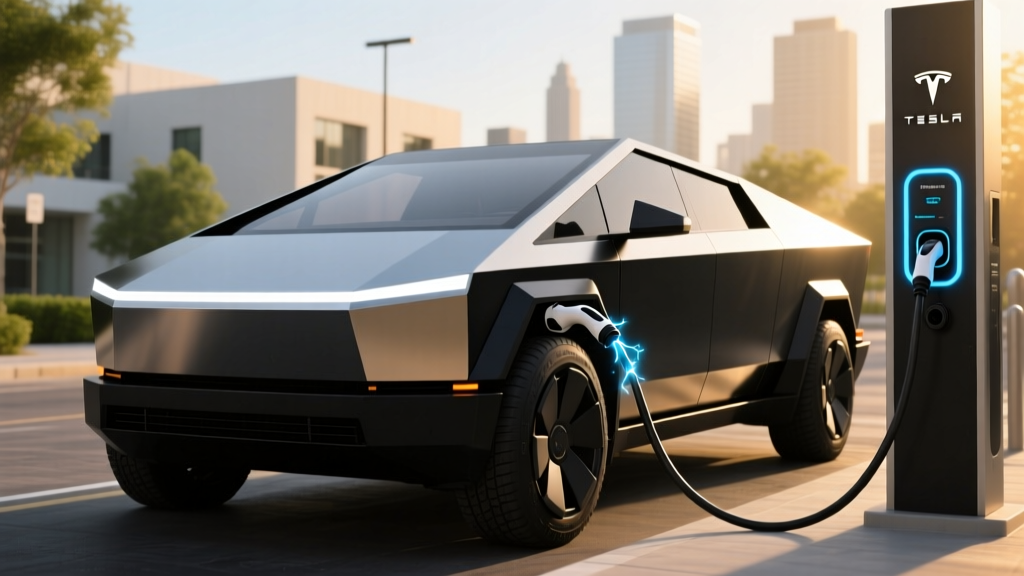
The Tesla Cybertruck's stainless-steel exoskeleton and angular silhouette grab headlines, but the question that actually determines daily satisfaction is simpler: how far can you really drive on a charge, and how do you keep it fueled? Tesla publishes EPA range estimates, but real-world efficiency in a heavy, brick-shaped pickup tells a different story — one shaped by aerodynamics, tire choice, terrain, and how you charge.
This guide breaks down the Cybertruck's real-world range expectations across trims, then walks through the complete charging picture: home Level 2 installation, DC fast-charging realities, connector compatibility, and the actual cost per mile versus a gas truck. Whether you've taken delivery or are evaluating whether the Cybertruck fits your driveway and your road-trip habits, the numbers below will ground your expectations in data.
Cybertruck Real-World Range: EPA Stickers vs. What You'll Actually See
Tesla currently offers the Cybertruck in two dual-motor AWD configurations and the tri-motor Cyberbeast. The EPA range figures are a starting point, but the Cybertruck's 6,600+ lb curb weight and flat-panel aerodynamics mean real-world results diverge noticeably from the sticker, especially at highway speeds.
| Trim | Battery (usable, kWh) | EPA Range (mi) | Real-World Highway (~70 mph) | Cold Weather (32°F, mixed) | MPGe (combined) | 0-60 mph |
|---|---|---|---|---|---|---|
| AWD (Dual Motor) | ~123 kWh (NMC) | 340 | ~265–285 mi | ~220–250 mi | 67 MPGe | 4.1 sec |
| Cyberbeast (Tri Motor) | ~123 kWh (NMC) | 320 | ~250–270 mi | ~210–240 mi | 64 MPGe | 2.6 sec |
The Cybertruck's NMC (nickel manganese cobalt) battery pack prioritizes energy density over the cycle-life longevity of LFP chemistry — a necessary trade-off for a vehicle this heavy. Tesla's thermal management system is among the best in the industry, which helps mitigate cold-weather losses compared to rivals, but physics is physics: a 6,600-lb vehicle pushing a flat frontal area through cold, dense air will consume more kWh per mile.
Charging Levels Explained: How Fast Each Level Adds Cybertruck Range
Understanding charging speed requires distinguishing kW (kilowatts) — the rate of power delivery, like water flow from a hose — from kWh (kilowatt-hours) — the total energy stored in the battery, like the volume of a tank. The Cybertruck's ~123 kWh battery is the tank; the charger's kW rating determines how fast you fill it.
| Level | Voltage / Amperage | Max Power (kW) | Miles of Range Added per Hour | 10–80% Time (approx.) | Best Use Case |
|---|---|---|---|---|---|
| Level 1 (120V) | 120V / 12A | ~1.4 kW | ~3–4 mi/hr | ~60+ hours | Emergency trickle only |
| Level 2 (240V) | 240V / 48A | ~11.5 kW | ~30–34 mi/hr | ~8–9 hours | Daily home charging |
| Level 2 (240V, 80A) | 240V / 80A | ~19.2 kW | ~50–56 mi/hr | ~5–6 hours | Heavy daily use / fleet |
| DC Fast Charge | 400V+ architecture | Peak 250 kW | ~200+ mi in 15 min | ~28–35 minutes | Road trips |
The Cybertruck supports a peak DC fast-charge rate of 250 kW on Tesla Superchargers (V3 and V4 stalls). However, peak rate is not sustained rate. The charging curve tapers significantly above 50–60% SoC to protect the battery. In practice, you'll see 250 kW only between roughly 10–30% SoC, dropping to ~150 kW by 50%, and falling below 50 kW past 80%. This is why road-trip strategy focuses on the 10–80% window: that ~28–35 minute stop adds roughly 200 miles of usable range.
For daily home charging on a 48A Level 2 circuit, overnight replenishment is more than sufficient. If you drive 60–80 miles per day, a Level 2 charger replaces that in 2–3 hours — well within any overnight window.
Home Charger Installation: Electrical Requirements, Costs & Panel Upgrades
Installing a Level 2 home charger for the Cybertruck is straightforward if your electrical panel has capacity, and expensive if it doesn't. Here's what's involved.
Electrical Requirements
The Cybertruck's onboard charger accepts up to 19.2 kW (80A) on Level 2 AC power, though the more common and cost-effective residential setup is a 48A circuit on a 60A breaker (the National Electrical Code requires breakers rated at 125% of continuous load). This delivers ~11.5 kW, which fully replenishes the Cybertruck overnight.
- Minimum recommended circuit: 240V / 60A breaker (supports 48A continuous)
- Optimal circuit for max onboard charging: 240V / 100A breaker (supports 80A continuous)
- Wire gauge: 6 AWG copper for 60A; 3 AWG for 100A (your electrician will specify)
- Dedicated circuit required: EV chargers must have their own breaker — no sharing
Installation Cost Breakdown
| Component | Simple Install (panel nearby, no upgrade) | Complex Install (long run, panel upgrade) |
|---|---|---|
| Level 2 charger equipment | $400–$750 | $400–$750 |
| Electrician labor (2–6 hrs) | $500–$1,200 | $1,500–$3,500 |
| Permit & inspection | $50–$200 | $100–$350 |
| Electrical panel upgrade (if needed) | $0 | $2,000–$5,000 |
| Conduit, wiring, mounting hardware | $100–$300 | $300–$800 |
| Total estimated cost | $1,050–$2,450 | $4,800–$10,400 |
The single biggest variable is whether your existing electrical panel can handle the additional load. Most modern 200A panels can accommodate a 60A EV circuit if there's room on the bus bar. Older homes with 100A or 150A service, or panels already near capacity from HVAC, electric ranges, and dryers, will likely need a panel upgrade — which can add $2,000–$5,000 to the project. A licensed electrician can perform a load calculation to determine this before you commit.
Connector Compatibility: NACS, CCS, and the Cybertruck
The Cybertruck uses Tesla's NACS (North American Charging Standard) connector natively. This is the same connector used across all current Tesla vehicles and, as of 2025–2026, is being adopted by Ford, GM, Rivian, Hyundai, and most other automakers for their North American models.
| Connector | Type | Cybertruck Compatible? | Adapter Needed? | Notes |
|---|---|---|---|---|
| NACS (Tesla) | AC Level 2 & DC Fast | Yes — native | None | Access to full Tesla Supercharger network |
| CCS1 | DC Fast | With adapter | Tesla CCS Adapter (~$175) | Access to Electrify America, EVgo, ChargePoint DC stalls |
| CHAdeMO | DC Fast | No practical adapter | N/A | Legacy standard; being phased out in North America |
| J1772 | AC Level 2 | With adapter | Tesla J1772 Adapter (included with vehicle) | For non-Tesla public Level 2 chargers (hotels, workplaces) |
The Cybertruck ships with a J1772-to-NACS adapter for public Level 2 chargers. For DC fast charging on non-Tesla networks (Electrify America, EVgo), you'll need the Tesla CCS adapter, which Tesla sells for approximately $175. This adapter enables charging at CCS1 stalls at up to the Cybertruck's peak acceptance rate, though real-world speeds on third-party networks may be limited by the station's maximum output.
One practical advantage: the Cybertruck's NACS-native design means seamless plug-and-charge access to the Tesla Supercharger network — over 6,000 stations and 65,000+ stalls in North America as of 2026, consistently rated the most reliable public charging network in driver surveys.
Cost to Charge: Home vs. Public vs. Gas Truck Comparison
One of the Cybertruck's strongest ownership arguments is fuel cost — but the savings depend heavily on where and when you charge. Here's a realistic breakdown.
| Scenario | Rate ($/kWh) | Cost to Add 200 mi | Cost per Mile | Annual Fuel Cost (12,000 mi) |
|---|---|---|---|---|
| Home, off-peak (utility time-of-use) | $0.09–$0.13 | $7.40–$10.70 | $0.037–$0.053 | $440–$640 |
| Home, standard rate (no TOU) | $0.14–$0.18 | $11.50–$14.80 | $0.058–$0.074 | $690–$890 |
| Tesla Supercharger (avg. national) | $0.28–$0.36 | $23.00–$29.50 | $0.115–$0.148 | $1,380–$1,770 |
| Third-party DC fast (EA, EVgo) | $0.35–$0.55 | $28.70–$45.10 | $0.144–$0.226 | $1,720–$2,710 |
| Comparable gas truck (Ford F-150 4WD, 20 MPG, $3.50/gal) | — | $35.00 | $0.175 | $2,100 |
At the Cybertruck AWD's real-world highway efficiency of roughly 2.4–2.6 kWh/mile (derived from its ~123 kWh usable battery and ~265–285 mile real-world highway range), fuel costs vary dramatically by charging location. Home charging on an off-peak utility rate delivers fuel savings of 70–75% versus a comparable gas truck. Exclusive Supercharger use narrows that gap to roughly 30–40% savings. Exclusive reliance on third-party DC fast chargers — the most expensive option — can approach or even exceed gas costs in high-rate markets like California.
The Cybertruck's EPA-rated efficiency of 67 MPGe (combined) translates to roughly 50 kWh per 100 miles. Use this figure for your own cost calculations: multiply your local electricity rate by 0.50 to get cost per mile at home.
Recommended Home Chargers for the Cybertruck
The Cybertruck's 19.2 kW onboard charger means it can accept more Level 2 power than most EVs. To take full advantage, you need a charger capable of 80A output — which requires a 100A breaker. Most homeowners opt for 48A units on a 60A breaker, which is more cost-effective and still delivers a full overnight charge.
Tesla Wall Connector
Power: Up to 11.5 kW (48A) or 19.2 kW (80A, hardwired)
Connector: NACS native
Cable length: 24 ft
Smart features: Wi-Fi, OTA updates, power sharing (multiple units on one circuit), access control
Price: ~$475 (48A) / ~$600 (80A)
Best for: Tesla-only households; cleanest integration with Cybertruck
ChargePoint Home Flex
Power: Up to 12 kW (50A, adjustable down to 16A)
Connector: NACS (2025+ models) or J1772 with adapter
Cable length: 23 ft
Smart features: Wi-Fi, app scheduling, Alexa, load management
Price: ~$550–$700
Best for: Multi-EV households with mixed brands
Emporia Vue Level 2 Charger
Power: Up to 11.5 kW (48A)
Connector: J1772 (use Tesla adapter) or NACS (newer models)
Cable length: 24 ft
Smart features: Energy monitoring, solar integration, time-of-use scheduling
Price: ~$400–$500
Best for: Budget-conscious installs with solar panels
Grizzl-E Smart
Power: Up to 10 kW (40A)
Connector: J1772 (use Tesla adapter) or NACS
Cable length: 24 ft
Smart features: App control, adjustable amperage, extreme-weather rated (-40°F)
Price: ~$450–$550
Best for: Cold-climate outdoor installs; durable build
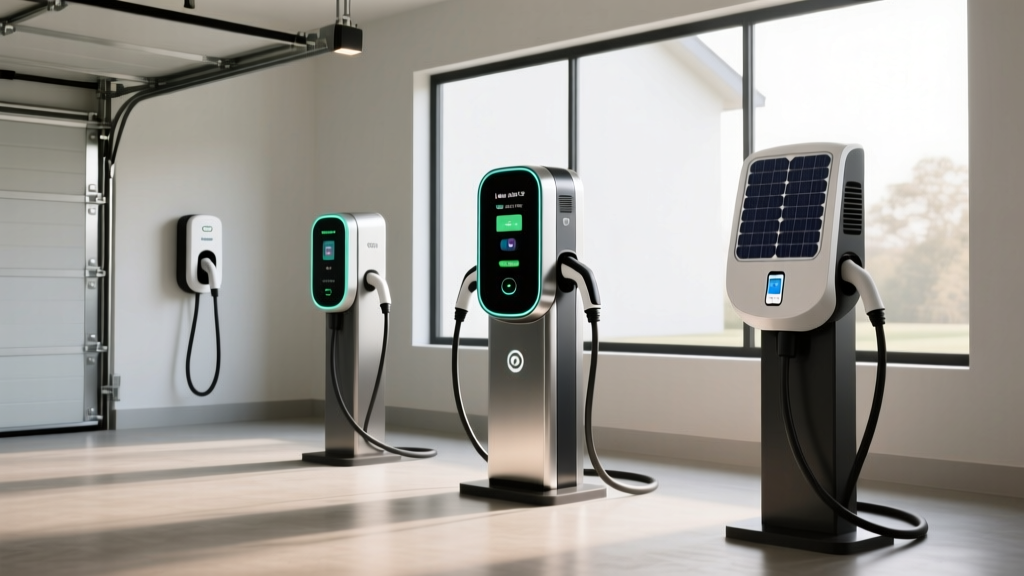
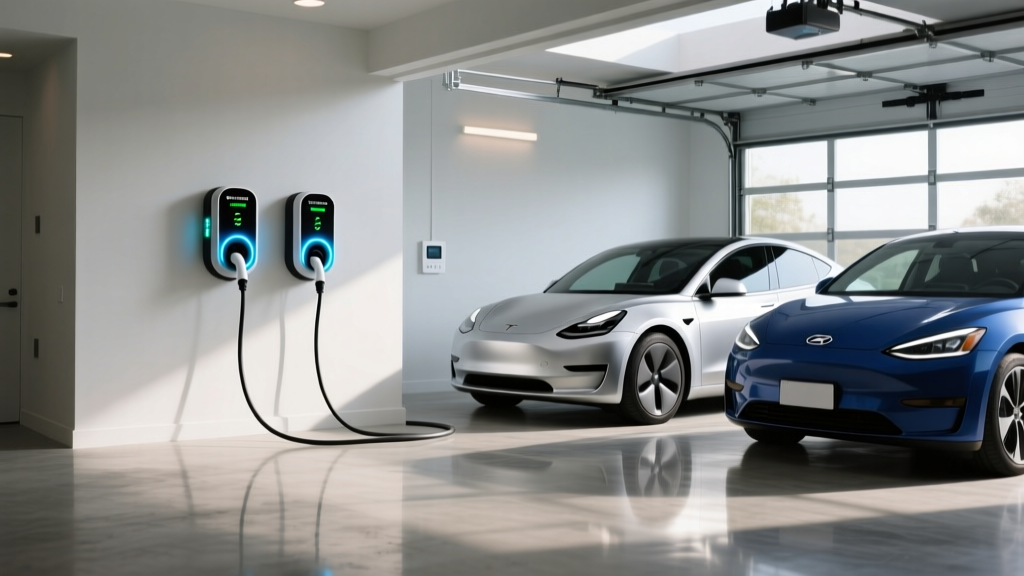
For Cybertruck owners, the Tesla Wall Connector is the default recommendation: native NACS means no adapter fumbling, and the 80A hardwired version is one of the few residential chargers that can fully utilize the Cybertruck's onboard charger capacity. If you share the garage with a non-Tesla EV, the ChargePoint Home Flex with a NACS plug (available on 2025+ units) offers multi-vehicle flexibility.
Safety, Code & Installation Considerations
EV charger installation is electrical work that must comply with the National Electrical Code (NEC) and local building codes. Key requirements for a Cybertruck home charging setup:
- Dedicated circuit: The charger must be on its own breaker — never shared with other appliances. This is non-negotiable per NEC Article 625.
- GFCI protection: Outdoor installations require Ground Fault Circuit Interrupter protection. Many modern Level 2 chargers have built-in GFCI, but your electrician may also install a GFCI breaker. Note: some EV owners report nuisance GFCI trips with double-GFCI setups (breaker + charger); your electrician can configure this correctly.
- Outdoor rating: If mounted outside, the charger must carry a NEMA 3R or NEMA 4 rating for weather resistance. The Tesla Wall Connector and Grizzl-E are rated for outdoor use.
- Permit required: Most jurisdictions require an electrical permit and post-installation inspection for hardwired EV chargers. Budget $50–$350 for permit fees. Skipping the permit can void homeowner's insurance coverage for electrical fires.
- Cable management: The Cybertruck's charge port is located on the driver-side rear quarter panel. Plan your charger mounting location and cable length to reach without stretching across the driveway — a tripping hazard and code violation in some areas.
Hire a licensed electrician experienced with EV charger installations. Ask for a load calculation before committing to a specific amperage — this determines whether your panel can support a 60A or 100A circuit without an upgrade.
Cybertruck Charging FAQ
How much does it cost to install a home EV charger for the Cybertruck?
A straightforward Level 2 installation (panel has capacity, short wire run) typically costs $1,050–$2,450 including equipment, electrician labor, and permit. If your home needs an electrical panel upgrade (common in pre-2000 homes with 100A or 150A service), total costs can reach $4,800–$10,400. Get a load calculation from a licensed electrician before budgeting.
How fast will each charging level add range to the Cybertruck?
Level 1 (120V) adds roughly 3–4 miles per hour — essentially useless for the Cybertruck's large battery. Level 2 at 48A (11.5 kW) adds 30–34 miles per hour, fully replenishing the pack overnight. DC fast charging at a 250 kW Supercharger adds roughly 200 miles in 15 minutes during the 10–80% SoC window.
Which connector does the Cybertruck use?
The Cybertruck uses NACS natively for both AC Level 2 and DC fast charging. It includes a J1772 adapter for non-Tesla Level 2 chargers. For non-Tesla DC fast chargers (Electrify America, EVgo), you'll need the Tesla CCS adapter (~$175).
How much does charging a Cybertruck cost per mile vs. a gas truck?
Home charging on off-peak electricity costs roughly $0.04–$0.05 per mile, compared to $0.175 per mile for a 20 MPG gas truck at $3.50/gallon — a savings of about 70%. Supercharging raises the cost to ~$0.12–$0.15 per mile, still cheaper than gas but less dramatically so.
What electrical upgrades might I need for a Cybertruck charger?
The most common upgrade is a panel upgrade from 100A or 150A to 200A service ($2,000–$5,000) if your existing panel lacks capacity for a 60A dedicated circuit. You may also need new conduit runs if the panel is far from the garage, or a sub-panel installation. A licensed electrician's load calculation will determine exactly what's needed.
Does the Cybertruck's battery degrade, and how does charging habits affect it?
All lithium-ion batteries degrade. Tesla's battery warranty covers the Cybertruck for 8 years / 120,000 miles with a minimum 70% capacity retention. To maximize longevity with the NMC pack: set daily charge limits to 80–90%, avoid frequent DC fast charging when Level 2 is available, and use the vehicle's scheduled departure preconditioning to avoid charging in extreme temperatures. Tesla's thermal management system is robust, but minimizing time at 100% SoC in hot weather reduces calendar degradation.