Why Your Cybertruck's Range Depends on Your Charging Setup
The Tesla Cybertruck's EPA-estimated range spans from 320 miles (Dual Motor AWD) to 340 miles (Cyberbeast with the available Range Extender battery pack). But those sticker numbers assume ideal conditions. In real-world highway driving at 70+ mph, expect roughly 260–290 miles from the Dual Motor and up to 310 miles from the Cyberbeast with the Range Extender. In cold weather (below 32°F), knock off another 15–25%.
The "Cybertruck Range Extender" refers to Tesla's supplemental battery pack that bolts into the bed, adding approximately 15–20 kWh of usable capacity on top of the base ~123 kWh (usable) NMC battery. This pack was announced for late-2025 availability and pushes the Cyberbeast closer to 340+ EPA miles. Whether you have the base pack or the Range Extender, how you charge at home determines whether you wake up to full range every morning — or waste hours babysitting a Level 1 trickle.
Charging Levels Explained: kW, Miles Per Hour, and What Each Means for Your Cybertruck
The single most important distinction in EV charging: kW (kilowatts) measures power — how fast energy flows. kWh (kilowatt-hours) measures energy — how much the battery holds. Think of kW as the width of a hose and kWh as the size of the bucket. The Cybertruck's battery holds roughly 123 kWh usable (base) or ~140+ kWh with the Range Extender. Here's how each charging level fills that bucket:
| Level | Voltage / Amperage | Max Power (kW) | Miles of Range Added Per Hour | 0–100% Time (Base 123 kWh) |
|---|---|---|---|---|
| Level 1 (Standard 120V) | 120V / 12A | ~1.4 kW | ~3–4 mi/hr | ~88+ hours |
| Level 2 (Home 240V) | 240V / 48A | 11.5 kW | ~30–34 mi/hr | ~11–13 hours |
| Level 2 (Tesla Wall Connector max) | 240V / 48A | 11.5 kW | ~30–34 mi/hr | ~11–13 hours |
| DC Fast Charge (V4 Supercharger) | ~400V DC | Peak ~250 kW | ~150–170 mi in 15 min | 10–80% in ~20 min |
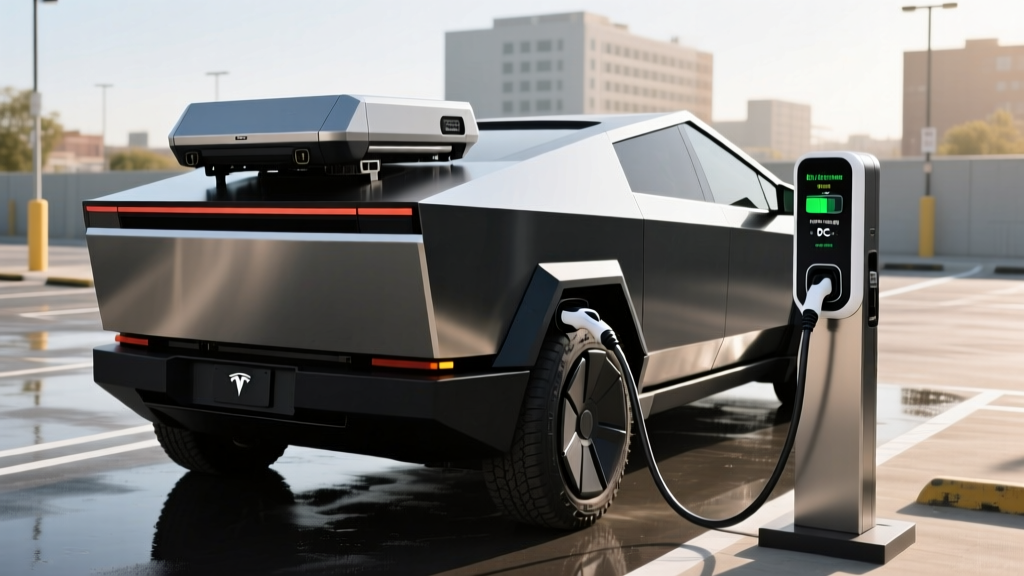
The Cybertruck's onboard charger maxes out at 11.5 kW on Level 2 AC. That means even if you install a 19.2 kW (80A) charger, the truck will only accept 11.5 kW. For DC fast charging, Tesla's V4 Supercharger cabinets deliver up to 250 kW to the Cybertruck, though the charge curve tapers significantly above 60% state of charge (SoC). Expect peak rates between 15–50% SoC, then a steep drop to under 50 kW past 80%.
How Much Does It Cost to Install a Home EV Charger for the Cybertruck?
Home Level 2 charging is where Cybertruck ownership makes the most sense. But installation costs vary dramatically depending on your electrical panel's capacity, the distance from the panel to your parking spot, and local permit fees. Here's a realistic breakdown:
| Component | Basic Install (Panel Adjacent) | Standard Install (50–80 ft run) | Complex Install (Panel Upgrade Needed) |
|---|---|---|---|
| EV Charger Equipment (48A) | $400–$600 | $400–$600 | $400–$600 |
| Electrical Permit | $50–$150 | $50–$200 | $100–$300 |
| Electrician Labor (60A circuit) | $300–$600 | $600–$1,500 | $800–$2,000 |
| Conduit, Wiring (6 AWG copper) | $100–$200 | $200–$500 | $300–$700 |
| Panel Upgrade (100A → 200A) | N/A | N/A | $1,500–$3,500 |
| Total Estimated Cost | $850–$1,550 | $1,250–$2,800 | $3,100–$7,100 |
Panel upgrade reality check: The Cybertruck's 11.5 kW charging draw requires a dedicated 60-amp circuit (48A continuous load × 125% = 60A breaker). If your home has a 100-amp main panel already loaded with HVAC, electric dryer, and oven circuits, you'll likely need a 200-amp upgrade. This is the single biggest variable in install cost. Have a licensed electrician perform a load calculation before committing to equipment.
Some utility companies offer rebates of $250–$750 for Level 2 installations, and certain states provide additional incentives. Check your local utility's EV program page before scheduling work.
Which Connector and Charger Is Compatible with the Cybertruck?
The Cybertruck uses Tesla's NACS (North American Charging Standard) connector natively — the same compact plug used on all Tesla vehicles since 2012. No adapter is needed for Tesla Superchargers or Tesla Wall Connectors. However, as of 2025–2026, many non-Tesla DC fast charging networks (Electrify America, EVgo, ChargePoint) have begun deploying NACS cables alongside CCS1.
| Connector Type | Native Support? | Adapter Needed? | Where You'll Find It |
|---|---|---|---|
| NACS (Tesla) | Yes — native | None | Tesla Superchargers, Tesla Wall Connector, growing non-Tesla networks |
| CCS1 (Combined Charging System) | No | Tesla CCS Adapter (~$175) | Electrify America, EVgo, ChargePoint DC stations |
| CHAdeMO | No | Not available for Tesla | Legacy Nissan/Mitsubishi stations — avoid |
| J1772 (Level 2 AC) | No | Tesla Mobile Connector J1772 adapter (included) | Public Level 2 stations, hotels, workplaces |
Recommendation: Buy the Tesla CCS Adapter ($175 from Tesla's shop) and keep it in the truck. It unlocks access to Electrify America's 350 kW chargers and other CCS networks, which matters when Superchargers are occupied or unavailable on road trips.
Recommended Level 2 Chargers for the Cybertruck
Since the Cybertruck's onboard charger caps at 11.5 kW (48A at 240V), you don't need an 80A charger. A 48A unit fully saturates the truck's AC charging capability. Here are three proven options:
Tesla Wall Connector (Gen 3)
- Power Output: Up to 11.5 kW (48A) — matches Cybertruck's max AC rate
- Connector: NACS native — no adapter needed
- Cable Length: 24 ft
- Smart Features: Wi-Fi for OTA updates, power-sharing with second unit, Tesla app integration
- Price: ~$475
- Best For: Tesla-only households wanting seamless integration
ChargePoint Home Flex
- Power Output: Up to 12 kW (50A) — configurable down to 40A/32A for panel-constrained homes
- Connector: NACS (2025+ models) or J1772 (use Tesla adapter)
- Cable Length: 23 ft
- Smart Features: Alexa integration, scheduled charging, energy tracking via app, amperage adjustable via DIP switch
- Price: ~$550–$650
- Best For: Multi-EV households with Teslas and non-Teslas
Emporia Level 2 EV Charger
- Power Output: Up to 11.5 kW (48A)
- Connector: J1772 (use included Tesla adapter) or NACS version
- Cable Length: 24 ft
- Smart Features: Real-time energy monitoring, solar integration, utility demand-response compatible, detailed app data
- Price: ~$350–$400
- Best For: Budget-conscious buyers who want granular energy data
How Much Does Charging a Cybertruck Cost Per Mile vs. Gas?
The Cybertruck Dual Motor AWD achieves an EPA-rated 70 MPGe combined (approximately 48 kWh/100 miles). The Cyberbeast rates slightly lower at 65 MPGe. Here's what that translates to in real dollars:
| Charging Scenario | $/kWh | Cost Per 100 Miles | Cost Per Mile | Equivalent Gas MPG at $3.50/gal |
|---|---|---|---|---|
| Home Off-Peak (Time-of-Use) | $0.08–$0.12 | $3.84–$5.76 | $0.04–$0.06 | 58–88 MPG |
| Home Standard Rate | $0.14–$0.18 | $6.72–$8.64 | $0.07–$0.09 | 39–50 MPG |
| Public Level 2 (ChargePoint/EVgo) | $0.25–$0.40 | $12.00–$19.20 | $0.12–$0.19 | 18–29 MPG |
| Tesla Supercharger (V3/V4) | $0.28–$0.42 | $13.44–$20.16 | $0.13–$0.20 | 18–27 MPG |
| Electrify America DC Fast | $0.35–$0.55 | $16.80–$26.40 | $0.17–$0.26 | 13–21 MPG |
Gas truck comparison: A 2026 Ford F-150 4WD with the 3.5L EcoBoost averages ~20 MPG combined. At $3.50/gallon, that's $0.175/mile. Home-charged Cybertruck owners pay roughly one-third to one-half the per-mile fuel cost of a comparable gas truck. Even exclusive Supercharger use undercuts gas on a cost-per-mile basis in most states.
For the Range Extender-equipped Cyberbeast (~140+ kWh usable), multiply these costs by approximately 1.14× due to the larger battery. The Range Extender adds range but doesn't change efficiency — the extra weight and capacity mean more kWh consumed per full charge cycle.
Safety, Electrical Code, and Installation Best Practices
The Cybertruck's high-capacity battery demands a properly engineered home charging circuit. Here are non-negotiable safety and code requirements per the 2023 National Electrical Code (NEC), which most jurisdictions have adopted as of 2026:
- Dedicated circuit: Your Level 2 charger must be on its own dedicated 60A breaker (for 48A continuous charging). Sharing the circuit with other loads violates NEC 625.40.
- GFCI protection: NEC 625.54 requires GFCI protection for all EV charging outlets rated 150V to ground or less. Hardwired installations (like the Tesla Wall Connector) are exempt from the GFCI breaker requirement, which avoids nuisance tripping — a key reason to hardwire rather than use a NEMA 14-60 receptacle.
- Outdoor rating: If your charger is outdoors, ensure the unit carries a NEMA 4 or NEMA 4X rating (all three chargers above qualify). The conduit and junction boxes must also be rated for wet locations.
- Wire gauge: 6 AWG copper (THHN in conduit) is standard for a 60A circuit. For runs over 100 feet, your electrician may need to step up to 4 AWG to prevent voltage drop.
- Permit and inspection: Every jurisdiction requires an electrical permit for a new 60A circuit. The inspection ensures proper grounding, torque on connections, and correct breaker sizing. Do not skip this — unpermitted work can void homeowner's insurance coverage in the event of an electrical fire.
Panel capacity check: Before purchasing any equipment, have an electrician perform a NEC Article 220 load calculation. This determines whether your existing panel can handle the additional 60A draw. If your panel is already at 80%+ capacity, a panel upgrade or a smart load-management device (like the Emporia VUE with automatic EV throttling) may be required.
Cybertruck Charging Times: 10–80% Scenarios
Most EV owners charge between 10% and 80% state of charge for daily use — this preserves battery longevity and avoids the slow taper above 80%. Here's what to expect with the Cybertruck's ~123 kWh base battery and the Range Extender configuration:
| Charging Method | Base Battery (~123 kWh usable) | With Range Extender (~140+ kWh usable) |
|---|---|---|
| Level 1 (120V / 1.4 kW) | ~74 hours | ~85 hours |
| Level 2 (240V / 48A / 11.5 kW) | ~7.5 hours | ~8.5 hours |
| DC Fast (V4 Supercharger, 250 kW peak) | ~20 minutes | ~24 minutes |
| DC Fast (Electrify America 350 kW via CCS adapter) | ~22 minutes* | ~26 minutes* |
*CCS adapter charging may not reach the Cybertruck's full peak DC rate due to adapter throughput limitations. Tesla's native NACS Supercharger connection is the fastest path.
The DC fast-charge curve matters here. The Cybertruck peaks near 250 kW between roughly 15–45% SoC, then tapers to ~120 kW by 60%, and drops below 50 kW past 80%. This is why manufacturers quote 10–80% times rather than 0–100% — the last 20% can take as long as the first 70%.
Frequently Asked Questions
Is the Cybertruck Range Extender a generator or a battery?
It's a supplemental battery pack, not a gasoline generator. The Range Extender adds approximately 15–20 kWh of NMC lithium-ion cells that integrate with the main battery pack. It charges through the same NACS port and regenerative braking system. There is no combustion engine or fuel tank involved.
Can I charge the Cybertruck on a standard 120V outlet?
Yes, but it's impractical for daily use. At ~1.4 kW, a 120V Level 1 connection adds only 3–4 miles of range per hour. Fully recharging the base battery from empty would take over 88 hours. Level 1 is useful as a trickle-charge or emergency top-off, not as a primary charging strategy for a vehicle with a 123+ kWh battery.
Does the Cybertruck qualify for the federal EV tax credit?
The Cybertruck's eligibility under IRS §30D clean vehicle credit depends on several factors that change periodically: the buyer's modified adjusted gross income (caps at $150K single / $300K joint), the vehicle's MSRP (must be under $80,000 for trucks/SUVs), and battery component and critical mineral sourcing requirements. The Dual Motor AWD starting around $79,990 may qualify for up to $7,500, but partial credit ($3,750) is common when only one of the two sourcing requirements is met. Always verify current eligibility on the IRS website and consult a tax professional — rules are subject to change.
Do I need a Tesla Wall Connector, or will any Level 2 charger work?
Any Level 2 charger with a NACS connector (or a J1772 charger with Tesla's included adapter) will work. The Cybertruck's onboard charger accepts up to 11.5 kW regardless of brand. The Tesla Wall Connector offers the cleanest experience with no adapter needed, but third-party chargers like the ChargePoint Home Flex or Emporia provide comparable performance with additional features like energy monitoring and adjustable amperage.
How does cold weather affect Cybertruck range and charging speed?
Lithium-ion batteries lose efficiency in cold temperatures. Expect 15–25% range reduction below freezing, primarily from increased cabin heating demand and reduced regenerative braking. DC fast charging also slows when the battery is cold — always use the Tesla app or in-car navigation to precondition the battery before arriving at a Supercharger. Preconditioning warms the cells to optimal temperature, restoring peak charge rates. Without preconditioning, a cold-soaked Cybertruck may peak at only 100–120 kW instead of 250 kW on a V4 Supercharger.
What size solar system would I need to charge a Cybertruck at home?
If you drive 40 miles per day (~19 kWh), you'd need roughly 5–7 kW of solar panels (15–20 panels at 350W each) to cover daily charging in a sun-rich climate. For full off-grid charging including the Range Extender pack, a 10–12 kW system with battery storage is more realistic. Consult a solar installer for site-specific estimates — roof orientation, shading, and local irradiance all affect output.