What Is the Range of a Cybertruck? Real Numbers for 2026
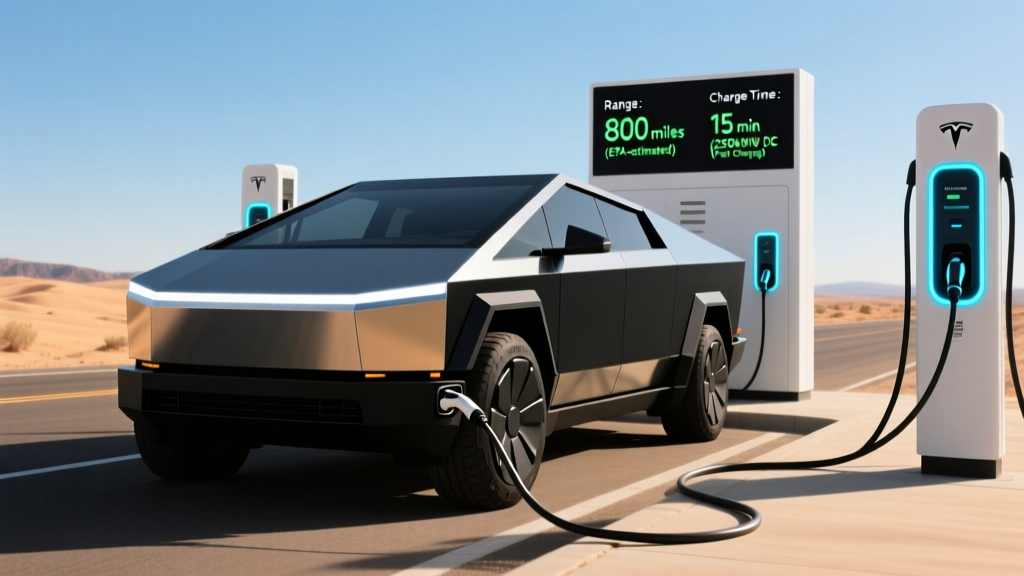
If you've been asking "what is the range of a Cybertruck?" you've probably noticed the numbers have shifted since Tesla's original 2019 reveal. For the 2026 model year, the Cybertruck lineup settles into a more realistic set of EPA-estimated ranges that still outclass most electric pickups — but real-world results depend heavily on how and where you charge.
The Cybertruck's stainless-steel exoskeleton and angular aero profile create unique efficiency challenges. Unlike sleek sedans, this truck pushes a lot of air, which matters at highway speed and in cold weather. Below, we break down every trim's range, the charging infrastructure you'll need, and the true cost of keeping one powered up — whether you're plugging in at home or relying on the Supercharger network.
- AWD (Dual Motor): 340 miles EPA
- Cyberbeast (Tri-Motor): 320 miles EPA
- Range Extender (bed-mounted battery): Up to 470 miles EPA (AWD trim)
Real-world caveat: Expect 260–300 miles on the AWD at sustained 75 mph highway speeds; 230–270 miles on the Cyberbeast. Cold weather (below 32°F) can reduce range an additional 15–25%. The Range Extender adds ~130 miles but adds significant bed weight.
Cybertruck Battery, Efficiency, and Real-World Range
The 2026 Cybertruck uses a structural battery pack with an estimated ~123 kWh usable capacity (AWD) and ~123 kWh usable (Cyberbeast), built on Tesla's 4680 cell architecture. These are NMC (nickel-manganese-cobalt) chemistry cells, chosen for energy density over the LFP chemistry found in the Model 3 Standard Range. NMC delivers more miles per pound but is more sensitive to sustained 100% SoC storage.
| Trim | EPA Range | Battery (usable kWh) | Efficiency (kWh/100mi) | 0-60 mph | Base MSRP |
|---|---|---|---|---|---|
| AWD (Dual Motor) | 340 mi | ~123 kWh | 36 kWh/100mi | 3.9 sec | $79,990 |
| Cyberbeast (Tri-Motor) | 320 mi | ~123 kWh | 38 kWh/100mi | 2.6 sec | $99,990 |
| AWD + Range Extender | 470 mi | ~123 + ~50 kWh extender | ~38 kWh/100mi (w/ extender drag) | 4.1 sec (added weight) | $96,990 (est.) |
The Cybertruck's efficiency — around 36–38 kWh per 100 miles — is notably worse than a Model Y Long Range (~28 kWh/100mi). That's the trade-off for a 6,600+ lb stainless-steel truck with the aerodynamics of a doorstop at speed. On the EPA's fueleconomy.gov listings, the Cybertruck AWD achieves roughly 76 MPGe combined, which is low for an EV but competitive against the Rivian R1T and Ford F-150 Lightning in the electric truck segment.
Charging the Cybertruck: Level 1, Level 2, and DC Fast Charging
Charging a 123 kWh battery is a different proposition than topping off a 75 kWh Model 3. You need more energy, which means longer sessions at every level. Here's how each charging tier performs with the Cybertruck:
| Level | Power (kW) | Miles Added / Hour | 10–80% Time | Best Use Case |
|---|---|---|---|---|
| Level 1 (120V / 12A) | ~1.4 kW | ~3–4 mi/hr | ~60+ hours | Emergency trickle only |
| Level 2 (240V / 48A) | ~11.5 kW | ~30–34 mi/hr | ~9–10 hours | Daily home charging |
| Level 2 (240V / 80A — Wall Connector) | ~19.2 kW | ~50–54 mi/hr | ~5.5–6 hours | Fast home / fleet depot |
| DC Fast (V4 Supercharger, 250 kW peak) | 250 kW peak (~170 kW avg) | ~450–550 mi/hr (peak) | ~25–30 min | Road trips, rapid top-ups |
Understanding kW vs. kWh: This is the most common EV confusion. kW (kilowatts) measures the rate of power delivery — like the flow rate of a hose. kWh (kilowatt-hours) measures total energy stored — like the size of the bucket. The Cybertruck's battery holds ~123 kWh. Charging at 11.5 kW means you're adding 11.5 kWh per hour, so a full charge from empty takes roughly 10.7 hours at Level 2.
Charge curve reality: Tesla's V4 Superchargers can peak at 250 kW on the Cybertruck, but that peak only holds between roughly 10–35% SoC. Above 50%, the rate tapers to ~150 kW; above 80%, it drops below 60 kW to protect the battery. That's why the 10–80% time (~25–30 minutes) is the meaningful metric — charging from 80–100% can take nearly as long as 10–80%.
Home Charger Installation: Electrical Requirements and Costs
Given the Cybertruck's massive battery, a high-amperage Level 2 home charger is essentially mandatory. Level 1 (120V) adds only ~3 miles per hour — you'd need over 100 hours of continuous charging to fill the battery. Here's what a proper home setup requires:
Electrical Requirements
- Circuit: Dedicated 60-amp breaker for a 48A continuous charger (NEC requires 125% headroom for continuous loads, so 48A × 1.25 = 60A breaker)
- Wire gauge: 6 AWG copper (THHN in conduit) for runs up to ~100 feet; 4 AWG for longer runs to prevent voltage drop
- Voltage: 240V single-phase (standard US residential split-phase)
- Panel capacity: Most modern 200A panels can accommodate a 60A breaker, but older 100A panels will likely need a service upgrade ($2,000–$4,000)
- Permit: Required in nearly all US jurisdictions; typically $50–$200 depending on municipality
Installation Cost Breakdown
| Component | Simple Install (panel nearby) | Complex Install (long run / panel upgrade) |
|---|---|---|
| EVSE equipment (48A smart charger) | $400–$650 | $400–$650 |
| Electrician labor (2–6 hours) | $300–$800 | $1,200–$3,000 |
| Wire, conduit, breaker, misc. | $100–$300 | $400–$1,200 |
| Permit & inspection | $50–$200 | $100–$300 |
| Panel upgrade (if needed) | N/A | $2,000–$4,000 |
| TOTAL | $850–$1,950 | $4,100–$9,150 |
The wide range reflects real variability. If your electrical panel is in the garage next to where you'll park, a licensed electrician can often complete the job in 2–3 hours. If the panel is on the opposite side of the house, or you need trenching for a detached garage, costs escalate quickly. Always get a load calculation from your electrician to confirm your panel can handle the additional 60A draw — skipping this step risks tripped mains or fire hazard.
Which Connector Does the Cybertruck Use?
The 2026 Cybertruck uses the NACS (North American Charging Standard) connector — Tesla's proprietary plug, now adopted as the industry standard by Ford, GM, Rivian, Hyundai, and most other major automakers. NACS handles both Level 2 AC charging and DC fast charging through a single, compact connector.
| Connector | Used By | Cybertruck Compatible? |
|---|---|---|
| NACS (Tesla / SAE J3400) | Tesla, Ford, GM, Rivian, Hyundai, Kia, Volvo, Polestar, BMW (newer) | ✅ Native — no adapter needed |
| CCS1 (Combined Charging System) | Legacy VW, BMW, Stellantis, some older public chargers | ⚠️ Adapter available (~$200–$250); needed for non-Tesla DC chargers |
| CHAdeMO | Nissan Leaf (legacy); largely discontinued in US | ❌ Not compatible; network is sunset |
For home charging, you'll want a NACS-equipped Level 2 wall connector. For public DC fast charging outside the Supercharger network, you may need a NACS-to-CCS adapter to access Electrify America or EVgo stations that haven't yet retrofitted NACS cables. As of 2026, most major networks have added NACS connectors, but coverage in rural areas still lags.
Level 2 Charger Recommendations for Cybertruck Owners
With a 123 kWh battery, you want the highest amperage your panel can support. Here are the top picks for Cybertruck home charging:
🏆 Best Overall: Tesla Wall Connector
- Power: Up to 19.2 kW (80A circuit / 48A continuous on some configs; 80A on 100A circuit)
- Connector: NACS native
- Cable: 24 ft
- Smart features: Wi-Fi, OTA updates, Tesla app integration, power sharing between two units
- Price: ~$475
- Why: Highest power output at the lowest price for NACS vehicles. Power sharing lets you run two chargers on one 60A circuit.
🔧 Best Universal: ChargePoint Home Flex
- Power: Up to 12 kW (50A circuit / 40A continuous) — configurable down to 16A
- Connector: NACS or J1772 (configurable)
- Cable: 23 ft
- Smart features: Wi-Fi, app scheduling, Alexa, energy tracking, flexible amperage
- Price: ~$649
- Why: Amperage dip-switch lets you match any panel capacity from 20A to 50A. Good for homes with limited electrical capacity.
⚡ Best Budget: Emporia Vue Level 2
- Power: Up to 11.5 kW (60A circuit / 48A continuous)
- Connector: J1772 (NACS adapter included)
- Cable: 24 ft
- Smart features: Wi-Fi, app, solar integration, load management
- Price: ~$399
- Why: 48A output at a budget price. Solar-aware charging pairs well with home PV systems.
🏠 Best for Older Panels: Enel X JuiceBox 32
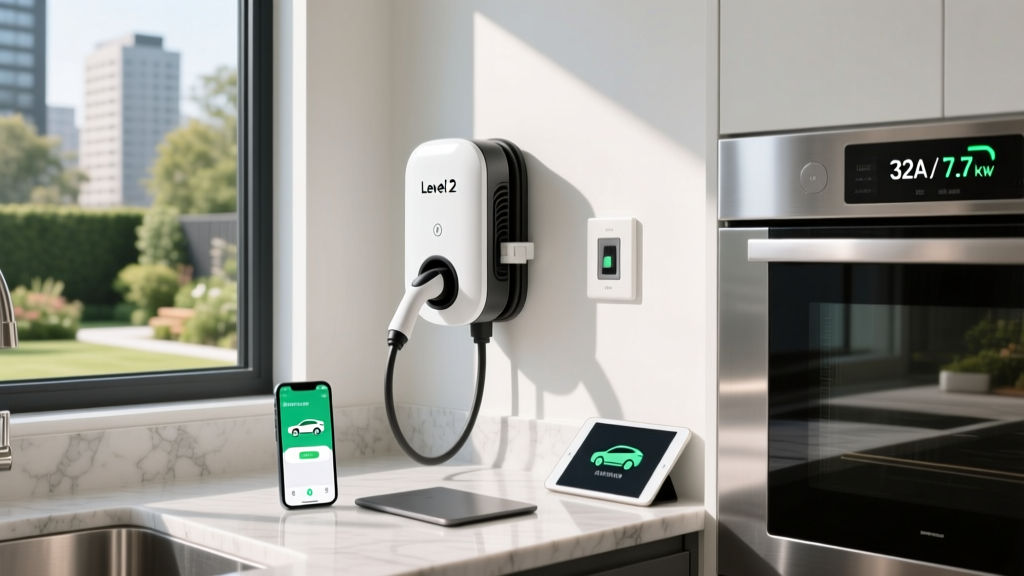
- Power: 7.7 kW (40A circuit / 32A continuous)
- Connector: J1772 (NACS adapter available)
- Cable: 25 ft
- Smart features: Wi-Fi, app scheduling, energy dashboard
- Price: ~$449
- Why: 32A draw fits a 40A breaker — ideal for 100A panels that can't spare 60A. Slower, but no panel upgrade needed.
How Much Does It Cost to Charge a Cybertruck?
The Cybertruck's 123 kWh battery means charging costs add up faster than with smaller EVs. Here's a realistic breakdown of what you'll pay per mile in different scenarios:
| Scenario | $/kWh | Full Charge Cost | Cost Per Mile |
|---|---|---|---|
| Home (off-peak utility rate) | $0.08–$0.12 | $9.84–$14.76 | $0.03–$0.04/mi |
| Home (standard rate, no TOU) | $0.14–$0.18 | $17.22–$22.14 | $0.05–$0.07/mi |
| Tesla Supercharger (average) | $0.28–$0.36 | $34.44–$44.28 | $0.10–$0.13/mi |
| Public DC fast (Electrify America, EVgo) | $0.35–$0.50 | $43.05–$61.50 | $0.13–$0.18/mi |
| Gas truck comparison (F-150 4x4, 20 MPG, $3.40/gal) | $3.40/gal | — | $0.17/mi |
Key takeaway: Home charging with time-of-use (TOU) rates is where the Cybertruck makes economic sense — at $0.03–$0.04/mile, you're paying roughly one-quarter the fuel cost of a comparable gas truck. But if you rely exclusively on public DC fast charging, your cost per mile can match or exceed a gas F-150. For a truck with a 123 kWh battery, home Level 2 access is nearly essential for cost-effective ownership.
Based on the average American driving 13,500 miles per year, a Cybertruck charged primarily at home (blended $0.10/kWh) would cost roughly $506/year in electricity. The same miles in a 20 MPG gas truck at $3.40/gallon: $2,295/year. That's ~$1,789 in annual fuel savings — though you need to factor in the Cybertruck's higher purchase price, insurance premiums, and home charger installation.
Safety, Code, and Installation Considerations
Installing a high-amperage EV charger isn't a DIY project. The Cybertruck's charging demands (up to 80A on Tesla's Wall Connector) push residential electrical systems harder than most household appliances. Here are the critical safety and code requirements:
- Dedicated circuit: Your EV charger must have its own breaker — never share a circuit with other loads (dryer, HVAC, oven). NEC Article 625 governs EV charging equipment.
- GFCI protection: 2023 NEC update requires GFCI protection for all receptacles used for EV charging (applies to plug-in chargers; hardwired units are exempt in many jurisdictions).
- Outdoor rating: If mounting outside, ensure the EVSE is NEMA 4 rated (weatherproof). The Tesla Wall Connector and ChargePoint Home Flex are both rated for outdoor use.
- Load management: If your panel is near capacity, consider a smart load-management system (e.g., Emporia's smart panel integration or Tesla's Power Sharing) that dynamically reduces charger amperage when other household loads spike.
- Permit & inspection: Skipping the permit might save $100 now, but it can void your homeowner's insurance if an electrical fire is traced to unpermitted work. Most jurisdictions require inspection within 30 days of installation.
Frequently Asked Questions
How much does it cost to install a home EV charger for a Cybertruck?
A straightforward installation (panel nearby, 60A circuit, short wire run) costs $850–$1,950 including equipment, labor, wire, and permit. Complex installations with long wire runs or a panel upgrade can reach $4,100–$9,150. Always get a load calculation from a licensed electrician before committing.
How fast will each charging level add range to the Cybertruck?
Level 1 (120V): ~3–4 miles per hour. Level 2 at 48A (240V): ~30–34 miles per hour. Level 2 at 80A (240V): ~50–54 miles per hour. DC fast charging at a V4 Supercharger: up to ~550 miles per hour at peak, but sustained average is lower due to the charge curve taper above 50% SoC.
Which connector does the Cybertruck use, and do I need adapters?
The Cybertruck uses the NACS (Tesla) connector natively. No adapter is needed for Tesla Superchargers or NACS-equipped home chargers. For older CCS1 public chargers, a NACS-to-CCS adapter (~$200–$250) may be needed, though most networks are adding NACS cables through 2026.
How much does charging a Cybertruck cost per mile vs. a gas truck?
Home charging at off-peak rates: $0.03–$0.04/mile. Supercharging: $0.10–$0.13/mile. A comparable gas F-150 at 20 MPG and $3.40/gal costs ~$0.17/mile. Home charging delivers the best savings; exclusive public DC fast charging can match gas costs.
What electrical upgrades might I need for a Cybertruck charger?
You'll need a dedicated 60A breaker (for a 48A charger) or a 100A breaker (for an 80A Tesla Wall Connector). If your home has a 100A main panel, you'll almost certainly need a service upgrade to 200A ($2,000–$4,000). Even with a 200A panel, a load calculation may reveal the need for load-management software to avoid overloading the service during peak household use.
Does the Cybertruck qualify for the federal EV tax credit?
Under IRS §30D rules for 2026, the Cybertruck's eligibility depends on battery-component and critical-mineral sourcing requirements, the buyer's modified adjusted gross income (MAGI caps: $150K single / $300K joint), and the vehicle's MSRP (must be under $80,000 for trucks/SUVs). The AWD trim at $79,990 may qualify; the Cyberbeast at $99,990 exceeds the MSRP cap and is ineligible. The point-of-sale transfer option allows you to apply the credit as a down-payment reduction at the dealer. Always verify current-year sourcing requirements and consult a tax professional — rules change annually.
Sources: EPA fueleconomy.gov, Tesla Cybertruck specifications, IRS §30D Clean Vehicle Credit. Pricing and specifications reflect 2026 model year data available at time of publication. Tax credit eligibility is subject to change; verify with IRS and a qualified tax advisor.