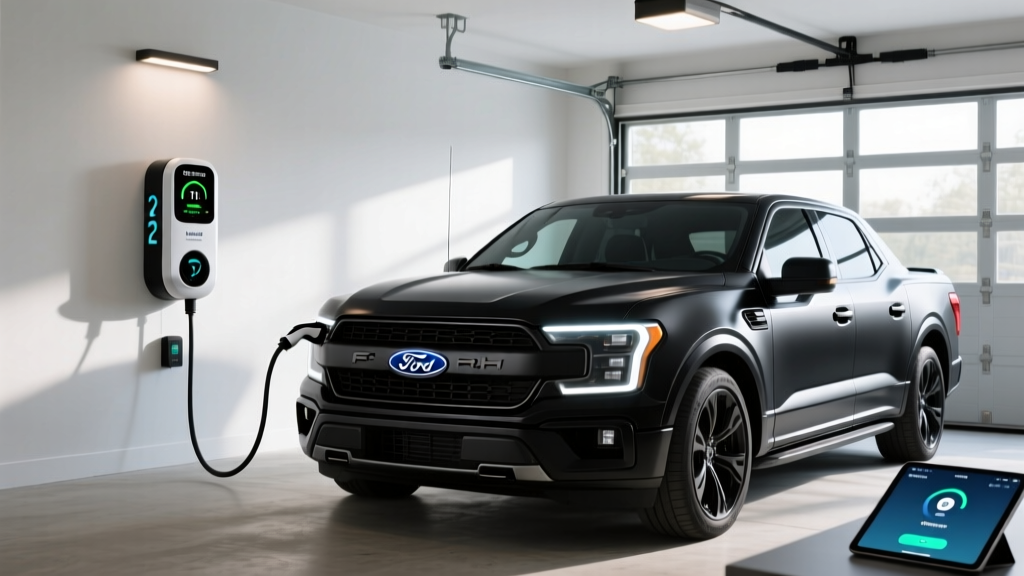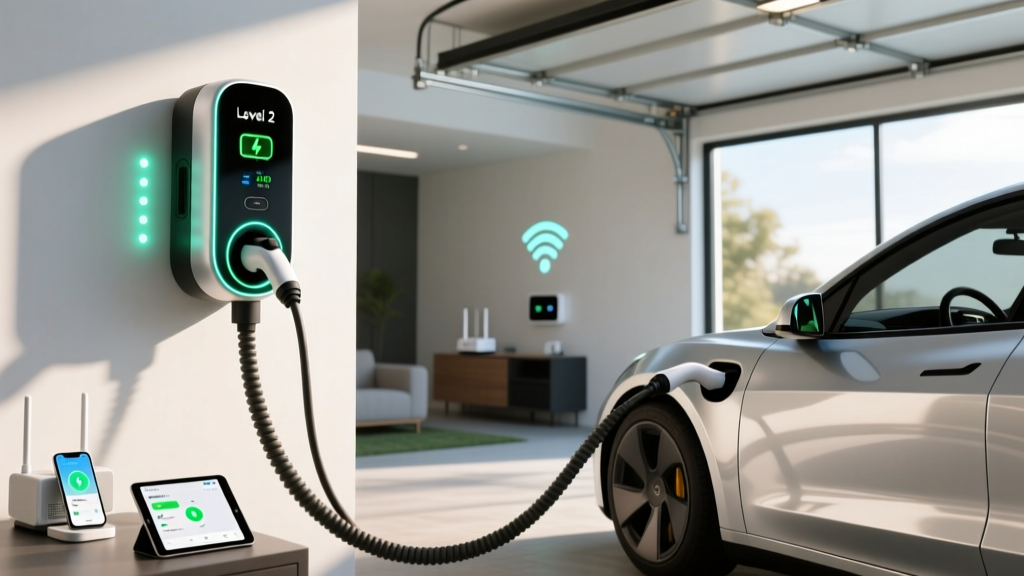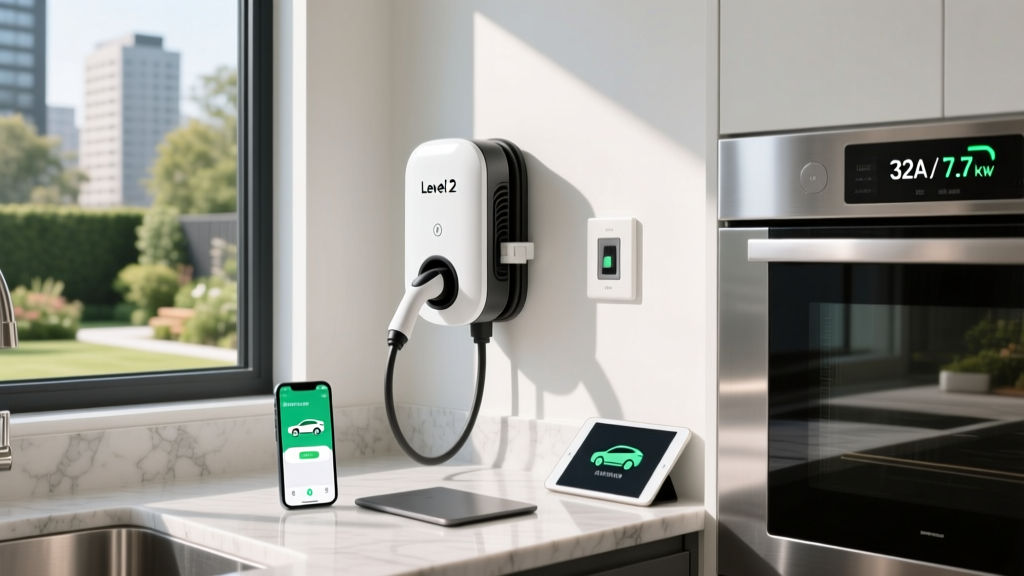
If you own or are shopping for an electric vehicle, a Level 2 home EV charger is the single highest-impact upgrade you can make. It transforms overnight parking into a full charge, eliminates most public-charging dependence, and costs a fraction of DC fast charging per mile. But choosing the right unit, understanding your home's electrical capacity, and budgeting for professional installation requires precise numbers — not marketing fluff.
This guide walks through exact charging speeds, real installation cost breakdowns, connector compatibility across every major brand, and the specific hardware we recommend in 2026. We'll also clarify the most common EV-charging confusion: the difference between kW (power — how fast energy flows) and kWh (energy — how much your battery holds). Getting this right is essential for sizing your charger and circuit correctly.
Charging Levels Explained: kW Speeds and Miles Added Per Hour
Every EV sold in the US supports at least two charging levels, and most support three. Here's what each delivers in practical terms:
| Level | Voltage | Power (kW) | Miles of Range Per Hour | Typical Use |
|---|---|---|---|---|
| Level 1 | 120V AC | 1.0–1.4 kW | 3–5 mi/hr | Emergency / PHEV overnight top-off |
| Level 2 | 240V AC | 3.3–19.2 kW | 12–75 mi/hr | Home daily charging, workplace, retail |
| DC Fast (Level 3) | 400–800V DC | 50–350 kW | 150–1,000+ mi/hr (peak) | Road trips, highway corridors |
Why kW matters for your circuit: A 48-amp Level 2 charger delivers up to 11.5 kW on a 240V circuit (48A × 240V = 11,520W). That's roughly 30–40 miles of range added per hour for a typical midsize EV like the Tesla Model Y or Hyundai Ioniq 5. A 72-amp (80A circuit) unit can push 17.3 kW, adding 50+ miles per hour — useful for larger-battery trucks like the Ford F-150 Lightning (131 kWh usable) or Rivian R1T.
kW vs. kWh — the critical distinction: Your EV battery capacity is measured in kilowatt-hours (kWh) — the total energy it stores. Your charger's output is measured in kilowatts (kW) — the rate of energy delivery. Think of kWh as the size of a bucket and kW as the flow rate of the hose filling it. A 75 kWh battery charged at 11.5 kW takes roughly 6.5 hours from empty to full (75 ÷ 11.5 ≈ 6.5), though charging slows as the battery approaches full — more on that below.
How Much Does It Cost to Install a Level 2 Home EV Charger?
Installation cost varies enormously based on your electrical panel's capacity, the distance from panel to charger location, and local permit requirements. Here's a realistic 2026 breakdown:
| Component | Simple Install (Panel Adjacent) | Standard Install (50–100 ft run) | Complex Install (Panel Upgrade + Long Run) |
|---|---|---|---|
| Level 2 Charger Unit | $350–$700 | $350–$700 | $350–$700 |
| Electrician Labor | $300–$600 | $600–$1,500 | $1,500–$3,500 |
| Electrical Permit | $50–$150 | $50–$250 | $100–$400 |
| Panel Upgrade (if needed) | $0 | $0–$500 (subpanel) | $2,000–$5,000+ |
| Conduit / Wiring Materials | $50–$150 | $200–$500 | $500–$1,500 |
| Total Estimated Range | $750–$1,600 | $1,200–$3,450 | $4,450–$11,100 |
The panel upgrade wildcard: Homes built before 2000 often have 100-amp main panels already near capacity. Adding a 40–60 amp dedicated EV circuit may require upgrading to a 200-amp service — a $2,000–$5,000 job on its own. Before purchasing any charger, have a licensed electrician perform a load calculation on your panel. Some utilities offer rebates of $250–$1,000 for panel upgrades tied to EV adoption; check your local provider.
Federal tax credit for home charging: Under IRS §30C, the Alternative Fuel Vehicle Refueling Property Credit covers 30% of home charger equipment and installation costs, up to $1,000. This credit has income limits and is subject to prevailing-wage requirements for installations placed in service after 2022. It is separate from the §30D vehicle purchase credit. Consult a tax professional to confirm your eligibility — rules vary by census tract and tax year.
Electrical Requirements: Voltage, Amperage, and Circuit Sizing
Every Level 2 home EV charger requires a 240-volt dedicated circuit — the same voltage as your electric dryer or oven. The circuit amperage must exceed the charger's maximum draw by at least 25% per the National Electrical Code (NEC Article 625), because EV charging is classified as a continuous load (3+ hours).
- 16-amp charger (3.8 kW): Requires a 20-amp breaker
- 32-amp charger (7.7 kW): Requires a 40-amp breaker
- 40-amp charger (9.6 kW): Requires a 50-amp breaker
- 48-amp charger (11.5 kW): Requires a 60-amp breaker
- 64-amp charger (15.4 kW): Requires an 80-amp breaker
- 80-amp charger (19.2 kW): Requires a 100-amp breaker
Hardwired vs. plug-in: Chargers rated at 40 amps or below are commonly available with a NEMA 14-50 plug (the same 240V outlet used by some ranges and RVs). Chargers above 40 amps are typically hardwired directly to the breaker panel — no plug. Hardwired installations are more reliable (no plug wear, no GFCI nuisance trips) and are required by code in some jurisdictions for higher-amperage circuits.
Safety and code essentials:
- The circuit must be dedicated — no other outlets or appliances on the same breaker
- Outdoor chargers must carry a NEMA 4 (weatherproof) rating
- NEC 2020+ requires GFCI protection on some 240V receptacles in garages — hardwired units bypass this requirement
- Wire gauge must match circuit amperage: 6 AWG copper for 60A, 4 AWG for 80A, etc.
- All work must be permitted and inspected per local code — unpermitted installs can void home insurance
Connector Compatibility: NACS, CCS, and CHAdeMO in 2026
The connector landscape shifted dramatically in 2024–2025 when nearly every major automaker adopted the North American Charging Standard (NACS), originally developed by Tesla. For Level 2 home charging, here's where things stand:
| Connector | Brands Using It (Native) | Level 2 Home Charging | Adapter Needed? |
|---|---|---|---|
| NACS (J3400) | Tesla, Ford, GM, Rivian, Hyundai, Kia, Volvo, Polestar, BMW, Mercedes, Nissan (2026+) | Yes — NACS wall connectors widely available | No for new EVs; CCS-to-NACS adapters available |
| CCS1 (J1772 combo) | VW, Audi, older Ford/GM/Hyundai/Kia (pre-2025), Stellantis, Lucid | Yes — J1772/CCS chargers still sold | NACS-to-J1772 adapter for newer chargers |
| CHAdeMO | Nissan Leaf (legacy only, discontinued) | Rare — Level 2 uses J1772 portion only | N/A for home L2 (CHAdeMO is DC only) |
Key takeaway for home chargers: All Level 2 charging in North America uses the J1772 signaling protocol, whether the physical connector is J1772 (CCS vehicles) or NACS. A NACS-connector Level 2 charger will directly plug into any 2025+ Ford, GM, Rivian, Hyundai, or Kia EV. For older CCS1-port vehicles, a J1772-to-NACS adapter ($50–$150) or a J1772-connector charger will work. Tesla vehicles can use any NACS charger natively.
When choosing a charger, match the connector to your current EV — but if you plan to switch brands, consider a universal J1772 unit with a NACS adapter, or vice versa. The J1772 standard is being phased out for new vehicles but will remain backward-compatible via adapters for years.
Charging Time Examples: 10–80% and Full Charges at Home
How long a Level 2 home EV charger takes depends on your battery size (kWh) and the charger's power output (kW). Here are real-world examples for popular 2025–2026 EVs using a 48-amp (11.5 kW) charger — the most common hardwired home setup:
| Vehicle | Battery (Usable kWh) | Max AC Charge Rate | 10–80% Time | 0–100% Time |
|---|---|---|---|---|
| Tesla Model Y Long Range | 75 kWh | 11.5 kW | ~4.5 hrs | ~6.5 hrs |
| Hyundai Ioniq 5 (Long Range) | 77.4 kWh | 10.9 kW | ~5.0 hrs | ~7.1 hrs |
| Ford F-150 Lightning (Extended) | 131 kWh | 19.2 kW* | ~8.0 hrs† | ~11.4 hrs† |
| Chevrolet Equinox EV | 85 kWh | 11.5 kW | ~5.2 hrs | ~7.4 hrs |
| Toyota bZ4X | 64 kWh | 7.2 kW | ~5.0 hrs‡ | ~8.9 hrs‡ |
*F-150 Lightning Extended Range supports optional 19.2 kW onboard charger; standard is 11.5 kW.
†Times shown at 11.5 kW charger; with 19.2 kW unit, reduce by ~40%.
‡bZ4X onboard charger caps at 7.2 kW — a 48A charger will not charge it faster.
Your vehicle's onboard charger is the bottleneck: Even if you install a 19.2 kW (80-amp) charger, a vehicle with a 7.2 kW onboard charger (like the bZ4X or base Nissan Ariya) will only draw 7.2 kW. Always check your EV's maximum AC charge rate — per fueleconomy.gov — before oversizing your home unit. For most 2025–2026 EVs with 11.5 kW onboard chargers, a 48-amp unit is the sweet spot.
Cost Per Mile: Home Charging vs. Gas vs. Public DC Fast
One of the strongest arguments for a Level 2 home EV charger is economics. Here's how costs compare across charging scenarios and a gas baseline, using a midsize EV averaging 3.5 miles/kWh (roughly 100 MPGe combined) and a gas car at 28 MPG combined:
| Scenario | Rate | Cost Per Mile | Annual Cost (12,000 mi) |
|---|---|---|---|
| Home Level 2 (national avg. $0.16/kWh) | $0.16/kWh | $0.046 | $550 |
| Home Level 2 (off-peak TOU rate $0.09/kWh) | $0.09/kWh | $0.026 | $310 |
| Public Level 2 (avg. $0.25/kWh) | $0.25/kWh | $0.071 | $857 |
| DC Fast Charging (avg. $0.45/kWh) | $0.45/kWh | $0.129 | $1,543 |
| Gas Car (28 MPG, $3.40/gal) | $3.40/gal | $0.121 | $1,457 |
Home Level 2 charging on a time-of-use (TOU) off-peak rate is roughly 5x cheaper per mile than gas. Even at standard residential rates, it's less than half the cost. Public DC fast charging, however, approaches or exceeds gas costs — which is why home charging is the economic backbone of EV ownership.
Preconditioning tip: Most EVs let you schedule departure times or precondition the battery via the app while plugged in. This warms the battery to optimal temperature using grid power rather than battery energy, improving efficiency and enabling faster DC charging on cold mornings. It's a free efficiency gain you only get with a home charger.
Best Level 2 Home EV Chargers for 2026
We evaluate home chargers on five criteria: power output, connector compatibility, cable length, smart features (scheduling, load management), and build quality. Here are our top picks across common use cases:
Best Overall: Tesla Wall Connector (Gen 4, NACS)
- Power: Up to 48A (11.5 kW) on 60A circuit
- Connector: NACS native
- Cable: 24 ft
- Smart features: Wi-Fi, OTA updates, Power Sharing (link up to 6 units on one circuit), scheduled charging via Tesla app
- Price: ~$425
- Best for: Tesla, Ford, GM, Rivian, Hyundai/Kia (2025+), and any NACS-equipped EV
Best Universal: ChargePoint Home Flex (J1772 or NACS)
- Power: Up to 50A (12 kW) on 60A circuit; adjustable 16–50A via DIP switches
- Connector: Available in J1772 or NACS
- Cable: 23 ft
- Smart features: Wi-Fi, ChargePoint app with scheduling, energy tracking, Alexa integration
- Price: ~$550–$650
- Best for: Multi-EV households, mixed connector needs, adjustable amperage for panel-constrained homes
Best High-Power: Emporia Vue Linked (NACS or J1772)
- Power: Up to 48A (11.5 kW); 80A version available at 19.2 kW
- Connector: NACS or J1772 options
- Cable: 24 ft
- Smart features: Integrates with Emporia Vue energy monitor for whole-home load management, solar-aware charging, TOU scheduling
- Price: ~$400–$550
- Best for: Solar-panel owners, homes needing active load management to avoid panel upgrades
Best Budget: Lectron V-BOX Pro (J1772)
- Power: 40A (9.6 kW) on 50A circuit
- Connector: J1772
- Cable: 20 ft
- Smart features: Basic LED status, no Wi-Fi/app — plug-and-charge simplicity
- Price: ~$250–$300
- Best for: Budget-conscious installs, older CCS1-port EVs, no-frills reliability
Load management matters: If your electrical panel is near capacity, smart chargers like the Emporia or ChargePoint can dynamically reduce charge rate when other household loads spike (dryer, HVAC, oven). This may let you avoid a costly panel upgrade entirely — a $300–$500 smart charger saving you $2,000+ in electrical work.
Frequently Asked Questions
How much does it cost to install a home EV charger?
A straightforward Level 2 home EV charger installation typically costs $750–$1,600 when the charger is near the electrical panel. A standard run of 50–100 feet costs $1,200–$3,450. If your home needs a 200-amp panel upgrade, total costs can reach $4,500–$11,000+. Always get a load calculation from a licensed electrician before purchasing equipment. The federal §30C tax credit can offset up to $1,000 (30%) of equipment and installation.
How fast will each charging level add range?
Level 1 (120V) adds roughly 3–5 miles per hour. Level 2 (240V) adds 12–75 miles per hour depending on amperage (16A to 80A) and your EV's onboard charger capacity. DC fast charging adds 150–1,000+ miles per hour at peak, but is only practical for road trips due to cost and battery-health considerations. For daily driving, a 48A Level 2 charger adding ~35 miles/hour is sufficient to fully recharge most EVs overnight.
Which connector/charger is compatible with my EV?
For 2025–2026 model-year EVs from Tesla, Ford, GM, Rivian, Hyundai, Kia, Volvo, BMW, and Mercedes, the connector is NACS. For older models or VW/Audi/Stellantis vehicles, it's likely CCS1 (J1772 combo). All Level 2 home chargers use J1772 signaling regardless of physical plug shape. Buy a charger matching your EV's port, or use an adapter ($50–$150). Check your owner's manual or the EPA's fueleconomy.gov vehicle listings for your specific port type.
How much does charging cost per mile vs gas?
Home Level 2 charging at the national average residential rate ($0.16/kWh) costs roughly $0.046 per mile — about 60% less than gasoline at $3.40/gallon for a 28 MPG car ($0.121/mile). On off-peak TOU rates ($0.09/kWh), home charging drops to $0.026/mile, roughly 5x cheaper than gas. Public DC fast charging ($0.40–$0.50/kWh) is comparable to or more expensive than gas, which is why a home charger is essential for EV economics.
What electrical upgrades might I need?
Three upgrades are common: (1) A new dedicated 240V circuit with appropriate breaker and wire gauge — standard for any install. (2) A subpanel if your main panel lacks physical breaker spaces. (3) A full service upgrade from 100A to 200A if your panel is near capacity — common in pre-2000 homes with electric heating, dryers, and ranges. A licensed electrician's load calculation (typically $100–$200 as a standalone service) will determine which scenario applies to your home. Smart chargers with load management can sometimes avoid the need for a panel upgrade entirely.
Can I install a Level 2 charger myself?
If you're using a NEMA 14-50 plug-in unit and the outlet already exists (e.g., for a dryer or welder), you can plug in yourself. However, installing a new 240V circuit involves working inside your main breaker panel with lethal voltages and must comply with NEC Article 625 and local building codes. Most jurisdictions require a licensed electrician and an inspection. DIY electrical work without permits can void homeowner's insurance and create fire risk. We strongly recommend professional installation for all new circuits.
Does Level 2 charging degrade my EV battery?
No — Level 2 charging at home is actually better for long-term battery health than frequent DC fast charging. Battery degradation is primarily driven by heat and high C-rates (charge speed relative to battery capacity). A 11.5 kW charge rate into a 75 kWh battery is roughly a 0.15C rate — very gentle. Per battery-health research, keeping your EV between 20–80% SoC for daily use and using the vehicle's built-in charge-limit setting will maximize longevity. Most 2026 EVs carry an 8-year/100,000-mile battery warranty guaranteeing at least 70% capacity retention, per NHTSA and manufacturer disclosures.