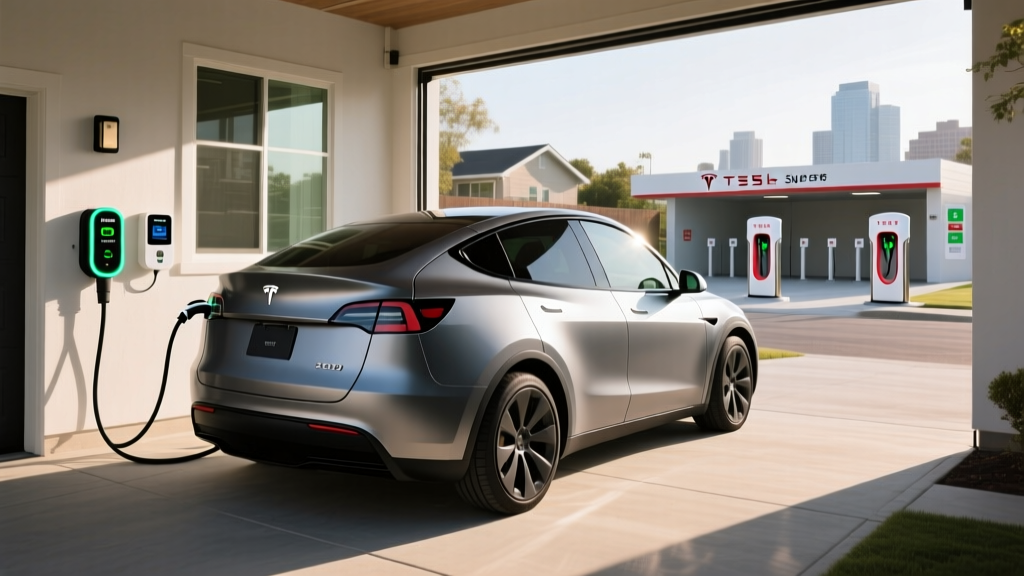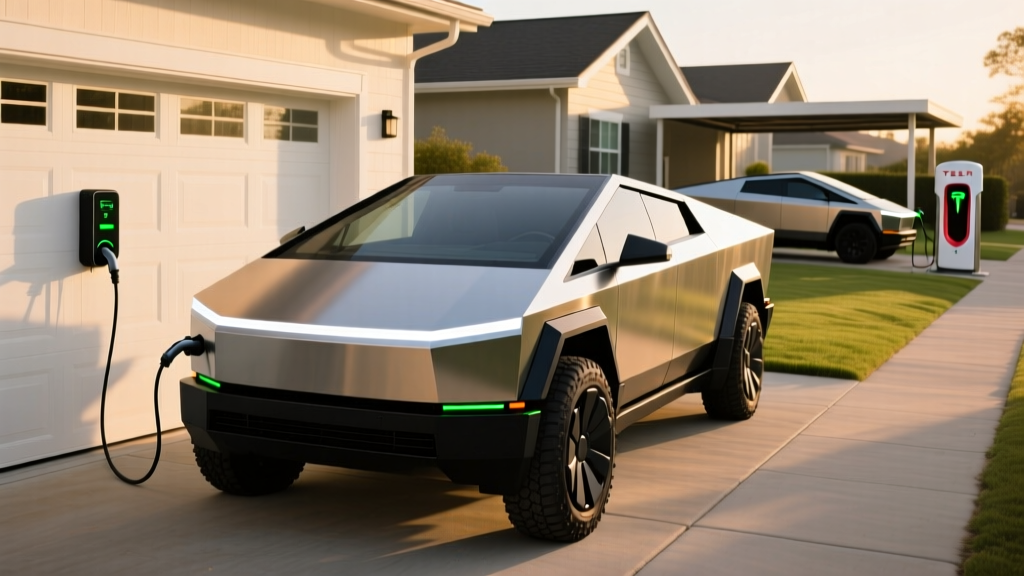
The 2025 Tesla Cybertruck Long Range is one of the largest, heaviest, and most power-hungry electric vehicles on the road. With an EPA-estimated 340 miles of range, a massive battery pack, and a 2,400-pound-plus payload capacity, keeping this truck charged demands more planning than a compact EV. Whether you're wiring a Level 2 charger in your garage, mapping Supercharger stops on a highway run, or calculating your true cost per mile, this guide gives you the exact numbers you need.
We'll cover the Cybertruck Long Range's battery and charging specs, break down every charging level by speed and cost, walk through a real home installation budget (including the panel upgrade scenario most guides skip), and compare what you'll actually pay versus fueling a gas truck. All figures reflect the 2025 model year and current 2026 infrastructure realities.
2025 Cybertruck Long Range: Battery, Range, and Charging Specs
Before plugging in, you need the baseline numbers. The 2025 Tesla Cybertruck Long Range uses a dual-motor all-wheel-drive powertrain with an estimated usable battery capacity of approximately 123 kWh (NMC chemistry). Tesla does not publish exact usable kWh figures, but independent teardown analysis and efficiency calculations place it in this range.
| Specification | Value |
|---|---|
| EPA Range | 340 miles |
| Real-World Highway Range | ~270–295 mi (70+ mph, moderate temps) |
| Real-World Cold-Weather Range | ~230–260 mi (below 32°F) |
| Battery Capacity (est. usable) | ~123 kWh (NMC) |
| Max DC Fast Charge Rate | 250 kW (peak) |
| 10–80% DC Fast Charge Time | ~35–40 minutes |
| Level 2 Charge Rate (max onboard) | 11.5 kW (48A) |
| Level 2 Full Charge Time (0–100%) | ~11–12 hours |
| Connector | NACS (native Tesla) |
| MPGe (combined) | 79 MPGe |
| Efficiency | ~42 kWh/100 mi |
| 0–60 mph | 4.1 seconds |
| Horsepower | 600 hp |
| Base MSRP | $79,990 (excl. destination) |
| Battery & Drive Unit Warranty | 8 years / 120,000 miles |
Charging Levels Explained: Speed, Power, and Miles Per Hour
Understanding the three charging tiers is essential for a vehicle with a battery this large. A critical distinction: kW (kilowatts) measures power — how fast energy flows into the battery. kWh (kilowatt-hours) measures energy — the total capacity of the battery, like gallons in a fuel tank. A 250 kW charger doesn't deliver 250 kWh; it delivers energy at a rate of 250 kW, filling a 123 kWh battery over time.
| Level | Power (kW) | Voltage / Amperage | Miles of Range Added Per Hour | Typical Use Case |
|---|---|---|---|---|
| Level 1 (120V outlet) | ~1.4 kW | 120V / 12A | ~3–4 mi/hr | Emergency / overnight trickle only |
| Level 2 (240V home/public) | 11.5 kW (vehicle max) | 240V / 48A | ~27–30 mi/hr | Daily home charging, workplace |
| DC Fast Charge (Supercharger) | Up to 250 kW (peak) | 400–800V DC | ~180–250 mi/hr (at peak) | Road trips, rapid top-ups |
At Level 1, fully recharging the Cybertruck Long Range from empty would take roughly 88 hours — essentially useless for daily driving. Level 2 is where 90% of your charging will happen. At 11.5 kW, you'll recover roughly 27–30 miles of range per hour, meaning an overnight session of 10 hours adds approximately 270–300 miles — enough to replenish most daily driving and then some.
DC fast charging on a V3 Tesla Supercharger peaks at 250 kW but does not sustain that rate. The charge curve tapers significantly above 50–60% state of charge (SoC). Expect roughly 15 minutes to go from 10% to 50%, then another 20–25 minutes to reach 80%. Charging from 80% to 100% on DC fast charge is painfully slow and generally not recommended — Tesla's battery management system throttles the rate to protect cell longevity.
Home Charger Installation: Electrical Requirements and Costs
Installing a Level 2 home charger for the Cybertruck Long Range is not a simple plug-and-play job. This truck's 11.5 kW onboard charger can accept up to 48 amps, which means you need a dedicated 60-amp circuit (electrical code requires circuits to be rated at 125% of continuous load — 48A × 1.25 = 60A breaker).
Electrical Requirements at a Glance
- Voltage: 240V (split-phase, standard US residential)
- Amperage: 60A dedicated circuit for full 48A charging
- Wire gauge: 6 AWG copper (or 4 AWG aluminum) for runs up to ~50 feet
- Connector: NACS (Tesla proprietary, now industry standard) or J1772 with Tesla adapter
- Outlet vs. hardwired: Hardwired recommended for 60A circuits (NEMA 14-50 outlets rated for 50A max)
| Component | Cost Range (No Panel Upgrade) | Cost Range (With 200A Panel Upgrade) |
|---|---|---|
| Level 2 Charger Equipment | $400 – $750 | $400 – $750 |
| Electrician Labor (2–6 hrs) | $600 – $1,800 | $600 – $1,800 |
| Electrical Permit | $50 – $200 | $50 – $200 |
| Panel Upgrade (if needed) | N/A | $1,500 – $3,500 |
| Conduit, Wire, Misc. Materials | $100 – $400 | $100 – $400 |
| Total Estimated Cost | $1,150 – $3,150 | $2,650 – $6,650 |
The wide range reflects variables like panel-to-garage distance (longer wire runs cost more), whether conduit must be run through walls or underground, and local labor rates. Homes with an attached garage and the panel on the same wall as the charger will be at the low end. Detached garages or long conduit runs push costs higher.
Always hire a licensed electrician and pull a permit. Unpermitted electrical work can void your homeowner's insurance and create fire risk — especially at 60A continuous loads.
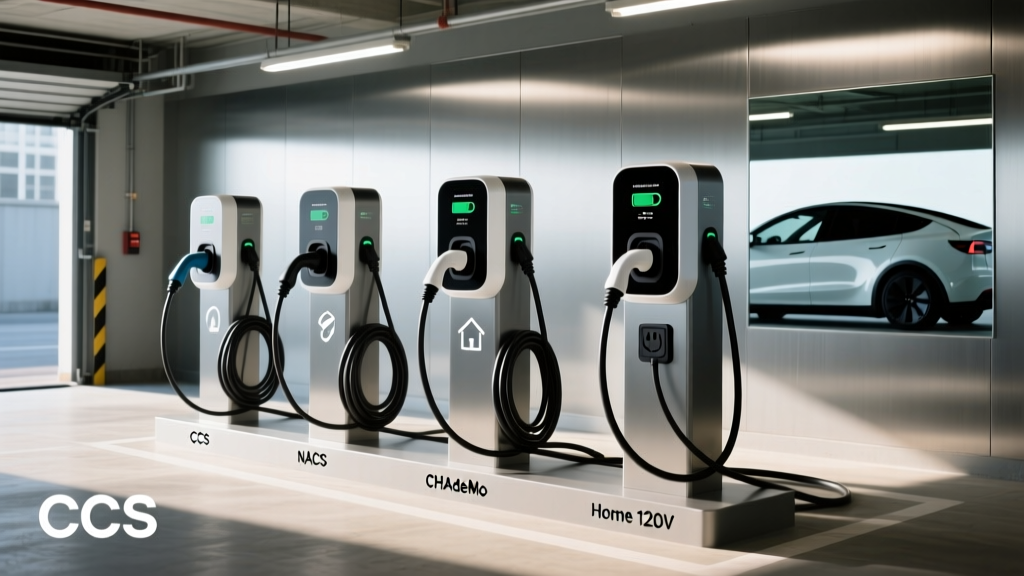
Connector Compatibility: NACS, CCS, and Adapter Needs
The 2025 Cybertruck Long Range comes equipped with a native NACS (North American Charging Standard) port — Tesla's proprietary connector, now adopted by Ford, GM, Rivian, Hyundai, and most major automakers for 2025+ models. This means the Cybertruck plugs directly into the entire Tesla Supercharger network without any adapter.
| Connector Type | Native Support? | Adapter Needed? | Network Access |
|---|---|---|---|
| NACS (Tesla) | Yes — native | No | Tesla Supercharger (20,000+ stalls in US) |
| CCS1 | No | Yes — Tesla CCS Adapter (~$175) | Electrify America, EVgo, ChargePoint DC stations |
| CHAdeMO | No | Not recommended (no official adapter) | Limited legacy network — declining |
| J1772 (Level 2 public) | No (for non-Tesla L2) | Yes — Tesla J1772 Adapter (included with vehicle) | Public Level 2 stations, workplaces, hotels |
The Tesla CCS adapter is worth purchasing if you frequently travel in areas where Supercharger coverage is sparse but Electrify America or other CCS networks have stations. However, for most Cybertruck owners, the Supercharger network alone covers 95%+ of road-trip needs. Tesla's in-car navigation automatically routes through Superchargers and preconditions the battery for optimal charge speed on arrival.
Cost to Charge: Home vs. Public vs. Gas Truck Comparison
The Cybertruck Long Range's efficiency of roughly 42 kWh per 100 miles makes it one of the less efficient EVs on the market — a consequence of its 6,600+ lb curb weight and angular aerodynamics. That means charging costs per mile are higher than a sedan EV but still competitive with gas trucks.
| Scenario | Cost per kWh / Gallon | Cost Per Mile (Cybertruck) | Cost Per Mile (F-150 Gas, 20 MPG) |
|---|---|---|---|
| Home Charging (off-peak utility rate) | $0.12/kWh | $0.050 | — |
| Home Charging (average US rate) | $0.16/kWh | $0.067 | — |
| Public Level 2 (ChargePoint, etc.) | $0.25/kWh | $0.105 | — |
| Tesla Supercharger (avg US) | $0.30/kWh | $0.126 | — |
| Non-Tesla DC Fast (EA, EVgo) | $0.38/kWh | $0.160 | — |
| Gasoline (US avg $3.50/gal) | $3.50/gal | — | $0.175 |
| Gasoline (US avg $4.00/gal) | $4.00/gal | — | $0.200 |
At home on off-peak rates, the Cybertruck costs roughly $0.05 per mile — about 70% cheaper than a comparable gas truck at $3.50/gallon. Even on Tesla Superchargers at $0.30/kWh, you're paying $0.126/mile versus $0.175/mile for gas. The savings narrow significantly on third-party DC fast networks at $0.38/kWh, where the Cybertruck's large battery makes each fill-up expensive: a 10–80% session (~86 kWh added) would cost roughly $32.68 at Electrify America.
Annual fuel cost estimate (15,000 miles/year, 80% home / 20% Supercharger mix): approximately $1,020 for the Cybertruck versus $2,625 for the F-150 gas truck at $3.50/gal — a savings of roughly $1,600 per year. Your actual savings depend on local electricity rates, which vary widely. Check your utility's EV-specific time-of-use (TOU) rate plans to maximize off-peak savings.
Best Home Level 2 Chargers for the Cybertruck Long Range
To take full advantage of the Cybertruck's 11.5 kW / 48A onboard charger, you need a Level 2 unit capable of delivering at least 48 amps on a 60-amp circuit. Here are three proven options that pair well with this truck:
Tesla Wall Connector (Gen 4)
- Power Output: Up to 11.5 kW (48A)
- Connector: NACS (native)
- Cable Length: 24 feet
- Smart Features: Wi-Fi, OTA updates, power sharing with second unit, load management
- Price: ~$475
- Best For: Tesla-only households — seamless integration, cleanest install
ChargePoint Home Flex
- Power Output: Up to 12 kW (50A, configurable down to 16A)
- Connector: J1772 (use included Tesla adapter) or NACS pigtail version
- Cable Length: 23 feet
- Smart Features: Wi-Fi, app scheduling, Alexa integration, flexible amperage settings
- Price: ~$699
- Best For: Multi-EV households with mixed Tesla and non-Tesla vehicles
Emporia Level 2 EV Charger
- Power Output: Up to 11.5 kW (48A)
- Connector: J1772 (Tesla adapter needed) or NACS version
- Cable Length: 24 feet
- Smart Features: Wi-Fi, energy monitoring via Emporia Vue panel integration, TOU scheduling
- Price: ~$399
- Best For: Budget-conscious buyers who want energy monitoring and solar integration
For Cybertruck-only households, the Tesla Wall Connector is the obvious pick — native NACS, no adapter fumbling, and power-sharing capability if you add a second EV later. The ChargePoint Home Flex earns its premium price with flexible amperage configuration, useful if your electrical panel can't support a full 60A circuit (it can be dialed down to 40A or 32A via the app without an electrician visit).
Safety, Code, and Installation Best Practices
A 60-amp continuous-load circuit is serious electrical infrastructure. Here are the non-negotiable safety requirements:
- Dedicated circuit: The charger must be on its own breaker — never shared with other appliances. A 60A breaker with 6 AWG copper wire is required for 48A continuous charging.
- GFCI protection: The 2023 NEC (National Electrical Code) requires GFCI protection for all EV charging outlets rated 150V to ground or less and 60A or less. Hardwired installations may be exempt depending on local code interpretation — your electrician will determine this.
- Outdoor rating: If your charger is mounted outside or in an unsealed garage, ensure the unit is rated NEMA 4 (weather-resistant). The Tesla Wall Connector and ChargePoint Home Flex both carry NEMA 4 ratings.
- Permit and inspection: Every jurisdiction requires a permit for new 240V circuits. The inspection ensures proper wire gauge, breaker sizing, grounding, and GFCI compliance. Skipping this risks insurance denial in the event of an electrical fire.
- Cable management: With a 24-foot cable and the Cybertruck's large footprint, plan your charger placement carefully. The charge port is on the driver-side rear quarter panel — mount the charger on the wall closest to where that corner will sit.
Federal Tax Credit and Incentives for Home Charging
Under current IRS §25C Residential Clean Energy rules, the federal Alternative Fuel Vehicle Refueling Property Credit (Form 8911) covers up to 30% of home EV charger equipment and installation costs, capped at $1,000. This credit is available through 2032 but has a geographic restriction: it applies only to equipment installed in a census tract that is not classified as an "urban area" or that meets specific low-income community criteria.
For the Cybertruck itself, the §30D New Clean Vehicle Credit is more complicated. At a $79,990 base MSRP, the Cybertruck Long Range exceeds the $80,000 MSRP cap for trucks — but only barely. Depending on options and destination charges, some configurations may push above the cap, disqualifying them. Additionally, the buyer must meet income limits ($300,000 joint / $150,000 single for 2026), and the vehicle must meet critical-mineral and battery-component sourcing requirements that shift annually. Always verify current-year eligibility on the IRS qualified vehicles list before purchasing, and consult a tax professional for your specific situation.
Frequently Asked Questions
How much does it cost to install a home EV charger for the Cybertruck?
Expect $1,150–$3,150 for a standard installation (no panel upgrade) covering the charger unit ($400–$750), electrician labor ($600–$1,800), permit ($50–$200), and materials ($100–$400). If your home needs a 200A panel upgrade, add $1,500–$3,500, bringing the total to $2,650–$6,650.
How fast will each charging level add range to the Cybertruck Long Range?
Level 1 (120V) adds roughly 3–4 miles per hour — impractical for daily use. Level 2 (240V, 48A) adds approximately 27–30 miles per hour, recovering ~270 miles overnight. DC fast charging at a V3 Supercharger peaks at ~250 kW, adding up to 200+ miles in the first 15–20 minutes before the charge curve tapers.
Which connector and charger is compatible with my Cybertruck?
The 2025 Cybertruck uses a native NACS connector, plugging directly into all Tesla Superchargers and Tesla Wall Connectors without an adapter. For CCS-based public DC fast chargers (Electrify America, EVgo), you'll need Tesla's CCS adapter (~$175). For non-Tesla Level 2 stations, use the J1772 adapter included with the vehicle.
How much does charging the Cybertruck cost per mile vs. a gas truck?
At home on average electricity rates ($0.16/kWh), the Cybertruck costs about $0.067/mile. A comparable gas truck (20 MPG at $3.50/gal) costs $0.175/mile — roughly 2.6× more. On Superchargers ($0.30/kWh), the Cybertruck costs $0.126/mile, still cheaper than gas. The savings are largest with home charging on off-peak utility rates.
What electrical upgrades might I need for a Cybertruck home charger?
You need a dedicated 60-amp, 240V circuit with 6 AWG copper wire. If your home's electrical panel is 100A or 150A and already near capacity, you may need a service upgrade to 200A ($1,500–$3,500). An electrician will perform a load calculation to determine if your existing panel can handle the additional 60A draw alongside HVAC, range, dryer, and other circuits.
Does the Cybertruck support V2H (vehicle-to-home) or V2L (vehicle-to-load)?
As of the 2025 model year, Tesla has announced Powershare vehicle-to-home capability for the Cybertruck, enabling backup power during outages. However, full V2H functionality requires Tesla's Powerwall or a compatible home energy management system. V2L (powering tools or devices from the truck bed) is available via the bed outlet. Check Tesla's current documentation for feature availability, as software updates continue to expand Powershare capabilities.