Why the Cybertruck Demands a Serious Charging Strategy
The Tesla Cybertruck's massive battery pack — 123 kWh of usable capacity in the AWD and Cyberbeast trims — means that plugging into a standard 120V wall outlet is little more than a trickle. At Level 1 speeds, you'd add roughly 3 miles of range per hour, requiring over 100 hours to fully replenish the pack. For a vehicle with an EPA-estimated range of 340 miles (AWD trim), that's impractical for daily use.
The good news: Tesla's North American Charging Standard (NACS) connector and access to the Supercharger network make the Cybertruck one of the easiest EVs to charge on the road. But at home, where most charging happens, you need a properly sized Level 2 charger and a 240V circuit to make ownership seamless. This guide breaks down every Cybertruck charger option — home, public, and portable — with exact speeds, costs, and equipment picks for 2026.
Charging Levels Explained: Speeds and Range Added Per Hour
Understanding the difference between kW (power, or how fast energy flows) and kWh (energy, or how much the battery stores) is essential. A charger's kW rating tells you its maximum delivery rate; the Cybertruck's 123 kWh battery tells you how much total energy it needs.
| Level | Voltage / Amps | Max Power (kW) | Miles of Range Added Per Hour | Full Charge Time (0–100%) |
|---|---|---|---|---|
| Level 1 (Standard Outlet) | 120V / 12A | ~1.4 kW | ~3 mi/hr | ~88 hours |
| Level 2 (Home / Destination) | 240V / 48A | 11.5 kW | ~30 mi/hr | ~11 hours |
| Level 2 (60A Circuit) | 240V / 48A continuous | 11.5 kW | ~30 mi/hr | ~11 hours |
| DC Fast Charging (Supercharger V4) | — | Peak ~250 kW | ~200+ mi in 15 min | 10–80% in ~25–30 min |
Real-world note: DC fast-charging speeds peak at lower states of charge and taper significantly above 80%. Expect the Cybertruck to pull its maximum ~250 kW only between roughly 10–30% SoC, then taper progressively. A 10–80% session at a V4 Supercharger takes approximately 25–30 minutes under ideal battery preconditioning. Cold weather can add 5–10 minutes to this time.
Home Charger Installation: Electrical Requirements and Costs
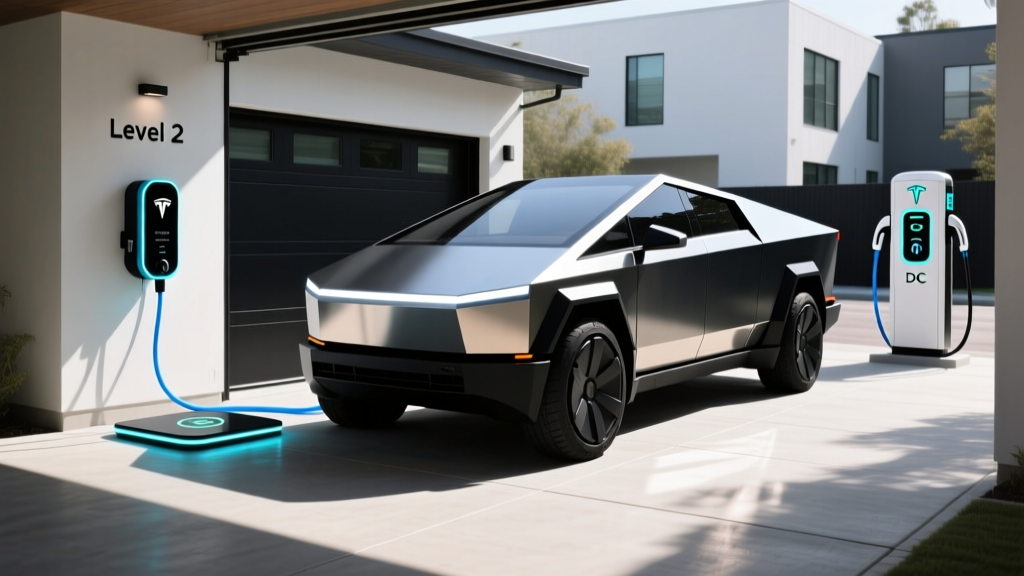
For daily Cybertruck charging, a hardwired Level 2 wall connector on a dedicated 60-amp circuit is the optimal setup. This delivers the full 11.5 kW (48 amps continuous, per the 80% NEC derating rule) that the Cybertruck's onboard charger can accept.
What Your Electrical Panel Needs to Support
A 60-amp EV circuit requires your home's electrical panel to have sufficient spare capacity. Most modern homes with 200-amp service can accommodate this without an upgrade. Older homes with 100-amp or 150-amp panels may need a panel upgrade or a load-management device — especially if you already run electric HVAC, a dryer, and an electric range.
A licensed electrician will perform a load calculation per NEC Article 220 to determine whether your panel can handle the additional draw. If an upgrade is needed, expect the following cost ranges:
| Component | Typical Cost Range | Notes |
|---|---|---|
| Level 2 Charger Equipment | $400 – $700 | Tesla Wall Connector, ChargePoint, Emporia |
| Electrician Labor (Standard Install) | $600 – $1,500 | Varies by run length, conduit, wall type |
| Permit and Inspection | $50 – $250 | Required in most jurisdictions |
| Electrical Panel Upgrade (if needed) | $1,500 – $3,500 | 100A → 200A service upgrade |
| Total (No Panel Upgrade) | $1,050 – $2,450 | Most homes with 200A service |
| Total (With Panel Upgrade) | $2,550 – $5,950 | Older homes with 100A/150A panels |
Federal incentive: The Residential Clean Energy Credit does not cover EV chargers as of 2026. However, the Alternative Fuel Refueling Property Credit (30C) may cover up to $1,000 of home charger equipment and installation for eligible taxpayers in qualifying census tracts. Check IRS guidelines and consult a tax professional for your specific eligibility.
Safety and Code Requirements
- Dedicated circuit: NEC requires EV chargers to be on a dedicated circuit — no sharing with other appliances.
- GFCI protection: 2023 NEC and later require GFCI protection for receptacle-based (plug-in) EV chargers. Hardwired units are exempt in most jurisdictions.
- Outdoor rating: If installing outdoors, ensure the charger is NEMA 4 rated (weatherproof). The Tesla Wall Connector and Emporia Vue both carry NEMA 4 ratings.
- Wire gauge: A 60-amp circuit typically requires 6 AWG copper wire (THHN in conduit) or 4 AWG if using NM-B (Romex) cable, depending on local code.
Which Cybertruck Charger Connector Do You Need?
The Cybertruck uses the NACS (North American Charging Standard) connector — Tesla's proprietary plug that has now been adopted industry-wide. This means you can charge at home with any NACS-equipped Level 2 charger and use Tesla Superchargers natively without an adapter.
| Connector Type | Native Support? | Adapter Needed? | Where You'll Find It |
|---|---|---|---|
| NACS (Tesla) | Yes — native | None | Tesla Superchargers, Tesla Wall Connector, home chargers with NACS plug |
| CCS1 | No | NACS-to-CCS adapter (Tesla sells one) | Electrify America, EVgo, non-Tesla public DC chargers |
| CHAdeMO | No | Not available for NACS vehicles | Largely deprecated; older Nissan Leaf stations |
| J1772 (Level 2) | No | Tesla includes a J1772-to-NACS adapter | Public Level 2 stations, hotels, workplaces |
The Cybertruck ships with a Tesla Mobile Connector and a J1772 adapter in the box. If you plan to use non-Tesla CCS1 DC fast chargers on road trips, purchase Tesla's CCS adapter ($175 MSRP) and keep it in the vehicle.
Cost to Charge a Cybertruck: Home vs. Public vs. Gas Comparison
The Cybertruck AWD consumes approximately 47 kWh per 100 miles (combined) according to EPA data, making it one of the less efficient EVs on the market due to its 6,800+ lb curb weight and angular aerodynamics. Here's what that translates to in real costs:
| Scenario | Cost per kWh or Gallon | Cost per Mile (Cybertruck AWD) | Cost per Mile (Gas Truck @ 19 MPG Combined) |
|---|---|---|---|
| Home Charging (Off-Peak / Utility Rate) | $0.13/kWh | $0.061/mi | — |
| Home Charging (Peak / High-Cost Utility) | $0.28/kWh | $0.132/mi | — |
| Public Level 2 (ChargePoint, etc.) | $0.35/kWh | $0.165/mi | — |
| Tesla Supercharger (Average) | $0.35/kWh | $0.165/mi | — |
| Non-Tesla DC Fast Charger | $0.48/kWh | $0.226/mi | — |
| Gasoline (National Avg $3.50/gal) | $3.50/gal | — | $0.184/mi |
The takeaway: Charging at home on an off-peak utility rate saves roughly $0.12 per mile compared to a gas truck — or about $1,800 over 15,000 miles of annual driving. However, relying exclusively on public DC fast charging can actually cost more than gasoline. Home charging access is the single biggest factor in EV operating economics.
Recommended Cybertruck Chargers for Home Use (2026)
Tesla Wall Connector (Best Overall for Cybertruck)
- Power Output: Up to 11.5 kW (48A) on a 60A circuit
- Connector: NACS — native fit, no adapter
- Cable Length: 24 feet
- Smart Features: Wi-Fi connectivity, OTA firmware updates, power sharing (link two units on one circuit), integrated Tesla app monitoring
- Price: ~$475
- Why it's our pick: The most seamless Cybertruck charging experience. Power sharing lets you install two Wall Connectors on a single 60A circuit — ideal if you also own a second Tesla. The 24-foot cable reaches the Cybertruck's charge port (located on the driver-side rear quarter panel) easily in most garage configurations.
Emporia Level 2 EV Charger (Best Value with Energy Monitoring)
- Power Output: Up to 11.5 kW (48A) on a 60A circuit; configurable down to 32A/40A for smaller circuits
- Connector: NACS (2025+ models); J1772 with adapter for older stock
- Cable Length: 24 feet
- Smart Features: Real-time energy monitoring, solar integration, time-of-use scheduling, whole-home energy dashboard (with Emporia Vue panel monitor)
- Price: ~$400 (charger only); ~$550 with Emporia Vue energy monitor bundle
- Why consider it: If you have solar panels or want granular energy data, the Emporia ecosystem is unmatched. Its configurable amperage means it works on 40A, 50A, or 60A circuits — flexible if your panel can't support a full 60A dedicated run.
ChargePoint Home Flex (Best for Non-Tesla Multi-EV Households)
- Power Output: Up to 12 kW (50A) on a 60A circuit; configurable from 16A to 50A via DIP switches
- Connector: NACS (new 2025+ models) or J1772 (use included Tesla adapter)
- Cable Length: 23 feet
- Smart Features: Alexa integration, ChargePoint app scheduling, charging history, works with utility demand-response programs
- Price: ~$550 (NACS version)
- Why consider it: If your household includes non-Tesla EVs (many now ship with NACS), the ChargePoint Home Flex's flexible amperage configuration and robust app make it a versatile garage staple.
Public Charging the Cybertruck: Supercharger Network and Beyond
The Cybertruck's biggest public charging advantage is native access to Tesla's Supercharger network — over 6,000 V3/V4 stalls across North America as of early 2026. At V3 stalls, expect a peak charge rate of ~250 kW. V4 stalls with the integrated CCS cable cabinet also support 250 kW+ for NACS vehicles.
Real-world charging time (DC Fast): A 10–80% session at a V3 Supercharger with a preconditioned battery takes approximately 25–30 minutes. The Cybertruck's large 123 kWh pack means it sustains useful charging power longer than smaller-battery EVs, but the charge curve still tapers sharply above 80%. Plan to charge to 80% on road trips and skip the slow top-off unless you need the full range for the next leg.
Non-Tesla DC chargers: With Tesla's CCS1 adapter ($175), you can use Electrify America, EVgo, and other CCS-equipped networks. Expect peak speeds of 150–350 kW depending on the station, though the Cybertruck's charge rate will be governed by its own onboard acceptance curve regardless of the charger's maximum output.
Cybertruck Charger FAQ
Can I charge the Cybertruck on a regular 120V outlet?
Yes, using the included Tesla Mobile Connector with the NACS adapter. However, you'll only add about 3 miles of range per hour (~1.4 kW). This is adequate only for emergency top-offs or if you drive fewer than 30 miles per day and can leave it plugged in overnight for 10+ hours.
Does the Cybertruck support 800V or 350 kW charging?
No. The Cybertruck uses a 400V-class architecture, limiting its peak DC charge rate to approximately 250 kW. This means 350 kW chargers from Electrify America or Ionity won't charge the Cybertruck any faster than a 250 kW Tesla Supercharger.
How much does it cost to install a home Cybertruck charger?
Expect $1,050–$2,450 for a standard Level 2 installation (equipment + electrician + permit) if your home has a 200-amp panel with spare capacity. If a panel upgrade from 100A to 200A is required, total costs can reach $2,550–$5,950.
Can I use a NEMA 14-50 outlet instead of hardwiring?
Yes. A NEMA 14-50 outlet on a 50-amp circuit delivers up to 40 amps continuous (9.6 kW), adding roughly 25 miles of range per hour. This is slightly slower than a hardwired 60A/48A setup but offers the advantage of portability — you can unplug and take the Mobile Connector with you. Ensure the outlet is installed by a licensed electrician with a dedicated circuit and proper torque-spec terminations; loose 14-50 outlets are a known fire risk.
Does the Cybertruck qualify for the federal EV tax credit?
As of 2026, the Cybertruck AWD and Cyberbeast trims have an MSRP above the §30D tax credit cap of $80,000 for pickups, making them ineligible for the up-to-$7,500 federal credit. The base Rear-Wheel-Drive Cybertruck (if and when it becomes available) may fall under the cap. Eligibility also depends on buyer income limits, battery component sourcing, and critical mineral requirements — always verify current IRS rules before purchasing.
Should I charge to 100% every night?
No. The Cybertruck uses an NMC (nickel manganese cobalt) battery chemistry, which degrades faster when held at 100% SoC for extended periods. Tesla recommends setting the daily charge limit to 80% and only charging to 100% when you need the full range for a road trip. This practice can meaningfully extend long-term battery health.