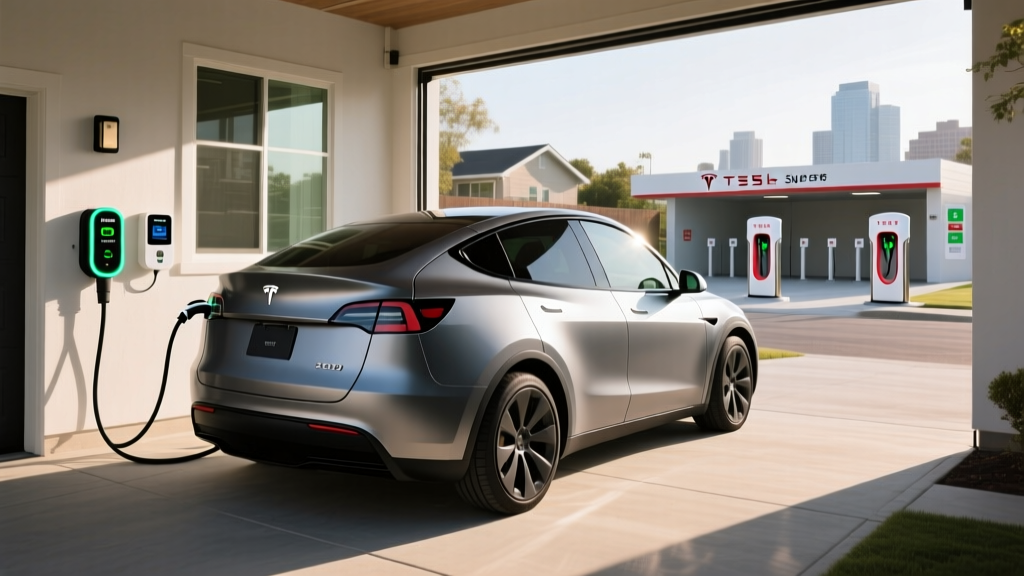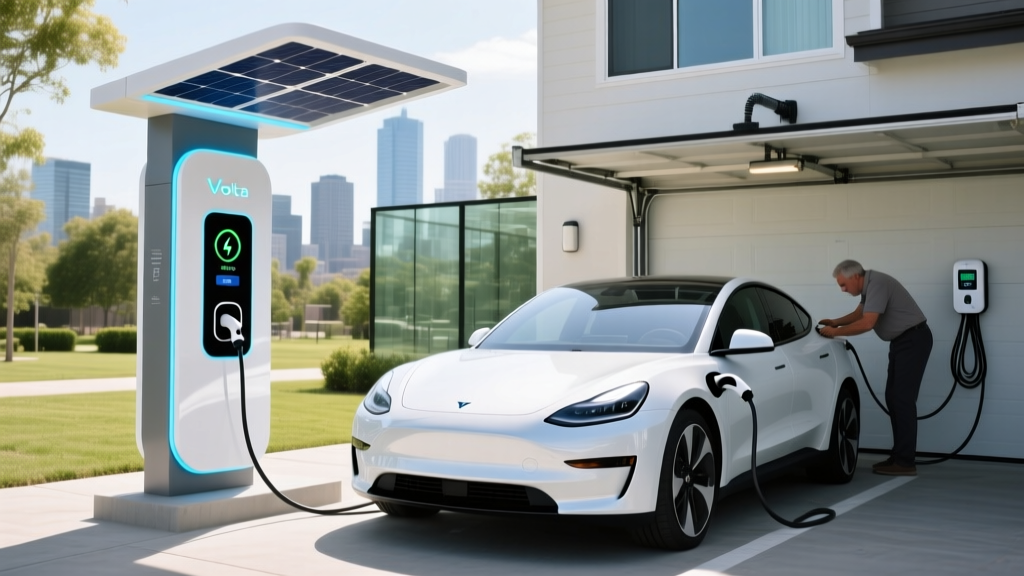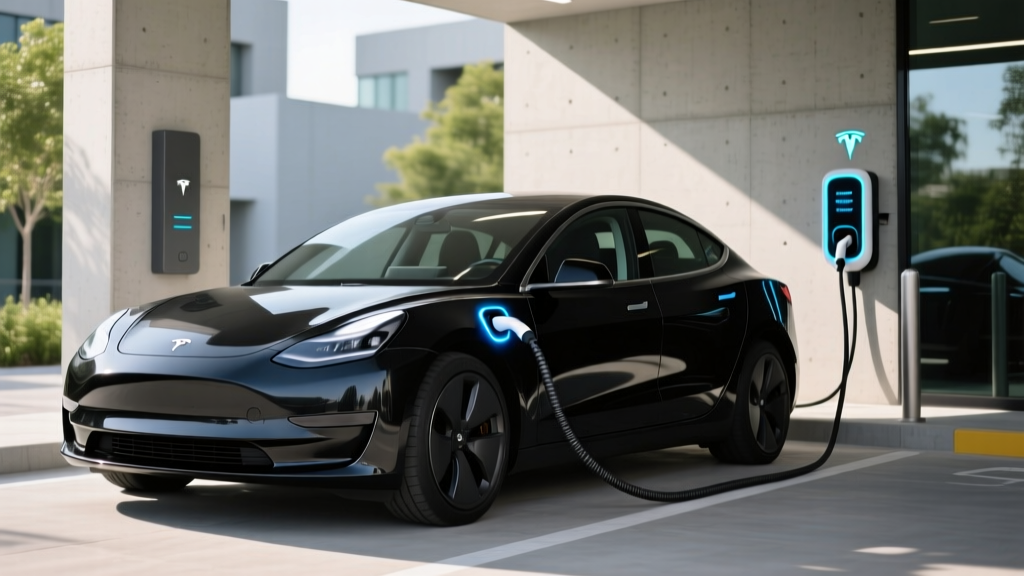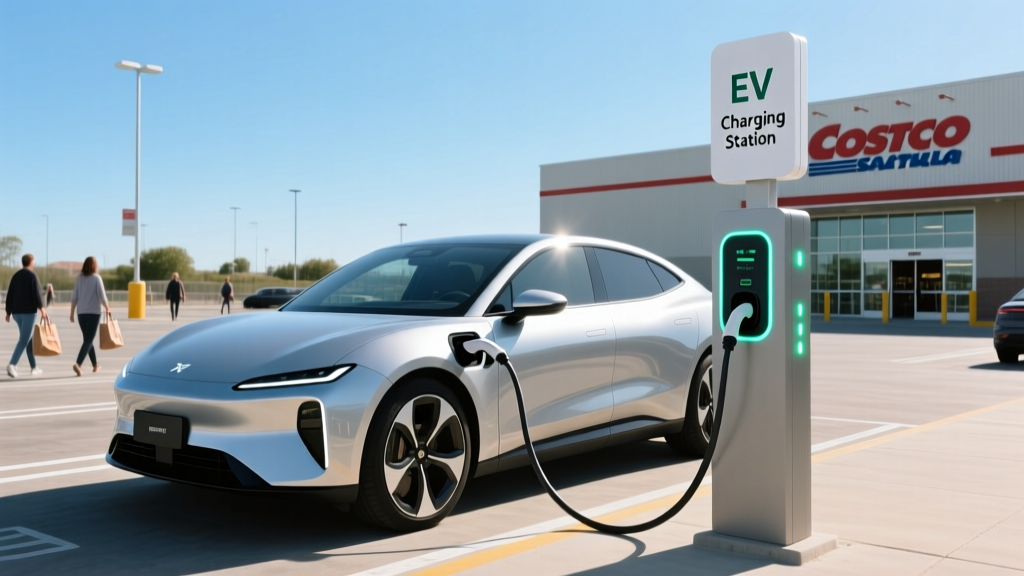
If you're a Costco member shopping for an electric vehicle — or already driving one — you've likely wondered whether you can top up your battery while stocking up on groceries. The short answer: Costco does not operate a universal, company-wide EV charging network. However, a growing number of Costco warehouse locations have third-party Level 2 or DC fast chargers installed in their parking lots by networks like Electrify America, ChargePoint, and EVgo. Availability varies sharply by region, store age, and local utility infrastructure.
This guide breaks down exactly what you'll find at Costco locations in 2026, how fast those chargers actually deliver energy, and — more importantly — how to build a charging strategy that doesn't leave you stranded if your local warehouse doesn't have a plug. We'll cover home installation costs, connector compatibility, real charging speeds, and the per-mile economics that make or break EV ownership.
Does Costco Have EV Chargers? What You'll Actually Find
Costco's corporate position on EV charging has been pragmatic rather than proactive. Unlike retailers such as Walmart (which partnered with Electrify America for nationwide DC fast-charging rollouts) or Target (which hosts ChargePoint stations at hundreds of locations), Costco has not mandated EV charging infrastructure across its roughly 600+ U.S. warehouses.
Instead, charging availability at Costco is determined by three factors:
- Third-party network agreements: Charging companies negotiate leases with individual property owners or regional Costco real estate managers. A ChargePoint or EVgo cluster at one Costco doesn't guarantee the same at another.
- Local utility capacity: DC fast chargers (50–350 kW) require significant electrical infrastructure — often a dedicated transformer and 480V three-phase service. Older Costco locations in dense urban areas may lack the grid headroom.
- State and municipal mandates: States like California, Washington, and New York increasingly require new commercial construction to include EV-ready parking. Newer Costco warehouses in these states are more likely to have chargers from day one.
How to check your local Costco: Before driving to a warehouse expecting a charge, open the PlugShare, ChargePoint, or Electrify America app and search the specific store address. These apps show real-time availability, connector types, pricing, and whether chargers are currently operational or out of service — a critical detail, since public charger uptime remains a persistent pain point industry-wide.
Charging Levels Explained: Speeds, Times, and Range Added
Whether you're charging at a Costco parking lot, a highway rest stop, or your own garage, every EV charging scenario falls into one of three levels. Understanding these is non-negotiable for EV ownership — and the single most important distinction is between kW (kilowatts), which measures the rate of energy delivery (like water pressure from a hose), and kWh (kilowatt-hours), which measures the total amount of energy stored in your battery (like the size of the bucket being filled).
| Level | Power Output | Voltage / Amps | Miles of Range Added Per Hour | Typical 10–80% Time (75 kWh Battery) | Best For |
|---|---|---|---|---|---|
| Level 1 (Standard Outlet) | 1.2–1.9 kW | 120V / 12–16A | 3–5 miles | 35–45 hours | Overnight top-ups for PHEVs or low-mileage drivers |
| Level 2 (Home/Public AC) | 3.3–19.2 kW | 208–240V / 16–80A | 12–75 miles | 4–8 hours (at 7.2–11.5 kW) | Daily home charging, workplace, retail destinations like Costco |
| DC Fast Charging | 50–350 kW | 400–800V DC | 150–1,200+ miles per hour (peak) | 15–35 minutes | Road trips, highway corridors, quick top-ups |
Why 10–80%? Lithium-ion batteries accept charge fastest at low states of charge (SoC). Above roughly 80%, the battery management system (BMS) throttles the charge rate to protect cell longevity — this is called the charge curve taper. A charger rated at 250 kW may only sustain that peak for the first 10–15 minutes of a session before dropping to 50–100 kW. This is why manufacturers and reviewers quote 10–80% times rather than 0–100%.
Real-world example: A 2026 Hyundai Ioniq 5 (84 kWh usable battery, NMC chemistry) charging at a 350 kW Electrify America station will peak near 240 kW and reach 10–80% in approximately 18 minutes under ideal conditions. In cold weather (below 40°F / 4°C), that same session could stretch to 28–35 minutes unless you precondition the battery via the vehicle's navigation-routed charging feature.
Connector Compatibility: Which Plug Fits Your EV?
The connector landscape in North America has shifted dramatically. As of 2026, the North American Charging Standard (NACS) — originally developed by Tesla — has become the dominant connector, adopted by Ford, GM, Rivian, Hyundai/Kia, BMW, and most major automakers for new vehicles. The legacy CCS1 (Combined Charging System) connector is still present on vehicles sold before the 2025 model year and at many existing public stations. CHAdeMO, used primarily by the Nissan Leaf, is effectively deprecated for new vehicles.
| Connector | Brands Using It (New Vehicles) | DC Fast Charge Capable? | Adapter Needed? |
|---|---|---|---|
| NACS (Tesla) | Tesla, Ford, GM, Rivian, Hyundai, Kia, BMW, Volvo, Polestar, Mercedes (2025+), Toyota (2025+) | Yes — up to 350 kW | CCS-to-NACS adapters available for legacy CCS stations |
| CCS1 | VW ID.4 (pre-2025), some Stellantis models, older Hyundai/Kia/GM | Yes — up to 350 kW | NACS-to-CCS adapter needed at Tesla Superchargers |
| CHAdeMO | Nissan Leaf (discontinued), Mitsubishi Outlander PHEV (older) | Yes — up to 100 kW (mostly 50 kW) | No widely available adapter; network support declining |
If your local Costco has chargers, check the connector type in your charging app before driving there. A CCS1-equipped 2024 Volkswagen ID.4 cannot plug into a NACS-only charger without an adapter, and vice versa. Tesla Superchargers that have opened to non-Tesla vehicles (via the "Open to Non-Tesla EVs" program) use NACS connectors exclusively — CCS1 vehicles need a Tesla-provided adapter, available at some stations or for purchase.
Home EV Charger Installation: Costs, Requirements, and Gotchas
For most EV owners, home Level 2 charging is the backbone of daily life. You plug in when you get home, wake up to a full battery, and rarely visit public chargers except on road trips. But installing a Level 2 home charger isn't as simple as plugging in a lamp — it requires a dedicated 240V circuit, proper wiring, and in many cases, an electrical panel upgrade.
Electrical Requirements for a Level 2 Home Charger
A typical Level 2 home charger operates at 240 volts and draws between 16 and 48 amps (some hardwired units go up to 80A). The most common residential setup is a 240V / 40A circuit delivering approximately 9.6 kW of continuous power — enough to fully recharge a 75 kWh battery overnight in about 8 hours.
Critical electrical specifications:
- Dedicated circuit: Your charger must have its own breaker — it cannot share a circuit with other appliances. A 40A charger requires a 50A breaker (the National Electrical Code requires circuits to be loaded to no more than 80% of breaker capacity for continuous loads).
- Wire gauge: 6 AWG copper wire for 40A circuits; 4 AWG for 50A; 2 AWG for 80A. Longer wire runs (over 50 feet from panel to charger) may require upsizing to reduce voltage drop.
- GFCI protection: NEC 2020 and later require ground-fault circuit interrupter (GFCI) protection for all EV charging outlets. Many modern hardwired chargers have built-in GFCI; plug-in units require a GFCI breaker.
- Outdoor rating: If your charger is mounted outside or in an unsealed garage, it must carry a NEMA 4 or IP65 weather rating.
Installation Cost Breakdown
| Cost Component | Budget Scenario (Short Run, Adequate Panel) | Mid-Range Scenario (Moderate Run, Minor Upgrades) | Complex Scenario (Long Run, Panel Upgrade) |
|---|---|---|---|
| Level 2 Charger Equipment | $300–$500 | $400–$700 | $500–$800 |
| Electrician Labor | $300–$600 | $600–$1,500 | $1,500–$3,500 |
| Electrical Permit | $50–$150 | $100–$250 | $150–$350 |
| Panel Upgrade (if needed) | $0 (not required) | $0–$500 (minor) | $2,000–$5,000 |
| Total Estimated Cost | $650–$1,250 | $1,100–$2,950 | $4,150–$9,650 |
Charging Cost Per Mile: EV vs. Gasoline in 2026
The economic argument for EVs hinges on fuel savings — but the actual cost per mile varies enormously depending on where and when you charge. A kilowatt-hour of electricity from your home outlet at off-peak rates costs a fraction of what a DC fast charger on the highway demands.
| Charging Scenario | Typical $/kWh | Cost to Add 200 Miles (at 3.5 mi/kWh efficiency) | Cost Per Mile |
|---|---|---|---|
| Home Off-Peak (utility time-of-use rate) | $0.08–$0.14 | $4.57–$8.00 | $0.023–$0.040 |
| Home Standard Rate (no TOU plan) | $0.14–$0.22 | $8.00–$12.57 | $0.040–$0.063 |
| Public Level 2 (ChargePoint, EVgo, retail) | $0.25–$0.49 | $14.29–$28.00 | $0.071–$0.140 |
| DC Fast Charging (Electrify America, EVgo, Tesla Supercharger) | $0.35–$0.65 | $20.00–$37.14 | $0.100–$0.186 |
| Gasoline Vehicle (28 MPG combined, $3.50/gal) | N/A | $25.00 | $0.125 |
The takeaway: Home off-peak charging delivers fuel costs roughly one-third to one-fifth of an equivalent gasoline vehicle. Even public DC fast charging, at the high end, is competitive with or cheaper than gasoline on a per-mile basis in most U.S. markets. However, if you rely exclusively on expensive public DC fast chargers (above $0.50/kWh), your fuel costs can exceed those of a fuel-efficient hybrid — making home charging access a critical economic factor.
For current fuel economy comparisons, the EPA's fueleconomy.gov tool lets you compare MPGe and kWh/100mi figures across all current EV models against gasoline and hybrid alternatives.
Recommended Home EV Chargers: 2026 Equipment Picks
Not all Level 2 chargers are equal. Differences in power output, cable length, smart features, and connector type directly affect your daily experience. Below are three widely recommended units for 2026, spanning budget to premium:
Emporia Level 2 Smart Charger
- Power Output: 48A (11.5 kW at 240V)
- Connector: NACS (native); CCS adapter included
- Cable Length: 24 feet
- Smart Features: Wi-Fi, app scheduling, solar integration, energy monitoring, TOU rate optimization
- Installation: Hardwired or NEMA 14-50 plug
- Price: ~$399
Best for: Budget-conscious buyers who want smart scheduling and energy tracking. Excellent value at 48A.
ChargePoint Home Flex
- Power Output: Up to 50A (12 kW at 240V) — adjustable via dip switches
- Connector: NACS (2025+ models); J1772 with NACS adapter for older stock
- Cable Length: 23 feet
- Smart Features: Wi-Fi, Alexa integration, app-based scheduling, usage reports
- Installation: Hardwired or NEMA 14-50 plug
- Price: ~$649
Best for: Established brand reliability, flexible amperage for homes with limited panel capacity.
Tesla Wall Connector (Gen 4)
- Power Output: 48A (11.5 kW at 240V)
- Connector: NACS (native Tesla)
- Cable Length: 24 feet
- Smart Features: Wi-Fi, OTA updates, power sharing (link multiple units on one circuit), vehicle-specific access control
- Installation: Hardwired only
- Price: ~$450
Best for: Tesla owners and NACS-equipped vehicles. Power sharing is ideal for multi-EV households.
Key buying note: Match the charger's amperage to your vehicle's onboard charger capacity. A Ford F-150 Lightning with the extended-range battery accepts up to 19.2 kW (80A AC) — one of the few vehicles that benefits from a 80A hardwired charger. Most other EVs (Hyundai Ioniq 5, Tesla Model Y, Chevrolet Equinox EV) max out at 11.5 kW (48A) or 10.9 kW (48A), so overspending on a 80A unit provides no benefit.
Safety and Electrical Code: What Your Electrician Must Get Right
EV charging places sustained, high-current loads on your home's electrical system — more comparable to running an electric furnace than plugging in a phone. Cutting corners on installation creates fire risk and may void your homeowner's insurance coverage.
Non-negotiable safety requirements per the National Electrical Code (NEC) and best practice:
- Load calculation: A licensed electrician must perform a whole-home load calculation (NEC Article 220) before adding an EV circuit. This determines whether your panel has sufficient spare capacity.
- Dedicated circuit: The EV charger must be on its own breaker — never shared with outlets, lighting, or appliances.
- Proper breaker sizing: Continuous loads (defined as operating 3+ hours, which EV charging always qualifies as) must not exceed 80% of the breaker rating. A 40A charger requires a 50A breaker.
- GFCI protection: Required for all receptacle-based EV charging installations (NEC 625.54). Hardwired units with integrated GFCI may satisfy this requirement.
- Permit and inspection: Virtually all jurisdictions require a permit for EV charger installation. The work must pass inspection before energizing. Unpermitted work can create liability issues during a home sale or insurance claim.
- Wire routing and protection: Wiring must be run in conduit where exposed (garage walls, exterior runs) and properly secured. Romex (NM-B) cable is acceptable inside finished walls but not in exposed locations.
For authoritative installation guidance, the U.S. Department of Energy's Alternative Fuels Data Center provides state-by-state codes and incentive information.
Building Your Charging Strategy: Costco, Home, and Beyond
Relying on any single charging location — whether a Costco parking lot, a workplace charger, or even a specific public station — is a recipe for frustration. The most successful EV owners build a layered charging strategy:
Charging Strategy Decision Framework
Choose home Level 2 charging as your primary if: You have a garage or dedicated parking spot with panel access, drive under 250 miles per day, and want the lowest per-mile cost. This covers 85%+ of daily needs for most EV owners.
Choose public Level 2 (Costco, workplace, gym) as supplemental if: Your daily driving exceeds what overnight home charging replenishes, or you lack home charging access and can reliably charge during routine stops. Budget 2–4 hours of dwell time per session.
Choose DC fast charging for road trips if: You're driving beyond your vehicle's one-charge range. Plan stops around 15–30 minute sessions using apps like A Better Routeplanner (ABRP), which accounts for your specific vehicle's charge curve, terrain, and weather.
Consider a PHEV instead of a BEV if: You cannot install home charging, frequently drive 300+ mile trips, or live in an area with sparse public charging infrastructure. A plug-in hybrid like the 2026 Toyota RAV4 Prime (42 miles electric-only range, 38 MPG combined on gas) eliminates range and charging-access anxiety entirely.
Frequently Asked Questions
Does Costco have EV chargers at every location?
No. Costco does not operate a company-wide charging network. Some locations have third-party chargers (ChargePoint, Electrify America, EVgo) in their parking lots, but availability depends on the individual store, local utility capacity, and regional network agreements. Always check PlugShare or the specific network's app before relying on a Costco location for charging.
How much does it cost to install a home EV charger?
Expect $650–$1,250 for a straightforward installation with an adequate electrical panel and short wire run. Costs rise to $1,100–$2,950 for moderate complexity, and $4,150–$9,650 if your home requires a 200A panel upgrade. The panel upgrade is the largest variable — homes built before 1990 with 100A service frequently need one.
How fast will each charging level add range?
Level 1 (120V outlet) adds 3–5 miles per hour. Level 2 (240V home charger) adds 12–75 miles per hour depending on amperage and your vehicle's onboard charger. DC fast charging adds 150–1,200+ miles per hour at peak rates, though the charge curve tapers significantly above 80% SoC. A typical 10–80% DC fast charge session takes 15–35 minutes for modern EVs.
Which connector/charger is compatible with my EV?
For 2025–2026 model-year vehicles from Tesla, Ford, GM, Hyundai, Kia, Rivian, BMW, and most others, the NACS connector is standard. Pre-2025 vehicles from VW, older Hyundai/Kia, and some Stellantis models use CCS1. The Nissan Leaf uses the now-deprecated CHAdeMO standard. Check your vehicle's charge port or owner's manual, and verify connector types at any public station before visiting.
How much does charging cost per mile compared to gas?
Home off-peak charging costs approximately $0.02–$0.04 per mile — roughly one-third the cost of gasoline at $3.50/gallon and 28 MPG ($0.125/mile). Public DC fast charging at $0.45–$0.65/kWh costs $0.10–$0.19 per mile, still competitive with gasoline. The economic advantage of EVs is strongest when you can charge at home on a time-of-use rate plan.
What electrical upgrades might I need for a home charger?
The most common upgrade is a panel capacity increase from 100A to 200A, required when your existing panel lacks spare capacity for a dedicated 40–50A EV circuit. Other potential upgrades include: adding a sub-panel closer to the charging location (to reduce wire run cost), upgrading the utility service drop, or installing a smart load-management device that dynamically shares capacity between the EV charger and other high-draw appliances. The IRS §30D clean vehicle credit does not cover charger installation, but the separate Residential Clean Energy Credit (25C) may cover up to $1,000 of home charging equipment in certain circumstances — consult a tax professional for eligibility.
Whether your local Costco has chargers or not, the foundation of reliable EV ownership in 2026 is a well-planned home charging setup, a clear understanding of your vehicle's connector and charge curve, and a backup plan for when public infrastructure falls short. The data consistently shows that EV owners with home Level 2 charging report dramatically higher satisfaction than those relying solely on public networks — and the per-mile economics make the installation investment pay for itself within 12–24 months for most drivers.