What Are Volta Charging Stations and Are They Really Free?
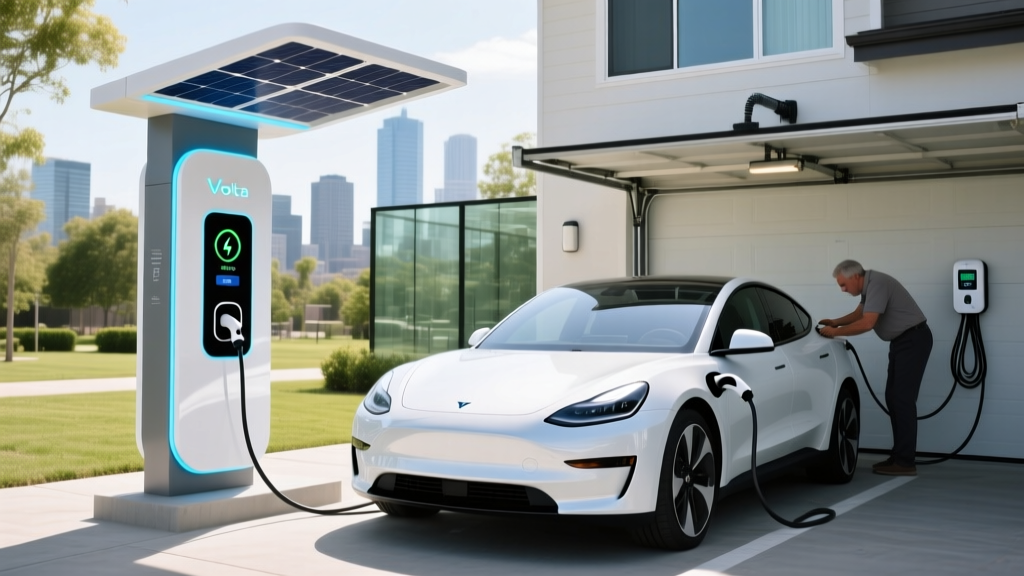
Volta charging stations have carved out a unique niche in the public EV charging landscape: they offer free charging, funded entirely by digital advertising displayed on large screens built into the charger housing. Originally an independent network, Volta was acquired by Shell in 2023 and has since been integrated into Shell's broader recharging strategy. As of 2026, Volta-branded stations continue to operate at retail locations, grocery stores, and shopping centers across the U.S., though many are transitioning to Shell Recharge branding.
Here's what makes Volta different from Electrify America, EVgo, or ChargePoint:
- Cost to charge: $0.00 — no app, no RFID card, no membership required
- Charging types: Mix of Level 2 (typically 7.2–19.2 kW AC) and DC fast charging (50–350 kW depending on site)
- Business model: Ad-supported — brands pay for screen time, subsidizing your electrons
- Access: Open to all EVs; no proprietary connector lock-in
The trade-off? Volta stations tend to be located at high-traffic retail destinations where you're expected to shop while charging. Sessions are often informally limited to 30–60 minutes, and availability can be competitive during peak hours. They're best used as supplemental, opportunistic charging — not your primary strategy.
Understanding EV Charging Levels: Speeds, kW, and Real-World Range Added
Before evaluating any public or home charger, you need clarity on the three charging levels and what they actually deliver. A critical distinction: kW (kilowatts) measures power — how fast energy flows. kWh (kilowatt-hours) measures energy — how much your battery holds. Think of kW as the width of a hose and kWh as the size of the bucket.
| Level | Voltage | Max Power (kW) | Miles of Range Per Hour | Best For |
|---|---|---|---|---|
| Level 1 | 120V AC | 1.4–1.9 kW | 3–5 mi/hr | Overnight top-ups, PHEVs, low daily mileage |
| Level 2 | 240V AC | 3.3–19.2 kW | 12–75 mi/hr | Home daily charging, workplace, Volta free stations |
| DC Fast | 400–800V DC | 50–350 kW | 150–1,000+ mi/hr (peak) | Road trips, rapid top-ups, highway corridors |
A few real-world charging time examples for common battery sizes:
- Tesla Model Y (75 kWh usable battery, 10–80%): ~7.5 hours on a 7.2 kW Level 2; ~25 minutes on a 250 kW DC fast charger (accounting for charge-curve taper above 80%)
- Ford F-150 Lightning Extended Range (131 kWh usable, 10–80%): ~13 hours on a 7.2 kW Level 2; ~40 minutes on a 150 kW DC fast charger
- Hyundai Ioniq 5 (77.4 kWh usable, 10–80%): ~8 hours on a 7.2 kW Level 2; ~18 minutes on a 350 kW charger (800V architecture enables sustained high power)
How Much Does It Cost to Install a Home EV Charger?
Home Level 2 charging is the backbone of practical EV ownership. According to fueleconomy.gov, over 80% of EV charging happens at home. But installation costs vary dramatically based on your electrical panel's capacity and the distance from panel to charger location.
| Component | Basic Install | Complex Install | Notes |
|---|---|---|---|
| Level 2 Charger (hardware) | $350–$500 | $500–$750 | 40A–48A smart charger, 240V, NACS or J1772 |
| Electrical Permit | $50–$150 | $150–$350 | Varies by municipality; required for code compliance |
| Electrician Labor | $300–$600 | $800–$2,000 | Simple: short run from panel. Complex: long conduit run, trenching |
| Electrical Panel Upgrade (if needed) | $0 | $1,500–$3,500 | Older homes with 100A service often need upgrade to 200A |
| Total | $700–$1,250 | $3,000–$6,600 | Without panel upgrade: $700–$2,750 |
Electrical Requirements for a Level 2 Home Charger
- Voltage: 240V (same as a dryer or oven outlet)
- Amperage: 40A circuit for a 32A charger, or 50A circuit for a 40A charger, or 60A circuit for a 48A charger (NEC requires circuits rated at 125% of continuous load)
- Dedicated circuit: EV chargers must have their own breaker — no sharing with other appliances
- Outlet type: NEMA 14-50 (most common, allows charger portability) or hardwired (no plug, slightly cheaper install, no GFCI breaker required in some jurisdictions)
- GFCI protection: Required by NEC 2020/2023 for outdoor receptacles; some chargers have built-in GFCI, which can conflict with panel GFCI breakers causing nuisance trips — hardwiring avoids this
- Outdoor rating: If mounted outside, the charger must carry a NEMA 4 or IP65 weather rating
Connector Compatibility: NACS, CCS1, CHAdeMO, and Adapter Realities
The North American charging connector landscape shifted dramatically in 2024–2025 when nearly every major automaker adopted Tesla's North American Charging Standard (NACS) for new vehicles. Here's where things stand in 2026:
| Connector | Brands Using It (New Vehicles) | Public Network Access | Adapter Needed? |
|---|---|---|---|
| NACS (Tesla plug) | Tesla, Ford, GM, Rivian, Volvo, Polestar, Hyundai/Kia (2025+), BMW, Mercedes, Nissan | Tesla Supercharger (17,000+ stalls), Volta/Shell Recharge, EVgo, many new Electrify America stations | Older CCS vehicles need CCS-to-NACS adapter (~$200–$300) |
| CCS1 | Legacy models (2024 and earlier from most brands), VW ID.4 (some 2025) | Electrify America, EVgo, ChargePoint DC stations | NACS-to-CCS adapter for Tesla Superchargers |
| CHAdeMO | Nissan Leaf (discontinued after 2025), Mitsubishi Outlander PHEV (older) | Limited — many networks have dropped CHAdeMO stalls | No adapter widely available; network access shrinking |
| J1772 (Level 2 AC) | All non-Tesla EVs (for Level 2 public charging) | Universal at Level 2 stations including Volta | Tesla vehicles use included J1772 adapter |
Volta stations typically offer J1772 connectors for Level 2 and a mix of CCS1 and NACS for DC fast charging. If you drive a 2025+ model with a native NACS port, you'll plug directly into Volta's NACS-equipped DC stalls. If your EV still has CCS1, you're covered at most Volta DC locations — but always check the station listing in the Volta or Shell Recharge app before driving there.
Charging Cost Per Mile: Home vs. Public vs. Gas
One of the strongest arguments for EV ownership is lower per-mile fuel cost — but the savings depend heavily on where and when you charge. Here's a data-driven breakdown using 2026 electricity and gas prices:
| Scenario | Rate | Vehicle Efficiency | Cost Per Mile |
|---|---|---|---|
| Home charging (off-peak, 12¢/kWh avg) | $0.12/kWh | 3.5 mi/kWh (typical EV like Model Y) | $0.034 |
| Home charging (standard rate, 17¢/kWh avg) | $0.17/kWh | 3.5 mi/kWh | $0.049 |
| Volta free public charging | $0.00/kWh | 3.5 mi/kWh | $0.00 |
| Public Level 2 (ChargePoint, 25¢/kWh avg) | $0.25/kWh | 3.5 mi/kWh | $0.071 |
| DC fast charging (Electrify America, 48¢/kWh avg) | $0.48/kWh | 3.5 mi/kWh | $0.137 |
| Gasoline car (30 MPG combined, $3.40/gal) | $3.40/gal | 30 MPG | $0.113 |
| Gasoline truck (20 MPG combined, $3.40/gal) | $3.40/gal | 20 MPG | $0.170 |
The math is clear: home off-peak charging delivers fuel costs roughly one-third that of a 30-MPG gas car. Even public DC fast charging at premium rates is competitive with gasoline on a per-mile basis. And Volta's free stations, while opportunistic, genuinely cost nothing — making them a legitimate supplement to reduce your monthly charging bill.
For context, a driver covering 12,000 miles per year in an EV charged primarily at home off-peak spends approximately $408/year on electricity, versus $1,360/year on gasoline in a 30-MPG car — a savings of nearly $1,000 annually.
Recommended Home EV Chargers: Power, Features, and Pricing
Choosing a home Level 2 charger comes down to amperage (which dictates charging speed), connector type (NACS or J1772), smart features (scheduling, load management), and build quality. Here are four proven options for 2026:
ChargePoint Home Flex
- Power: Up to 50A (12 kW), adjustable via DIP switches
- Connector: J1772 (NACS adapter included in 2026 models)
- Cable length: 23 feet
- Smart features: Wi-Fi, app scheduling, Alexa integration, energy reporting
- Price: ~$549
- Best for: Flexible amperage — can be dialed down for older panels
Tesla Wall Connector
- Power: Up to 48A (11.5 kW)
- Connector: Native NACS (J1772 adapter available separately)
- Cable length: 24 feet
- Smart features: Wi-Fi, OTA updates, power sharing (link multiple units on one circuit), Tesla app integration
- Price: ~$475
- Best for: Tesla and NACS-equipped EV owners seeking the cleanest integration
Grizzl-E Smart
- Power: Up to 40A (9.6 kW)
- Connector: J1772 or NACS (selectable at purchase)
- Cable length: 24 feet
- Smart features: OCPP-compatible, works with multiple apps, load management
- Price: ~$449
- Best for: Budget-conscious buyers wanting a rugged, Canadian-built unit with extreme cold tolerance (-40°C rated)
Emporia Level 2 EV Charger
- Power: Up to 48A (11.5 kW)
- Connector: J1772 or NACS
- Cable length: 24 feet
- Smart features: Solar integration, energy monitoring via Emporia Vue panel, scheduled charging, TOU rate optimization
- Price: ~$399
- Best for: Homes with solar panels or those wanting granular energy tracking
How Volta Charging Stations Fit Into Your Overall Charging Strategy
Volta stations are best understood as a complement to, not a replacement for, home charging. Here's a practical framework for integrating them:
Decision Framework: When to Use Volta vs. Other Options
- Choose home Level 2 charging if: You have a garage or driveway, can install a 240V circuit, and want the cheapest, most convenient daily charging (3–5¢/mile)
- Choose Volta free charging if: You live near a Volta-equipped retail location, shop there regularly, and can add 20–40 miles of range during a 30-minute stop — or need DC fast charging on a road trip corridor where a Volta/Shell Recharge station is available
- Choose paid DC fast networks (Electrify America, EVgo) if: You're on a long highway trip, need a reliable 150–350 kW charger, and can't afford to wait for a free Volta stall that may be occupied
- Choose workplace Level 2 if: Your employer offers it — often free or subsidized, and your car sits for 8 hours, making even 7.2 kW sufficient for a full daily recharge
For apartment dwellers without home charging access, Volta stations combined with workplace charging and occasional DC fast sessions can form a viable — if less convenient — ownership model. The key is mapping your weekly routine: where does your car sit for 30+ minutes regularly? Those are your charging opportunities.
Frequently Asked Questions
How much does it cost to install a home EV charger?
A straightforward Level 2 home charger installation (short wire run from a 200A panel, no upgrades needed) typically costs $700–$1,250 total, including the charger hardware ($350–$500), electrician labor ($300–$600), and permit ($50–$150). Complex installations with long conduit runs or a required panel upgrade from 100A to 200A can push the total to $3,000–$6,600. Always get at least two quotes from licensed electricians and verify they pull a permit — unpermitted work can void home insurance claims.
How fast will each charging level add range?
Level 1 (120V) adds 3–5 miles of range per hour — suitable for PHEVs with small batteries but impractical for full EVs. Level 2 (240V, 40A) adds roughly 30–35 miles per hour for a typical EV. DC fast charging adds 150–1,000+ miles per hour at peak, but sessions are limited to 10–80% SoC due to charge-curve taper, meaning a typical road-trip stop takes 18–40 minutes depending on your battery size and the charger's power output.
Which connector/charger is compatible with my EV?
For 2025–2026 model-year vehicles, most brands now use the NACS connector natively (Tesla, Ford, GM, Hyundai, Kia, Rivian, Volvo, BMW, Mercedes). Older 2023–2024 models from non-Tesla brands likely have CCS1. The Nissan Leaf (now discontinued) used CHAdeMO. For Level 2 public charging, all non-Tesla EVs use J1772, and Tesla includes a J1772 adapter. Check your vehicle's charge port or owner's manual to confirm.
How much does charging cost per mile vs. gas?
Home off-peak charging at $0.12/kWh costs roughly $0.034 per mile in a typical EV (3.5 mi/kWh). A comparable 30-MPG gas car at $3.40/gallon costs $0.113 per mile — over three times more. Even expensive DC fast charging at $0.48/kWh ($0.137/mile) is competitive with gasoline. Volta's free stations, when available, bring your per-mile cost to $0.00. Over 12,000 miles/year, home-charged EV drivers save approximately $950 annually versus a 30-MPG gas vehicle.
What electrical upgrades might I need?
The most common upgrade is an electrical panel increase from 100A to 200A service, costing $1,500–$3,500, required when your home's total calculated load (including the new EV circuit) exceeds the panel's capacity. Other potential upgrades include: a new conduit run if your panel is far from the garage ($200–$800 extra), a utility service upgrade if the incoming supply wire is undersized (rare, $2,000–$5,000), or a smart load-management system ($200–$400) that shares amperage between your EV charger and other high-draw appliances to avoid a panel upgrade entirely. Per the National Electrical Code, a licensed electrician must perform a NEC Article 220 load calculation before installing any EV circuit.
Can I claim a tax credit for home charger installation?
The federal Alternative Fuel Vehicle Refueling Property Credit (IRS Form 8911) offers up to 30% of equipment and installation costs, capped at $1,000 for residential installations. However, eligibility depends on your home being located in a qualifying census tract (low-income or non-urban area), and the credit is non-refundable — meaning it can only offset tax liability you already owe. Consult a tax professional to confirm eligibility for your specific address.