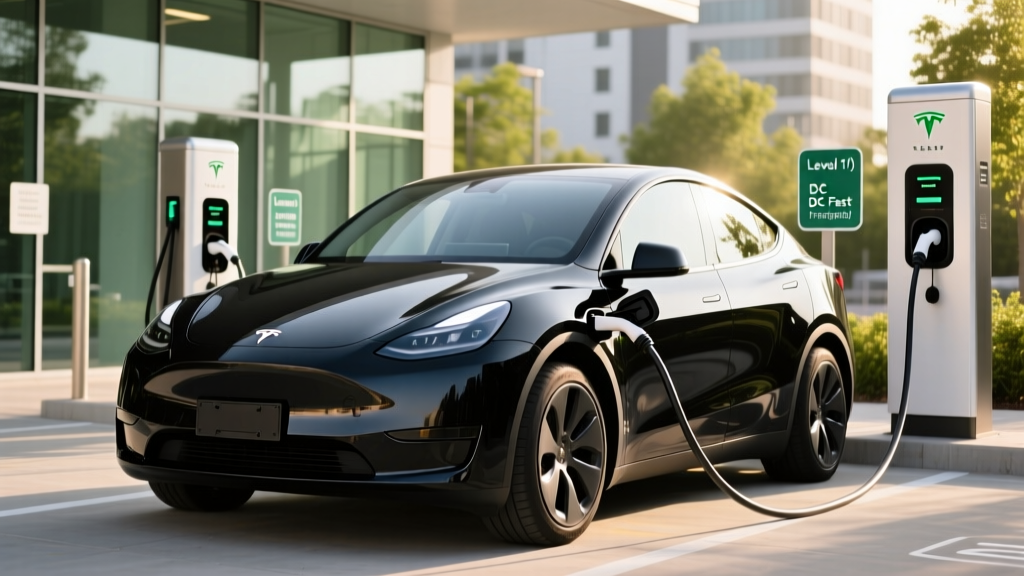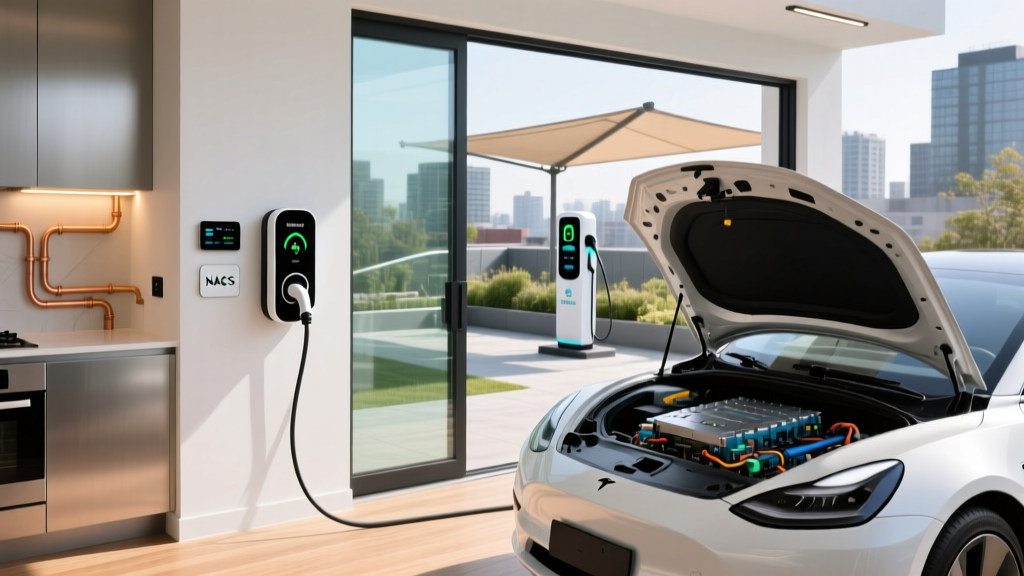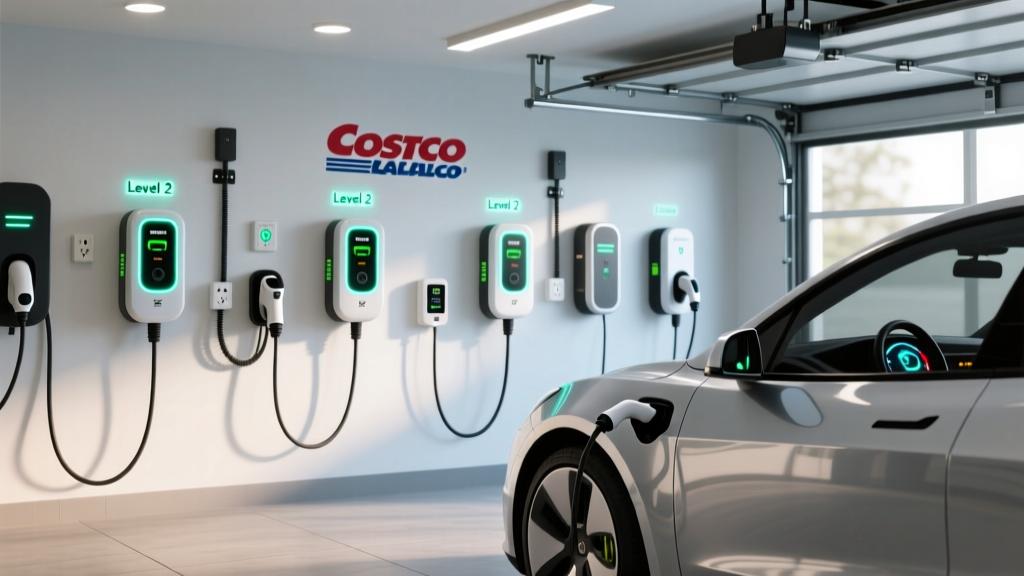
If you've searched for a Costco EV charger hoping to roll a Level 2 home charging station into your next warehouse run alongside bulk paper towels, you'll need to adjust expectations. As of 2026, Costco does not carry dedicated Level 2 EV charging hardware (the 240V wall-box units that add 25–44 miles of range per hour) in its warehouses or on Costco.com. What you will find are J1772-to-NACS adapters, extension cords rated for Level 1 trickle charging, portable power stations, and occasionally limited-time online promotions for third-party chargers. For a reliable, code-compliant home charger, you'll need to source equipment from dedicated EV brands and pair it with a licensed electrician.
This guide covers exactly what EV charging gear Costco does and doesn't sell, the real costs of a Level 2 home installation, which connector your vehicle requires, and the specific chargers we recommend based on power output, cable length, smart features, and price.
What Costco Actually Sells for EV Owners (and What It Doesn't)
Costco's EV-related inventory in 2026 centers on accessories rather than core charging hardware:
- J1772-to-NACS adapters: Useful for Tesla owners who need to charge at non-Tesla Level 2 public stations. Typically priced $40–$80 when available.
- Heavy-duty extension cords (10-gauge, 25 ft): Rated for 120V Level 1 charging only — never use a standard household extension cord for EV charging, as undersized wires create fire risk.
- Portable power stations (Jackery, EcoFlow, Bluetti): These can technically trickle-charge an EV in an emergency via their 120V AC outlet, but at roughly 1–2 kW output, expect to add only 3–6 miles of range per hour. Not a practical daily solution.
- Occasional online-only charger deals: Costco has historically run limited promotions for brands like Lectron or Emporia, but availability is sporadic and stock sells out quickly.
For a permanent, high-speed Level 2 home charger, you'll need to look to dedicated manufacturers like ChargePoint, Emporia, Wallbox, Grizzl-E, or Tesla — and budget for professional installation.
EV Charging Levels Explained: Speed, Power, and Real-World Range
Understanding the difference between kW (kilowatts — the rate of power delivery, like water pressure from a hose) and kWh (kilowatt-hours — the total energy stored in your battery, like gallons in a tank) is the single most important concept for EV ownership. Confusing them is the most common mistake new EV buyers make.
| Level | Voltage | Power (kW) | Miles of Range Added Per Hour | Typical Use Case |
|---|---|---|---|---|
| Level 1 | 120V AC | 1.0–1.9 kW | 3–5 mi/hr | Overnight trickle; PHEVs; emergency backup |
| Level 2 | 240V AC | 3.3–19.2 kW | 12–44+ mi/hr | Home daily charging; workplace; public destinations |
| DC Fast Charge | 400–800V DC | 50–350 kW | 150–1,000+ mi/hr (peak) | Road trips; highway corridors; 10–80% in 15–40 min |
Real-world charging time examples for common battery sizes using a 48-amp (11.5 kW) Level 2 home charger:
- Tesla Model Y (75 kWh usable, NMC): 10–80% in approximately 5.5 hours
- Hyundai Ioniq 5 (77.4 kWh usable, NMC): 10–80% in approximately 5.7 hours
- Ford F-150 Lightning Extended Range (131 kWh usable, NMC): 10–80% in approximately 9.5 hours
- Toyota Prius Prime PHEV (13.6 kWh usable): 0–100% in approximately 1.2 hours
For most EV owners driving 30–50 miles per day, a Level 2 charger running overnight fully replenishes daily consumption. DC fast charging is reserved for road trips — peak speeds above 80% State of Charge (SoC) taper significantly due to battery management system (BMS) protections, so a "350 kW charger" rarely sustains that rate for more than a few minutes.
Home Installation Costs: Equipment, Electrician, Permits, and Panel Upgrades
The total cost to install a Level 2 home EV charger varies dramatically based on your home's electrical panel capacity, the distance from panel to charger location, and local permit fees. Here's a realistic breakdown for 2026:
| Component | Low-End Estimate | High-End Estimate | Notes |
|---|---|---|---|
| Level 2 charger hardware | $300 | $750 | 32A–48A smart chargers; hardwired or NEMA 14-50 plug |
| Electrician labor (standard install) | $400 | $1,200 | Short run from panel to garage; drywall work minimal |
| Electrical permit | $50 | $250 | Varies by municipality; some jurisdictions bundle with inspection |
| Panel upgrade (if needed) | $1,500 | $4,000+ | Required if existing panel is 100A or at capacity; upgrade to 200A |
| Total (no panel upgrade) | $750 | $2,200 | Most homes with 200A service and short wire runs |
| Total (with panel upgrade) | $2,250 | $6,200+ | Older homes, 100A panels, or long conduit runs |
Electrical requirements for a 48-amp Level 2 charger: You need a dedicated 60-amp circuit breaker (National Electrical Code requires circuits to be rated 125% of continuous load — 48A × 1.25 = 60A). The charger connects to a 240V supply via either a hardwired connection (preferred for outdoor installs and maximum reliability) or a NEMA 14-50 receptacle (allows charger portability but requires a GFCI breaker in most jurisdictions under NEC 2020+).
Panel upgrade reality check: If your home has a 100-amp main panel and you're already running central AC, an electric dryer, and an electric oven, adding a 60-amp EV circuit will likely exceed your panel's capacity. An electrician will perform a load calculation to determine whether an upgrade to 200A service is required. This is the single biggest cost variable and the one most online guides understate.
Connector Compatibility: NACS, CCS1, and CHAdeMO
The North American EV charging connector landscape has consolidated significantly since Tesla opened its Supercharger network and the NACS (North American Charging Standard, SAE J3400) connector was adopted by nearly every major automaker starting in 2025.
| Connector Type | Brands Using It (Native) | Notes |
|---|---|---|
| NACS (J3400) | Tesla (all), Ford, GM, Rivian, Volvo, Polestar, Mercedes-Benz, BMW, Hyundai/Kia (2026+ models), Nissan (2026+) | Now the dominant standard; smaller, lighter connector; no CCS combo bulk |
| CCS1 | Older Hyundai/Kia (pre-2026), Stellantis, VW ID.4 (pre-2026), some legacy models | Being phased out; adapters to NACS available for Supercharger access |
| CHAdeMO | Nissan Leaf (legacy only — 2026+ Leaf uses NACS) | Effectively discontinued; public CHAdeMO stations are declining |
Adapter needs: If you own a CCS1-equipped EV (2024 or earlier Hyundai Ioniq 5, Kia EV6, VW ID.4, etc.), you'll need a CCS1-to-NACS adapter (~$150–$250) to access Tesla Superchargers, which now form the largest reliable DC fast-charging network in North America. Ford and GM provided these adapters to early transition buyers; aftermarket options from Lectron and A2Z are widely available. For home Level 2 charging, all vehicles use the J1772 standard (or NACS for Tesla), and most home chargers ship with J1772 connectors — Tesla owners use the included Mobile Connector or a NACS-terminated wall unit.
Recommended Level 2 Home Chargers: Power, Features, and Price
These are the chargers we recommend based on reliability, power output, smart features, and real-world owner feedback. None are available at Costco — source directly from the manufacturer or authorized retailers.
Emporia Vue Smart EV Charger
Power: 48A / 11.5 kW (hardwired) or 40A / 9.6 kW (NEMA 14-50)
Connector: J1772 (NACS adapter included with 2026 models)
Cable length: 24 ft
Smart features: Wi-Fi, app scheduling, solar integration, energy monitoring via Emporia Vue panel
Price: ~$399 (hardwired) / ~$349 (plug-in)
Best for: Budget-conscious buyers who want energy monitoring and solar-aware charging
ChargePoint Home Flex
Power: Up to 50A / 12 kW (configurable 16A–50A via DIP switches)
Connector: J1772 (NACS version available 2026)
Cable length: 23 ft
Smart features: Wi-Fi, Alexa/Google Home integration, app scheduling, utility demand-response programs
Price: ~$699
Best for: Flexible amperage matching to your circuit; robust app ecosystem
Tesla Wall Connector (Gen 3)
Power: 48A / 11.5 kW
Connector: NACS native (J1772 adapter available for non-Tesla EVs)
Cable length: 24 ft
Smart features: Wi-Fi, over-the-air updates, power-sharing between two units on one circuit
Price: ~$475
Best for: Tesla-only households; cleanest integration with Tesla vehicles
Grizzl-E Smart
Power: 40A / 9.6 kW
Connector: J1772 (NACS version available)
Cable length: 24 ft
Smart features: Wi-Fi, OCPP-compatible, works with utility programs
Price: ~$449
Best for: Cold-climate durability (rated to -40°F); Canadian-built; simple and rugged
Cost to Charge: Home vs. Public vs. Gas — The Per-Mile Math
Charging at home on a Level 2 circuit is almost always the cheapest way to fuel an EV. Here's how costs compare across scenarios, using a vehicle averaging 3.0 miles per kWh (roughly 112 MPGe, typical for a midsize crossover like the Tesla Model Y or Hyundai Ioniq 5):
| Charging Scenario | Cost per kWh | Cost per Mile (at 3 mi/kWh) | Annual Fuel Cost (12,000 mi/yr) |
|---|---|---|---|
| Home Level 2 (national avg. residential) | $0.16/kWh | $0.053/mi | $640 |
| Home Level 2 (off-peak TOU rate) | $0.09/kWh | $0.030/mi | $360 |
| Public Level 2 (ChargePoint, EVgo) | $0.25–$0.40/kWh | $0.083–$0.133/mi | $1,000–$1,600 |
| DC Fast Charge (Electrify America, Tesla Supercharger) | $0.32–$0.55/kWh | $0.107–$0.183/mi | $1,280–$2,200 |
| Gasoline (25 MPG avg. ICE vehicle, $3.40/gal) | — | $0.136/mi | $1,632 |
Source: Residential electricity rates from U.S. Energy Information Administration. Gas prices from EIA weekly retail surveys.
The takeaway: home charging saves $1,000–$1,300 per year compared to gasoline for the average driver, and even public DC fast charging is often cheaper per mile than gas — though relying exclusively on DCFC accelerates battery wear and costs more than home Level 2. If your utility offers time-of-use (TOU) rates, scheduling charging between 10 PM and 6 AM can cut your fuel cost to roughly $0.03 per mile.
Safety, Electrical Code, and Installation Best Practices
EV charging places a sustained high-current load on your home's electrical system for hours at a time — far longer than a dryer or oven cycle. Proper installation is non-negotiable for fire safety:
- Dedicated circuit: Your Level 2 charger must have its own dedicated breaker — never share a circuit with other appliances. A 48A charger requires a 60A breaker per NEC Article 625.
- GFCI protection: NEC 2020 and later requires ground-fault circuit interrupter (GFCI) protection for all receptacles used for EV charging. Hardwired installations are exempt from this requirement, which is one reason many electricians prefer hardwiring.
- Outdoor rating: If your charger is mounted outdoors or in an uncovered carport, ensure it carries a NEMA 4 or IP65 weather-resistance rating. All chargers listed above meet this standard.
- Wire gauge: A 60A circuit requires 6 AWG copper wire (THHN in conduit) or 4 AWG aluminum. Undersized wire causes overheating and is a leading cause of EV charging electrical fires.
- Permit and inspection: Every jurisdiction requires an electrical permit for EV charger installation. The inspection ensures code compliance and protects your homeowner's insurance coverage. Skipping the permit risks claim denial in the event of an electrical fire.
- Load management: If your panel is near capacity but you want to avoid a full upgrade, consider a smart charger with built-in load management (like the Emporia Vue or Wallbox Pulsar Plus with Power Meter) that monitors total household draw and throttles charging to stay within your panel's limit.
Federal Tax Credit and Utility Rebates for Home Charger Installation
The federal Alternative Fuel Vehicle Refueling Property Credit (IRS Form 8911) covers 30% of the cost of home EV charger equipment and installation, up to $1,000. However, this credit is subject to significant limitations:
- Your home must be located in a qualifying low-income or non-urban census tract — many suburban and urban addresses do not qualify under the Inflation Reduction Act's geographic restrictions.
- The credit applies to both equipment and labor costs.
- It is non-refundable (you must have tax liability to benefit).
- Check eligibility using the IRS guidance page or consult a tax professional.
Beyond federal incentives, many utilities offer rebates of $250–$1,000 for Level 2 charger installation, especially when paired with a TOU rate enrollment. Check with your local utility before purchasing equipment — some programs require pre-approval or specify eligible charger models.
Frequently Asked Questions
How much does it cost to install a home EV charger?
A standard Level 2 home charger installation costs between $750 and $2,200 if your electrical panel has sufficient capacity. If a panel upgrade from 100A to 200A is required, total costs range from $2,250 to $6,200 or more. The charger hardware itself typically costs $300–$750.
How fast will each charging level add range?
Level 1 (120V) adds 3–5 miles per hour. Level 2 (240V, 48A) adds 30–44 miles per hour depending on vehicle efficiency. DC fast charging adds 150–1,000+ miles per hour at peak, but sessions are typically limited to 15–40 minutes (10–80% SoC) due to charge-curve taper above 80%.
Which connector/charger is compatible with my EV?
For 2026 model-year vehicles: Tesla, Ford, GM, Rivian, and most new Hyundai/Kia/Volvo/BMW models use NACS. Older (pre-2026) non-Tesla EVs mostly use CCS1. The Nissan Leaf (legacy) uses CHAdeMO. For home Level 2 charging, all non-Tesla EVs use J1772; Teslas use NACS. Adapters are available for cross-compatibility.
How much does charging cost per mile vs gas?
Home Level 2 charging costs approximately $0.03–$0.05 per mile (depending on your electricity rate), compared to $0.14 per mile for a 25 MPG gasoline vehicle at $3.40/gallon. Public DC fast charging costs $0.11–$0.18 per mile — still often cheaper than gas but significantly more expensive than home charging.
What electrical upgrades might I need?
If your home has a 100-amp electrical panel or your existing panel is near capacity with other large loads (central AC, electric dryer, electric oven), you'll likely need a panel upgrade to 200A service — costing $1,500–$4,000+. An electrician will perform a load calculation to determine this. Some homes can avoid a full upgrade by installing a lower-amperage charger (32A instead of 48A) or using a smart load-management system.
Does Costco sell EV chargers I can install at home?
Costco does not regularly stock Level 2 home EV chargers in-warehouse or online. You may occasionally find limited-time online promotions for third-party chargers or adapters, but for a reliable, warrantied home charging solution, purchase directly from ChargePoint, Emporia, Tesla, Grizzl-E, or Wallbox.