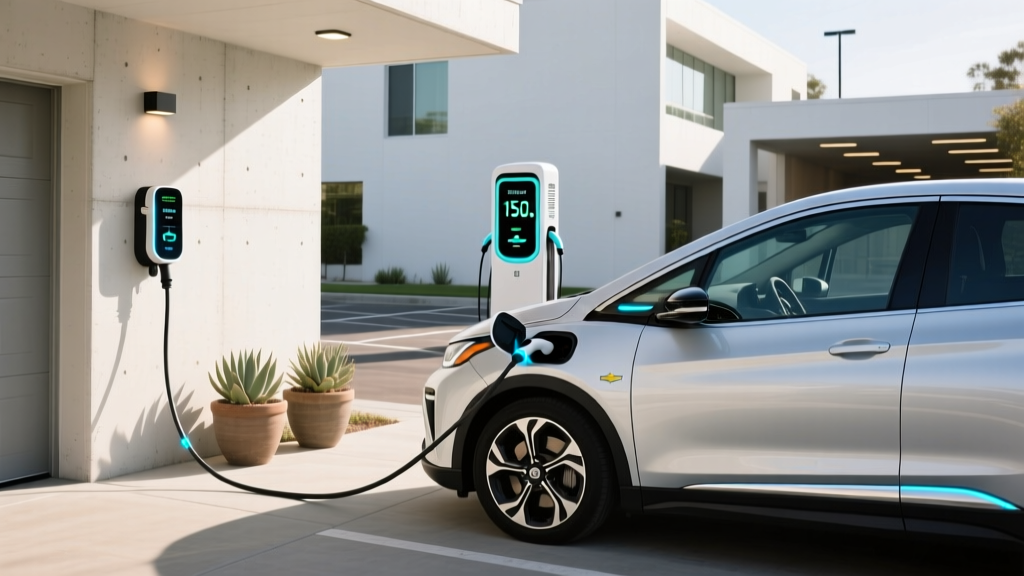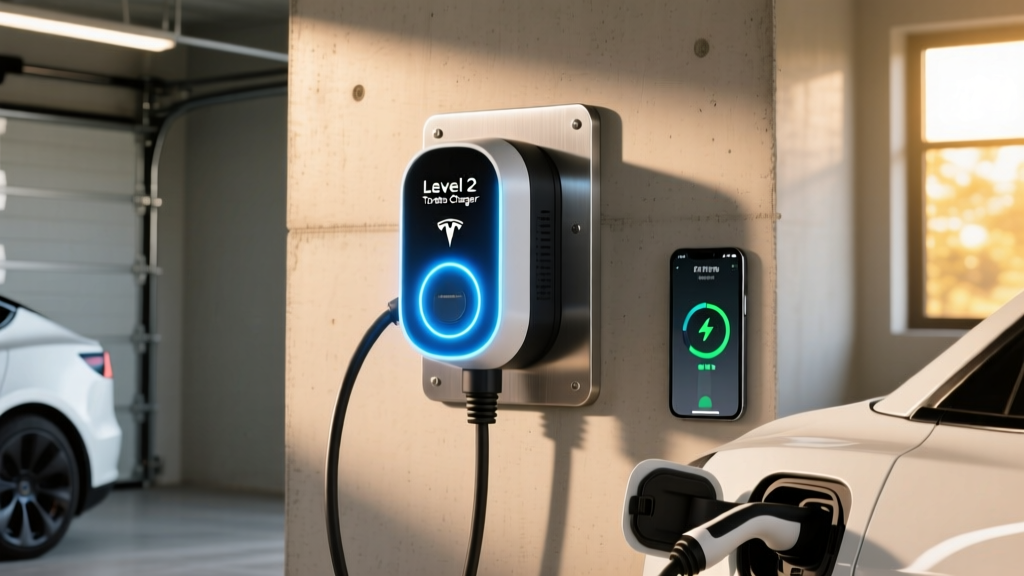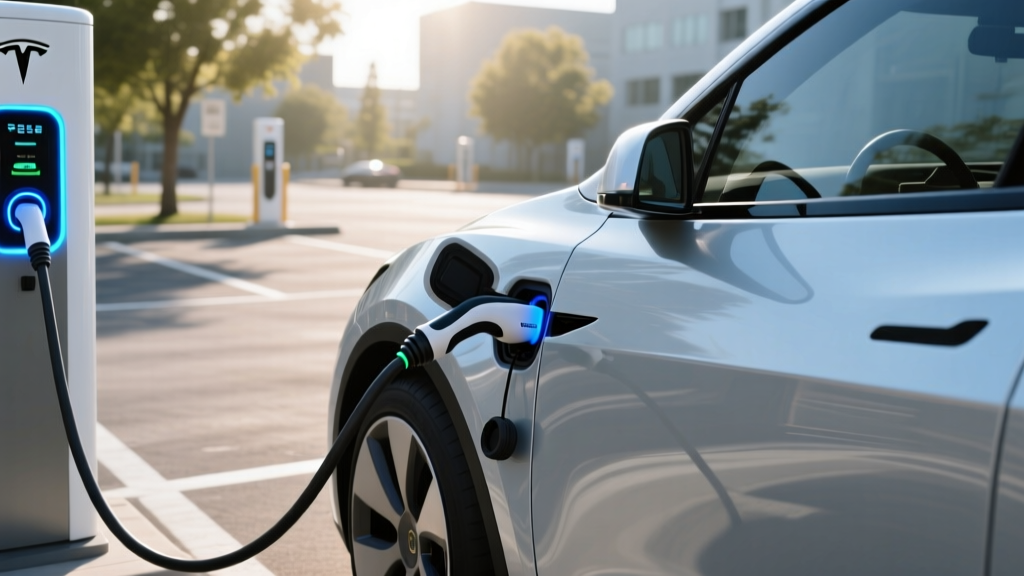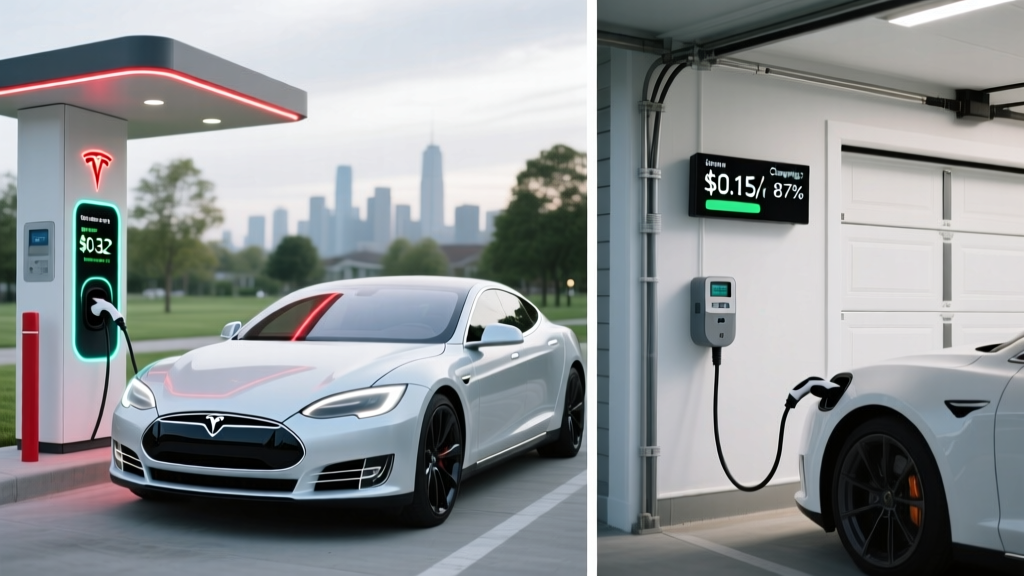
If you own or are considering a Tesla Model 3, Model Y, Model S, or Model X, one question dominates your ownership math: what does it actually cost to keep the battery full? The cost of charging Tesla at charging station networks varies wildly depending on whether you plug in at home, use a public Level 2 destination charger, or rely on DC fast charging during road trips. This guide breaks down every scenario with real 2026 numbers — per-kWh rates, per-mile costs, home installation expenses, and how Tesla's energy consumption stacks up against gasoline.
Before we get into pricing, let's settle the most common EV confusion. kW (kilowatts) measures power — how fast energy flows into your car, like water pressure from a hose. kWh (kilowatt-hours) measures energy — the total amount stored in your battery, like gallons in a tank. You pay for kWh consumed. Chargers are rated in kW output. A 150 kW DC fast charger delivers energy faster than a 7.2 kW Level 2 unit, but both add the same kWh if run long enough.
Charging Levels Explained: Speed, Power, and Range Added
Every Tesla sold since 2012 supports three charging tiers. Understanding the speed differences is essential for calculating both time cost and dollar cost, because public networks price each tier differently.
| Level | Voltage / Amperage | Max Power (kW) | Miles of Range / Hour | Best For |
|---|---|---|---|---|
| Level 1 | 120V / 12A | 1.4 kW | 3–5 mi/hr | Overnight trickle, emergencies |
| Level 2 | 240V / 32–48A | 7.7–11.5 kW | 25–44 mi/hr | Daily home / workplace charging |
| DC Fast (Supercharger) | 400–800V DC | 150–250 kW | 200–1,000+ mi/hr (peak) | Road trips, rapid top-ups |
For context, a Tesla Model Y Long Range (2026) has an EPA range of 320 miles and a usable battery capacity of approximately 75 kWh. On Level 2 at 11.5 kW (48A), you'd add roughly 44 miles of range per hour — enough to fully replenish overnight. On a V3 Supercharger peaking at 250 kW, Tesla rates the 10–80% charge at approximately 27 minutes, though real-world sessions taper significantly above 60% state of charge (SoC). Expect an average sustained rate closer to 100–130 kW across the full 10–80% session.
The Real Cost of Charging Tesla at Charging Station Networks
Tesla Supercharger pricing is dynamic and varies by station, time of day, and region. As of early 2026, here's what Tesla owners typically encounter:
- Supercharger (DC fast): $0.28–$0.48/kWh depending on location and time-of-use tier. Urban stations in California and the Northeast trend toward $0.40–$0.48/kWh during peak hours. Rural Midwest stations may sit at $0.28–$0.32/kWh.
- Tesla Destination Chargers (Level 2): Often free at hotels, restaurants, and shopping centers — but increasingly metered at $0.10–$0.25/kWh at commercial venues.
- Non-Tesla public Level 2 (ChargePoint, EVgo, Electrify America): $0.15–$0.39/kWh, plus potential idle fees or session fees.
- Home charging (national average electricity): ~$0.16/kWh (per EIA data), dropping to $0.08–$0.12/kWh on time-of-use off-peak plans.
Cost-Per-Mile Breakdown: Tesla vs Gasoline
The Model Y Long Range AWD achieves approximately 28 kWh/100 miles (or roughly 3.6 miles per kWh) in mixed driving per fueleconomy.gov. A comparable gas SUV averaging 28 MPG gives us a direct comparison.
| Scenario | Rate | Cost / Mile | Cost for 300-Mi Trip |
|---|---|---|---|
| Home (off-peak TOU) | $0.10/kWh | $0.028 | $8.40 |
| Home (national avg) | $0.16/kWh | $0.045 | $13.44 |
| Supercharger (avg) | $0.36/kWh | $0.101 | $30.24 |
| Gas SUV (28 MPG) | $3.40/gal | $0.121 | $36.43 |
The takeaway: even at peak Supercharger rates, the Tesla costs less per mile than a comparable gas vehicle. But home charging slashes fuel costs by 60–75% compared to gasoline. If you can install a Level 2 charger at home, the economics overwhelmingly favor electrification.
How Much Does It Cost to Install a Home EV Charger?
A Level 2 home charger is the single biggest ownership upgrade you can make. But installation costs vary dramatically based on your electrical panel, the distance from panel to charger location, and local permitting requirements. Here's a realistic breakdown for 2026:
| Component | Simple Install (panel nearby) | Complex Install (long run / upgrade) |
|---|---|---|
| Level 2 charger (hardware) | $350–$650 | $350–$650 |
| Electrician labor (240V/50A circuit) | $400–$800 | $1,000–$2,500 |
| Electrical permit | $50–$150 | $50–$200 |
| Panel upgrade (100A → 200A) if needed | $0 (not needed) | $1,500–$3,500 |
| Total Range | $800–$1,600 | $2,900–$6,850 |
Electrical Requirements and Panel-Upgrade Gotchas
A hardwired Level 2 charger delivering 11.5 kW requires a 240V, 60A dedicated circuit (NEC code requires the circuit breaker to be rated 125% above the continuous load, so a 48A charger needs a 60A breaker). The Tesla Wall Connector, ChargePoint Home Flex, and similar units ship configured for this amperage.
The panel-upgrade trap: Many homes built before 1990 have 100-amp main service panels. If your panel is already near capacity (running central AC, electric range, electric dryer, and water heater), adding a 60A EV circuit may exceed the panel's safe load calculation. A licensed electrician will perform a load calculation per NEC Article 220. If you're over 80% of panel capacity, you'll need a service upgrade to 200A — which adds $1,500–$3,500 and may require utility coordination.
Alternatives to avoid a panel upgrade: You can install a lower-amperage charger (a 32A/7.7 kW unit on a 40A breaker) or use a smart panel monitor like the Span Drive or Sense system that dynamically limits EV charging when other loads spike. Some utilities also offer managed-charging programs that provide credits for allowing them to throttle your charger during peak demand.
Connector Compatibility: NACS, CCS, and Adapters
As of 2025, Tesla's North American Charging Standard (NACS) connector has been adopted by Ford, GM, Rivian, Volvo, BMW, Hyundai, and most major automakers. By 2026, NACS is effectively the dominant DC fast-charging connector in North America. Here's what that means for compatibility:
| Connector | Native Vehicles | Adapter Needed? | DC Fast Charge Support |
|---|---|---|---|
| NACS (Tesla) | All Tesla models; 2025+ Ford, GM, Rivian, Volvo, BMW, Hyundai | CCS→NACS adapter for non-Tesla CCS vehicles ($150–$250) | Yes — up to 250 kW at Superchargers |
| CCS1 | Pre-2025 non-Tesla EVs (VW ID.4, older Bolt, Ioniq 5 pre-NACS) | NACS→CCS adapter needed for Tesla Superchargers (Magic Dock or Tesla-supplied) | Yes — up to 350 kW at Electrify America |
| CHAdeMO | Nissan Leaf, Mitsubishi Outlander PHEV (legacy) | No widely available adapter to NACS/CCS | Yes — but infrastructure declining rapidly |
For Tesla owners, the native NACS connector works at every Supercharger without adapters. Tesla also includes a J1772 adapter in the glovebox for Level 2 destination chargers that use the older standard. If you drive a non-Tesla EV with CCS, Tesla's Supercharger network is now accessible via the built-in Magic Dock adapter at select stations or via a third-party NACS adapter — but verify compatibility with your specific vehicle before purchasing.
Best Home EV Chargers for Tesla Owners (2026 Equipment Picks)
Tesla's onboard charger accepts up to 11.5 kW (48A) on Level 2 AC. To maximize charging speed at home, you need a charger that can deliver at least 48A on a 60A circuit. Here are the top units we recommend, all hardwired and NACS-native or NACS-compatible:
Tesla Wall Connector (Gen 4)
- Power: 11.5 kW (48A)
- Connector: Native NACS
- Cable: 24 ft
- Smart features: Wi-Fi, OTA updates, load sharing with 2nd unit, power-sharing across multiple Wall Connectors
- Price: ~$475
- Verdict: Best value for Tesla-only households. No adapter needed.
ChargePoint Home Flex (NACS version)
- Power: 12 kW (50A adjustable)
- Connector: NACS (2025+ models)
- Cable: 23 ft
- Smart features: Wi-Fi, app scheduling, Alexa integration, detailed energy tracking
- Price: ~$599
- Verdict: Best app experience and energy reporting. Ideal for mixed EV households.
Emporia Vue Smart EV Charger
- Power: 11.5 kW (48A)
- Connector: NACS (2025+ version) or J1772 with adapter
- Cable: 24 ft
- Smart features: Solar integration, whole-home energy monitoring via Emporia Vue panel monitor, TOU scheduling
- Price: ~$399 (charger only)
- Verdict: Best for solar-equipped homes wanting integrated energy management.
Grizzl-E Smart (NACS)
- Power: 10 kW (40A) — slightly below Tesla max
- Connector: NACS
- Cable: 24 ft
- Smart features: OCPP support, adjustable amperage (16–40A), extreme cold rated (-40°F)
- Price: ~$449
- Verdict: Best for cold climates. Built in Canada, rugged enclosure.
Safety, Electrical Code, and Permit Essentials
Any hardwired Level 2 installation must comply with the National Electrical Code (NEC) and your local jurisdiction's amendments. Here's what your electrician will address:
- Dedicated circuit: Your EV charger must be on its own breaker — no shared circuits with other appliances. A 48A charger requires a 60A breaker.
- GFCI protection: NEC 2020 and later require Ground Fault Circuit Interrupter protection for outdoor receptacles. Hardwired units typically integrate GFCI internally, but outdoor installations using a NEMA 14-50 receptacle require a GFCI breaker ($80–$150 additional).
- Outdoor rating: If mounting outside, the charger must carry a NEMA 4 (weatherproof) rating. All four chargers listed above meet this standard.
- Wire gauge: A 60A circuit requires 6 AWG copper wire (THHN in conduit) or 4 AWG aluminum. Longer wire runs may require upsizing to prevent voltage drop beyond 3%.
- Permit and inspection: Virtually all jurisdictions require an electrical permit ($50–$200) and a post-installation inspection. Skipping this voids homeowner's insurance coverage for electrical fires and can flag during a home sale.
Under IRS Form 8911, the Alternative Fuel Vehicle Refueling Property Credit covers 30% of home EV charger equipment and installation costs, up to $1,000. This credit is available for property placed in service through 2032, but is subject to census-tract eligibility restrictions (must be in a non-urban or low-income census tract). Check your eligibility at the IRS link above or consult a tax professional.
Charging Time Examples: How Long to Fill Common Tesla Batteries
Charging time depends on battery size, starting state of charge, and — critically — the charge curve. DC fast charging does not maintain peak speed throughout the session. Batteries accept charge fastest between 10–50% SoC, then taper to protect cell health. Here are realistic estimates for 2026 Tesla models:
| Model | Battery (usable kWh) | Level 2 at 11.5 kW (0–100%) | V3 Supercharger (10–80%) | V4 Supercharger (10–80%) |
|---|---|---|---|---|
| Model 3 RWD | 57.5 kWh (LFP) | ~5.5 hours | ~25 min | ~20 min |
| Model 3 Long Range | 75 kWh (NMC) | ~7 hours | ~27 min | ~22 min |
| Model Y Long Range | 75 kWh (NMC) | ~7 hours | ~27 min | ~22 min |
| Model S Plaid | 95 kWh (NMC) | ~9 hours | ~33 min | ~25 min |
Those 10–80% Supercharger times assume you arrive with a preconditioned battery (Tesla's navigation system automatically warms the pack when you route to a Supercharger) and an ambient temperature above 50°F. In cold weather (below 32°F), expect 10–80% times to increase by 20–40% due to slower lithium-ion diffusion. Charging from 80–100% on DC fast charging adds another 20–30 minutes and is rarely worth the wait — Tesla recommends charging to 80% on road trips and topping up at home.
Frequently Asked Questions
How much does it cost to charge a Tesla at a Supercharger in 2026?
The average cost of charging Tesla at charging station Superchargers ranges from $0.28 to $0.48 per kWh, depending on location and time of day. For a Model Y Long Range (75 kWh battery), a 10–80% session (adding ~52.5 kWh) costs approximately $14.70–$25.20. This translates to roughly $0.09–$0.10 per mile — still cheaper than a comparable gas SUV at $3.40/gallon.
Is it cheaper to charge a Tesla at home or at a Supercharger?
Home charging is dramatically cheaper. At the national average electricity rate of $0.16/kWh, you'll pay about $0.045 per mile. On a time-of-use off-peak plan ($0.08–$0.12/kWh), that drops to $0.028–$0.034 per mile. Supercharger rates are 2–3x higher than home electricity. Over 12,000 miles of annual driving, home charging saves $700–$1,200 compared to exclusive Supercharger use.
Can I install a Tesla charger myself?
Level 1 (120V) charging requires no installation — just plug into a standard outlet. Level 2 hardwired installations (240V, 40–60A) must be performed by a licensed electrician to meet NEC code, pass inspection, and maintain your homeowner's insurance coverage. A NEMA 14-50 receptacle installation is also possible and allows you to use the Tesla Mobile Connector, but still requires an electrician and permit.
What electrical upgrades might I need for a home charger?
The most common upgrade is a panel capacity increase from 100A to 200A service ($1,500–$3,500). You may also need a new conduit run from the panel to the garage ($5–$15 per linear foot for longer runs), a GFCI breaker for outdoor receptacles ($80–$150), or a smart load-management device if your panel is near capacity but you want to avoid a full upgrade.
Do Tesla Superchargers charge idle fees?
Yes. Tesla imposes idle fees of $0.50–$1.00 per minute if your vehicle remains plugged in after reaching its charge limit and the station is at 50% capacity or higher. At 100% station occupancy, the fee doubles. Move your car promptly after charging completes.
Does frequent Supercharging degrade the Tesla battery?
DC fast charging generates more heat than Level 2, which accelerates lithium-ion cell degradation over time. However, Tesla's battery management system actively manages thermal conditions and limits charge rates to protect longevity. Data from fleet analyses suggest that vehicles that Supercharge frequently may see 2–5% more degradation over 150,000 miles compared to primarily Level 2-charged vehicles. Tesla's battery warranty covers 8 years / 120,000 miles (Model 3/Y) or 8 years / 150,000 miles (Model S/X) with a minimum 70% capacity retention threshold.