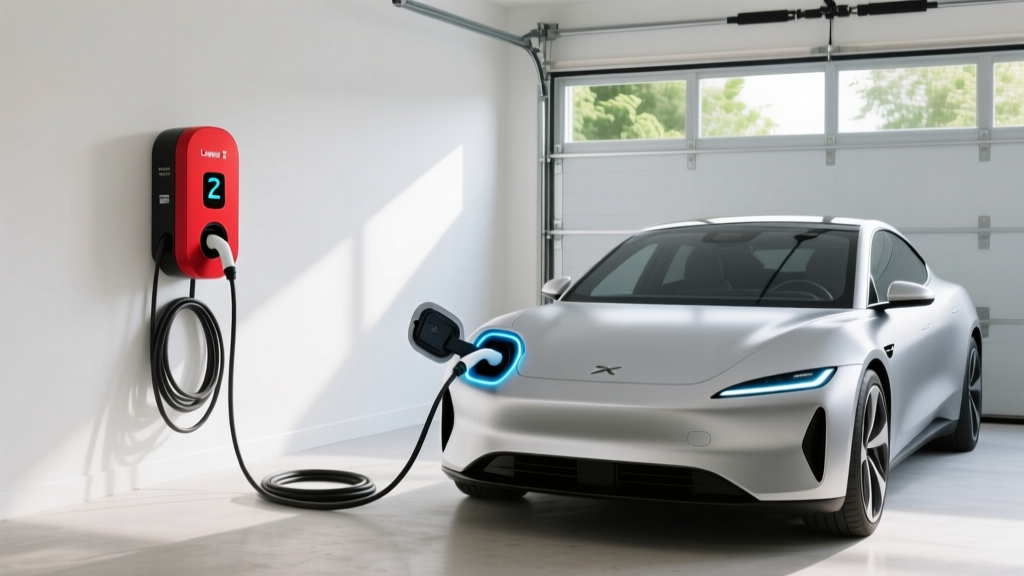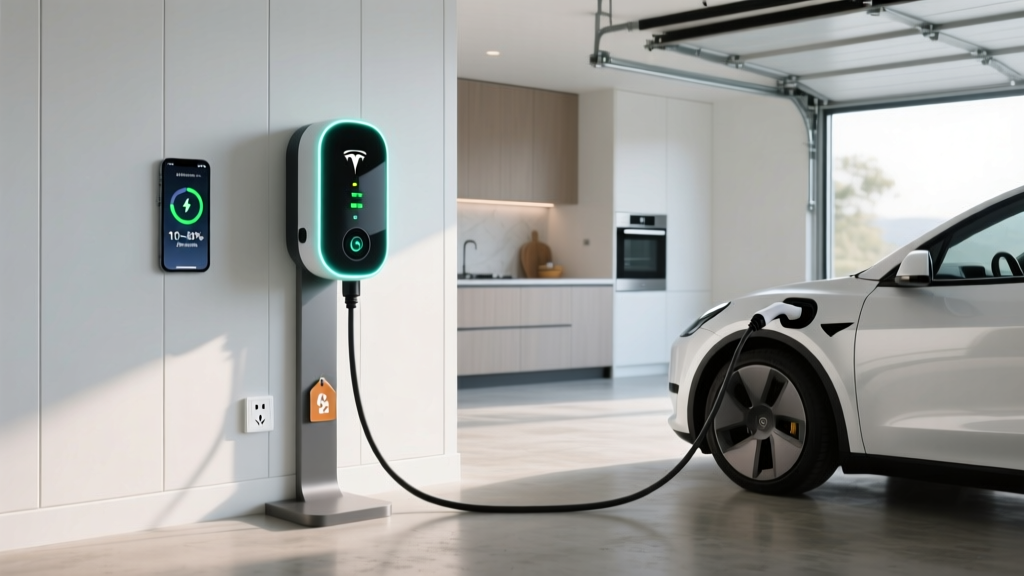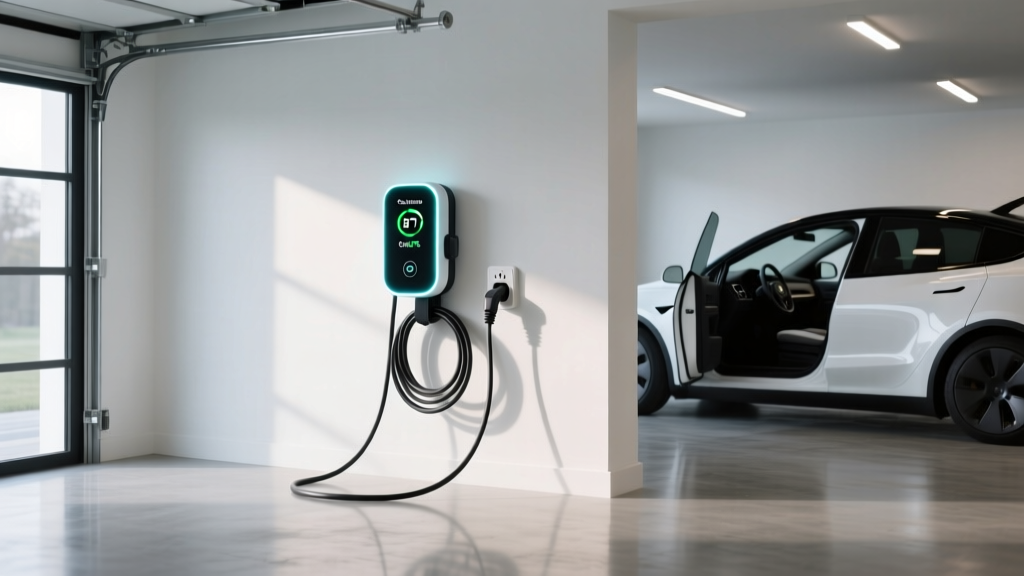
If you own a Tesla—or any EV with a NACS port—the single highest-impact upgrade you can make is a Level 2 home charger. But the cost of installing a Tesla charger at home varies enormously depending on your electrical panel, the distance from your panel to the garage, and whether you choose a hardwired unit or a plug-in model. This guide breaks down every line item so you can budget accurately before calling an electrician.
Charging Levels Explained: How Fast Will Each Level Add Range?
Before discussing installation cost, you need to understand what you're buying. EV charging happens at three levels, measured in kilowatts (kW), which is a unit of power—the rate at which energy flows into your battery. Your battery capacity, meanwhile, is measured in kilowatt-hours (kWh), a unit of energy. Confusing kW and kWh is the most common EV literacy mistake; keep them separate and everything else clicks into place.
| Level | Voltage | Max Power (kW) | Miles of Range per Hour | Typical Location |
|---|---|---|---|---|
| Level 1 | 120V AC | 1.2–1.9 kW | 3–5 mi/hr | Standard household outlet |
| Level 2 | 240V AC | 7.2–19.2 kW | 20–60+ mi/hr | Home, workplace, public AC stations |
| DC Fast Charge | 400–800V DC | 50–350 kW | 150–1,000+ mi/hr | Public fast-charging stations |
For most Tesla owners, a Level 2 home charger operating at 11.5 kW (48 amps on a 60-amp circuit) adds roughly 44 miles of range per hour. That means a nearly empty Model Y Long Range (75 kWh usable battery, ~310 miles EPA range) charges from 10% to 80% in about 5.5 hours overnight—more than enough for daily driving. Level 1, by contrast, would take over 60 hours for the same session, making it viable only as an emergency trickle option.
How Much Does It Cost to Install a Tesla Charger at Home?
The total cost of installing a Tesla charger at home in 2026 typically falls between $800 and $4,500, with most homeowners spending around $1,500–$2,200 for a straightforward installation. Here's where that money goes:
| Line Item | Low-End Cost | High-End Cost | Notes |
|---|---|---|---|
| Tesla Wall Connector (equipment) | $420 | $475 | 24-foot cable, Wi-Fi-enabled, up to 11.5 kW / 48A |
| Electrician labor (standard run, <30 ft) | $400 | $900 | Includes conduit, wiring, 60A breaker |
| Electrician labor (long run or complex) | $900 | $2,500 | Attic/crawlspace routing, >50 ft, trenching |
| Electrical permit | $50 | $250 | Varies by municipality |
| Panel upgrade (100A → 200A) | $1,500 | $3,500 | Required if panel lacks capacity for new 60A circuit |
| NEMA 14-50 outlet (alternative to hardwire) | $150 | $400 | Allows portable Mobile Connector use; GFCI breaker required by NEC 2020+ |
When does a panel upgrade become necessary? Most homes built after 2000 have a 200-amp service panel with enough spare capacity for a 60-amp EV circuit. Older homes with 100-amp or 150-amp panels often need an upgrade, especially if you also run electric HVAC, a dryer, and an electric range. Your electrician will perform a load calculation per NEC Article 220 to determine whether your panel can handle the added draw. If it can't, budget an additional $1,500–$3,500 for the upgrade—a significant but one-time investment that also increases your home's resale value.
Tesla Wall Connector vs. Universal Wall Connector: Which Should You Buy?
Tesla currently sells two home charging units. Choosing the right one affects both compatibility and total cost:
Tesla Wall Connector (NACS)
- Power Output: Up to 11.5 kW (48A) on a 60A circuit; configurable down to 32A/40A/48A
- Connector: Native NACS (Tesla plug)
- Cable Length: 24 feet
- Smart Features: Wi-Fi connectivity, over-the-air firmware updates, Tesla app integration, load sharing (pair up to 6 units on one circuit), Access Control (restrict who can charge)
- Price: $420 (Tesla.com)
- Best For: Tesla-only households
Tesla Universal Wall Connector
- Power Output: Up to 11.5 kW (48A) on a 60A circuit
- Connector: Built-in J1772 with integrated NACS adapter (Magic Dock style)
- Cable Length: 24 feet
- Smart Features: Same Wi-Fi/app features, auto-detects vehicle type
- Price: $599 (Tesla.com)
- Best For: Mixed-EV households (Tesla + non-Tesla with J1772/CCS)
Both units are hardwired (no plug), which avoids the NEC-mandated GFCI breaker required for a NEMA 14-50 receptacle—a $75–$150 GFCI breaker that can also nuisance-trip more often than a hardwired connection. For reliability and cost, hardwired is the better choice unless you need portability.
Connector Compatibility: NACS, CCS1, CHAdeMO, and Adapters
The North American Charging Standard (NACS) has become the dominant connector in the US as of 2025–2026. Here's how compatibility breaks down across major brands:
| Automaker | Home Charging Connector | DC Fast Charge Connector | Adapter Needed? |
|---|---|---|---|
| Tesla (all models) | NACS (native) | NACS (Supercharger) | CCS1 adapter ($175) for non-Tesla DC networks |
| Ford (F-150 Lightning, Mustang Mach-E 2025+) | NACS (native) | NACS | None |
| GM (Cadillac Lyriq, Chevy Equinox EV 2025+) | NACS (native) | NACS | None |
| Hyundai/Kia (Ioniq 5/6, EV6/EV9 2025+) | NACS (native) | NACS | None |
| Rivian (R1T/R1S 2025+) | NACS (native) | NACS | None |
| Volkswagen (ID.4) | CCS1 / J1772 | CCS1 | NACS-to-J1772 adapter for Tesla home chargers |
| Nissan (Leaf, Ariya) | J1772 (Leaf: CHAdeMO DC) | CHAdeMO (Leaf) / CCS1 (Ariya) | Tesla J1772 adapter included with Universal Wall Connector |
| BMW (i4, iX 2025+) | NACS (native) | NACS | None |
If you own a Tesla and are installing a Tesla Wall Connector, connector compatibility is a non-issue—it's a native NACS plug. If your household includes a non-Tesla EV with J1772, the Universal Wall Connector handles both without a separate adapter. For public DC fast charging, Tesla's CCS1 adapter ($175) unlocks Electrify America, EVgo, and other CCS-equipped networks, though Tesla's Supercharger network now covers most major US corridors.
Cost to Charge: Home Electricity vs. Gas vs. Public DC Fast Charging
One of the strongest financial arguments for home charging is the per-mile cost advantage. Let's compare a Tesla Model Y Long Range (averaging 28 kWh/100 miles in mixed driving, per EPA data) against a comparable gas SUV averaging 26 MPG combined.
| Scenario | Rate | Cost per 100 Miles | Cost per Mile |
|---|---|---|---|
| Home charging (national avg electricity, 2026) | $0.16/kWh | $4.48 | $0.045 |
| Home charging (off-peak TOU rate) | $0.09/kWh | $2.52 | $0.025 |
| Home charging (high-cost state, e.g., CA avg) | $0.28/kWh | $7.84 | $0.078 |
| Public DC fast charge (Tesla Supercharger avg) | $0.32/kWh | $8.96 | $0.090 |
| Public DC fast charge (Electrify America) | $0.48/kWh | $13.44 | $0.134 |
| Gas SUV (26 MPG, $3.40/gal national avg) | $3.40/gal | $13.08 | $0.131 |
At off-peak residential rates, home charging costs roughly 80% less per mile than gasoline. Even at California's higher electricity rates, home charging still beats gas by about 40%. Public DC fast charging narrows the gap significantly—at Electrify America's standard rates, you're paying nearly the same per mile as a gas car. This is why home charging isn't just convenient; it's where the economics of EV ownership really work.
Time-of-use (TOU) tip: Most utilities offer TOU plans where electricity drops to $0.07–$0.12/kWh between 10 PM and 6 AM. Schedule your Tesla to charge during these windows (Settings → Scheduled Charging in the car or via the Tesla app) to maximize savings.
Charging Time Examples: What to Expect with Common Tesla Battery Sizes
Charge time depends on three variables: battery size (kWh), charger power (kW), and the charge curve (the rate tapers as the battery fills). Here are real-world estimates for 10–80% sessions on a Tesla Wall Connector at 11.5 kW:
| Vehicle | Usable Battery (kWh) | Energy Added 10→80% (kWh) | Estimated Time |
|---|---|---|---|
| Tesla Model 3 RWD (LFP) | 57.5 kWh | ~40.3 kWh | ~3.5 hours |
| Tesla Model 3 Long Range | 75 kWh | ~52.5 kWh | ~4.6 hours |
| Tesla Model Y Long Range | 75 kWh | ~52.5 kWh | ~4.6 hours |
| Tesla Model S / X (2025+) | 95 kWh | ~66.5 kWh | ~5.8 hours |
| Tesla Cybertruck AWD | 123 kWh | ~86.1 kWh | ~7.5 hours |
These times assume a full 48-amp draw. If your electrician configures the Wall Connector for a 40-amp circuit (common in homes with limited panel capacity), power drops to 9.6 kW, adding roughly 20% to these times—still easily sufficient for overnight charging.
Safety, Electrical Code, and Installation Best Practices
A Level 2 EV charger draws sustained high current for hours—more like an electric furnace than a typical appliance. Proper installation is non-negotiable for safety and insurance compliance. Key requirements include:
- Dedicated circuit: Your Wall Connector must be on its own dedicated breaker—never shared with other appliances. A 60-amp breaker supports 48A continuous draw (NEC requires circuits to be rated at 125% of continuous load).
- Wire gauge: 6 AWG copper (THHN in conduit) for a 60-amp circuit; 4 AWG aluminum is an acceptable, lower-cost alternative for longer runs.
- GFCI protection: If you install a NEMA 14-50 receptacle instead of hardwiring, NEC 2020 and later requires a GFCI breaker (~$75–$150). Hardwired installations do not require GFCI, which is one reason electricians often recommend hardwiring for EV chargers.
- Outdoor rating: The Tesla Wall Connector is rated NEMA 3R (suitable for outdoor installation). If mounting outside, ensure the conduit entry point is sealed and the unit is positioned under an eave or carport when possible to reduce UV and weather exposure over time.
- Permit and inspection: Nearly all US jurisdictions require an electrical permit for a new 240V circuit. Your electrician should pull the permit; the city/county inspector will verify the work after installation. Skipping the permit can void homeowner's insurance coverage for electrical fires and cause issues during a home sale.
Always hire a licensed electrician—preferably one with EV charging installation experience. Tesla maintains a certified installer directory on its website, though any licensed electrician can legally install a Wall Connector. Get at least two quotes, and ask specifically whether the quote includes permit fees and a load calculation.
Federal Tax Credit: Can You Claim 30% of Your Charger Installation?
The IRS §30C Alternative Fuel Vehicle Refueling Property Credit covers 30% of the cost of home EV charging equipment and installation, up to a maximum credit of $1,000. This is separate from the §30D vehicle purchase credit.
- Credit amount: 30% of equipment + installation cost, capped at $1,000
- Eligible costs: The Wall Connector itself, electrician labor, conduit, wiring, permit fees
- Location requirement: Equipment must be installed at your primary residence in the US
- Census tract requirement: For property placed in service after 2022, your home must be in an eligible census tract (non-urban or low-income community per IRS guidance)—check the IRS eligibility tool
- Filing: Claim on IRS Form 8911 with your federal tax return
For a typical $1,800 installation, the credit would cover $540—meaning your effective cost drops to $1,260. However, the census tract requirement disqualifies many suburban and urban homeowners. Consult a tax professional to confirm eligibility before counting on this credit in your budget.
Frequently Asked Questions
Can I install a Tesla Wall Connector myself?
Technically, yes—if you're a licensed electrician. For everyone else, no. A 240V/60A circuit carries lethal current and must comply with NEC and local codes. An unpermitted DIY install risks fire, insurance denial, and code violations that surface during a home inspection. The $400–$900 electrician cost is worth it.
Do I need a Tesla Wall Connector, or can I use the Mobile Connector?
The Tesla Mobile Connector (included with some models, ~$200 separately) can plug into a NEMA 14-50 outlet and deliver up to 32A (7.7 kW)—adequate for most daily charging but about 33% slower than the Wall Connector's 48A. If your daily driving exceeds 40–50 miles, the Wall Connector's faster speed is worthwhile. The Mobile Connector is best kept in the car as a travel backup.
Will a Tesla charger work with non-Tesla EVs?
The standard Tesla Wall Connector outputs through a NACS plug, which fits Teslas and 2025+ models from Ford, GM, Hyundai, Kia, Rivian, and BMW natively. For older non-Tesla EVs with J1772/CCS ports, buy the Tesla Universal Wall Connector ($599), which includes an integrated J1772 adapter.
How much does it cost to charge a Tesla at home per month?
If you drive 1,000 miles/month in a Model Y (28 kWh/100 mi) at $0.16/kWh, your monthly home charging cost is roughly $44.80. At off-peak TOU rates ($0.09/kWh), that drops to $25.20. Compare that to $130/month for a 26 MPG gas SUV at $3.40/gallon.
My electrician said I need a panel upgrade. Is that common?
It's fairly common in homes built before 2000 with 100A or 150A service, especially those with electric dryers, ranges, and HVAC. A load calculation per NEC Article 220 will confirm. If an upgrade is needed, expect $1,500–$3,500, which is a one-time cost that also benefits future home electrification (heat pumps, solar, etc.).
Is the Tesla Wall Connector better than third-party chargers like ChargePoint or Emporia?
For Tesla owners, the Wall Connector offers the best integration—native NACS plug, Tesla app control, and a competitive $420 price. Third-party chargers like the Emporia Vue ($399, 48A) or ChargePoint Home Flex ($549, up to 50A) are excellent for multi-EV households or users who want platform-agnostic apps, but they typically ship with J1772 connectors and require a NACS adapter for Teslas.