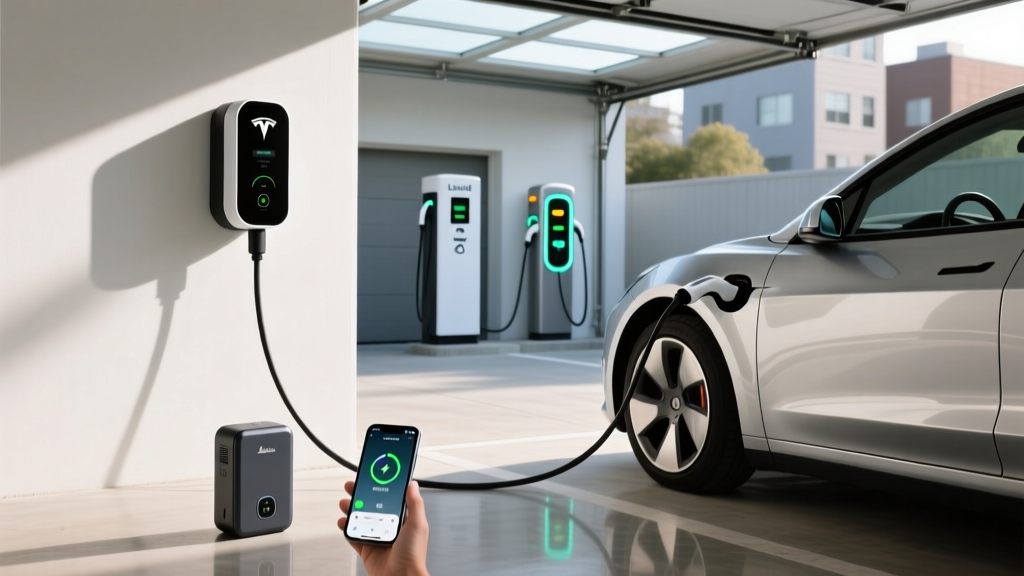
Search "cost to install a supercharger at home" and you will find forums full of confusion. Here is the short answer: you cannot install a Tesla Supercharger at your house. Superchargers are commercial DC fast-charging stations that pull 150–350 kW from dedicated utility infrastructure — they require three-phase power, utility-grade transformers, and Tesla's proprietary commercial networking. What homeowners can install is a Tesla Wall Connector, which delivers up to 11.5 kW (48 amps) on a 240V circuit and costs a fraction of commercial DC equipment.
This guide breaks down what you actually can install at home, what it costs, what electrical work is required, and how Level 2 home charging compares to public DC fast charging for daily ownership. All pricing reflects early-2026 market rates for equipment and licensed electrician labor in the United States.
Charging Levels Explained: What You Can Actually Install at Home
Before discussing cost, let us clarify the three charging levels and which ones are realistic for residential installation. Power is measured in kW (the rate electricity flows), while your battery stores energy measured in kWh (the total capacity). Confusing these two is the single most common EV literacy gap — a 10 kW charger adds 10 kWh of energy per hour of charging.
| Level | Voltage | Max Power (kW) | Miles of Range Added/Hour | Home Install? |
|---|---|---|---|---|
| Level 1 | 120V AC | 1.4–1.9 kW | 3–5 mi/hr | Yes (standard outlet) |
| Level 2 | 240V AC | 3.3–19.2 kW | 14–75 mi/hr | Yes (dedicated circuit) |
| DC Fast (incl. Supercharger) | 400–800V DC | 50–350 kW | 150–1,000+ mi/hr | No (commercial only) |
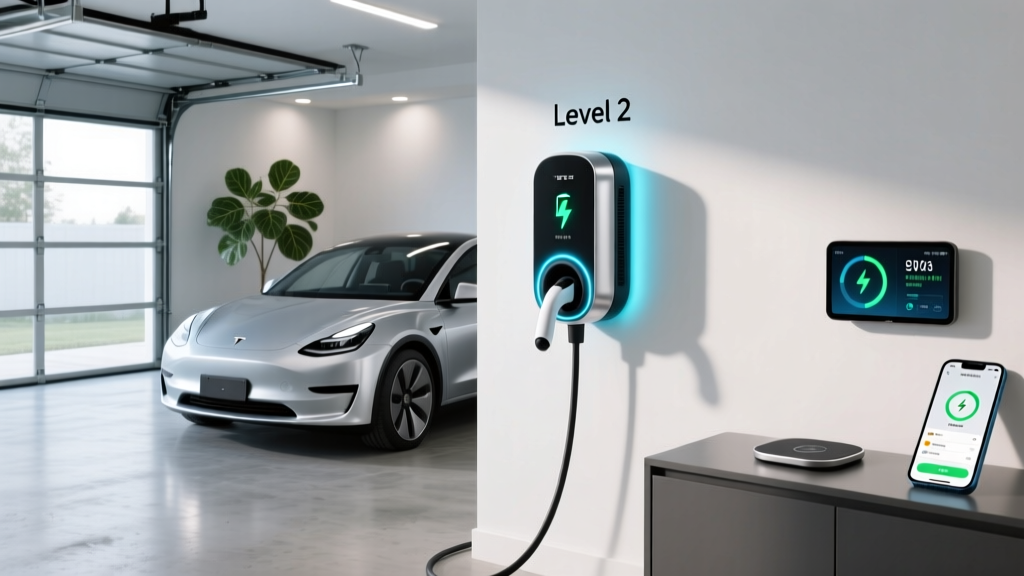
Level 2 is the practical ceiling for home charging. A Tesla Wall Connector at 48 amps delivers up to 11.5 kW on a 60-amp dedicated circuit — enough to fully recharge a 75 kWh Tesla Model Y battery in roughly 7 hours, or add about 44 miles of range per hour of charging. For a 94 kWh Ford F-150 Lightning Extended Range, that same charger replenishes the pack in about 8.5 hours, easily covering overnight needs.
DC fast chargers (including Superchargers) are designed for road trips and fleet depots. A Tesla V4 Supercharger delivers up to 350 kW and can take a Model 3 Long Range from 10% to 80% in approximately 15 minutes. But the electrical service required — typically a dedicated 480V three-phase feed — makes this impossible for residential installation.
How Much Does It Cost to Install a Home Level 2 EV Charger?
The total cost to install a Level 2 home charger varies widely based on your electrical panel's capacity, the distance from panel to charger location, and local permit fees. Here is a realistic 2026 breakdown:
| Component | Simple Install | Complex Install |
|---|---|---|
| Level 2 Charger Unit | $400–$650 | $400–$750 |
| Electrician Labor (2–6 hrs @ $85–$150/hr) | $170–$450 | $510–$900 |
| Electrical Materials (conduit, wire, breaker) | $50–$150 | $200–$500 |
| Permit & Inspection | $50–$150 | $100–$300 |
| Panel Upgrade (if needed) | $0 | $1,500–$3,500 |
| Total Range | $670–$1,400 | $2,710–$5,950 |
The "simple install" assumes you have a modern 200-amp electrical panel with spare capacity, the charger mounts on a wall within 10 feet of the panel, and no drywall repair or trenching is required. The "complex install" reflects older homes with 100-amp panels that need upgrading, runs over 30 feet through walls or underground conduit, or require a sub-panel installation in a detached garage.
Panel upgrade reality check: Roughly 20–30% of homes built before 1990 have 100-amp panels with limited breaker slots. Adding a 60-amp dedicated EV circuit may require a full panel upgrade to 200 amps, costing $1,500–$3,500. Some utilities offer rebates for panel upgrades tied to EV adoption — check with your local provider. Always have a licensed electrician perform a load calculation before committing to a charger amperage.
Electrical Requirements: Voltage, Amperage, and Circuit Rules
A Level 2 EV charger requires a 240-volt dedicated circuit — the same voltage as your electric dryer or oven. The circuit must be sized at 125% of the charger's continuous draw per the National Electrical Code (NEC Article 625). That means:
- A 48-amp charger (like the Tesla Wall Connector at max output) requires a 60-amp breaker and 6 AWG copper wire.
- A 40-amp charger (like the ChargePoint Home Flex at a common setting) requires a 50-amp breaker and 6 AWG copper wire.
- A 32-amp charger requires a 40-amp breaker and 8 AWG copper wire.
Your electrician will also verify that your panel has enough spare capacity to handle the new continuous load. A 200-amp panel with a 60-amp EV circuit still has 140 amps for the rest of your home, which is generally sufficient. A 100-amp panel may not have the headroom, triggering the panel-upgrade scenario above.
Safety and Code Considerations
- Dedicated circuit: EV chargers must be on their own circuit — not shared with other appliances.
- GFCI protection: The 2020 NEC requires GFCI protection for all EV receptacles. Hardwired chargers with built-in ground-fault protection may not require a separate GFCI breaker, but your electrician will confirm local code.
- Outdoor rating: If mounting outdoors, ensure the charger carries a NEMA 4 or IP65 rating for weather resistance. The Tesla Wall Connector and ChargePoint Home Flex are both rated for outdoor use.
- Hardwired vs. plug: Hardwired installations (no plug) support up to 48 amps and eliminate the need for a 240V receptacle. Plug-in installations using a NEMA 14-50 outlet are limited to 40 amps continuous (on a 50-amp breaker) but offer portability.
Which Connector and Charger Is Compatible with My EV?
The North American charging landscape consolidated heavily around the NACS (North American Charging Standard, originally Tesla's proprietary connector) between 2024 and 2026. As of 2026, most new EVs sold in the US ship with a native NACS charge port or include a CCS-to-NACS adapter. Here is how compatibility breaks down by brand:
| Brand | Native Connector | Adapter Needed for Superchargers? |
|---|---|---|
| Tesla (all models) | NACS | No — native |
| Ford (Mach-E, F-150 Lightning) | NACS (2025+) | No — native; CCS adapter for non-Tesla DCFC |
| GM (Chevy Equinox EV, Blazer EV, Silverado EV, Cadillac Lyriq) | NACS (2025+) | No — native |
| Hyundai/Kia (Ioniq 5/6, EV6, EV9) | NACS (2026+ models); CCS on 2025 and earlier | CCS-to-NACS adapter for 2025 and earlier models |
| Rivian (R1T, R1S) | NACS | No — native |
| BMW, Mercedes, VW, Volvo | CCS1 (legacy); NACS transition in progress | Check manufacturer adapter program |
| Nissan (Leaf — legacy) | CHAdeMO | No adapter available; CHAdeMO network shrinking |
For home Level 2 charging, the Tesla Wall Connector now ships with a NACS plug and can charge any NACS-equipped vehicle. For CCS vehicles, Tesla sells a Universal Wall Connector with an integrated CCS adapter, priced around $600, that charges both NACS and CCS vehicles without swapping cables.
Recommended Home Level 2 Chargers: Specs, Features, and Pricing
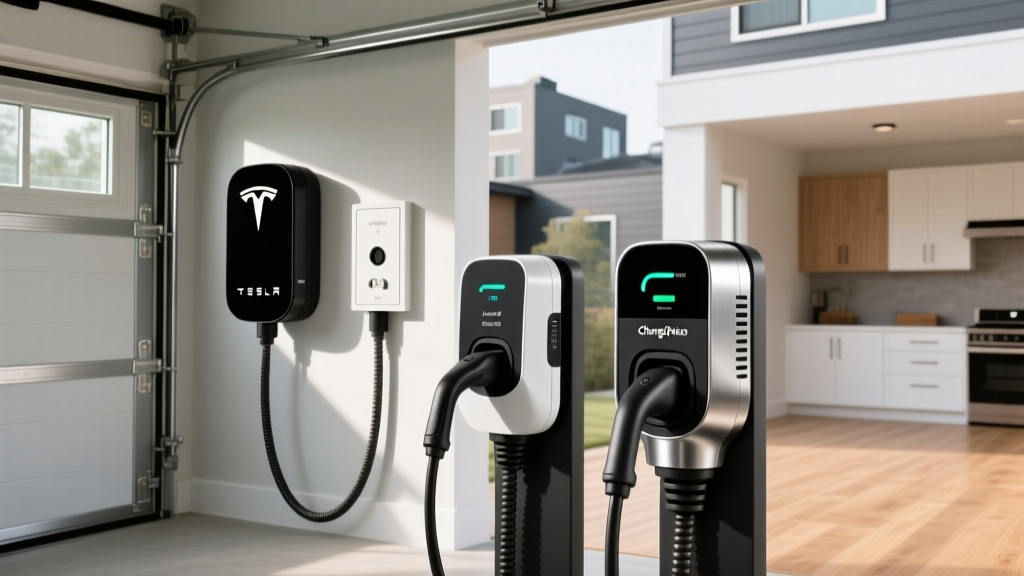
These are the top-performing Level 2 home chargers as of early 2026, selected based on power output, build quality, smart features, and connector flexibility:
Tesla Wall Connector (3rd Gen)
- Max Output: 11.5 kW (48A) on a 60A circuit
- Connector: NACS (native Tesla plug)
- Cable Length: 24 feet
- Smart Features: Wi-Fi, OTA firmware updates, Tesla app scheduling, load sharing (pair up to 6 units on one circuit)
- Outdoor Rating: NEMA 4 (fully weatherproof)
- Price: ~$475
- Best For: Tesla owners and NACS-equipped EVs; best value-to-power ratio
ChargePoint Home Flex
- Max Output: 12 kW (50A) on a 60A circuit; configurable down to 16A
- Connector: NACS or J1772 (selectable at purchase); CCS adapter available
- Cable Length: 23 feet
- Smart Features: Wi-Fi, ChargePoint app, Alexa integration, scheduled charging, energy tracking
- Outdoor Rating: NEMA 4
- Price: ~$550–$650
- Best For: Multi-EV households with mixed connector types; flexible amperage settings for older panels
Emporia Level 2 EV Charger
- Max Output: 11.5 kW (48A) on a 60A circuit
- Connector: J1772 (NACS adapter included)
- Cable Length: 24 feet
- Smart Features: Wi-Fi, Emporia app, real-time energy monitoring, solar integration, scheduled charging
- Outdoor Rating: NEMA 4
- Price: ~$400
- Best For: Budget-conscious buyers; homes with solar panels (pairs with Emporia energy monitor)
Charging Time Examples: How Long Does a Full Charge Take?
Charging time depends on your battery's usable capacity (in kWh), the charger's power output (in kW), and the charge curve — batteries accept power fastest between roughly 10% and 50% State of Charge, then taper significantly above 80% to protect cell health. Here are real-world charging times for popular EVs on a home Level 2 charger at 11.5 kW:
| Vehicle | Battery (Usable kWh) | 10–80% Time | 0–100% Time |
|---|---|---|---|
| Tesla Model Y Long Range (2026) | 75 kWh | ~4.5 hours | ~6.5 hours |
| Ford F-150 Lightning Ext. Range | 98 kWh | ~5.9 hours | ~8.5 hours |
| Chevrolet Equinox EV RS (2026) | 85 kWh | ~5.1 hours | ~7.4 hours |
| Hyundai Ioniq 5 (84 kWh pack) | 77.4 kWh | ~4.7 hours | ~6.7 hours |
| BMW i4 eDrive40 | 81.5 kWh | ~4.9 hours | ~7.1 hours |
For context, DC fast charging at a Supercharger (250 kW peak) takes a Tesla Model Y from 10–80% in approximately 15–20 minutes. But you do not need that speed at home — overnight charging at Level 2 covers virtually all daily driving needs. According to fueleconomy.gov, the average American drives about 37 miles per day, which a Level 2 charger replenishes in under one hour.
Cost to Charge: Home vs. Public DC Fast Charging vs. Gas
Electricity pricing varies by state and utility, but here are representative scenarios for 2026:
| Scenario | Rate | Cost per Mile (3.5 mi/kWh efficiency) |
|---|---|---|
| Home off-peak (national avg.) | $0.13/kWh | $0.037 |
| Home peak (time-of-use) | $0.28/kWh | $0.080 |
| Public Level 2 (ChargePoint, EVgo) | $0.30–$0.45/kWh | $0.086–$0.129 |
| DC Fast Charging (Electrify America, Supercharger) | $0.35–$0.55/kWh | $0.100–$0.157 |
| Gas vehicle (25 MPG combined, $3.40/gal) | $3.40/gallon | $0.136 |
At home off-peak rates, an EV costs roughly 3.7 cents per mile to fuel — about 73% less than a 25 MPG gas car at $3.40/gallon. Even at peak DC fast-charging rates, EVs remain competitive with or cheaper than gasoline on a per-mile basis. The savings compound: a driver covering 12,000 miles per year saves approximately $1,200–$1,500 annually by charging at home off-peak versus buying gasoline, according to data from the U.S. Department of Energy.
One important nuance: DC fast charging at peak public rates ($0.45–$0.55/kWh) can approach or exceed gas costs per mile. The economic case for EVs is strongest when you charge primarily at home. If your living situation prevents home charging (apartment, street parking), a plug-in hybrid (PHEV) may be a more practical electrified option until charging access improves.
Federal Tax Credit for Home Charger Installation
The IRS Residential Clean Energy Credit (IRC §25C, as extended through 2026) covers 30% of the cost of home EV charging equipment and installation, up to a maximum credit of $1,000 per year. This applies to the charger unit and the electrician labor, wiring, and permit costs.
- Maximum credit: $1,000 (30% of up to $3,333 in qualified expenses)
- Eligible costs: Charger hardware, electrician labor, wiring, conduit, permits
- Not eligible: Panel upgrades (these may qualify under the separate §25C energy-efficient home improvement credit for electrical panel upgrades — consult a tax professional)
- Income limits: None for the charger installation credit (unlike the §30D vehicle credit)
- Claiming: File IRS Form 8911 with your tax return for the year installation was completed
For a typical $1,200 installation, the credit reduces your federal tax liability by $360. For a $3,000 installation with a panel upgrade, consult a tax professional to determine which portions qualify under which credit provision.
Frequently Asked Questions
Can I install a Tesla Supercharger at my house?
No. Tesla Superchargers are commercial DC fast-charging stations requiring 480V three-phase power, utility-grade infrastructure, and Tesla's commercial networking. They are not available for residential purchase or installation. The closest residential equivalent is the Tesla Wall Connector, which delivers up to 11.5 kW on a 240V circuit and costs approximately $475 for the unit.
How much does it cost to install a home EV charger?
A straightforward Level 2 home charger installation (60-amp circuit, short run, no panel upgrade) costs $670–$1,400 in 2026, including equipment, electrician labor, materials, and permits. Complex installations requiring a panel upgrade, long conduit runs, or sub-panel additions can reach $2,700–$5,950. The federal §25C tax credit covers 30% of equipment and installation costs up to $1,000.
How fast will each charging level add range?
Level 1 (120V) adds 3–5 miles of range per hour — too slow for most EVs but workable for PHEVs with small batteries. Level 2 (240V, 48A) adds approximately 35–44 miles of range per hour, fully recharging most EVs overnight. DC fast charging (Supercharger, Electrify America) adds 150–1,000+ miles per hour at peak power, taking most EVs from 10–80% in 15–30 minutes.
Do I need a panel upgrade to install a Level 2 charger?
Not always, but possibly. If you have a 200-amp panel with spare breaker slots, a 60-amp dedicated EV circuit fits easily. If you have a 100-amp panel (common in pre-1990 homes), your electrician will perform a load calculation. If the panel is near capacity, a 200-amp upgrade costs $1,500–$3,500. Some homeowners opt for a lower-amperage charger (32A/40A) to avoid the upgrade, which still adds 23–29 miles of range per hour — adequate for most daily driving.
Which home charger should I buy for a non-Tesla EV?
If your EV has a NACS charge port (2025+ Ford, GM, Rivian, and 2026+ Hyundai/Kia models), the Tesla Universal Wall Connector (~$600) charges both NACS and CCS vehicles with an integrated adapter. For CCS-only vehicles (2024 and earlier non-Tesla EVs), the ChargePoint Home Flex in J1772 configuration (~$550) with a CCS adapter is a strong choice. The Emporia charger (~$400) includes a NACS adapter in the box and is the best budget option.
How much does charging an EV cost per mile compared to gas?
At the national average residential electricity rate of $0.13/kWh and a typical EV efficiency of 3.5 miles per kWh, home charging costs approximately $0.037 per mile — about 73% less than a 25 MPG gas car at $3.40/gallon ($0.136/mile). Public DC fast charging at $0.45/kWh costs roughly $0.129/mile, still competitive with gasoline. The biggest savings come from charging at home during off-peak hours.