The Real Cost at Tesla Charging Stations — and How It Stacks Up
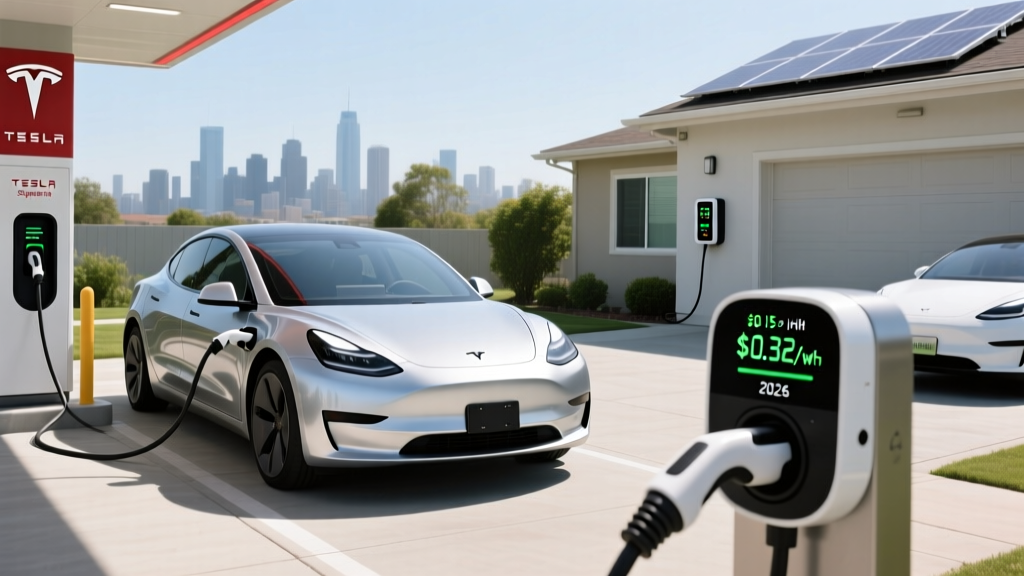
If you're shopping for an EV or just picked up a new Tesla, one question dominates your ownership math: what does it actually cost to charge? The cost at Tesla charging stations (Superchargers) varies by location, time of day, and whether you're on a paid plan — but in 2026, most U.S. Superchargers bill between $0.25 and $0.50 per kWh, with a national average hovering near $0.35/kWh.
That number alone doesn't tell the full story. Your real charging economics depend on how often you use Superchargers versus a home Level 2 setup, what you'd pay for gasoline in a comparable vehicle, and whether your home electrical panel can support a dedicated 240V circuit. This guide breaks down every layer — from the kW speeds at each charging tier to the exact installation costs and equipment you'll need.
kW (kilowatts) = the rate of power delivery, like water pressure from a hose. A 250 kW Supercharger delivers energy faster than a 7.2 kW home charger.
kWh (kilowatt-hours) = the total energy delivered, like gallons of water in a bucket. A Tesla Model Y Long Range has about 75 kWh of usable battery capacity. You're billed per kWh at charging stations.
Charging Levels Explained: Speeds, Costs, and Use Cases
Every EV owner uses a mix of three charging tiers. Understanding each level's speed in kW — and the real miles of range added per hour — is the foundation for comparing the cost at Tesla charging stations against alternatives.
| Level | Voltage / Power | Miles of Range / Hour | 10–80% Time (75 kWh Battery) | Typical $/kWh |
|---|---|---|---|---|
| Level 1 (120V household) | 120V / 1.4–1.9 kW | 3–5 mi/hr | ~35–45 hours | $0.12–$0.20 (home electric rate) |
| Level 2 (240V home/public) | 240V / 7.2–19.2 kW | 20–60 mi/hr | ~4–8 hours | $0.12–$0.20 home; $0.25–$0.49 public |
| DC Fast Charging (Supercharger, EA, etc.) | 400–800V / 50–350 kW | 150–1,000+ mi/hr | ~15–30 minutes | $0.25–$0.50+ (varies by network) |
Real-world charging curve note: A V3 Tesla Supercharger peaks at 250 kW, but that rate only holds between roughly 10% and 30% state of charge. Above 50%, the rate tapers significantly — often dropping below 100 kW by 70% SoC and below 50 kW past 85%. This is why manufacturers quote 10–80% times rather than 0–100%. Charging to 100% at a DC fast charger is slow, expensive, and stressful on the battery. Reserve it for when you genuinely need the full range.
Cost at Tesla Charging Stations: Supercharger Pricing in 2026
Tesla Supercharger pricing is set per station and can shift with time-of-use (TOU) rates. Here's what owners typically encounter across U.S. regions:
- Off-peak hours (late night/early morning at many urban stations): $0.25–$0.32/kWh
- Standard/peak hours: $0.32–$0.42/kWh
- High-demand urban and corridor stations (California, Northeast corridor, major metros): $0.42–$0.55/kWh
- Idle fees: $0.50–$1.00/minute if your car remains plugged in after reaching its charge limit at a full station
Tesla also offers a membership plan (roughly $12.99/month) that discounts Supercharger rates by approximately 15–25% at participating stations — worth it if you Supercharge more than ~80 kWh per month.
For context, a Tesla Model Y Long Range with a ~75 kWh usable battery charging from 10% to 80% (about 52.5 kWh delivered) at a station billing $0.38/kWh would cost approximately $19.95. That adds roughly 210 miles of real-world range.
Cost Per Mile: Supercharger vs Home Level 2 vs Gasoline
The cost at Tesla charging stations becomes meaningful when compared against home charging and gasoline on a per-mile basis. The table below uses a Tesla Model Y Long Range (rated at ~3.5 miles per kWh, or about 28.5 kWh/100 mi per fueleconomy.gov) and a comparable gas SUV averaging 28 MPG combined.
| Scenario | Rate | Cost Per Mile | Cost for 12,000 mi/yr |
|---|---|---|---|
| Home Level 2 (off-peak, $0.14/kWh avg) | $0.14/kWh | $0.040 | $480 |
| Tesla Supercharger ($0.38/kWh avg) | $0.38/kWh | $0.109 | $1,303 |
| Electrify America / other DC fast ($0.48/kWh avg) | $0.48/kWh | $0.137 | $1,646 |
| Gasoline SUV (28 MPG, $3.40/gal) | $3.40/gallon | $0.121 | $1,457 |
Key takeaway: Home charging at off-peak rates is roughly 3× cheaper per mile than the average Supercharger and 3× cheaper than gasoline. If you rely exclusively on Tesla Superchargers, your per-mile cost can actually exceed a fuel-efficient gas car in some markets — which is why home Level 2 installation is the single highest-ROI upgrade an EV owner can make.
How Much Does It Cost to Install a Home EV Charger?
Installation costs vary enormously based on your home's electrical panel capacity, the distance from the panel to the charger location, and local permitting. Here's a realistic breakdown for a typical 48-amp (11.5 kW) Level 2 home charger on a dedicated 60-amp circuit:
| Component | Low End | High End | Notes |
|---|---|---|---|
| Level 2 charger (hardwired, 48A) | $400 | $750 | Wi-Fi-enabled smart chargers cost more |
| Electrician labor (run 60A circuit, mount unit) | $500 | $2,000 | Depends on run distance, wall type, conduit |
| Permit and inspection | $50 | $300 | Required in most jurisdictions |
| Electrical panel upgrade (if needed) | $1,500 | $4,000 | 100A→200A service upgrade; common in pre-1990 homes |
| Total (no panel upgrade) | $950 | $3,050 | Most homes with 200A panels fall in this range |
| Total (with panel upgrade) | $2,450 | $7,050 | Older homes may require full service upgrade |
Electrical Requirements and Panel Upgrade Gotchas
A 48-amp Level 2 charger requires a dedicated 60-amp, 240V circuit (NEC code requires circuits be rated at 125% of continuous load). Your electrical panel must have two adjacent open breaker slots and sufficient remaining capacity — typically at least 60 amps of headroom on a 200A service.
Homes built before 1990 often have 100-amp or 150-amp panels already near capacity with HVAC, electric range, and dryer loads. A licensed electrician will perform a load calculation (NEC Article 220) to determine if your panel can handle the added circuit. If not, a service upgrade to 200A or even 400A (with a sub-panel) becomes necessary — adding $1,500–$4,000 to your project.
Safety and code essentials:
- Dedicated circuit: Never share the EV charger circuit with other appliances.
- GFCI protection: NEC 2020+ requires GFCI protection for outdoor receptacles; hardwired installations may be exempt in some jurisdictions but GFCI breakers add safety.
- Outdoor rating: If your charger mounts outside, it must carry a NEMA 4 or NEMA 4X weather-resistance rating.
- Hardwired vs plug: Hardwired chargers (no plug) avoid the need for a NEMA 14-50 receptacle, reduce points of failure, and are often preferred by inspectors for 48A+ units.
Which Connector and Charger Is Compatible with My EV?
The connector landscape shifted dramatically in 2024–2025 when most major automakers adopted the North American Charging Standard (NACS) — originally Tesla's proprietary connector. As of 2026, NACS is the dominant light-duty EV connector in North America, but millions of CCS1-equipped vehicles remain on the road.
| Connector | Brands Using It (Native) | Tesla Supercharger Access | Adapter Needed? |
|---|---|---|---|
| NACS (Tesla) | Tesla, Ford, GM, Rivian, Volvo, Polestar, Hyundai/Kia (2025+), BMW, Mercedes | Native — no adapter | CCS→NACS adapter ($150–$250) for non-Tesla DCFC networks |
| CCS1 | VW, Audi, older Ford/GM/Hyundai/Kia models (pre-adoption) | Requires NACS→CCS adapter (~$200) or use EA/other CCS networks | NACS→CCS adapter for Tesla Superchargers |
| CHAdeMO | Nissan Leaf (legacy), Mitsubishi Outlander PHEV | No — not compatible | Limited adapters; network is being phased out |
Tesla opened its Supercharger network to non-Tesla NACS-equipped vehicles starting in 2024, and by 2026 most new EVs ship with a native NACS port. If you own a CCS1 vehicle (like a 2023 Hyundai Ioniq 5 or VW ID.4), you'll need a Tesla-approved NACS-to-CCS adapter to access Superchargers — and even then, access may be limited to stations marked "Open to Non-Tesla Vehicles" in the Tesla app.
Equipment Recommendations: Best Home Level 2 Chargers for 2026
A quality Level 2 charger should last 10+ years and deliver reliable daily charging. Here are three proven options spanning different budgets and feature sets:
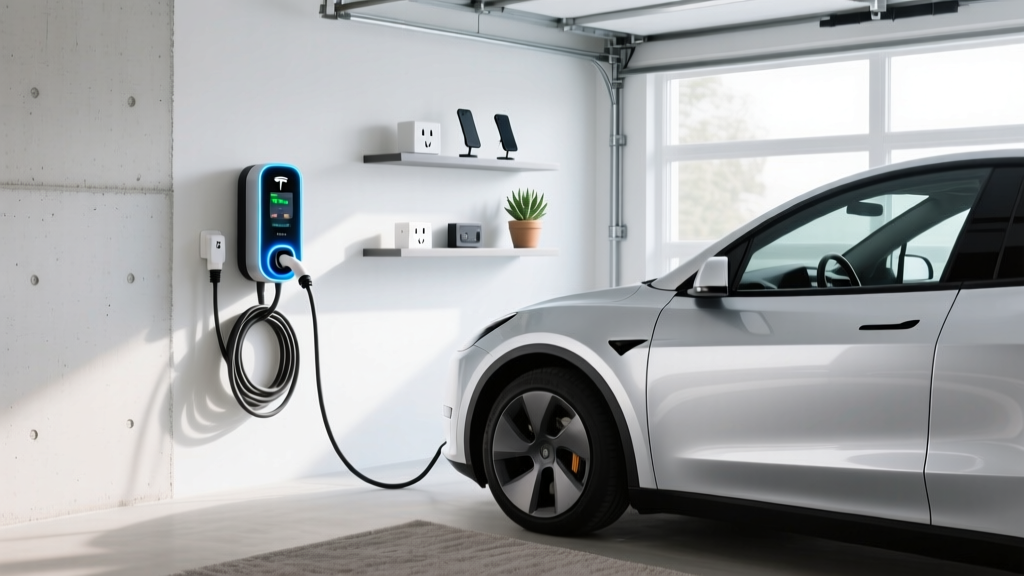
Tesla Wall Connector (Gen 4)
- Power output: 11.5 kW (48A) on a 60A circuit
- Connector: NACS (native Tesla); J1772 adapter included for non-Tesla EVs
- Cable length: 24 ft
- Smart features: Wi-Fi, OTA updates, power sharing (link two units on one circuit), Tesla app integration
- Price: ~$475
- Best for: Tesla owners who want seamless integration and the cleanest aesthetic
ChargePoint Home Flex
- Power output: Up to 12 kW (50A) on a 60A circuit; adjustable from 16A–50A via DIP switches
- Connector: J1772 (NACS adapter available separately)
- Cable length: 23 ft
- Smart features: Wi-Fi, ChargePoint app scheduling, Alexa integration, energy reporting, TOU optimization
- Price: ~$550–$650
- Best for: Multi-EV households or owners wanting detailed energy tracking and utility TOU scheduling
Emporia Level 2 EV Charger
- Power output: 11.5 kW (48A) on a 60A circuit
- Connector: J1772 (NACS adapter available)
- Cable length: 24 ft
- Smart features: Wi-Fi, Emporia app, integrates with Emporia Vue home energy monitor for solar-aware charging
- Price: ~$350–$400
- Best for: Budget-conscious buyers and solar-panel owners who want to charge only on excess solar production
All three units support hardwired installation (recommended for 48A+) and carry NEMA 4 outdoor ratings. The Tesla Wall Connector is the natural choice for Tesla-only garages; the ChargePoint Home Flex offers the most flexibility if your household includes a non-Tesla EV.
Federal Tax Credit for Home Charger Installation
The IRS Alternative Fuel Vehicle Refueling Property Credit (IRC §30C) covers 30% of home EV charger equipment and installation costs, up to $1,000. Key eligibility points for 2026:
- The charger must be installed at your primary residence.
- The property must be located in an eligible census tract (designated as low-income or non-urban — check the IRS census tract locator tool).
- The credit applies to both equipment and labor costs.
- It is non-refundable (it can reduce your tax liability to zero but won't generate a refund beyond that).
This credit is separate from the §30D new EV purchase credit and can be claimed in the same tax year. Consult a tax professional to confirm eligibility for your specific situation.
Frequently Asked Questions
How much does it cost to charge a Tesla at a Supercharger vs at home?
At the 2026 national Supercharger average of ~$0.38/kWh, fully replenishing a Tesla Model Y Long Range (10–80%, ~52.5 kWh) costs about $20. The same charge at home at $0.14/kWh costs about $7.35. Over a year of 12,000 miles, exclusive Supercharging runs ~$1,300 while home charging runs ~$480.
Is it cheaper to charge at Tesla Superchargers or buy gas?
It depends on your local rates. At $0.38/kWh, the cost per mile for a Model Y is roughly $0.109/mile — slightly cheaper than a 28 MPG gas SUV at $3.40/gallon ($0.121/mile). But in high-cost markets like California where some Superchargers charge $0.50+/kWh, EV fast-charging can exceed gas costs per mile. Home charging is always significantly cheaper than both.
Can non-Tesla EVs use Tesla Superchargers?
Yes, but with conditions. As of 2026, most new EVs ship with a native NACS port and can access Superchargers directly. Older CCS1-equipped vehicles require a Tesla-approved adapter and can only use stations designated "Open to Non-Tesla Vehicles" in the Tesla app. CHAdeMO vehicles cannot use Superchargers.
Do I need a panel upgrade for a home EV charger?
Possibly. Homes with 100A or 150A service, or 200A panels already heavily loaded (electric heat, range, dryer, pool), may need a service upgrade to add a 60A EV circuit. A licensed electrician will perform a NEC Article 220 load calculation. Budget $1,500–$4,000 for a panel upgrade if required.
How long does it take to charge at a Tesla Supercharger?
A Tesla Model Y Long Range (75 kWh battery) charging at a V3 Supercharger (250 kW peak) typically reaches 10–80% in approximately 20–25 minutes with battery preconditioning enabled. Without preconditioning — especially in cold weather — the same session can stretch to 35–45 minutes as the battery management system limits charge rate to protect the cells. V4 Supercharger stalls (350 kW capable) can shave 3–5 minutes off peak sessions for compatible vehicles.
What's the best way to minimize charging costs as a Tesla owner?
Prioritize home Level 2 charging on off-peak utility rates (often 10 PM – 6 AM). Use the Tesla app or your charger's scheduling feature to automate this. Reserve Superchargers for road trips. If you must Supercharge regularly, the Tesla membership plan (~$12.99/month) saves ~15–25% per session and pays for itself after roughly 80 kWh/month of usage.