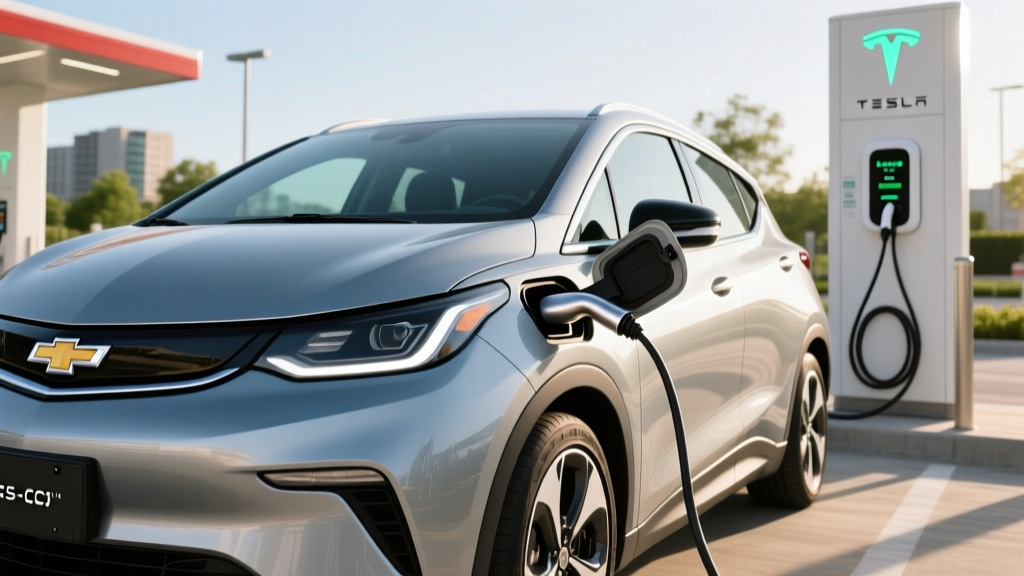
If you own a Chevrolet Bolt EV or Bolt EUV, you've likely wondered: can a Chevy Bolt use a Tesla Supercharger? The short answer is yes — but only with the right adapter, and only at certain stations. The longer answer involves understanding which connector your Bolt has, what Tesla's open network actually supports, and how to build a reliable charging strategy around home Level 2 and public DC fast charging.
This guide covers everything Bolt owners need to know in 2026: Supercharger adapter compatibility, real-world charging speeds at every level, home installation costs, and the electrical upgrades you might need before plugging in.
Can a Chevy Bolt Use a Tesla Supercharger? The 2026 Answer
Starting in 2024, Tesla began opening its Supercharger network to non-Tesla EVs through the Magic Dock — a built-in CCS1 adapter at select stalls — and through third-party NACS-to-CCS adapters. By 2026, the landscape has matured considerably, but Bolt owners face specific constraints worth understanding.
| Bolt Model | Factory Connector | Tesla Supercharger Access | Adapter Required |
|---|---|---|---|
| 2017–2023 Bolt EV/EUV | CCS1 (Combo) | Yes — at Magic Dock stations or with approved NACS-to-CCS adapter | Tesla Magic Dock (built-in at select stalls) or aftermarket NACS-to-CCS adapter |
| 2025+ Bolt EV/EUV (next-gen, announced) | NACS (native) | Yes — direct plug, no adapter | None |
Key detail: Most currently registered Bolt EVs and EUVs on the road have the CCS1 connector. To use a Tesla Supercharger with a CCS1-equipped Bolt, you need either:
- A Supercharger stall with Tesla's Magic Dock — a built-in adapter that converts the NACS plug to CCS1. These exist at select locations but are not yet universal across the network.
- An approved NACS-to-CCS1 adapter — several manufacturers (including Lectron, A2Z, and Tesla's own adapter for non-Tesla vehicles) sell adapters rated for DC fast charging. Prices typically range from $175 to $300.
You can check which Supercharger locations have the Magic Dock via the Tesla app (filter for "Charge Your Non-Tesla") or through apps like PlugShare, which now tag NACS-open stations.
Real-world caveat: Not every Supercharger stall at a Magic Dock location supports non-Tesla vehicles. Some stalls have the dock; others don't. Arrive prepared with a backup CCS station on your route via PlugShare or A Better Routeplanner.
Charging Levels Explained: How Fast Will Each Level Add Range?
Before evaluating chargers, you need to understand the three charging levels and what they mean in terms of power (measured in kilowatts, or kW) versus energy stored (measured in kilowatt-hours, or kWh). Think of kW as the flow rate of water through a hose, and kWh as the total volume of the tank you're filling.
| Level | Voltage | Power (kW) | Miles of Range Added Per Hour | Best For |
|---|---|---|---|---|
| Level 1 (120V outlet) | 120V AC | 1.2–1.9 kW | 3–5 miles | Overnight trickle, PHEVs, emergency top-ups |
| Level 2 (240V home/public) | 240V AC | 3.3–19.2 kW | 12–75 miles | Daily home charging, workplace, destination |
| DC Fast Charging | 200–900V DC | 25–350 kW | 100–1,000+ miles (equivalent rate) | Road trips, rapid top-ups |
Chevy Bolt Charging Speeds in Practice
The Bolt EV has a 65 kWh usable battery (LG Chem NMC chemistry), and the Bolt EUV carries the same pack. Here's what charging looks like at each level:
- Level 1 (120V, 12A): Adds roughly 4 miles of range per hour. A full 0–100% charge takes approximately 60+ hours. Functional for overnight top-ups if your daily commute is under 30 miles.
- Level 2 (240V, 32A / 7.7 kW): The Bolt's onboard charger maxes out at 7.7 kW (32 amps). A 10–80% charge takes about 7 hours. This is the practical daily charging method for most Bolt owners.
- Level 2 (240V, 48A / 11.5 kW): Even with a 48A charger, the Bolt cannot accept more than 7.7 kW. You won't damage anything — the car simply draws what it can — but you won't gain speed.
- DC Fast Charging (CCS1): The Bolt peaks at approximately 55 kW. A 10–80% charge takes roughly 45–55 minutes. This is the Bolt's most significant charging limitation: 55 kW is slow by 2026 standards, where competitors like the Hyundai Ioniq 5 peak at 240 kW.
The Bolt's EPA range is 259 miles (EV) and 247 miles (EUV). Per fueleconomy.gov, expect roughly 200–220 miles of real-world highway range, and as low as 170–190 miles in sustained cold weather (below 30°F) due to battery resistance and cabin heating demands.
Home Charger Installation: Costs, Electrical Requirements, and Panel Upgrades
Installing a Level 2 home charger is the single most impactful upgrade for daily EV ownership. But costs vary enormously depending on your home's electrical panel, the distance from panel to charger location, and local permit requirements.
Electrical Requirements for a Bolt-Compatible Level 2 Charger
Since the Bolt accepts a maximum of 7.7 kW (32A), you need a 240V circuit rated for at least 40 amps (the National Electrical Code requires circuits to be rated at 125% of continuous load, so a 32A charger needs a 40A breaker). A 48A charger would require a 60A breaker.
- Minimum circuit: 240V / 40A dedicated breaker
- Wire gauge: 6 AWG copper (for 40A) or 4 AWG (for 60A, future-proofing)
- Outlet type: NEMA 14-50 (most common) or hardwired connection
- GFCI protection: Required by NEC 2020+ for EV receptacles in garages
| Component | Low Estimate | High Estimate | Notes |
|---|---|---|---|
| Level 2 charger (equipment) | $300 | $700 | 32A–48A smart chargers; see recommendations below |
| Electrician labor | $400 | $1,500 | Depends on panel proximity, wall material, conduit run length |
| Electrical permit | $50 | $250 | Varies by municipality; some jurisdictions bundle with inspection |
| Panel upgrade (if needed) | $1,500 | $4,000 | Required if panel is 100A or has insufficient breaker spaces |
| Total (no panel upgrade) | $750 | $2,450 | Most homes with 200A service fall in this range |
| Total (with panel upgrade) | $2,250 | $6,450 | Older homes with 100A panels or full breaker boxes |
Will You Need a Panel Upgrade?
This is the cost variable most buyers overlook. A licensed electrician will perform a load calculation to determine whether your existing panel can handle the added 40A or 60A circuit. Homes built before 2000 often have 100A or 150A panels that may be near capacity. If your panel is already running electric heat, a dryer, an oven, and A/C, a 200A upgrade (or a secondary sub-panel) may be necessary.
Cost-saving alternative: Some utilities and smart-panel companies (like Span) offer load-management devices that allow EV charging without a full panel upgrade by dynamically limiting charger draw when other appliances are running. These devices cost $300–$600 but can save thousands versus a panel replacement.
Always defer final electrical specifications to a licensed electrician. The National Electrical Contractors Association maintains a directory of certified installers.
How Much Does Charging Cost Per Mile vs. Gas?
One of the strongest arguments for the Bolt is its low operating cost. Here's a breakdown comparing home charging, public DC fast charging, and a gas equivalent.
| Scenario | Rate | Cost for Full Charge (65 kWh) | Cost Per Mile (259 mi range) |
|---|---|---|---|
| Home off-peak (utility TOU rate) | $0.09/kWh | $5.85 | $0.023/mile |
| Home standard rate | $0.16/kWh | $10.40 | $0.040/mile |
| Public Level 2 (ChargePoint, etc.) | $0.25/kWh | $16.25 | $0.063/mile |
| DC Fast Charging (Electrify America, EVgo) | $0.40/kWh | $26.00 | $0.100/mile |
| Tesla Supercharger (non-Tesla rate) | $0.35/kWh | $22.75 | $0.088/mile |
| Gas vehicle (30 MPG, $3.40/gal) | $3.40/gallon | $29.28 (equiv.) | $0.113/mile |
Even at the most expensive public DC fast-charging rates, the Bolt costs less per mile than a 30 MPG gas car. At home off-peak rates, it's roughly one-fifth the cost per mile. Over 15,000 annual miles, a Bolt owner charging primarily at home saves $1,100–$1,400 per year versus fueling a comparable gas compact.
Recommended Level 2 Chargers for the Chevy Bolt
Since the Bolt caps at 7.7 kW (32A), you don't need a 48A charger to get maximum speed — but buying a 48A unit future-proofs your installation for your next EV. Here are top picks for Bolt owners in 2026:
Emporia Level 2 Smart Charger (48A)
- Power output: Up to 11.5 kW (48A) — Bolt will draw 7.7 kW max
- Connector: J1772 (CCS1 compatible)
- Cable length: 24 feet
- Smart features: Wi-Fi, energy monitoring, solar integration, scheduling via app
- Price: ~$399
- Best for: Budget-conscious buyers who want smart scheduling and energy tracking
ChargePoint Home Flex (50A)
- Power output: Up to 12 kW (50A) — adjustable via DIP switch
- Connector: J1772 (CCS1 compatible)
- Cable length: 23 feet
- Smart features: Wi-Fi, Alexa integration, charge scheduling, detailed session history
- Price: ~$549
- Best for: Brand reliability, robust app, and broad utility integration
Grizzl-E Smart (40A)
- Power output: Up to 9.6 kW (40A)
- Connector: J1772 (CCS1 compatible)
- Cable length: 24 feet
- Smart features: OCPP protocol, app control, outdoor-rated (NEMA 4)
- Price: ~$449
- Best for: Outdoor installations, extreme climates, and durability
Wallbox Pulsar Plus (40A)
- Power output: Up to 9.6 kW (48A version also available)
- Connector: J1772 (CCS1 compatible)
- Cable length: 25 feet
- Smart features: Wi-Fi + Bluetooth, Power Sharing (daisy-chain two units on one circuit), compact form factor
- Price: ~$499
- Best for: Tight garage spaces and multi-EV households
Important: All of these chargers use the J1772 connector, which is the AC charging standard for all CCS1-equipped EVs including the Bolt. For DC fast charging, the Bolt uses the CCS1 (Combo) connector — the two lower DC pins below the J1772 inlet.
Safety, Code, and Installation Best Practices
EV charging involves sustained high-current draw — often 8+ hours at a time. This is fundamentally different from intermittent loads like a dryer. Proper installation isn't optional; it's a fire-safety requirement.
- Dedicated circuit: Your Level 2 charger must be on its own dedicated breaker. Never share the circuit with other appliances.
- GFCI protection: The 2020 NEC (and subsequent editions) require GFCI protection for EV charging receptacles. Some chargers have built-in GFCI; if yours doesn't, your electrician must install a GFCI breaker.
- Outdoor rating: If installing outside, ensure the charger carries a NEMA 4 (or IP65+) rating. Indoor-rated units will fail in rain or snow.
- Cable management: A 24-foot cable draped across a garage floor is a trip hazard. Most chargers include a wall-mount holster; use it.
- Permit and inspection: Most jurisdictions require an electrical permit for new 240V circuits. Skipping the permit risks insurance denial in the event of an electrical fire. Budget $50–$250 for the permit and schedule the inspection before the electrician leaves.
For authoritative guidance on EV charging electrical safety, reference the NFPA 70 National Electrical Code, Article 625 (Electric Vehicle Charging System Equipment).
Building a Complete Bolt Charging Strategy
Knowing that a Chevy Bolt can use a Tesla Supercharger (with the right adapter) is one piece of the puzzle. Here's how to build a practical, resilient charging strategy:
- Primary: Home Level 2. Install a 40A/240V circuit with a smart charger. Set a scheduled charge window during off-peak utility hours (typically 10 PM – 6 AM). This covers 90%+ of your charging needs at $0.02–$0.04/mile.
- Secondary: Public CCS1 DC fast chargers. Use PlugShare, A Better Routeplanner, or your vehicle's built-in navigation to identify Electrify America, EVgo, and ChargePoint DC stations along common routes. The Bolt's 55 kW peak means you'll spend 45–55 minutes going from 10–80%.
- Tertiary: Tesla Superchargers with Magic Dock or adapter. Use these when CCS1 stations are sparse or out of service. Tesla's network reliability is generally higher than third-party CCS networks, but non-Tesla access remains limited to select locations.
- Emergency: Level 1 (120V). The Bolt ships with a dual-level charge cord that includes a 120V plug. At ~4 miles of range per hour, it's slow but functional for overnight recovery if your Level 2 goes down.
Real-World Range Reality for the Bolt: The EPA rates the Bolt EV at 259 miles. In real-world highway driving at 70 mph, expect 210–230 miles. In winter conditions below 30°F, plan for 170–190 miles. Always keep a 10–15% buffer for unexpected detours or charger outages.
Frequently Asked Questions
Can a Chevy Bolt use a Tesla Supercharger without an adapter?
No. Current Bolt EV and EUV models (2017–2023) use the CCS1 connector, while Tesla Superchargers use the NACS connector. You need either a Tesla Magic Dock stall (which has a built-in adapter) or an aftermarket NACS-to-CCS1 adapter to connect. The next-generation Bolt (announced for 2025+) is expected to ship with a native NACS port, eliminating the adapter requirement.
How much does it cost to install a home EV charger?
For a typical installation without a panel upgrade, expect $750–$2,450 total (equipment + electrician + permit). If your home needs a 200A panel upgrade, add $1,500–$4,000. Homes with existing 200A service and a nearby garage panel typically fall at the lower end of the range.
How fast will each charging level add range to my Bolt?
Level 1 (120V) adds 3–5 miles per hour. Level 2 (240V, 32A) adds approximately 25–30 miles per hour and is the Bolt's maximum AC acceptance rate. DC fast charging at 55 kW peak can add roughly 150–180 miles in a 45-minute session (10–80%).
Which connector is compatible with my Chevy Bolt?
All 2017–2023 Bolt EV and EUV models use CCS1 (Combo) for DC fast charging and J1772 for Level 1/Level 2 AC charging. Any J1772 or CCS1 charger is directly compatible. NACS (Tesla) chargers require an adapter.
How much does charging cost per mile vs. gas?
At home off-peak rates ($0.09/kWh), the Bolt costs about $0.023 per mile. At public DC fast-charging rates ($0.40/kWh), it costs about $0.10 per mile. A comparable 30 MPG gas car at $3.40/gallon costs $0.113 per mile. Home charging delivers 4–5x savings per mile.
What electrical upgrades might I need for a home charger?
The most common upgrade is a panel capacity increase from 100A to 200A ($1,500–$4,000). You may also need additional breaker spaces, a sub-panel, or a load-management device. Your electrician will perform a load calculation to determine requirements. Per IRS guidelines, some electrical upgrades may qualify for the §30D or §25C residential energy credit — consult a tax professional for eligibility.
Is it worth buying a 48A charger if the Bolt only accepts 32A?
Yes, if you plan to own future EVs that accept higher AC charge rates (many newer EVs accept 48A/11.5 kW). The extra cost is typically $50–$100, and it avoids replacing the charger when you upgrade vehicles. Just ensure your electrician installs a 60A circuit to support it.
Does the Bolt's 55 kW DC fast charging limit make road trips impractical?
It makes them slower, not impractical. A 10–80% charge takes 45–55 minutes — enough time for a meal or rest stop. The bigger limitation is on very long drives (400+ miles) where you'll need 2–3 charging stops. If road trips are frequent, consider an EV with 150+ kW DC fast charging capability, like the Hyundai Ioniq 5 or Kia EV6.