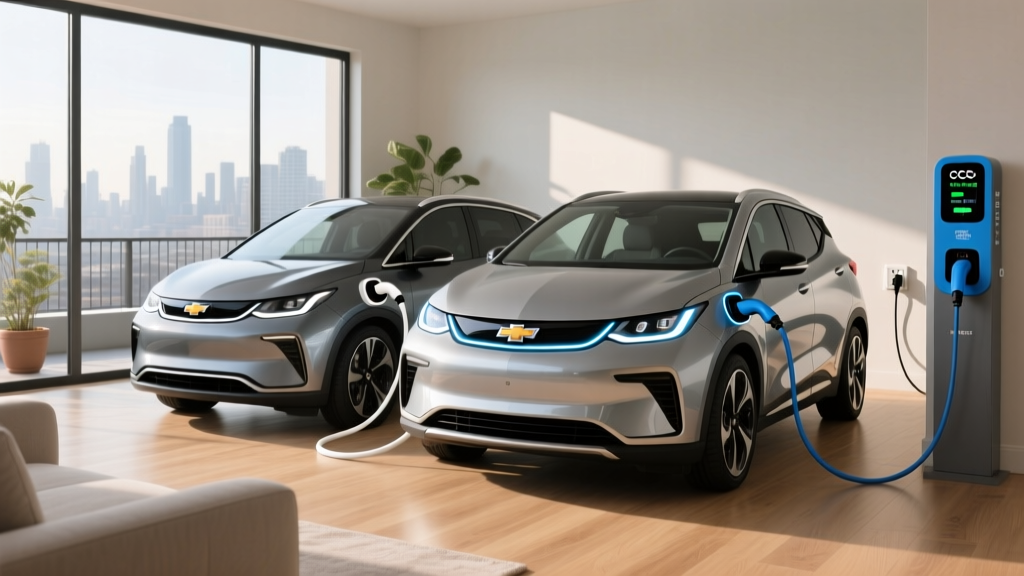
The Chevrolet Bolt EV (65 kWh battery, EPA 259 miles) and Bolt EUV (65 kWh, EPA 249 miles) remain among the most affordable long-range electric vehicles on the used and new-adjacent market. But their charging story is more nuanced than the spec sheet suggests. With a maximum Level 2 acceptance rate of 11.5 kW and DC fast charging capped near 55 kW, choosing the right charger — and understanding what your home electrical panel can support — directly determines whether your Bolt is a seamless daily driver or a frustration machine on road trips.
This guide breaks down exactly what charger hardware works with the Bolt platform, what your home needs to support it, what you'll pay per mile, and which specific chargers we recommend in 2026. Whether you're picking up a pre-owned 2022 Bolt EV or evaluating the refreshed Bolt lineup, the electrical fundamentals below apply.
Charging Levels Explained: What Speeds Actually Look Like for a Bolt
Before buying any equipment, you need to understand the three charging tiers and — critically — the difference between kW (kilowatts, a measure of power or charge rate) and kWh (kilowatt-hours, a measure of energy stored in your battery). The Bolt EV and EUV both carry a 65 kWh usable battery pack. A charger's kW rating tells you how fast energy flows into that pack; it does not tell you how much energy the pack holds.
| Level | Voltage | Max Power (kW) | Miles of Range Added per Hour | Full Charge Time (0–100%) |
|---|---|---|---|---|
| Level 1 (120V household outlet) | 120V AC | 1.2–1.4 kW | ~4 miles/hr | ~55–65 hours |
| Level 2 (240V home/public) | 240V AC | 11.5 kW (Bolt max) | ~34–39 miles/hr | ~6.5–7 hours |
| DC Fast Charging | 400V+ DC | ~55 kW peak (Bolt limit) | ~150–180 miles/hr (peak) | 10–80% in ~45–55 min |
Home Charger Installation: Electrical Requirements and Real Costs
The single biggest variable in Bolt ownership is your home charging setup. A proper Level 2 installation transforms the car from a slow-charging compromise into a wake-up-full-every-morning convenience. But the installation cost varies enormously depending on your electrical panel, the distance from panel to charger location, and local permit requirements.
What Your Bolt Actually Needs Electrically
The Bolt's onboard charger accepts up to 11.5 kW on Level 2. To deliver that, you need a 240V circuit rated for at least 48 amps (EVSE rated at 40A continuous, since the National Electrical Code requires circuits be rated 125% of continuous load). However, many homes install a 40A circuit (32A continuous EVSE), delivering roughly 7.7 kW — still enough to fully recharge a depleted Bolt overnight in about 9 hours.
- Ideal setup: 240V / 48A dedicated circuit → 40A continuous EVSE → 11.5 kW to the Bolt
- Common setup: 240V / 40A dedicated circuit → 32A continuous EVSE → ~7.7 kW to the Bolt
- Minimum viable: 240V / 20A circuit → 16A continuous EVSE → ~3.8 kW (still ~12 miles/hr)
Panel Capacity: The Hidden Cost Factor
Most modern homes with 200A service can accommodate a 40–48A EV circuit without a panel upgrade. Older homes with 100A service, or homes where the panel is already near capacity (electric range, dryer, HVAC, water heater all running), may need a service upgrade to 200A — which typically costs $1,500–$3,000 on its own. Some utilities offer rebates for panel upgrades tied to EV adoption; check with your local provider.
An alternative to a full panel upgrade is a smart load-management system (like the Span panel or Emporia smart breaker), which dynamically throttles charger draw when other large appliances are running. This can avoid a panel upgrade entirely in some cases.
| Component | Typical Cost Range | Notes |
|---|---|---|
| Level 2 EVSE hardware (charger unit) | $350–$700 | Varies by brand, power output, smart features |
| Electrician labor (standard install, <30 ft run) | $500–$1,200 | Conduit, wiring, breaker, outlet or hardwire |
| Electrical permit | $50–$200 | Varies by municipality; some jurisdictions waive for EV |
| Panel upgrade (if needed, 100A → 200A) | $1,500–$3,000 | Not required for most 200A-service homes |
| Total (no panel upgrade) | $900–$2,100 | Most common scenario |
| Total (with panel upgrade) | $2,400–$5,100 | Older homes or maxed-out panels |
The IRS §30C alternative fuel vehicle refueling property credit covers up to 30% of home charger hardware and installation costs (capped at $1,000), subject to income limits and census-tract eligibility. Always confirm current-year rules with a tax professional.
Connector Compatibility: CCS1, NACS, and the Adapter Reality
The Chevy Bolt EV and Bolt EUV (model years 2017–2025) were built with the CCS1 (Combined Charging System) connector — the J1772 AC plug with two additional DC pins below it. Starting in 2025, GM began transitioning new vehicles to the NACS (North American Charging Standard) port used by Tesla. Depending on your Bolt's model year, your connector situation differs:
| Scenario | Bolt Port | Charger Connector Needed | Adapter Required? |
|---|---|---|---|
| 2017–2024 Bolt EV/EUV at home (Level 2) | CCS1 (J1772 AC portion) | J1772 plug (standard on all non-Tesla Level 2 EVSE) | No |
| 2017–2024 Bolt at CCS DC fast charger | CCS1 | CCS1 plug | No |
| 2017–2024 Bolt at Tesla Supercharger | CCS1 | NACS plug | Yes — GM-approved NACS-to-CCS adapter (~$225–$250) |
| 2025+ Bolt (NACS-equipped) at home | NACS | NACS plug or J1772 with NACS adapter | Depends on EVSE |
| 2025+ Bolt at Tesla Supercharger | NACS | NACS plug | No — native compatibility |
Charging Cost Per Mile: Bolt vs. Gasoline Baseline
One of the strongest ownership arguments for the Bolt is fuel cost. With an EPA-rated efficiency of roughly 28–30 kWh per 100 miles (about 120–128 MPGe combined for the Bolt EV), your cost per mile depends entirely on your electricity rate. Here's how common scenarios break down:
| Charging Scenario | Electricity Rate ($/kWh) | Bolt Cost/Mile | Gas Car Cost/Mile ($3.50/gal, 30 MPG) | Annual Savings (12,000 mi/yr) |
|---|---|---|---|---|
| Home, off-peak utility rate | $0.09/kWh | $0.027 | $0.117 | ~$1,080 |
| Home, average US residential rate | $0.16/kWh | $0.048 | $0.117 | ~$828 |
| Public Level 2 (ChargePoint, etc.) | $0.25–$0.35/kWh | $0.075–$0.105 | $0.117 | ~$144–$504 |
| DC Fast Charging (Electrify America, EVgo) | $0.35–$0.55/kWh | $0.105–$0.165 | $0.117 | –$144 to +$144 (break-even to slight loss) |
The takeaway is clear: home charging is where the Bolt's economics shine. If you rely exclusively on DC fast charging at $0.45+/kWh, your per-mile cost can actually exceed a 30 MPG gas car. This makes a home Level 2 installation not just a convenience but a financial necessity for most Bolt owners.
For the latest average electricity rates by state, the U.S. Energy Information Administration (EIA) publishes monthly residential pricing data.
Best Level 2 Chargers for the Chevy Bolt: 2026 Equipment Picks
Because the Bolt's onboard charger maxes at 11.5 kW (48A), any Level 2 EVSE rated at 48A or higher will fully utilize the car's acceptance rate. Going higher (e.g., an 80A charger) won't charge the Bolt faster, but it future-proofs for your next EV. Below are chargers we've evaluated for Bolt compatibility, reliability, and value.
Emporia Level 2 Smart Charger
- Power output: 48A max (11.5 kW at 240V)
- Connector: J1772 (CCS1 AC compatible)
- Cable length: 24 ft
- Smart features: Wi-Fi, app scheduling, solar integration, energy monitoring, load management with Emporia panel
- Price: ~$399
- Best for: Budget-conscious Bolt owners wanting full 11.5 kW and smart scheduling for off-peak rates
ChargePoint Home Flex
- Power output: Up to 50A (12 kW, configurable via DIP switches for lower circuits)
- Connector: J1772 (NACS version also available)
- Cable length: 23 ft
- Smart features: Wi-Fi, app scheduling, Alexa integration, flexible amperage settings
- Price: ~$549–$599
- Best for: Owners who want adjustable amperage to match their panel capacity without buying a different unit
Grizzl-E Smart (United Chargers)
- Power output: 40A (9.6 kW) — does NOT max out the Bolt's 11.5 kW capability
- Connector: J1772
- Cable length: 24 ft
- Smart features: Wi-Fi, OCPP-compatible, works with multiple apps, extreme cold rating (–40°F)
- Price: ~$449
- Best for: Cold-climate owners on a 40A circuit who prioritize rugged build over max charge speed
Tesla Wall Connector (with J1772 adapter or for NACS Bolts)
- Power output: Up to 48A (11.5 kW at 240V)
- Connector: NACS native; J1772 adapter available (~$50–$95)
- Cable length: 24 ft
- Smart features: Wi-Fi, OTA updates, power sharing between two units, load management
- Price: ~$450 (unit only)
- Best for: Multi-EV households with a Tesla + Bolt, or 2025+ NACS-equipped Bolt owners
Safety, Code Compliance, and Installation Best Practices
EV charging is a high-draw, continuous-load application — your charger may run at near-maximum circuit capacity for 6–10 hours straight. This demands strict adherence to electrical code and safety practices:
- Dedicated circuit: Your Level 2 charger must be on its own dedicated breaker — never shared with other appliances. The NEC requires continuous loads to use only 80% of the circuit rating (a 40A breaker supports 32A continuous).
- GFCI protection: NEC 2020 and later require GFCI protection for EVSE outlets (not hardwired units) in garages. Many modern EVSE units have built-in ground-fault detection. Hardwiring eliminates the GFCI breaker requirement in most jurisdictions and is generally more reliable.
- NEMA 14-50 outlet vs. hardwire: A NEMA 14-50 receptacle offers portability (take your charger when you move) but requires a GFCI breaker under current code in most areas (~$100–$150 for the breaker alone). Hardwiring is more permanent, avoids the GFCI requirement, and is slightly more efficient (no plug connection losses).
- Outdoor rating: If your charger is installed outside, ensure the EVSE is rated for outdoor use (NEMA 4 or IP65). The Emporia, ChargePoint Home Flex, and Grizzl-E all carry outdoor ratings. The receptacle or junction box must also have a weatherproof in-use cover.
- Wire gauge: For a 48A circuit, your electrician will typically use 6 AWG copper wire (or 4 AWG aluminum for longer runs). Do not undersize wire — this is a fire risk.
- Permit and inspection: Most jurisdictions require an electrical permit for EVSE installation. The inspection ensures your wiring, breaker sizing, and grounding meet code. Skipping the permit risks insurance denial in the event of an electrical fire.
DC Fast Charging on the Road: What Bolt Owners Need to Know
The Bolt's ~55 kW DC fast-charge ceiling is the platform's most discussed limitation. For context, vehicles like the Kia EV6 or Hyundai Ioniq 5 can accept 230–350 kW on compatible chargers, completing a 10–80% session in 18 minutes. The Bolt takes roughly 45–55 minutes for the same session.
This doesn't make road trips impossible — it makes them require planning. Here's how to optimize:
- Precondition the battery: If your Bolt has navigation-based preconditioning (available on 2022+ models), set a DC fast charger as your destination. The car will warm the battery to optimal temperature, which can improve charge rate by 10–20% in cold weather.
- Charge in the 10–60% sweet spot: The Bolt's charge curve is most aggressive below 60% SoC. Above 80%, the rate drops to ~15–20 kW. Plan shorter, more frequent stops rather than trying to fill to 90%+.
- Use PlugShare or A Better Routeplanner: These tools let you filter for CCS1 chargers (or NACS with your adapter) and show real-time availability. The PlugShare database is community-maintained and generally reliable for station status.
- Expect 150–180 miles of range per 30-minute stop: At peak rate, the Bolt adds roughly 3 miles per minute of DC charging. A 40-minute stop from 15% to 75% typically yields ~160–170 miles of usable range.
Frequently Asked Questions
How much does it cost to install a home EV charger for a Chevy Bolt?
For a typical home with a 200A panel and a short wire run, expect $900–$2,100 total (charger unit + electrician + permit). If your home needs a panel upgrade from 100A to 200A, add $1,500–$3,000. The federal §30C credit can offset up to $1,000 (30% of costs) if you meet income and census-tract requirements.
How fast will each charging level add range to my Bolt?
Level 1 (120V): approximately 4 miles of range per hour. Level 2 (240V, 48A): approximately 34–39 miles per hour — a full overnight charge. DC Fast Charging: roughly 150–180 miles per hour at peak rate, but sustained rate drops significantly above 60% SoC, making real-world 10–80% sessions 45–55 minutes.
Which connector and charger are compatible with my Bolt EV or EUV?
Model years 2017–2024 use CCS1 (J1772 for AC Level 1/2 charging). Any J1772 Level 2 charger works natively. For Tesla Supercharger access, you need a GM-authorized NACS-to-CCS adapter (~$225–$250). Model year 2025+ Bolts are expected to ship with NACS ports natively, enabling direct Supercharger access.
How much does charging a Bolt cost per mile compared to gas?
At the US average residential rate of ~$0.16/kWh, the Bolt costs roughly $0.048/mile to fuel — compared to ~$0.117/mile for a 30 MPG gas car at $3.50/gallon. That's about $828 in annual savings over 12,000 miles. Off-peak home rates ($0.09/kWh) push savings above $1,000/year. Exclusive DC fast charging at $0.45+/kWh can erase the advantage.
What electrical upgrades might I need for a Level 2 Bolt charger?
Most homes with 200A service need only a new 40–48A double-pole breaker, appropriate wire (6 AWG copper), and a NEMA 14-50 outlet or hardwire junction box. Homes with 100A service, older wiring (aluminum or undersized copper), or panels already near capacity may require a full service upgrade ($1,500–$3,000) or a smart load-management system to avoid one. A licensed electrician can perform a load calculation to determine your exact needs.
Can I use a Tesla Wall Connector with my older CCS1 Bolt?
Yes, but only with a NACS-to-J1772 adapter for AC Level 2 charging (~$50–$95). The Tesla Wall Connector outputs up to 48A (11.5 kW), which fully utilizes the Bolt's onboard charger. However, this adapter only works for AC charging — it does not enable DC fast charging at Superchargers. For Supercharger access, you need GM's NACS-to-CCS DC adapter instead.