Quick Answer: How Long Does a Chevy Bolt EV Take to Charge?
The 2026 Chevy Bolt EV (and Bolt EUV) carries a 65 kWh usable lithium-ion battery pack (NMC chemistry). Real-world charge time depends entirely on which charging level you use. Here's the headline number: on a 240V Level 2 home charger delivering 11.5 kW, a full 0–100% charge takes roughly 7 hours. On a 50 kW DC fast charger, a 10–80% session takes approximately 55–65 minutes. Plug into a standard 120V wall outlet (Level 1), and you're looking at over 50 hours for a full charge — barely enough to replenish a day's driving overnight.
But those numbers only tell part of the story. Charge curves taper, home electrical panels need capacity, connector compatibility has shifted with the industry-wide move to NACS, and public charging costs vary wildly. This guide breaks down every variable that affects your Chevy Bolt EV charge time, what you'll spend to set up home charging, and how the per-mile cost compares to gas.
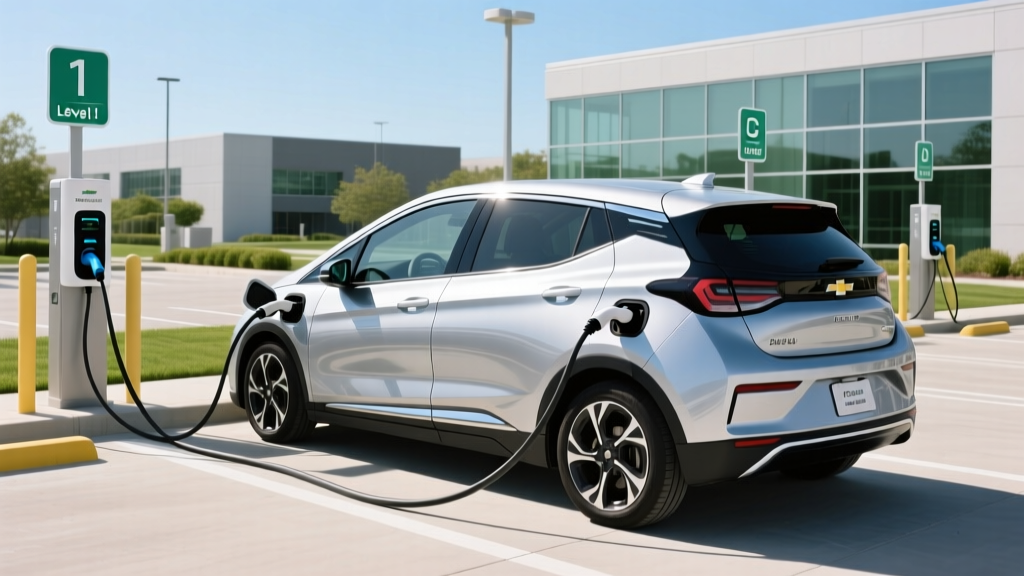
Charging Levels Explained: kW, Miles Per Hour, and Bolt EV Times
Before we get to specific numbers, let's clear up the single most common EV confusion: kW (kilowatts) measures power — how fast energy flows into the battery. kWh (kilowatt-hours) measures energy — the total capacity of the battery. Think of kW as the width of a hose and kWh as the size of the bucket. A wider hose (higher kW) fills the bucket faster, but the bucket size (kWh) doesn't change.
The 2026 Chevy Bolt EV accepts the following maximum charge rates depending on the source:
| Charging Level | Voltage / Power | Max kW to Bolt | Miles of Range Added Per Hour | 0–100% Full Charge Time | 10–80% Time |
|---|---|---|---|---|---|
| Level 1 (standard outlet) | 120V / ~1.4 kW | 1.4 kW | ~4 mi/hr | ~48–52 hours | ~35 hours |
| Level 2 (home/public AC) | 240V / 7.2–11.5 kW | 11.5 kW (Bolt's onboard charger max) | ~32–34 mi/hr | ~6.5–7 hours | ~4.5 hours |
| DC Fast Charging | 400V+ / up to 55 kW | ~55 kW peak | ~150+ mi/hr (peak) | N/A (not used for full) | ~55–65 min |
Understanding the Bolt's DC Fast-Charging Limitation
The Chevy Bolt's DC fast-charging speed has been a known limitation since the model's introduction. While competitors like the Hyundai Ioniq 5 peak at 240 kW and the Tesla Model Y at 250 kW, the Bolt tops out around 55 kW on DC fast charging. This means a 10–80% session takes close to an hour, compared to 18–25 minutes on vehicles with 800V architectures.
Additionally, the Bolt's charge curve tapers significantly above 80% state of charge (SoC). Charging from 80–100% on DC fast charging can add another 40+ minutes. For road trips, the practical strategy is to charge to 80% and move on — the time penalty for that final 20% is rarely worth it.
Home Charger Installation: Electrical Requirements, Costs, and Panel Upgrades
Most Bolt EV owners will do 85–95% of their charging at home on a Level 2 charger. Here's what's required to set that up.
Electrical Requirements for Level 2 Home Charging
To achieve the Bolt's maximum 11.5 kW Level 2 charge rate, you need:
- Circuit: A dedicated 60-amp breaker (EV chargers must run at 80% of circuit capacity per NEC, so a 48-amp charger requires a 60-amp circuit)
- Voltage: 240V (same as a dryer or oven outlet)
- Wire gauge: Typically 6 AWG copper, run from your panel to the charger location
- Panel capacity: At least 200-amp main service is recommended; older homes with 100-amp panels often need an upgrade
If you're willing to accept slower Level 2 speeds — say 7.2 kW on a 40-amp circuit — you can reduce the electrical requirements to a 40-amp breaker with 8 AWG wire. At 7.2 kW, the Bolt still charges fully in about 9 hours overnight, which is sufficient for most daily driving patterns.
How Much Does It Cost to Install a Home EV Charger?
Installation costs vary widely based on your home's electrical panel, the distance from the panel to your garage or parking spot, and local permit fees. Here's a realistic breakdown:
| Component | Simple Install (panel nearby) | Complex Install (long run / panel upgrade) |
|---|---|---|
| Level 2 EVSE equipment (charger) | $350–$700 | $350–$700 |
| Electrician labor (2–4 hrs simple, 6–12 hrs complex) | $400–$800 | $1,200–$3,000 |
| Materials (wire, conduit, breaker) | $100–$250 | $300–$600 |
| Permit fee | $50–$150 | $50–$200 |
| Electrical panel upgrade (100A → 200A, if needed) | Not needed | $1,500–$3,500 |
| Total estimated cost | $900–$1,900 | $3,400–$8,000 |
What Electrical Upgrades Might I Need?
Beyond the panel itself, watch for these potential upgrades:
- Conduit run: If your parking spot is far from the panel (detached garage, carport), the electrician must run conduit outdoors — adding labor and material cost
- GFCI breaker: The 2020 NEC (adopted by most jurisdictions by 2026) requires GFCI protection for EV circuits in garages and outdoors. GFCI breakers cost $50–$120 more than standard breakers
- Sub-panel: For detached garages, a sub-panel may be required ($300–$600 additional)
- Utility service upgrade: In rare cases, the utility must upgrade the service drop to your home (typically free or low-cost, but can add weeks of scheduling)
Connector Compatibility: NACS, CCS1, and What the Bolt Uses
The connector landscape has shifted dramatically. As of 2026, the North American Charging Standard (NACS), developed by Tesla, has become the dominant connector for new EVs. However, the 2026 Chevy Bolt EV still ships with a CCS1 (Combo) connector for DC fast charging and a J1772 connector for Level 1 and Level 2 AC charging.
| Connector Type | Used For | Bolt EV Compatible? | Adapter Needed? |
|---|---|---|---|
| J1772 | Level 1 & Level 2 AC charging | Yes (native) | No |
| CCS1 (Combo) | DC fast charging | Yes (native) | No |
| NACS (Tesla) | Level 2 & DC fast (Superchargers) | Yes, with adapter | Yes — CCS-to-NACS adapter (~$150–$250) |
| CHAdeMO | DC fast charging (legacy) | No | N/A (obsolete standard) |
Accessing Tesla Superchargers with a Bolt EV
GM and Tesla opened Supercharger access to non-Tesla EVs with CCS adapters. If your Bolt has a CCS1 port, you can use a GM-approved CCS-to-NACS adapter to charge at Tesla Supercharger V2 and V3 stations. However, because the Bolt peaks at ~55 kW, you won't benefit from V3's 250 kW capability — you'll charge at the Bolt's maximum regardless of the station's capacity.
For home Level 2 charging, any J1772 charger works natively. If you install a Tesla Wall Connector (NACS), you'll need an adapter on the Bolt's end, or you can opt for a J1772-equipped charger instead.
Cost to Charge a Chevy Bolt EV: Home vs. Public vs. Gas
Charging cost depends on your electricity rate, which varies by utility, time of day, and state. Below are realistic scenarios based on the Bolt's 65 kWh battery.
| Charging Scenario | Rate ($/kWh) | Cost for Full 65 kWh | Cost Per Mile (259 mi range) |
|---|---|---|---|
| Home — off-peak utility rate | $0.08–$0.12 | $5.20–$7.80 | $0.02–$0.03 |
| Home — standard residential rate | $0.13–$0.18 | $8.45–$11.70 | $0.03–$0.05 |
| Public Level 2 (workplace, retail) | $0.20–$0.35 | $13.00–$22.75 | $0.05–$0.09 |
| DC Fast Charging (Electrify America, EVgo) | $0.35–$0.55 | $22.75–$35.75 | $0.09–$0.14 |
How Does That Compare to Gas?
A comparable gas-powered compact car (Chevrolet Equinox, Honda CR-V) averaging 28 MPG combined at $3.40/gallon spends $0.12 per mile on fuel. Here's the comparison:
| Vehicle | Energy Source | Cost Per Mile | Annual Cost (12,000 mi) |
|---|---|---|---|
| Chevy Bolt EV (home charging) | Electricity @ $0.14/kWh | $0.04 | $480 |
| Chevy Bolt EV (DC fast only) | Electricity @ $0.45/kWh | $0.11 | $1,320 |
| Gas compact crossover (28 MPG) | Gasoline @ $3.40/gal | $0.12 | $1,440 |
If you charge primarily at home, the Bolt costs roughly one-third as much per mile as a gas car. Even exclusive DC fast charging is slightly cheaper than gas. The savings are most dramatic with home off-peak rates — potentially under $500/year for 12,000 miles of driving.
Recommended Level 2 Home Chargers for the Chevy Bolt EV
Since the Bolt's onboard charger maxes out at 11.5 kW, any charger rated 48 amps or higher will unlock the full Level 2 speed. Here are three proven options across different budgets:
Emporia Vue Level 2 Smart Charger
- Power output: 48 amps / 11.5 kW (240V)
- Connector: J1772 (native for Bolt)
- Cable length: 24 feet
- Smart features: Wi-Fi, app scheduling, energy monitoring, solar integration
- Price: ~$399
- Best for: Budget-conscious buyers who want smart scheduling and energy tracking
ChargePoint Home Flex
- Power output: Up to 50 amps / 12 kW (configurable to match circuit)
- Connector: J1772 (NACS version also available)
- Cable length: 23 feet
- Smart features: Wi-Fi, Alexa integration, ChargePoint app, flexible amperage settings
- Price: ~$649
- Best for: Flexibility — adjustable amperage lets you match your existing circuit without overspending on electrical work
Grizzl-E Smart Level 2
- Power output: 40 amps / 9.6 kW (240V)
- Connector: J1772
- Cable length: 24 feet
- Smart features: Wi-Fi, OCPP protocol, app control, extreme cold rating (-40°F)
- Price: ~$549
- Best for: Cold-climate owners and outdoor installations — IP65-rated, built in Canada
Editor's note: At 48 amps, the Emporia and ChargePoint both hit the Bolt's 11.5 kW maximum. The Grizzl-E at 40 amps delivers 9.6 kW, adding roughly 27 miles of range per hour instead of 32 — a minor difference for overnight charging but noticeable if you're topping up midday.
Safety, Code, and Installation Best Practices
EV charging draws sustained high current for hours — more like a furnace than a phone charger. Safety and code compliance are non-negotiable.
- Dedicated circuit: Your EV charger must have its own dedicated breaker — never share a circuit with other appliances. This is an NEC requirement.
- GFCI protection: Required for all EV outlets and hardwired installations in garages and outdoors per the 2020 NEC (Article 625). Most modern EVSEs have built-in GFCI, but your breaker may also need to be GFCI-rated depending on local code.
- Hardwired vs. plug-in: Hardwired chargers (no plug, direct connection) are preferred for 48A+ installations because NEMA 14-50 receptacles are rated for intermittent, not continuous, use. If you use a 14-50 outlet, ensure it's an industrial-grade receptacle (Hubbell, Bryant) — cheap receptacles have caused melting and fire incidents.
- Outdoor rating: If your charger is mounted outside, it must be rated IP65 or higher (dust-tight and protected from water jets). All three chargers recommended above meet this standard.
- Permit and inspection: Most jurisdictions require an electrical permit for EV charger installation ($50–$200). The work must pass inspection. Skipping the permit can void home insurance coverage if an electrical fire occurs.
Frequently Asked Questions
How fast will each charging level add range to my Bolt EV?
Level 1 (120V) adds about 4 miles per hour — essentially overnight trickle charging. Level 2 (240V at 11.5 kW) adds roughly 32 miles per hour, easily replenishing a full day's driving in 2–3 hours. DC fast charging at 55 kW peak can add 150+ miles in about an hour, though the Bolt's relatively modest DC charge rate means road-trip stops take longer than in competitors like the Ioniq 5 or Model Y.
Can I charge my Bolt EV at a Tesla Supercharger?
Yes, with a CCS-to-NACS adapter. GM has approved adapter use for accessing Tesla's Supercharger network. Purchase a GM-recommended adapter (typically $150–$250) and you can use any Supercharger with a Magic Dock or any NACS-equipped station that supports non-Tesla vehicles. Keep in mind the Bolt's 55 kW DC cap means you won't utilize the full speed of V3 Superchargers.
Does the Bolt EV qualify for any home charger tax credits?
The federal Residential Clean Energy Credit (IRS Form 5695) previously covered 30% of home EV charger equipment and installation costs up to $1,000. As of 2026, check current IRS guidance for active eligibility, as the alternative fuel vehicle refueling property credit has specific expiration and geographic targeting provisions. Some states and utilities also offer separate rebates for Level 2 charger installation — check your local utility's EV program page.
Is it worth installing a Level 2 charger if I only drive 30 miles a day?
Almost certainly, yes. At 30 miles per day, Level 1 charging (4 mi/hr) would require ~7.5 hours plugged in to replenish — technically feasible overnight, but it leaves zero buffer for days you drive more, and Level 1 is notably less efficient due to higher parasitic losses during the extended charge session. A Level 2 charger replenishes 30 miles in under an hour, is more energy-efficient, and preconditions the battery more effectively in cold weather. If your panel supports it, the $900–$1,900 simple install pays for itself in convenience and efficiency within a few years.
What's the real-world range I should plan around?
While the EPA rates the 2026 Bolt EV at 259 miles, plan your trips around ~220 miles of usable range in moderate weather and ~180–200 miles in freezing temperatures. The Bolt lacks a heat pump (it uses resistive cabin heating), which draws significantly more energy in cold weather than a heat-pump-equipped EV. For road trips, plan DC fast stops every 150–180 miles to maintain a comfortable buffer.
How does the Bolt's charging speed compare to other affordable EVs?
The Bolt's 55 kW DC fast-charging peak is the slowest among current mainstream EVs. The Hyundai Ioniq 5 peaks at 240 kW (10–80% in ~18 min), the Kia EV6 at 235 kW, and even the base Tesla Model 3 at 170 kW (~25 min). If you road-trip frequently, the Bolt's charging speed is a meaningful drawback. For daily commuting and overnight home charging, it's irrelevant — Level 2 speeds are competitive, and you'll rarely use DC fast charging day-to-day.