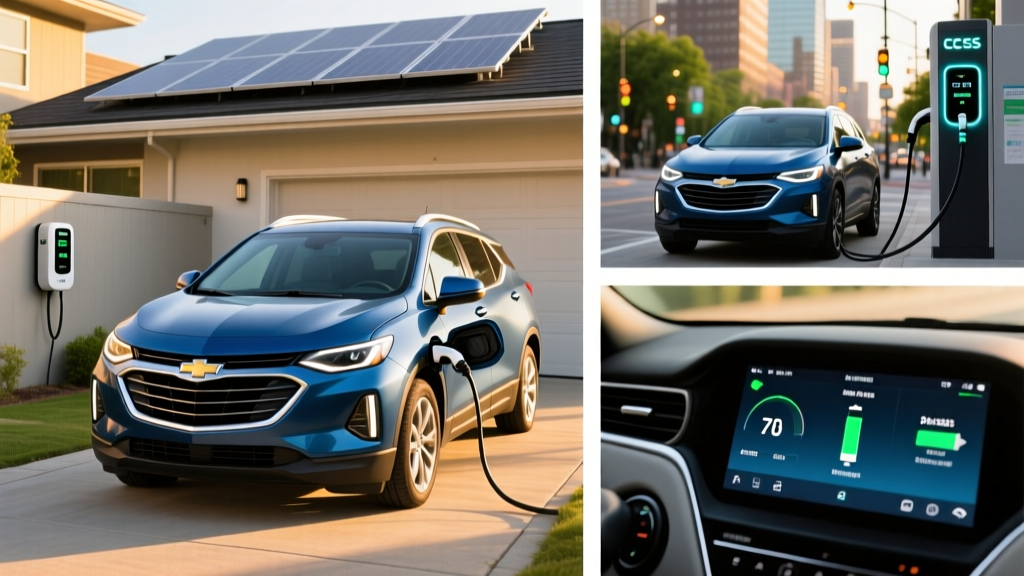
The 2026 Chevrolet Equinox EV offers an EPA-estimated range of up to 319 miles on the 3RS trim with the larger 85 kWh (usable) Ultium battery pack, making it one of the longest-range affordable electric SUVs on the market. But achieving that range — and keeping charging costs low over years of ownership — depends entirely on how you set up your charging infrastructure at home and which networks you rely on in public.
This guide breaks down exactly how to charge the Equinox EV, what it costs to install a home Level 2 charger, which connectors you need, and what you will actually pay per mile compared to a gas-powered Equinox. All figures reflect 2026 model-year specs and current electrical code requirements.
The 3RS AWD with the 85 kWh battery carries an EPA rating of 315 miles. In real-world highway driving at 70 mph, expect roughly 260–285 miles. In cold weather (below 32°F), plan for 220–250 miles due to battery chemistry limitations and cabin heating load. The FWD 3LT with the same pack achieves an EPA 319 miles but faces similar real-world reductions.
How Fast Each Charging Level Adds Range to the Equinox EV
The Chevrolet Equinox EV accepts charging at three levels, each with dramatically different speeds. Understanding the difference between kW (power, or how fast energy flows) and kWh (energy, or how much the battery stores) is essential. The Equinox EV's battery holds approximately 85 kWh of usable energy; how quickly you refill it depends on the charger's kW output.
| Charging Level | Voltage / Power | Rate (kW) | Miles of Range Added Per Hour | Best Use Case |
|---|---|---|---|---|
| Level 1 | 120V / 12A | ~1.4 kW | ~4–5 miles | Overnight top-up, emergencies |
| Level 2 (Home) | 240V / 48A | ~11.5 kW | ~34–38 miles | Daily home charging |
| Level 2 (Max Acceptance) | 240V / 48A | 11.5 kW (vehicle max) | ~34–38 miles | Full-speed home/public L2 |
| DC Fast Charging | 400V architecture | Up to ~150 kW peak | ~200+ miles in 30 min | Road trips, quick top-ups |
The Equinox EV's onboard charger maxes out at 11.5 kW on Level 2, meaning even if you plug into a 19.2 kW public Level 2 station, the vehicle will only draw 11.5 kW. For DC fast charging, GM's Ultium platform in the Equinox EV peaks around 150 kW, though sustained rates taper significantly above 80% state of charge (SoC) to protect battery health. A typical 10–80% DC fast charge session takes approximately 30–35 minutes at a capable 150+ kW station.
Home Charger Installation: Electrical Requirements and Costs
Installing a dedicated Level 2 home charger is the single most impactful upgrade for Equinox EV ownership. Here is what the installation actually involves and what it costs.
Electrical Requirements
To achieve the Equinox EV's maximum 11.5 kW Level 2 acceptance rate, you need a 240-volt circuit rated at 60 amps (which delivers a continuous 48 amps to the vehicle, per NEC 80% rule for continuous loads). A 40-amp circuit (32A continuous) will deliver about 7.7 kW — still adequate for overnight charging of the 85 kWh pack, adding roughly 23–26 miles of range per hour.
Homes built after 2000 typically have a 200-amp electrical panel with sufficient spare capacity. Older homes with 100-amp service may require a panel upgrade — a significant added cost.
| Cost Component | Low Estimate | High Estimate | Notes |
|---|---|---|---|
| Level 2 Charger Equipment | $400 | $750 | 40A–48A smart charger, 25ft cable |
| Electrician Labor (standard install) | $600 | $1,500 | Varies by run length, wall type |
| Permit & Inspection | $50 | $300 | Required by most jurisdictions |
| Electrical Panel Upgrade (if needed) | $1,500 | $3,500 | 100A → 200A service upgrade |
| Total (no panel upgrade) | $1,050 | $2,550 | Most common scenario |
| Total (with panel upgrade) | $2,550 | $6,050 | Older homes with 100A service |
Always hire a licensed electrician and pull a permit. Unpermitted electrical work can void home insurance and create fire risk. The NEC requires a dedicated circuit for EV charging — sharing a circuit with other appliances is a code violation and a safety hazard.
What Electrical Upgrades Might You Need?
Beyond the circuit itself, consider these potential requirements:
- Panel capacity check: An electrician will calculate your existing load. If your panel is near capacity, a service upgrade or a smart load-management device (like the Emporia V2X or a DCC-10 by SimpleBuddy) can avoid a full panel replacement.
- GFCI protection: The 2023 NEC (adopted in most states by 2026) requires GFCI protection for EV charging circuits in garages. Some chargers include built-in GFCI; otherwise your electrician will install a GFCI breaker.
- Outdoor rating: If your charger is mounted outside, it must carry a NEMA 4 or NEMA 4X rating for weather resistance.
- Conduit and wire gauge: A 60A circuit requires 6 AWG copper wire (or 4 AWG aluminum) in conduit. Longer runs from panel to charger increase material costs.
Connector Compatibility: NACS, CCS, and the Equinox EV
The 2026 Chevrolet Equinox EV ships with the NACS (North American Charging Standard) connector — the Tesla-style plug now adopted across most major automakers. This is a significant advantage for charging access.
| Connector Type | Equinox EV Compatibility | Network Access | Adapter Needed? |
|---|---|---|---|
| NACS (Tesla-style) | Native (built-in) | Tesla Superchargers, Electrify America (new stalls), Rivian Adventure Network | No |
| CCS1 | Via adapter (GM provides or aftermarket) | Legacy Electrify America, EVgo, ChargePoint DC stations | Yes — NACS-to-CCS adapter (~$200–$300) |
| CHAdeMO | Not supported | Nissan Leaf legacy stations | N/A — avoid |
| J1772 (Level 2 public) | Via included adapter | Public Level 2 stations everywhere | Yes — NACS-to-J1772 adapter (often included) |
With the native NACS port, 2026 Equinox EV owners gain access to over 25,000 Tesla Supercharger stalls nationwide using the Tesla app or built-in navigation integration. For older CCS-equipped public DC chargers still common at shopping centers and highway rest stops, keep a NACS-to-CCS adapter in the frunk or cargo area.
Charging Cost Per Mile: Equinox EV vs. Gas Equinox
One of the strongest financial arguments for the Equinox EV is the per-mile fuel cost. The EV achieves an EPA-rated efficiency of approximately 3.0–3.2 miles per kWh (roughly 106–112 MPGe combined). Here is how that translates to real costs across different charging scenarios.
| Charging Scenario | Cost per kWh | Cost per Mile (Equinox EV) | Annual Cost (12,000 mi) |
|---|---|---|---|
| Home — Off-Peak Utility Rate | $0.08–$0.12 | $0.025–$0.038 | $300–$456 |
| Home — Standard Residential Rate | $0.14–$0.18 | $0.044–$0.058 | $528–$696 |
| Public Level 2 (ChargePoint, etc.) | $0.25–$0.39 | $0.078–$0.125 | $936–$1,500 |
| DC Fast Charging (public) | $0.35–$0.55 | $0.11–$0.175 | $1,320–$2,100 |
For comparison, the 2026 gas-powered Chevrolet Equinox AWD achieves an EPA 26 MPG combined. At $3.20/gallon (2026 national average), the gas Equinox costs approximately $0.123 per mile, or $1,476 annually for 12,000 miles. Even charging entirely on standard residential electricity, the Equinox EV cuts fuel costs roughly in half. Home off-peak charging reduces fuel spend by 70–75%.
Check whether your utility offers a time-of-use (TOU) rate plan — scheduling charging between 10 PM and 6 AM can lock in the lowest per-kWh rates and pay for the home charger installation within 18–24 months.
Recommended Home Chargers for the Equinox EV
Since the Equinox EV accepts a maximum of 11.5 kW on Level 2, you want a charger capable of at least 48 amps to take full advantage. Here are three proven options at different price points, all featuring the NACS connector natively for 2026.
Emporia Vue V2 (Best Value)
- Power Output: 48A / 11.5 kW (hardwired) or 40A / 9.6 kW (NEMA 14-50 plug)
- Connector: NACS native
- Cable Length: 24 feet
- Smart Features: Wi-Fi, energy monitoring, solar integration, load management
- Price: ~$399 (hardwired) / ~$449 (plug-in)
- Best For: Budget-conscious owners who want energy data
ChargePoint Home Flex (Most Versatile)
- Power Output: Up to 50A / 12 kW (adjustable 16A–50A via DIP switches)
- Connector: NACS native (2025+ models)
- Cable Length: 23 feet
- Smart Features: Wi-Fi, app scheduling, Alexa, load sharing for dual installs
- Price: ~$549–$649
- Best For: Flexible amperage, future-proofing, multi-EV households
Wall Connector (Tesla / GM-Approved)
- Power Output: 48A / 11.5 kW (hardwired, 60A circuit)
- Connector: NACS native
- Cable Length: 24 feet
- Smart Features: Wi-Fi, OTA updates, power sharing between two units, access control
- Price: ~$475
- Best For: Reliability, Supercharger ecosystem integration, clean design
All three chargers are NEMA 4 rated for indoor or outdoor installation and UL-listed for safety. The hardwired versions deliver the full 48A; plug-in versions (NEMA 14-50) are limited to 40A continuous unless your outlet and circuit are rated for 50A.
DC Fast Charging Reality: Charge Curves and Road Trip Planning
The Equinox EV's ~150 kW peak DC fast charging rate is competitive for its class, but the charge curve matters more than the peak number. Here is what a typical DC fast session looks like:
- 10%–50% SoC: Charges near peak rate (~130–150 kW), adding roughly 130–150 miles in 15 minutes
- 50%–80% SoC: Rate tapers to ~80–110 kW, adding another 80–100 miles in ~15 minutes
- 80%–100% SoC: Rate drops sharply to ~20–40 kW — the final 20% can take as long as the first 70%
For road trips, plan to charge from 10% to 80% (about 30–35 minutes at a 150+ kW station) and drive on. Charging above 80% at a DC station is rarely worth the time unless you are at your final destination overnight.
Use the Equinox EV's built-in navigation to precondition the battery before arriving at a DC fast charger. Battery preconditioning warms the pack to optimal temperature, which can shave 5–10 minutes off your charging session, especially in cold weather. Without preconditioning, a cold-soaked battery in winter may peak at only 80–100 kW instead of 150 kW.
Federal Tax Credits and Incentives for Home Charging
The IRS §30D Clean Vehicle Credit may apply to the Equinox EV purchase (up to $7,500, subject to MSRP caps, buyer income limits, and battery sourcing requirements — see IRS guidelines for current eligibility). Additionally, the Alternative Fuel Vehicle Refueling Property Credit (§30C) can cover up to 30% of home charger equipment and installation costs (maximum $1,000), provided you live in an eligible census tract.
Many utilities also offer rebates of $250–$500 for Level 2 charger purchases or TOU rate enrollment. Check your local utility's EV program page before purchasing equipment.
Safety, Code Compliance, and Maintenance
Home EV charging is safe when installed correctly. Key code and safety requirements for 2026:
- Dedicated circuit: The EV charger must have its own breaker — no shared circuits with dryers, ovens, or HVAC.
- GFCI breaker: Required for all garage and outdoor EV circuits per NEC 2023 (Article 625).
- Proper wire gauge: 6 AWG copper for 60A circuits; undersized wire creates fire risk.
- Outdoor mounting: NEMA 4-rated enclosure required; ensure the charger's cord and connector are rated for UV exposure and temperature extremes.
- Ventilation: While EV chargers don't produce fumes, enclosed garages should have adequate airflow to prevent heat buildup around the unit.
Maintenance is minimal: inspect the cable and connector annually for cracking or corrosion, and ensure the mounting bracket remains secure. Most quality chargers carry 3-year warranties on the unit itself.
Frequently Asked Questions
How much does it cost to install a home EV charger for the Equinox EV?
Expect $1,050–$2,550 for a standard installation (equipment, electrician labor, and permit) if your electrical panel has sufficient capacity. If a panel upgrade from 100A to 200A service is needed, total costs can reach $2,550–$6,050. The §30C federal credit may offset up to $1,000 of this cost in eligible areas.
How fast will each charging level add range to the Equinox EV?
Level 1 (120V) adds about 4–5 miles per hour — adequate only for overnight top-ups of 30–40 miles. Level 2 (240V, 48A) adds roughly 34–38 miles per hour, fully recharging the 85 kWh pack in about 8–9 hours. DC fast charging adds 130–150 miles in approximately 15–20 minutes at a 150+ kW station.
Which connector is compatible with the 2026 Equinox EV?
The 2026 Equinox EV uses a native NACS (Tesla-style) connector. This gives direct access to Tesla Superchargers and new NACS-equipped public stations. For legacy CCS1 stations, a NACS-to-CCS adapter is needed. For public Level 2 J1772 stations, a NACS-to-J1772 adapter is required (often included with the vehicle).
How much does charging the Equinox EV cost per mile vs. gas?
Home charging at off-peak rates costs approximately $0.025–$0.038 per mile. Standard residential rates bring it to $0.044–$0.058 per mile. The gas-powered Equinox AWD costs about $0.123 per mile at $3.20/gallon. Even exclusive public DC fast charging ($0.11–$0.175 per mile) can be competitive with gas on a per-mile basis, though home charging delivers the largest savings.
What electrical upgrades might I need for a Level 2 charger?
Most homes with a 200-amp panel need only a new 60A dedicated circuit with appropriate wire gauge and a GFCI breaker. Homes with 100-amp service, outdated wiring (knob-and-tube, aluminum branch circuits), or panels near capacity may require a full service upgrade ($1,500–$3,500), a smart load-management device, or a lower-amperage charger (32A–40A) to avoid the panel upgrade entirely.
Does the Equinox EV qualify for the $7,500 federal tax credit?
Eligibility depends on the 2026 §30D rules: the vehicle MSRP must not exceed $80,000 (SUVs), buyer modified adjusted gross income must fall below caps ($150K single / $300K joint), and the battery must meet critical-mineral and battery-component sourcing thresholds that tighten annually. The credit can now be transferred to the dealer at point of sale as an instant discount. Verify current eligibility at fueleconomy.gov and consult a tax professional.