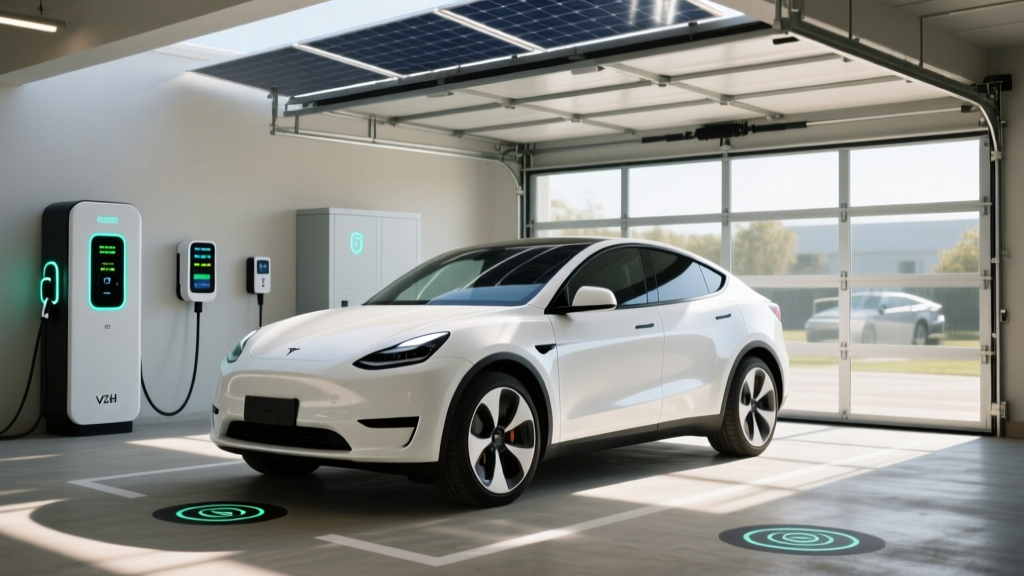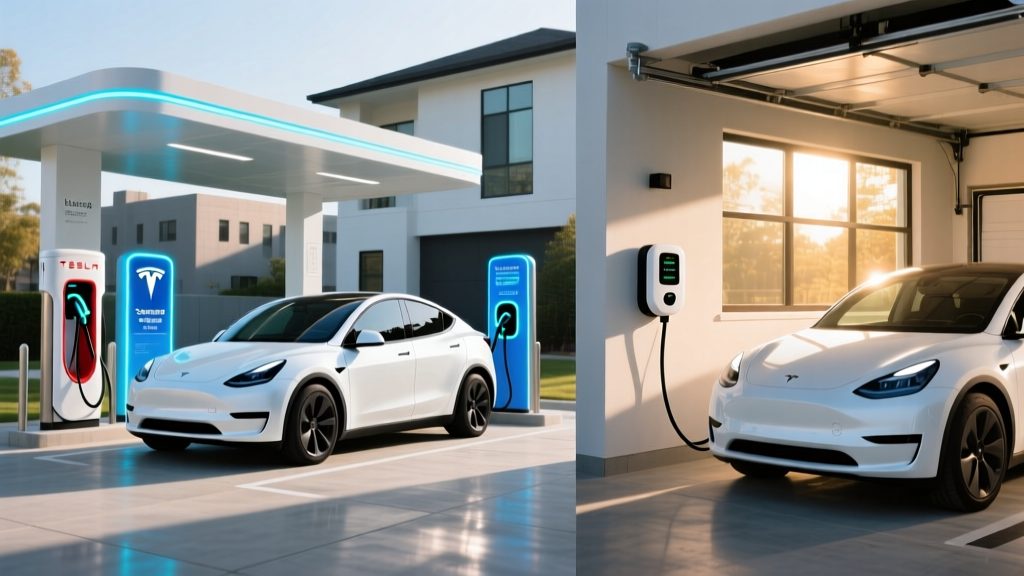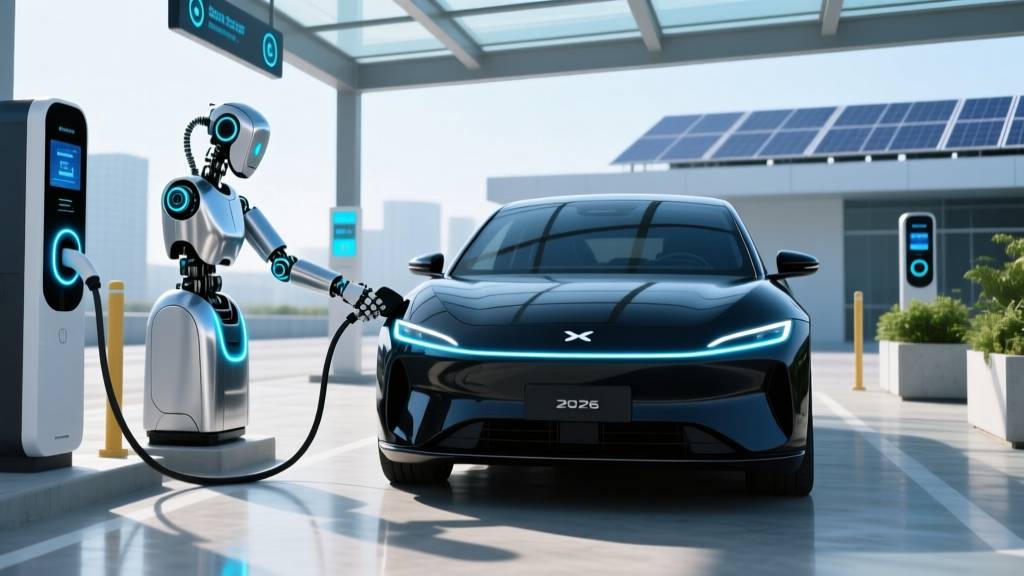
For most EV owners, the daily charging routine is simple: pull into the garage, plug in, and wake up to a full battery. But what if you never had to handle a cable again? The concept of a charging robot — an automated system that physically connects your EV to power without human intervention — has moved from auto-show gimmick to early commercial deployment. Companies like Beta.i's Ziggy and autonomous mobile chargers from manufacturers like Volkswagen are testing the waters, while the broader charging ecosystem continues to mature around home Level 2 installations and public DC fast-charging networks.
This guide covers where charging-robot technology stands today, and provides the complete practical breakdown every EV owner or shopper needs: charging levels and speeds, home installation costs, connector compatibility, equipment picks, and real cost-per-mile comparisons against gasoline.
What Is a Charging Robot and Who Makes One?
A charging robot is a device that autonomously locates your EV's charge port and inserts the connector, eliminating the need for the driver to manually plug in. The use cases fall into three categories:
- Accessibility: Drivers with mobility limitations who find handling heavy CCS or NACS cables difficult.
- Autonomous fleet charging: Robotaxis (Level 4 vehicles like Waymo's Jaguar I-PACE fleet) and future AVs that cannot plug themselves in without external automation.
- Convenience/premium experience: Luxury or garage-integrated systems that treat charging like a hands-free experience.
Current Charging-Robot Projects
Ziggy (Beta.i / EV Safe Charge): A mobile battery unit on wheels that a driver reserves via app. You park in a standard space, and Ziggy drives itself to your vehicle, extends a cable, and a robotic arm (or attendant in early deployments) connects it. It's designed for parking garages and fleet lots where installing fixed chargers at every space is cost-prohibitive. As of early 2026, Ziggy has been deployed in limited pilot programs at commercial parking facilities in California.
Volkswagen Mobile Charging Robot: VW demonstrated a concept that navigates a parking structure, locates the EV via V2X communication, opens the charge-port door, and plugs in using a robotic arm with camera guidance. This remains in the pilot and demonstration phase — not yet available for consumer purchase.
Tesla Snake Charger (concept): Originally shown in 2016, this articulated robotic cable concept was never productized. Tesla has instead focused on Supercharger network expansion and the NACS standard. No consumer Tesla charging robot is available.
Hyundai/IONIQ Robotic Charging: Hyundai demonstrated a robotic arm integrated into a parking-space bollard that communicates with the IONIQ 5/6 via the vehicle's Automated Valet Parking system. Still in development for potential integration into future Hyundai Motor Group parking facilities.
Charging Levels: Speeds, Power, and Range Added Per Hour
Before choosing equipment or planning an installation, you need a clear picture of the three charging levels. The critical distinction: kW (kilowatts) measures power — the rate at which energy flows into your battery. kWh (kilowatt-hours) measures energy — the total capacity of your battery. A 240 kW DC fast charger delivers power at a rate that can add roughly 3 miles of range per minute to a compatible vehicle; a 100 kWh battery stores enough energy for ~300 miles of driving.
| Level | Voltage / Power | Max kW Output | Miles of Range Added Per Hour | Typical Use Case |
|---|---|---|---|---|
| Level 1 | 120V AC / 12–16A | 1.4–1.9 kW | 3–5 mi/hr | Overnight trickle; emergency top-up |
| Level 2 | 240V AC / 16–80A | 3.8–19.2 kW | 14–75 mi/hr | Home garage, workplace, destination |
| DC Fast (Level 3) | 200–900V DC | 50–400 kW | 150–1,200+ mi/hr (peak) | Road-trip corridors, commercial hubs |
Real-World Charging Time Examples (10–80% SoC)
Charging times depend on battery size (kWh), peak charge rate (kW), and the charge curve — most EVs taper significantly above 80% State of Charge to protect battery health. Here are representative times for common battery sizes at typical power levels:
- 60 kWh battery (e.g., base Hyundai Kona Electric): Level 2 at 11.5 kW → ~5 hours (10–80%); DC fast at 100 kW peak → ~25 min (10–80%).
- 82 kWh battery (e.g., Tesla Model Y Long Range): Level 2 at 11.5 kW → ~6.5 hours; DC fast at 250 kW peak → ~22 min (10–80% on V3 Supercharger).
- 110 kWh battery (e.g., Ford F-150 Lightning Extended Range): Level 2 at 19.2 kW → ~5.5 hours; DC fast at 150 kW peak → ~45 min (10–80%).
On a DC fast charger, your vehicle will pull peak kW only while the battery is in its optimal temperature and SoC window (roughly 10–50% on most NMC packs). Expect the rate to drop to 40–60 kW between 80–90%, and to a trickle above 95%. This is why road-trip strategy focuses on 10–80% charges rather than filling to 100%.
Home Level 2 Installation: Electrical Requirements and Costs
Installing a Level 2 home charger is the single highest-impact upgrade an EV owner can make. You'll need a licensed electrician, and the total cost varies enormously based on your home's existing electrical panel, the distance from panel to charger location, and local permit fees.
Electrical Specifications
A typical home Level 2 installation requires a 240-volt dedicated circuit. Common configurations:
- 40-amp circuit / 32-amp continuous: Supports chargers up to 7.7 kW (NEMA 14-50 outlet or hardwired). This is the most common residential setup and sufficient for most EVs with 11.5 kW or lower onboard chargers.
- 50-amp circuit / 40-amp continuous: Supports chargers up to 9.6 kW. Common for higher-capacity home units.
- 60-amp circuit / 48-amp continuous: Supports chargers up to 11.5 kW — the maximum single-phase residential Level 2 speed (e.g., ChargePoint Home Flex, Tesla Wall Connector at max config).
- 80-amp circuit / 64-amp continuous: Supports 19.2 kW chargers (e.g., Ford Charge Station Pro). Requires a 200A+ main panel and is more common in new construction.
The National Electrical Code (NEC) requires that continuous loads (anything running 3+ hours, which EV charging does) use only 80% of a circuit's rated capacity. A 40A breaker → 32A continuous → ~7.7 kW.
Panel Upgrade Considerations
This is the cost variable most homeowners underestimate. If your home has a 100-amp main service panel (common in homes built before the 1990s), adding a 40–60A EV circuit may exceed available capacity, especially if you also run electric dryers, ovens, or HVAC. Upgrading to a 200A panel typically costs $1,500–$3,500 including permit, utility coordination, and electrician labor. Some homes may qualify for utility rebates that offset this cost.
An alternative to a full panel upgrade is a smart load-management device (e.g., Span smart panel, or certain charger-integrated load-balancing features) that dynamically throttles EV charging when other high-draw appliances are running. This can avoid a panel upgrade but adds $500–$1,500 in equipment cost.
Installation Cost Breakdown
| Component | Simple Install (panel nearby, no upgrade) | Complex Install (long run, panel upgrade needed) |
|---|---|---|
| Level 2 charger equipment | $400–$700 | $500–$800 |
| Electrician labor (2–4 hrs simple / 6–10 hrs complex) | $300–$800 | $1,200–$2,500 |
| Electrical permit | $50–$150 | $100–$300 |
| Panel upgrade (if needed) | $0 | $1,500–$3,500 |
| Conduit, wiring, miscellaneous materials | $50–$200 | $300–$800 |
| Total estimated range | $800–$1,850 | $3,600–$7,900 |
Always get at least three quotes from licensed electricians. Ask specifically about: panel amperage headroom, wire gauge (6 AWG copper for 50A circuits, 4 AWG for 60A), whether they'll install a NEMA 14-50 receptacle (allows charger swapping) or hardwire (required above 48A continuous, and some jurisdictions prefer it for 40A+), and GFCI breaker requirements per NEC 2020/2023 in your jurisdiction.
Connector Compatibility: NACS, CCS1, and CHAdeMO
The North American charging connector landscape has undergone a major shift. As of 2026, NACS (North American Charging Standard, originally Tesla's proprietary connector) has become the dominant standard, adopted by Ford, GM, Rivian, Hyundai/Kia, BMW, and most major automakers for new vehicles starting with 2025–2026 model years. CCS1 remains on many vehicles sold between 2019–2024, and CHAdeMO is effectively legacy (Nissan Leaf being the last major holdout, now discontinued in the U.S.).
| Connector | Vehicles Using It (2026 Models) | Home Level 2? | DC Fast Network Access |
|---|---|---|---|
| NACS | Tesla (all), Ford (2025+), GM (2025+), Rivian, Hyundai/Kia (2025+), BMW, Mercedes, Volvo/Polestar | Yes — native NACS wallboxes widely available | Tesla Supercharger (open to all NACS), Electrify America, EVgo (NACS stalls expanding) |
| CCS1 | VW ID.4 (through 2024), older Chevy Bolt, Hyundai Ioniq 5 (pre-2025), Kia EV6 (pre-2025), BMW i4/iX (pre-2025) | Yes — CCS1/J1772 Level 2 chargers still produced | Electrify America, EVgo, ChargePoint (CCS stalls remain but new installs favor NACS) |
| CHAdeMO | Nissan Leaf (discontinued in U.S.), Mitsubishi Outlander PHEV (older models) | J1772 for Level 2 | Declining — most networks phasing out CHAdeMO stalls |
Adapter Needs
If you own a CCS1-equipped EV but want to access the Tesla Supercharger network (now open to non-Tesla NACS vehicles), you'll need a CCS-to-NACS adapter. Ford, GM, and Rivian have offered these to customers (sometimes complimentary during transition periods). Third-party adapters from companies like Lectron and A2Z are available for $150–$250. Always verify the adapter is rated for the DC fast-charge power level your vehicle supports — a 150 kW-capable vehicle needs an adapter rated to at least that power level.
For home Level 2 charging, the physical connector difference matters less than you might think: Level 2 charging uses the J1772 signal protocol regardless of whether the plug is physically NACS or J1772. Most NACS home wallboxes will charge any EV with the appropriate adapter, and vice versa.
Cost to Charge: Home vs. Public vs. Gas
The economic case for EV ownership hinges on charging costs. Here's how the numbers break down in 2026:
| Scenario | Cost per kWh | Vehicle Efficiency | Cost per Mile |
|---|---|---|---|
| Home off-peak (utility TOU rate) | $0.08–$0.14 | 3.5 mi/kWh (285 Wh/mi) | $0.025–$0.04 |
| Home standard rate (no TOU) | $0.14–$0.22 | 3.5 mi/kWh | $0.04–$0.065 |
| Public Level 2 (workplace, shopping) | $0.20–$0.40 | 3.5 mi/kWh | $0.06–$0.115 |
| DC fast charging (Electrify America, EVgo) | $0.35–$0.55 | 3.5 mi/kWh | $0.10–$0.16 |
| Gasoline car (28 MPG avg, $3.40/gal) | — | 28 mi/gal | $0.121 |
The takeaway: home charging on an off-peak rate is roughly 3–5× cheaper per mile than gasoline. Even DC fast charging at the highest public rates is competitive with or slightly below gasoline per mile. The economics favor EVs most strongly when you can charge at home overnight on a time-of-use plan. According to fueleconomy.gov, the average EV achieves 3–4 miles per kWh, while efficient models like the Lucid Air and Tesla Model 3 exceed 4.5 mi/kWh.
Recommended Level 2 Home Chargers for 2026
Tesla Wall Connector (Gen 4)
- Power: Up to 11.5 kW (48A) on 60A circuit
- Connector: NACS native
- Cable length: 24 ft
- Smart features: Wi-Fi, OTA updates, Power-Share (load balancing between two units), integration with Tesla app
- Price: ~$475
- Best for: Tesla owners or NACS-equipped EVs; cleanest integration with Tesla ecosystem
ChargePoint Home Flex
- Power: Up to 12 kW (50A) on 60A circuit, configurable down to 16A
- Connector: J1772 (NACS adapter available)
- Cable length: 23 ft
- Smart features: Wi-Fi, Alexa integration, scheduling, energy tracking via ChargePoint app, flexible amperage DIP-switch config
- Price: ~$550–$650
- Best for: Multi-EV households, CCS/J1772 vehicles, renters who may move (flexible amp config)
Emporia Vue Level 2 Charger
- Power: Up to 11.5 kW (48A) on 60A circuit
- Connector: J1772 (NACS version available 2025+)
- Cable length: 24 ft
- Smart features: Wi-Fi, integrates with Emporia Vue energy monitor for whole-home load tracking, solar-aware scheduling, very competitive price
- Price: ~$350–$400
- Best for: Budget-conscious buyers who want smart features and solar integration
Grizzl-E Smart
- Power: Up to 10 kW (40A) on 50A circuit
- Connector: J1772 (NACS adapter available)
- Cable length: 24 ft
- Smart features: Wi-Fi, OCPP protocol support, adjustable amperage, extreme-cold rated (-40°C), rugged aluminum enclosure
- Price: ~$450–$550
- Best for: Cold-climate installations, outdoor mounting, durability priority
NEMA 14-50 Receptacle vs. Hardwired
A NEMA 14-50 outlet gives you flexibility to unplug and take your charger with you (or swap units). However, NEC 2020/2023 in many jurisdictions now requires a GFCI breaker for 14-50 receptacles, which adds $80–$150 and can cause nuisance trips with some chargers. Hardwired installations (no plug) are required for circuits above 50A, avoid the GFCI issue, and are generally preferred by inspectors for 48A+ chargers. Discuss both options with your electrician — the right answer depends on your charger's max amperage, local code, and whether you value portability.
Safety, Code, and Inspection Requirements
EV charging draws sustained high current for hours — this is unlike any other household load except perhaps a large HVAC system. Safety considerations are non-negotiable:
- Dedicated circuit: Your EV charger must be on its own dedicated breaker. Never share a circuit with other appliances.
- Wire gauge: Must match circuit amperage per NEC Table 310.16. For a 50A circuit, minimum 6 AWG copper (THHN in conduit or NM-B rated appropriately). For 60A, 4 AWG copper.
- GFCI protection: Required for receptacles (14-50) in garages and outdoor locations per NEC 2020+. Hardwired units are generally exempt from GFCI requirements.
- Outdoor rating: If mounting outside, the charger must be NEMA 4 rated (weatherproof). Verify cable and connector are rated for UV exposure and wet conditions.
- Permit and inspection: Virtually all jurisdictions require an electrical permit for new 240V circuits. The inspector will verify wire gauge, breaker sizing, grounding, and GFCI compliance. Never skip the permit — unpermitted work can void homeowner's insurance and create fire risk.
- Load calculation: Your electrician should perform an NEC Article 220 load calculation to confirm your panel can handle the added EV circuit without exceeding 80% of panel capacity for continuous loads.
Frequently Asked Questions
How much does it cost to install a home EV charger?
A straightforward Level 2 installation (240V/40–50A circuit, short wire run from a 200A panel, no panel upgrade needed) typically costs $800–$1,850 including equipment, electrician labor, and permit. If your home needs a panel upgrade from 100A to 200A service, or the wire run is long (through finished walls, across a basement, or underground to a detached garage), expect $3,600–$7,900 total. Always get three quotes and verify the electrician is licensed and will pull a permit.
How fast will each charging level add range?
Level 1 (120V, 1.4 kW): approximately 3–5 miles of range per hour — adequate only for PHEVs with small batteries or as emergency backup. Level 2 (240V, 7.7–11.5 kW typical): 25–45 miles per hour for most EVs, meaning a full overnight charge adds 200–360 miles. DC fast charging (50–350 kW): adds 150–1,200+ miles per hour at peak, but realistically expect 10–80% in 18–45 minutes depending on battery size and peak charge rate.
Which connector/charger is compatible with my EV?
Check your vehicle's charge port. For 2025–2026 model-year vehicles from Ford, GM, Rivian, Hyundai, Kia, BMW, and most others, the connector is NACS. For 2019–2024 models from VW, older Hyundai/Kia, and Chevrolet Bolt, it's CCS1 (which uses J1772 for Level 2). Nissan Leaf uses CHAdeMO for DC fast charging. For home Level 2, any J1772 or NACS wallbox will work with the appropriate adapter — the Level 2 protocol is universal.
How much does charging cost per mile vs gas?
Home charging on a time-of-use off-peak rate costs roughly $0.03–$0.04 per mile. A comparable gasoline car at 28 MPG with $3.40/gallon fuel costs about $0.12 per mile. That's a 3–4× savings per mile when charging at home. Even public DC fast charging at $0.45/kWh yields roughly $0.13/mile — competitive with gasoline. The savings are largest for high-mileage drivers and those with access to cheap home electricity. Refer to the DOE's EV cost calculator at fueleconomy.gov for model-specific comparisons.
What electrical upgrades might I need?
The most common upgrade is a panel capacity increase from 100A to 200A service ($1,500–$3,500), needed when your existing panel lacks headroom for a 40–60A EV circuit. Older homes may also need wiring updates (aluminum to copper), new conduit runs, or a sub-panel addition for detached garages. Some utilities offer "make-ready" programs that cover the cost of wiring from the utility's transformer to your panel — check with your local utility before starting work. A smart load-management system ($500–$1,500) can sometimes avoid a full panel upgrade by dynamically sharing capacity between the EV charger and other appliances.
Will a charging robot ever be available for my home garage?
Unlikely in the near term. Current charging-robot projects (Ziggy, VW's concept, Hyundai's robotic arm) are designed for commercial parking structures and autonomous fleet depots where the cost of the robotic system can be amortized across hundreds of vehicles. For a residential garage, a $500 wallbox and a 15-second manual plug-in will remain far more practical and cost-effective for the foreseeable future. The technology to watch is inductive (wireless) charging — pads embedded in the garage floor that charge via magnetic resonance without any physical connection. WiTricity and other companies have demonstrated 11 kW wireless charging prototypes, but commercial availability for consumer vehicles remains limited as of 2026.