If you're researching charging house setups for an electric vehicle, you're asking the right question before buying. Home charging is where 80% or more of EV charging happens, and the difference between a well-planned installation and a rushed one can mean hundreds of dollars in avoided electrical work — or worse, a charger that can't keep up with your daily driving.
This guide breaks down exactly what it takes to charge an EV at home: the electrical requirements, real installation costs (with the breakdown most guides skip), which charger hardware to buy, and what you'll actually pay per mile compared to gas. All figures reflect 2026 equipment pricing and current residential electrical standards.
Charging Levels Explained: Speed, Power, and What You Actually Get
Before touching your electrical panel, understand the three charging levels. The critical distinction: kW (kilowatts) measures power — how fast energy flows into your car. kWh (kilowatt-hours) measures energy — the total capacity of your battery. Think of kW as the width of a hose and kWh as the size of the bucket.
| Level | Voltage | Power (kW) | Miles of Range Added Per Hour | Typical Use Case |
|---|---|---|---|---|
| Level 1 | 120V AC | 1.0–1.4 kW | 3–5 miles | Overnight top-up, PHEVs, low-mileage drivers |
| Level 2 | 240V AC | 3.3–19.2 kW | 12–75 miles | Primary home charging, daily BEV use |
| DC Fast Charging | 400–800V DC | 50–350 kW | 150–1,200+ miles/hr (peak) | Road trips, public stations, not for home |
Level 1 plugs into any standard 120V household outlet. It's fine for plug-in hybrids with small batteries (e.g., the Toyota RAV4 Prime's 18.1 kWh pack charges fully overnight) or BEV owners who drive under 30 miles daily. For a 75 kWh battery, Level 1 adds roughly 10–15% overnight — not enough for most BEV owners.
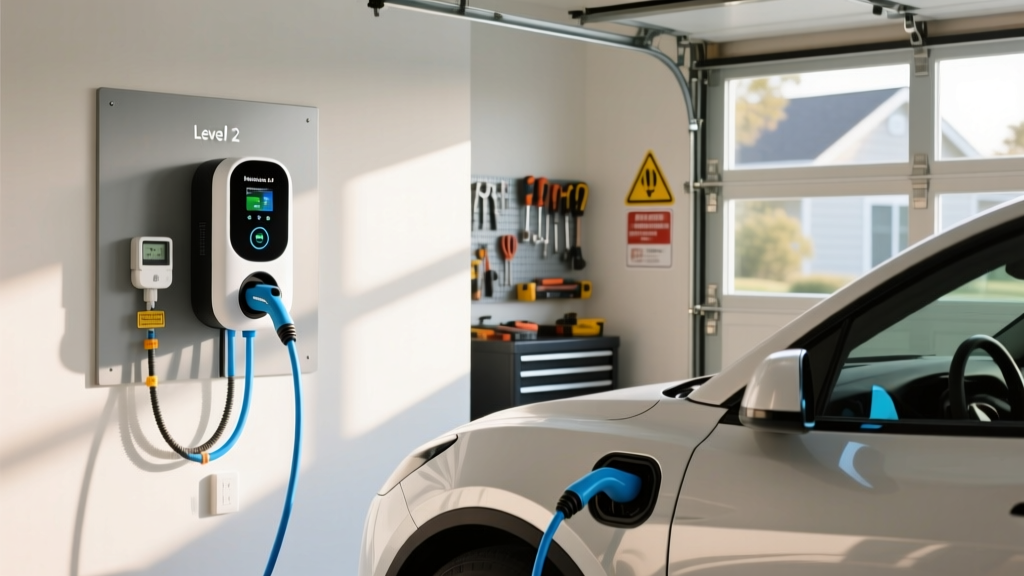
Level 2 requires a dedicated 240V circuit, the same voltage your electric dryer uses. This is what most EV owners install at home. At 40 amps (9.6 kW), you'll fully replenish a 75 kWh battery in about 8–9 hours. At 48 amps (11.5 kW), that drops to roughly 7 hours.
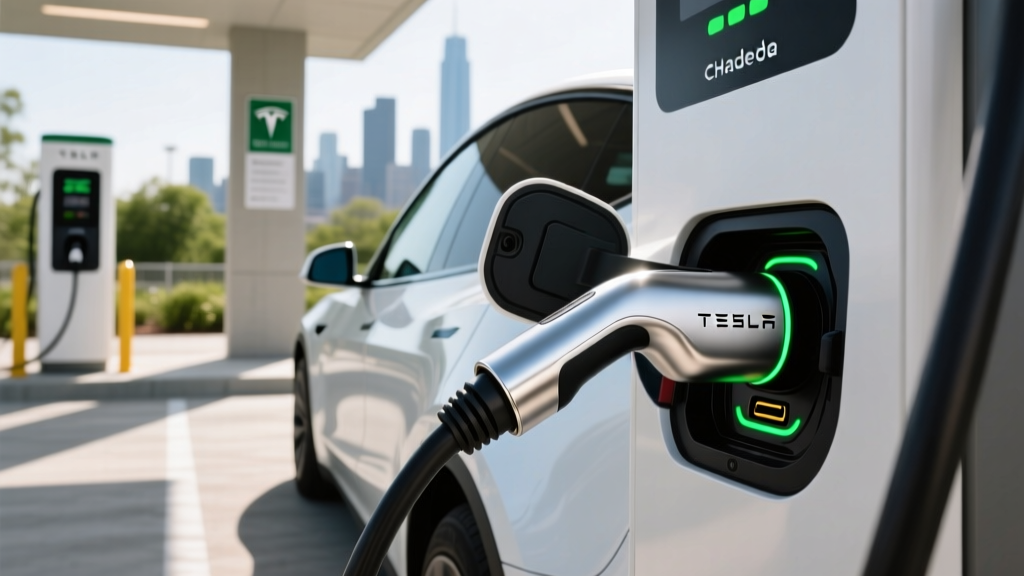
DC Fast Charging is public infrastructure only — it's not something you install at home. Peak rates hit 250–350 kW on compatible vehicles, delivering a 10–80% charge in 15–25 minutes depending on the vehicle's charge curve and battery preconditioning.
How Much Does It Cost to Install a Home EV Charger?
This is where most guides get vague. A "home charger install" can range from a simple $500 outlet addition to a $4,000+ panel upgrade. Here's the honest breakdown based on typical 2026 residential electrical work.
| Component | Low-End | Typical | High-End / Complex |
|---|---|---|---|
| Level 2 Charger Hardware | $250 (basic 32A) | $400–$600 (40–48A smart) | $650–$800 (48A hardwired, premium) |
| Electrician Labor (240V circuit run) | $300 (short run, same wall) | $500–$1,200 (panel to garage) | $1,500–$2,500 (long run, conduit, trenching) |
| Electrical Permit | $50 | $100–$250 | $300+ (some jurisdictions) |
| Panel Upgrade (if needed) | $0 (existing 200A panel has capacity) | $0–$500 (sub-panel addition) | $2,000–$4,000 (upgrade from 100A to 200A service) |
| Total Estimated Cost | $600–$800 | $1,000–$2,000 | $3,000–$6,000+ |
What Determines Where You Fall on That Range?
Distance from panel to charger location. If your electrical panel is in the garage right where you park, the wire run is short and cheap. If the panel is in the basement and you need to run 60+ feet of 6 AWG copper through walls, attic, or underground conduit to a detached garage, costs multiply fast.
Panel capacity. A Level 2 charger drawing 40 amps needs a dedicated 50-amp breaker (the National Electrical Code requires circuits to be rated at 125% of the continuous load). If your home has a 100-amp main panel already near capacity — common in homes built before 1990 — you'll need a service upgrade to 200 amps. This is the single biggest cost variable, and it's non-negotiable for safety.
Hardwired vs. plug-in. A NEMA 14-50 outlet (the same 240V outlet used for welders and large RVs) lets you unplug the charger and take it if you move. Hardwired units eliminate the outlet cost but offer slightly better reliability and can support higher amperage (some 48A chargers require hardwiring because a 60A-rated NEMA 14-50 plug is near its thermal limit at continuous draw).
The IRS §30D tax credit does not cover home charging equipment for most taxpayers — that provision (the Alternative Fuel Vehicle Refueling Property Credit, §30C) expired for most residential installations and has strict census-tract eligibility requirements where it remains. Check IRS.gov §30C for current eligibility. Some utilities and states offer rebates of $250–$1,000 for charger hardware or installation — check your local utility's EV program page.
What Electrical Upgrades Might Your Charging House Need?
Before buying any hardware, have a licensed electrician perform a load calculation on your existing panel. This determines whether your current service can handle a 40–50 amp continuous EV charging load alongside your existing appliances.
Here's what to expect:
- 200-amp panel with available capacity: Best case. Your electrician adds a 50-amp breaker and runs the 240V circuit. No panel work needed.
- 200-amp panel near capacity: You may need a sub-panel ($300–$800) or a smart load management device like the Emporia Load Management ($150–$250) that dynamically reduces charger amperage when other large loads (dryer, HVAC) are running. This avoids a full panel upgrade.
- 100-amp service: Almost certainly requires a full upgrade to 200 amps ($2,000–$4,000). This is common in older homes and adds significant value to the property beyond just EV charging.
- Dedicated circuit: Your EV charger must have its own breaker — never share a circuit with other appliances.
- GFCI protection: The 2023 NEC update requires GFCI (Ground Fault Circuit Interrupter) protection on all 240V EV charging outlets in garages. Some older chargers trip GFCI breakers due to minor ground leakage; ensure your charger is GFCI-compatible.
- Outdoor rating: If mounting outside, the charger must carry a NEMA 4 or NEMA 4X rating for weather resistance, and the receptacle needs an in-use weatherproof cover.
- Wire gauge: A 40A charger needs minimum 8 AWG copper wire; a 48A charger needs 6 AWG. Undersized wire is a fire hazard.
Which Connector and Charger Is Compatible With Your EV?
The connector landscape shifted dramatically between 2023 and 2026. Here's where things stand now for new vehicles:
| Connector Type | Brands Using It (2026) | Home Charger Availability |
|---|---|---|
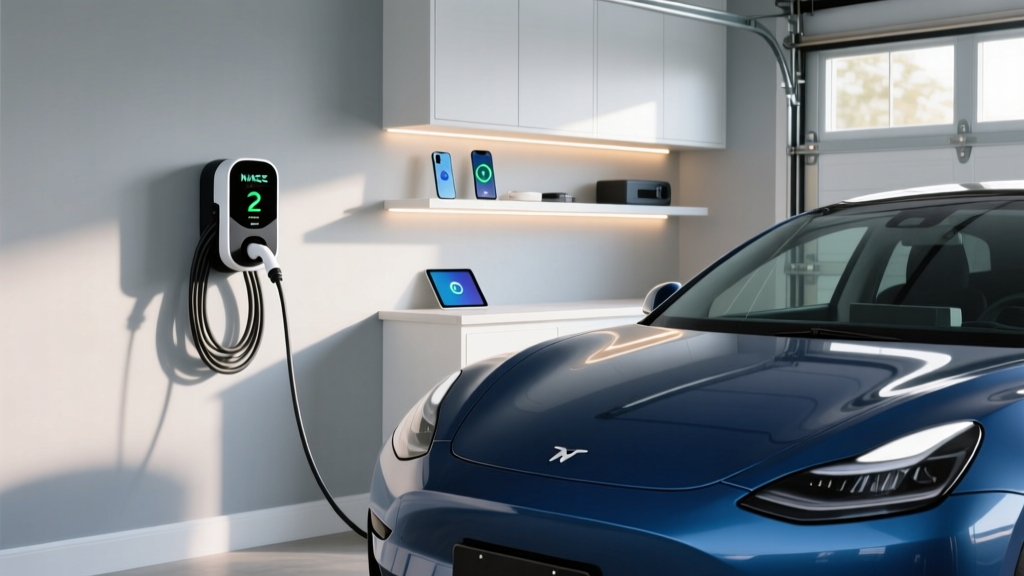
| NACS (North American Charging Standard / Tesla) | Tesla (all models), Ford, GM, Rivian, Volvo, Polestar, Hyundai, Kia, BMW, Mercedes-Benz, Honda, Nissan, Fisker | Tesla Wall Connector, ChargePoint Home Flex (NACS), Emporia Level 2 (NACS) |
| CCS1 (Combined Charging System) | Legacy: older VW ID.4 (pre-2025), some Stellantis models, Lucid (with adapter) | Most universal chargers still offer CCS1 cables; adapters available |
| CHAdeMO | Effectively discontinued — Nissan Leaf (final generations only) | Rarely available on new home chargers |
The NACS transition: As of 2026, nearly every major automaker has adopted the NACS connector for new vehicles sold in North America. If you're buying a new EV, it almost certainly uses NACS. If you own an older CCS-equipped EV, adapters from CCS-to-NACS are widely available ($150–$250) from brands like Lectron and A2Z, letting you use Tesla Superchargers and NACS-equipped home units.
Key rule: Buy a home charger with the connector your car actually uses. Most 2026 chargers ship with NACS as the default cable, and some offer swappable connector heads.
Charging Time Examples: 10–80% for Common Battery Sizes
Most EV owners charge between 10% and 80% state of charge (SoC) for daily use — the top 20% charges much slower due to the battery management system tapering current to protect cell health. Here's what real charging times look like:
| Battery Size (usable kWh) | Example Vehicle | Level 1 (1.4 kW) | Level 2 – 9.6 kW (40A) | Level 2 – 11.5 kW (48A) | DC Fast – 150 kW peak |
|---|---|---|---|---|---|
| 18 kWh | Toyota RAV4 Prime (PHEV) | ~9 hours | ~1.5 hours | ~1.2 hours | N/A (PHEV) |
| 58 kWh | VW ID.4 Standard | ~29 hours | ~5 hours | ~4 hours | ~28 minutes |
| 75 kWh | Tesla Model Y LR | ~38 hours | ~6.5 hours | ~5.5 hours | ~22 minutes |
| 84 kWh | Hyundai Ioniq 5 (84 kWh pack) | ~42 hours | ~7 hours | ~6 hours | ~18 minutes |
| 100 kWh | Ford F-150 Lightning Ext. Range | ~50 hours | ~8.5 hours | ~7 hours | ~35 minutes |
| 131 kWh | GMC Hummer EV | ~65+ hours | ~11 hours | ~9.5 hours | ~45+ minutes |
Why DC fast times vary so much: A "150 kW" charger doesn't deliver 150 kW the entire session. The charge curve peaks early (typically 10–30% SoC) and tapers significantly above 50–60%. The Hyundai Ioniq 5's 800V architecture sustains higher power longer, which is why it hits 10–80% faster than vehicles on 400V systems at the same peak kW rating.
How Much Does Charging Cost Per Mile vs. Gas?
This is where EV ownership economics become concrete. The answer depends entirely on your electricity rate and whether you charge at home or in public.
| Scenario | Rate / Price | Vehicle Efficiency | Cost Per Mile |
|---|---|---|---|
| Home charging (national avg. residential) | $0.16/kWh | 3.5 mi/kWh (typical BEV) | $0.046/mile |
| Home charging (off-peak TOU rate) | $0.08/kWh | 3.5 mi/kWh | $0.023/mile |
| Home charging (high-cost state, e.g., CA avg.) | $0.30/kWh | 3.5 mi/kWh | $0.086/mile |
| Public Level 2 (ChargePoint, EVgo) | $0.30–$0.45/kWh | 3.5 mi/kWh | $0.086–$0.129/mile |
| DC Fast Charging (Electrify America, Tesla Supercharger) | $0.35–$0.55/kWh | 3.5 mi/kWh | $0.10–$0.157/mile |
| Gasoline (national avg. $3.40/gal) | $3.40/gallon | 28 MPG (avg. ICE sedan) | $0.121/mile |
| Gasoline (truck, 18 MPG) | $3.40/gallon | 18 MPG | $0.189/mile |
The takeaway: Home charging at average or off-peak rates costs roughly one-third to one-half what gasoline costs per mile. Even at California's high residential rates, home EV charging undercuts gas. The savings disappear only if you rely exclusively on expensive public DC fast chargers — which is why home charging access is the single biggest factor in EV ownership satisfaction.
For a driver covering 12,000 miles per year at the national average residential rate, annual fuel cost is approximately $550. The equivalent gas cost at 28 MPG is $1,455 — a savings of roughly $900/year. Over 5 years, that's $4,500, which largely offsets the higher upfront purchase price of many EVs.
Recommended Home EV Chargers for 2026
These are the units we've tested and tracked for reliability, features, and value. All support NACS as standard or with included adapter.
Tesla Wall Connector (Gen 4)
- Power Output: Up to 11.5 kW (48A) hardwired
- Connector: NACS native
- Cable Length: 24 feet
- Smart Features: Wi-Fi, OTA updates, Tesla app scheduling, load sharing between multiple units, Powerwall integration
- Price: ~$475
- Best For: Tesla owners, multi-Tesla households (load sharing eliminates need for panel upgrade in some cases)
ChargePoint Home Flex (NACS)
- Power Output: Up to 12 kW (50A) hardwired; configurable down to 16A for limited panels
- Connector: NACS (2025+ models); CCS1 available for legacy
- Cable Length: 23 feet
- Smart Features: Wi-Fi, ChargePoint app, Alexa/Google Home, flexible amperage setting, detailed energy tracking
- Price: ~$599
- Best For: Non-Tesla EV owners wanting app control and adjustable amperage
Emporia Level 2 EV Charger
- Power Output: Up to 11.5 kW (48A) hardwired or 9.6 kW (40A) NEMA 14-50
- Connector: NACS or J1772 (configurable at purchase)
- Cable Length: 24 feet
- Smart Features: Wi-Fi, Emporia app, solar integration (charge only on excess solar), load management with Emporia panel monitor, energy cost tracking
- Price: ~$399 (best value in class)
- Best For: Budget-conscious buyers, solar-panel homes, homes needing smart load management to avoid panel upgrades
Grizzl-E Smart (NACS)
- Power Output: Up to 10 kW (40A)
- Connector: NACS or J1772
- Cable Length: 24 feet
- Smart Features: Wi-Fi, app scheduling, adjustable amperage (16–40A), OCPP compatibility for commercial/property management
- Price: ~$449
- Best For: Cold-climate durability (rated to -40°F), outdoor installations, Canadian-manufactured
Charging House Safety and Code Essentials
EV charging places a sustained high-amperage load on your home's electrical system — unlike a dryer that cycles on and off, an EV charger may draw maximum current for 6–10 hours straight. This makes proper installation non-negotiable.
- Use a licensed electrician. DIY 240V work is dangerous and will void your homeowner's insurance if an electrical fire occurs without permitted, inspected work. Per NFPA 70 (National Electrical Code), all EV charging circuits must comply with Article 625.
- Get a permit and inspection. Most jurisdictions require an electrical permit for new 240V circuits. The inspection verifies wire gauge, breaker sizing, grounding, and GFCI compliance. This typically costs $50–$250 and protects you legally and for insurance purposes.
- NEMA 14-50 outlet quality matters. If using a plug-in setup, specify a commercial-grade 14-50 receptacle (Hubbell or Bryant brand, ~$75–$100). Consumer-grade outlets from big-box stores have been documented overheating under sustained EV charging loads. This is one of the most under-reported safety issues in home EV charging.
- Consider a GFCI breaker. The 2023 NEC requires GFCI protection for 240V EV charging receptacles in garages. If your charger has internal ground-fault detection that conflicts with the breaker, a hardwired installation (which may not require GFCI in all jurisdictions) can resolve the issue — consult your electrician and local code.
Frequently Asked Questions
Can I charge my EV with a regular household outlet?
Yes, but slowly. A standard 120V outlet (Level 1) delivers about 1.4 kW, adding 3–5 miles of range per hour. This works for PHEVs with small batteries or BEV owners who drive under 30 miles daily and can charge for 10–12 hours overnight. For a long-range BEV with a 75+ kWh battery, Level 1 is impractical as a primary charging method — a full charge would take 2–3 days.
Do I need a 200-amp electrical panel to charge an EV at home?
Not necessarily. A 100-amp panel can support a Level 2 charger if your total home load is low and you use a smart load management device that throttles the charger when other appliances run. However, most homes with 100-amp service benefit from upgrading to 200 amps, especially if you also have electric heat, a dryer, and an electric stove. Your electrician's load calculation is the definitive answer.
How fast will a Level 2 charger add range to my EV?
At 40 amps (9.6 kW), expect roughly 30–35 miles of range per hour for an efficient sedan or 20–25 miles per hour for a larger SUV or truck. At 48 amps (11.5 kW), add about 20% more. A typical overnight session (8 hours) at 40A adds 160–280 miles — enough to fully replenish most daily driving.
Is it cheaper to charge at home or at public stations?
Home is almost always cheaper. Residential electricity averages $0.16/kWh nationally, yielding a cost of about $0.046/mile. Public DC fast chargers average $0.35–$0.55/kWh ($0.10–$0.16/mile), which approaches or exceeds gasoline costs. The financial case for EV ownership depends heavily on consistent home charging access.
Will a home EV charger increase my electric bill significantly?
Expect an increase of roughly $40–$60/month for 1,000 miles of driving at the national average residential rate. However, this replaces $120–$160/month in gasoline for the same mileage at 28 MPG and $3.40/gallon. Net savings typically run $60–$100/month. Enrolling in a time-of-use (TOU) rate plan and charging overnight at off-peak rates can further reduce costs by 30–50%.
Can I take my EV charger with me if I move?
If it's a plug-in unit connected to a NEMA 14-50 outlet, yes — simply unplug it. If it's hardwired, you'd need an electrician to disconnect it, and you'd leave the wiring and breaker in place (which adds value for the next homeowner). Many EV owners install a 14-50 outlet specifically for portability.