Most EV owners do 80% or more of their charging at home. It's cheaper than any public network, eliminates detours to gas stations, and means you start every morning with a full battery. But "home charging" covers everything from a slow 120V trickle to a hardwired 48-amp Level 2 station — and the setup cost can range from $0 (just plug in) to $3,000+ if your electrical panel needs an upgrade.
This guide breaks down exactly what's involved in charging an electric car at home, what it costs, what equipment to buy, and the electrical gotchas that catch first-time EV buyers off guard.
Charging Levels Explained: Speed, Power, and Real-World Range
Before buying equipment, you need to understand the three charging levels. The single most important distinction in EV charging is between kW (kilowatts — the rate of power delivery, like water pressure from a hose) and kWh (kilowatt-hours — the total energy delivered, like gallons in a bucket). Your battery capacity is measured in kWh; charger speed is measured in kW.
| Level | Voltage | Max Power (kW) | Miles of Range Added per Hour | Typical Use Case |
|---|---|---|---|---|
| Level 1 | 120V AC | 1.0–1.4 kW | 3–5 miles/hr | Overnight top-ups, PHEVs, low-mileage drivers |
| Level 2 | 240V AC | 3.3–19.2 kW | 12–75 miles/hr | Daily home charging, most EVs |
| DC Fast Charge | 400–800V DC | 50–350 kW | 150–1,000+ miles/hr (peak) | Road trips, public stations only |
Level 1 uses a standard household outlet (NEMA 5-15). Every EV ships with a mobile cord that handles Level 1. At roughly 1.2 kW, a 75 kWh battery (like a Tesla Model Y Long Range) would take 60+ hours from empty to full. That's impractical for most BEVs but workable for PHEVs with 30–45 miles of electric range.
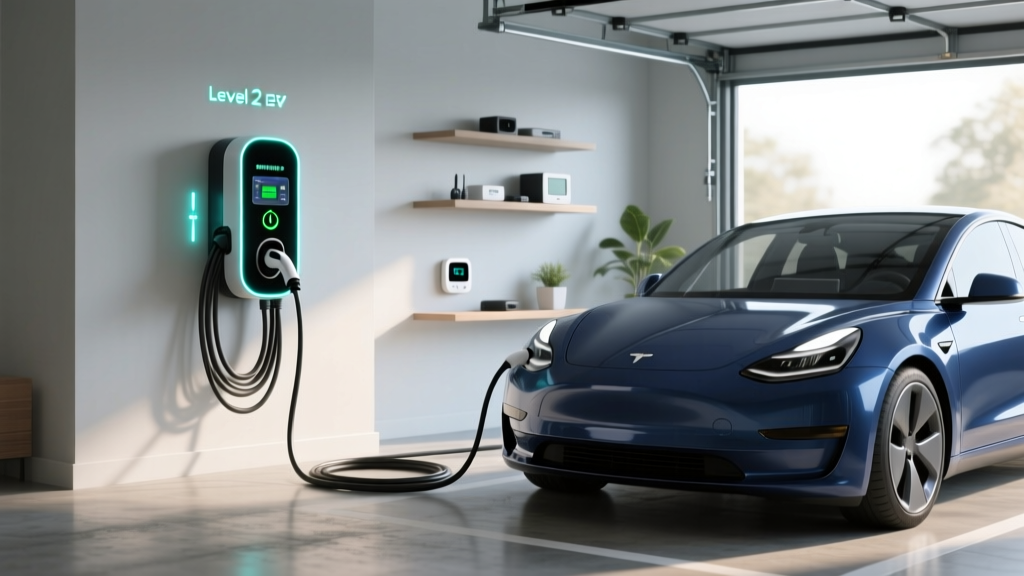
Level 2 is what most EV owners install at home. Running on 240V (the same voltage as your dryer), Level 2 chargers deliver anywhere from 3.3 kW to 19.2 kW. At a common 11.5 kW (48 amps), you'll add roughly 40–44 miles of range per hour — enough to fully replenish most EVs overnight in 6–8 hours.
DC Fast Charging bypasses the car's onboard charger and feeds DC current directly to the battery. These stations are only found in public locations (Electrify America, Tesla Superchargers, EVgo) and aren't available for residential installation. They're designed for road-trip stops, not daily use — frequent DC fast charging can accelerate battery degradation.
How Much Does It Cost to Install a Home EV Charger?
The total cost to install a Level 2 home charger depends on three variables: the charger hardware, the electrical work required, and whether your panel can handle the additional load. Here's a realistic breakdown based on 2026 national averages:
| Component | Simple Install (Panel Nearby) | Complex Install (Long Run / Panel Upgrade) |
|---|---|---|
| Level 2 Charger (hardware) | $350–$700 | $350–$700 |
| Electrician labor (licensed) | $300–$800 | $1,000–$2,500 |
| Permit & inspection | $50–$200 | $100–$300 |
| Electrical panel upgrade (if needed) | $0 | $1,500–$3,500 |
| Total estimated range | $700–$1,700 | $2,950–$7,000 |
The panel-upgrade gotcha: Homes built before 1990 often have 100-amp electrical panels. Adding a 40-amp or 48-amp dedicated EV circuit may push total load beyond the panel's capacity, requiring an upgrade to 200 amps. This is the single biggest cost surprise for new EV owners. Before buying a charger, have a licensed electrician perform a load calculation on your panel — it's usually free or low-cost as part of a quote.
Federal tax credit note: The IRS Residential Clean Energy Credit (IRC §25D) has historically covered 30% of home charging equipment and installation costs, up to $1,000. Check current-year eligibility on irs.gov, as incentive structures change and may have income or location-based requirements for 2026. Some utilities and states also offer rebates — check your local provider.
Electrical Requirements: What Your Home Needs for Level 2
A Level 2 charger requires a 240-volt dedicated circuit — the same type of circuit that powers your electric dryer or oven. Here's what that means in practice:
Amperage and circuit sizing: Electrical code (NEC Article 625) requires that continuous loads like EV chargers operate at no more than 80% of the circuit's rated capacity. That means:
- A 40-amp circuit supports a 32-amp (7.7 kW) charger
- A 50-amp circuit supports a 40-amp (9.6 kW) charger
- A 60-amp circuit supports a 48-amp (11.5 kW) charger
Hardwired vs. plug-in (NEMA 14-50): You can either hardwire the charger directly to your panel or install a NEMA 14-50 outlet (the same 240V receptacle used by some dryers and RV hookups). Hardwired installations are generally safer (no plug to loosen over time), allow higher amperage (up to 48A or 60A on some units), and are required by code in some jurisdictions for circuits above 50 amps. A NEMA 14-50 outlet offers portability — you can unplug the charger and take it if you move — but is limited to 40 amps continuous.
Safety and code requirements:
- Dedicated circuit: The EV charger must have its own breaker — it cannot share a circuit with other appliances.
- GFCI protection: NEC 2020 and later requires ground-fault circuit interrupter protection for outdoor receptacles. Hardwired units often have built-in GFCI.
- Outdoor rating: If your charger is mounted outside (driveway, exterior wall), it must carry a NEMA 4 or NEMA 4X weather-resistance rating.
- Permit and inspection: Most jurisdictions require an electrical permit for a new 240V circuit. The inspection ensures the wire gauge, breaker size, and grounding meet code. Skipping this step can void your homeowner's insurance coverage for electrical fires.
Connector Compatibility: NACS, CCS1, and CHAdeMO
The connector landscape has consolidated significantly by 2026, but you still need to match your charger's plug to your vehicle's inlet. Here's the current state:
| Connector | Brands Using It | Notes |
|---|---|---|
| NACS (Tesla / J3400) | Tesla, Ford, GM, Rivian, Volvo, Polestar, Nissan (2025+), Fisker, Lucid (adapter) | Now the dominant North American standard. Most non-Tesla automakers switched for 2025–2026 models. |
| CCS1 | Hyundai, Kia, BMW, VW, older Ford/GM models (pre-2025) | Still on many existing vehicles. Adapters to NACS available from Tesla and third parties. |
| CHAdeMO | Nissan Leaf (legacy), Mitsubishi Outlander PHEV (older) | Effectively discontinued for new vehicles. Existing infrastructure remains operational. |
What this means for your charger purchase: If you're buying a new EV in 2026, it almost certainly uses NACS. Buy a NACS-connector home charger. If you own a 2023–2024 Hyundai Ioniq 5 or Kia EV6 (CCS1), buy a CCS1 charger — or use a CCS-to-NACS adapter if your charger is NACS-equipped. Adapters typically cost $150–$250 and are widely available from Tesla, Lectron, and A2Z.
For Level 2 home charging, the adapter situation is simpler than DC fast charging: most Level 2 chargers use a J1772 connector (which physically fits both CCS1 and NACS inlets for AC charging) or a native NACS connector. Tesla's Wall Connector, for instance, uses NACS natively but ships with a J1772 adapter in the box for non-Tesla vehicles.
Best Home EV Chargers for 2026: Equipment Picks
These are the Level 2 chargers we recommend based on reliability, smart features, build quality, and value. All units listed are UL-listed (or equivalent ETL-certified) for safety.
ChargePoint Home Flex (NACS or J1772)
- Power output: Up to 12 kW (50 amps) on a 60A circuit; adjustable down to 16A for smaller panels
- Connector: Available in NACS or J1772 configurations
- Cable length: 23 feet
- Smart features: Wi-Fi, ChargePoint app with scheduling, energy tracking, Alexa/Google Home integration
- Indoor/Outdoor: NEMA 4 rated — suitable for outdoor mounting
- Price: ~$599 (NACS) / ~$549 (J1772)
Best all-around pick. The adjustable amperage means you can install it on a 40A circuit today and reconfigure for a 60A circuit if you upgrade your panel later.
Tesla Wall Connector (NACS)
- Power output: Up to 11.5 kW (48 amps) on a 60A circuit
- Connector: NACS native; includes J1772 adapter in box
- Cable length: 24 feet
- Smart features: Wi-Fi, over-the-air updates, power sharing (link two units on one circuit), Tesla app integration
- Indoor/Outdoor: NEMA 4 rated
- Price: ~$420
Best value for Tesla owners and increasingly for NACS-equipped Fords, GMs, and Rivians. The power-sharing feature is excellent for two-EV households on a single circuit.
Emporia Vue Smart EV Charger (J1772)
- Power output: Up to 11.5 kW (48 amps) on a 60A circuit
- Connector: J1772 (compatible with all EVs for AC Level 2; NACS vehicles via adapter)
- Cable length: 24 feet
- Smart features: Wi-Fi, Emporia app with real-time energy monitoring, solar integration, scheduling, utility demand-response compatible
- Indoor/Outdoor: NEMA 4 rated
- Price: ~$399
Best for solar-home owners. The Emporia ecosystem tracks your solar production and can prioritize charging when excess solar energy is available, maximizing self-consumption.
Grizzl-E Smart (J1772)
- Power output: Up to 10 kW (40 amps) on a 50A circuit
- Connector: J1772
- Cable length: 24 feet
- Smart features: Wi-Fi, OCPP protocol support, adjustable amperage (16A–40A), works with SmartThings
- Indoor/Outdoor: NEMA 4 rated, built in Canada for extreme cold (rated to -40°F)
- Price: ~$449
Best for cold climates and ruggedness. The Grizzl-E is known for its heavy-duty build and reliable cold-weather operation — a strong pick for northern US and Canadian owners.
Charging Time Examples: How Long to Charge Common EVs at Home
Charging time depends on your battery's usable capacity (kWh), the charger's power output (kW), and charging losses (typically 5–10% due to heat and AC-to-DC conversion). Here are real-world estimates for common 2026 EVs charging from 10% to 80% State of Charge on a typical 48-amp (11.5 kW) Level 2 home charger:
| Vehicle | Usable Battery (kWh) | EPA Range | 10–80% at 11.5 kW | 10–80% at 7.7 kW (32A) |
|---|---|---|---|---|
| Tesla Model Y Long Range | 75 kWh | 320 mi | ~4.5 hours | ~6.8 hours |
| Ford Mustang Mach-E Extended Range | 88 kWh | 320 mi | ~5.4 hours | ~8.0 hours |
| Hyundai Ioniq 5 (Long Range AWD) | 77.4 kWh | 290 mi | ~4.7 hours | ~7.0 hours |
| Chevrolet Equinox EV 3RS | 85 kWh | 319 mi | ~5.2 hours | ~7.7 hours |
| Toyota bZ4X | 64 kWh | 252 mi | ~3.9 hours | ~5.8 hours |
| BMW i4 eDrive40 | 81.5 kWh | 301 mi | ~5.0 hours | ~7.4 hours |
Key insight: For most drivers who arrive home with 30–50% battery remaining, even a 32-amp (7.7 kW) Level 2 charger will fully replenish overnight in 4–6 hours. You don't necessarily need the highest-amperage charger — match the charger to your daily driving needs and your panel's capacity.
Cost to Charge at Home vs. Gas: The Per-Mile Math
One of the strongest arguments for charging an electric car at home is the cost advantage. Here's how home charging compares to gasoline and public DC fast charging on a per-mile basis:
| Scenario | Rate | Vehicle Efficiency | Cost Per Mile |
|---|---|---|---|
| Home Level 2 (national avg electricity) | $0.16/kWh | 3.5 mi/kWh (typical EV) | $0.046/mi |
| Home Level 2 (off-peak / time-of-use rate) | $0.08/kWh | 3.5 mi/kWh | $0.023/mi |
| Home with solar (marginal cost) | ~$0.00–$0.04/kWh | 3.5 mi/kWh | $0.00–$0.011/mi |
| Public DC Fast (Electrify America / EVgo) | $0.40–$0.55/kWh | 3.5 mi/kWh | $0.11–$0.16/mi |
| Tesla Supercharger (avg 2026) | $0.30–$0.40/kWh | 3.5 mi/kWh | $0.086–$0.114/mi |
| Gas car (28 MPG combined, $3.40/gal) | $3.40/gallon | 28 mi/gal | $0.121/mi |
The bottom line: Charging at home on a standard rate costs roughly one-third what gasoline costs per mile. On an off-peak time-of-use plan (available from most utilities), it drops to one-fifth. For a driver covering 12,000 miles per year, home charging saves $600–$1,200 annually compared to gas, depending on local rates.
Public DC fast charging, however, can equal or exceed the cost of gasoline per mile. This is why home charging is economically essential — relying primarily on public fast chargers erases much of the EV cost advantage. According to fueleconomy.gov, the average 2026 EV achieves 100–130 MPGe combined, translating to roughly 3.0–4.0 miles per kWh.
Smart Charging Tips: Save Money and Extend Battery Life
Use time-of-use (TOU) rates: Most utilities offer TOU plans that charge significantly less for electricity during off-peak hours (typically 9 PM – 6 AM). Schedule your charging session through your charger's app to start at 10 PM or later. This alone can cut your charging cost in half.
Set a charge limit for daily use: For EVs with NMC (nickel manganese cobalt) batteries — most Teslas, Hyundais, Fords, and BMWs — daily charging to 80% rather than 100% reduces long-term degradation. Reserve 100% charges for road trips. If your EV has an LFP (lithium iron phosphate) battery — some Tesla Model 3/Y Standard Range, base Rivian configurations — manufacturers recommend periodic 100% charges for battery calibration. Check your owner's manual for chemistry-specific guidance.
Precondition in cold weather: If your EV supports scheduled departure or preconditioning, set it to warm the battery while still plugged in. This uses grid power rather than battery power, preserving range. It also enables faster regenerative braking from the moment you leave — cold batteries limit regen, which can feel jarring if you're used to one-pedal driving.
Avoid unnecessary DC fast charging: While modern battery management systems handle DC fast charging well, frequent use (multiple times per week) generates sustained high heat that accelerates degradation over years. Use Level 2 at home for daily needs and reserve DC fast charging for road trips.
Frequently Asked Questions
Can I charge my EV with a regular 120V outlet?
Yes. Every EV comes with a Level 1 mobile charging cord that plugs into a standard NEMA 5-15 (120V) outlet. However, at 1.0–1.4 kW, you'll only add 3–5 miles of range per hour. For a 75 kWh battery, a full charge from empty takes 50–60+ hours. Level 1 is practical for PHEVs with small batteries or for BEV owners who drive fewer than 30 miles per day and can top up overnight. For most BEV owners, Level 2 is the practical minimum for daily convenience.
Do I need a permit to install a home EV charger?
In most US jurisdictions, yes. Adding a new 240V circuit requires an electrical permit and a post-installation inspection to verify code compliance (wire gauge, breaker sizing, grounding, GFCI protection). Permit fees typically range from $50 to $200. Skipping the permit risks code violations that can cause problems during a home sale or insurance claim. Your electrician will usually pull the permit on your behalf.
Will charging an electric car at home increase my electric bill significantly?
It will increase your electricity usage, but the cost is modest compared to the gasoline it replaces. A driver covering 1,000 miles per month in an EV averaging 3.5 mi/kWh will consume roughly 285 kWh monthly. At the national average of $0.16/kWh, that's about $46/month in electricity — versus roughly $121/month in gasoline for a 28 MPG car at $3.40/gallon. Net savings: approximately $75/month or $900/year.
What if my electrical panel doesn't have enough capacity?
If your home has a 100-amp panel and your electrician's load calculation shows insufficient headroom, you have three options: (1) upgrade to a 200-amp panel ($1,500–$3,500), (2) install a lower-amperage charger (a 16-amp/3.8 kW unit only needs a 20-amp circuit), or (3) use a smart load-management device like the Emporia VUE or Tesla Wall Connector with power-sharing, which dynamically reduces charging power when other appliances are drawing heavily. Option 3 can avoid a panel upgrade entirely in many homes.
Is it safe to leave my EV plugged in overnight?
Yes. Modern EVs and UL-listed chargers have multiple safety systems: the vehicle's battery management system (BMS) stops charging at the set limit, the charger has built-in thermal protection, and the circuit breaker provides overcurrent protection. Leaving your EV plugged in overnight is the standard operating pattern for millions of EV owners. The BMS also uses the grid connection for battery thermal management in extreme temperatures, which actually helps preserve battery health.
Can I install a Level 2 charger myself?
While physically possible for experienced DIYers, we strongly recommend using a licensed electrician. A 240V circuit involves working inside your main panel (risk of arc flash), running correctly-gauged wire through walls or conduit, and meeting local code requirements. An improper installation can cause a fire, void your homeowner's insurance, and fail inspection. The labor cost ($300–$800 for a straightforward install) is justified by the safety and code-compliance assurance.