If you own or are shopping for an electric vehicle, the single most impactful decision you'll make is setting up reliable charging at home. Public DC fast chargers grab headlines with 350 kW peak numbers, but the reality of EV ownership is that 80% or more of your charging will happen in your garage or driveway — where slower, cheaper, and battery-friendly Level 2 power is the sweet spot.
This guide walks through exactly what each charging level delivers, what your home's electrical panel can handle, what a real installation costs in 2026, which connectors fit your EV, and how home charging compares to gasoline on a per-mile basis. Numbers are drawn from EPA data, manufacturer specs, and current electrical code — no marketing fluff.
The Three Charging Levels: Speed, Power, and Real-World Range Added
Before comparing equipment, the most common EV confusion needs clearing up: kW (kilowatts) measures power — how fast energy flows into your car. kWh (kilowatt-hours) measures energy — the total capacity of your battery. Think of kW as the flow rate of a hose and kWh as the size of the bucket. A 10 kW charger fills a 75 kWh battery in roughly 7.5 hours (minus taper losses).
| Level | Voltage / Amps | Max Power (kW) | Miles of Range per Hour | Typical 10–80% Time (75 kWh pack) | Where You Find It |
|---|---|---|---|---|---|
| Level 1 | 120V / 12–16A | 1.4–1.9 kW | 3–5 mi/hr | ~35–40 hours | Standard household outlet |
| Level 2 | 240V / 24–80A | 5.8–19.2 kW | 18–60 mi/hr | ~4.5–9 hours | Home, workplace, public AC |
| DC Fast | 400–800V DC | 50–350 kW | 150–800+ mi/hr (peak) | 18–45 minutes | Highway corridors, retail hubs |
Level 1 is the emergency trickle — the mobile cord that ships with most EVs. It's fine for plug-in hybrids with 15–20 kWh batteries (a Toyota RAV4 Prime's ~9.4-hour Level 1 charge is manageable overnight) but painfully slow for a 75–100 kWh BEV.
Level 2 is the backbone of home charging. A 48-amp, 11.5 kW wallbox adds roughly 35–40 miles of range per hour — enough to fully replenish a Tesla Model 3 Long Range (341-mile EPA, ~82 kWh usable) in about 8 hours overnight.
DC Fast Charging bypasses the car's onboard charger and feeds DC directly to the battery. Peak rates (250–350 kW) only hold for a narrow state-of-charge window — typically 10% to 40–55% SoC — then taper aggressively. A Hyundai Ioniq 5 peaking at 240 kW may average closer to 140 kW across the full 10–80% session, landing around 18–22 minutes on a 350 kW-capable station.
Home Installation: Electrical Requirements, Panel Upgrades, and Real Costs
A Level 2 home charger requires a dedicated 240-volt circuit, typically 40A, 50A, or 60A depending on the charger's max amperage. National Electrical Code (NEC) requires that continuous loads — and EV charging qualifies — not exceed 80% of a circuit's rating. So a 48-amp charger needs a 60-amp breaker; a 40-amp charger needs a 50-amp breaker.
Typical electrical requirements
- 32A charger (7.7 kW): 40A breaker, 8 AWG copper wire
- 40A charger (9.6 kW): 50A breaker, 6 AWG copper wire
- 48A charger (11.5 kW): 60A breaker, 6 AWG copper (short runs) or 4 AWG
- 80A charger (19.2 kW): 100A breaker, 2 AWG copper — rarely justified for home use
The panel-upgrade gotcha
This is the cost most online guides gloss over. A typical US home built before 2010 has a 100A or 150A main panel. If your panel is already near capacity (electric dryer, oven, HVAC, water heater all competing), an electrician's load calculation may require a service upgrade to 200A or even 400A before adding a 60A EV circuit. That upgrade alone runs $2,000 to $5,000+ depending on your utility and local code.
Newer homes (post-2015) often have 200A service with spare capacity — making a Level 2 install relatively straightforward. Always get a load calculation before committing to equipment.
| Component | Low-End | Typical | High-End / Complex |
|---|---|---|---|
| Level 2 charger hardware (hardwired or NEMA 14-50) | $350 | $550 | $750 |
| Electrician labor (run circuit, mount, terminate) | $400 | $850 | $1,500 |
| Materials (wire, conduit, breaker, subpanel if needed) | $150 | $350 | $700 |
| Permit & inspection | $50 | $150 | $350 |
| Panel/service upgrade (if required) | $0 | $0 | $2,000–$5,000 |
| Total (no panel upgrade) | $950 | $1,900 | $3,300 |
| Total (with panel upgrade) | $2,950 | $3,900 | $8,300 |
Most homeowners with a modern 200A panel and a garage close to the panel land in the $1,500–$2,500 all-in range for a quality 48A hardwired unit. Longer wire runs (100+ feet from panel to garage), detached garages, or underground conduit push costs toward the high end.
Connector Compatibility: NACS, CCS1, CHAdeMO, and What You Need in 2026
The connector landscape has consolidated dramatically. Tesla's North American Charging Standard (NACS) is now the dominant light-vehicle EV connector in the US, with Ford, GM, Rivian, Hyundai, Kia, BMW, and most other major automakers shipping NACS-equipped vehicles for the 2025–2026 model years.
| Connector | Brands Using It (2026) | Home Charger Availability |
|---|---|---|
| NACS (J3400) | Tesla, Ford, GM, Rivian, Hyundai, Kia, BMW, Mercedes, Volvo, Polestar, Lucid, Nissan (Ariya) | Tesla Wall Connector, ChargePoint Home Flex (NACS), Emporia J3400, Lectron, Autel |
| CCS1 | VW ID.4 (older), legacy models, some commercial vehicles | ChargePoint Home Flex (CCS), JuiceBox (CCS legacy) |
| CHAdeMO | Nissan Leaf (discontinued 2025), Mitsubishi Outlander PHEV (older) | Limited — mostly public DC stations |
If you drive a CCS1-equipped EV (say a 2023 VW ID.4) but want access to the expanding NACS home-charger ecosystem, a CCS-to-NACS adapter (roughly $150–$250 from Lectron or A2Z) lets you plug into a NACS-terminated home unit. Verify the adapter's kW rating — most are rated for Level 2 AC only, not DC fast charging.
Charging Cost: Home Electricity vs. Public DC vs. Gasoline
This is where home charging delivers its biggest advantage. The US residential average electricity rate in early 2026 hovers around $0.17/kWh (per EIA data), but time-of-use plans can drop off-peak rates to $0.08–$0.12/kWh overnight. Public DC fast chargers, by contrast, typically charge $0.35–$0.55/kWh — sometimes more at highway Tesla Superchargers and Electrify America stations during peak hours.
| Scenario | Energy Cost | Efficiency | Cost per Mile |
|---|---|---|---|
| Home Level 2 (off-peak TOU, $0.10/kWh) | $0.10/kWh | 3.2 mi/kWh (typical midsize EV) | $0.031 |
| Home Level 2 (national avg, $0.17/kWh) | $0.17/kWh | 3.2 mi/kWh | $0.053 |
| Public DC fast ($0.45/kWh avg) | $0.45/kWh | 3.2 mi/kWh | $0.141 |
| Gasoline car ($3.40/gal, 28 MPG combined) | $3.40/gallon | 28 MPG | $0.121 |
| Efficient hybrid ($3.40/gal, 50 MPG) | $3.40/gallon | 50 MPG | $0.068 |
At off-peak home rates, an EV costs roughly one-quarter what a 28-MPG gas car costs per mile. Even at the national average residential rate, home charging is about half the per-mile cost of gasoline. Public DC fast charging, however, erases most of that advantage — which is exactly why charging at home is the economic linchpin of EV ownership.
Recommended Home EV Chargers for 2026
Below are four well-regarded Level 2 units across price tiers. All support the 80% NEC continuous-load rule (i.e., a 48A charger requires a 60A circuit).
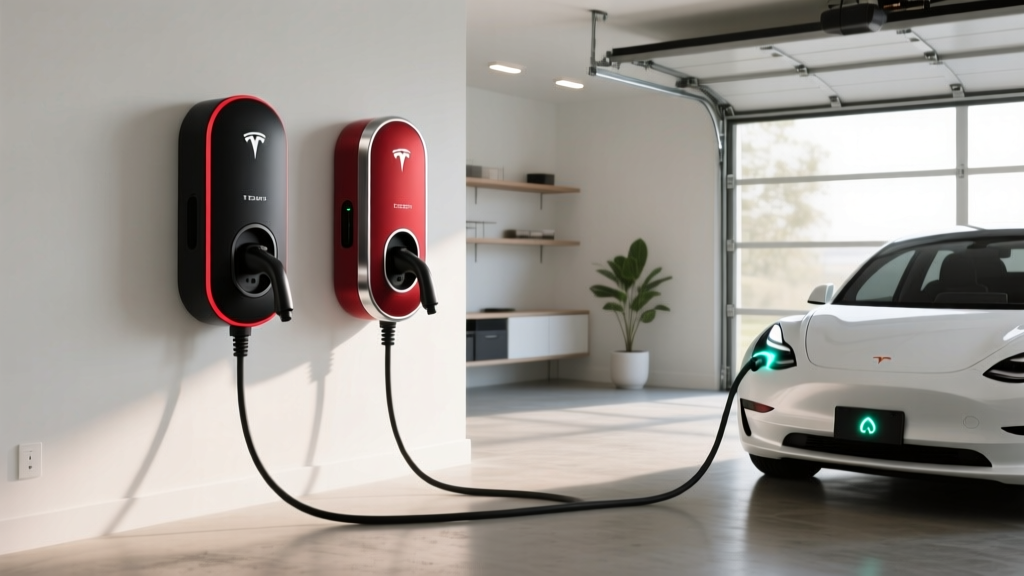
Tesla Wall Connector (Gen 4, NACS)
- Max output: 11.5 kW (48A @ 240V)
- Connector: NACS native
- Cable length: 24 ft
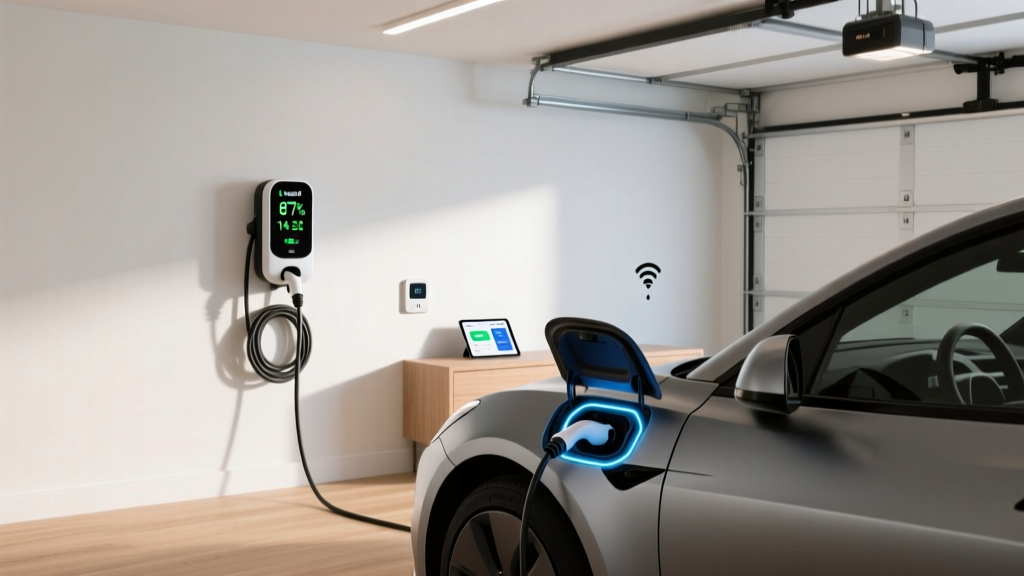
- Smart features: Wi-Fi, OTA updates, Tesla app scheduling, load-sharing between multiple units
- Price: ~$475
- Best for: Tesla owners and any 2025+ NACS vehicle
ChargePoint Home Flex (NACS or CCS1)
- Max output: 12 kW (50A adjustable, 240V)
- Connector: NACS or CCS1 (swappable pigtail)
- Cable length: 23 ft
- Smart features: Wi-Fi, ChargePoint app, Alexa/Google Home, utility demand-response integration
- Price: ~$599 (NACS), ~$549 (CCS1)
- Best for: Multi-EV households, utility demand-response programs
Emporia Vue Level 2 (J3400/NACS)
- Max output: 11.5 kW (48A @ 240V)
- Connector: NACS (J3400)
- Cable length: 24 ft
- Smart features: Wi-Fi, Emporia app, solar-integration (pair with Emporia Vue energy monitor), V2H-ready on select configs
- Price: ~$399
- Best for: Budget-conscious buyers with solar or energy-monitoring setups
Grizzl-E Smart (NACS or J1772)
- Max output: 10 kW (40A @ 240V)
- Connector: NACS or J1772
- Cable length: 24 ft
- Smart features: Wi-Fi, OCPP-compatible, adjustable amperage (16–40A) for panel-limited homes
- Price: ~$449
- Best for: Homes with limited panel capacity (dial down to 24A/32A)
For most 2026 NACS-equipped EVs, the Tesla Wall Connector Gen 4 or ChargePoint Home Flex NACS offers the best mix of price, output, and app quality. If your panel is constrained (say, only a 40A breaker slot available), the Grizzl-E's adjustable amperage is a practical workaround.
Safety, Code, and Outdoor Installation Considerations
Level 2 chargers pull serious current for hours at a time. A few code and safety items are non-negotiable:
- Dedicated circuit: Your EV charger must be on its own breaker — no sharing with a dryer or outlet. Continuous-load rules (NEC Article 210.20) enforce this.
- GFCI protection: NEC 2020 and later require GFCI for 240V receptacles (like a NEMA 14-50). Hardwired chargers are generally exempt from GFCI but still require proper grounding. Hardwiring also avoids the most common home-charging failure mode: a melted NEMA 14-50 receptacle from sustained high-amperage draw.
- NEMA 14-50 vs. hardwired: A plug-in 14-50 gives you portability but requires a quality industrial-grade receptacle (Hubbell or Bryant, ~$75–$100 — not the $12 big-box-store version). Hardwired installs skip the receptacle failure risk and often qualify for simpler permitting.
- Outdoor rating: If mounting outside, verify the charger is NEMA 4 (weatherproof) rated. All four units above meet this. Use a conduit-rated cable entry and ensure the unit is mounted at least 18" above grade in snow-prone areas.
- Permit and inspection: Most jurisdictions require an electrical permit for a new 240V circuit. Inspections catch undersized wire, improper grounding, and overloaded panels — worth the $50–$350 fee.
- Utility notification: Some utilities require you to inform them before adding a large continuous load. Many also offer EV-specific time-of-use rates that dramatically cut charging cost.
Frequently Asked Questions
How much does it cost to install a home EV charger?
For a typical 48A hardwired Level 2 charger in a home with an adequate 200A panel and a short wire run, expect $1,500–$2,500 all-in (equipment, labor, permit). Homes needing a panel upgrade should budget $3,500–$8,000+. Get three quotes — electrician rates vary wildly by region.
How fast will each charging level add range?
Level 1 (120V) adds 3–5 miles per hour. Level 2 (240V, 48A) adds roughly 35–40 miles per hour in a midsize EV. DC fast charging peaks at 150–800+ miles per hour but only sustains that rate for a narrow SoC window — expect 10–80% in 18–45 minutes depending on the vehicle's charge curve and station power.
Which connector/charger is compatible with my EV?
For 2025–2026 model-year vehicles from Tesla, Ford, GM, Hyundai, Kia, Rivian, BMW, and most others, NACS (J3400) is the standard. Older CCS1 vehicles (2022–2024 VW ID.4, etc.) need a CCS1-terminated charger or a CCS-to-NACS adapter. CHAdeMO is effectively end-of-life outside the used Nissan Leaf market.
How much does charging cost per mile vs gas?
At off-peak home rates (~$0.10/kWh), an efficient EV costs about $0.03/mile — roughly one-quarter the cost of a 28-MPG gas car at $3.40/gallon ($0.12/mile). Public DC fast charging at $0.45/kWh costs roughly $0.14/mile, slightly more than gas. Home charging is where the savings live.
What electrical upgrades might I need?
The most common upgrade is a panel service increase from 100A or 150A to 200A ($2,000–$5,000). Older homes may also need aluminum-to-copper wire remediation, a new meter base, or a utility transformer upgrade. A licensed electrician's load calculation (Article 220 of the NEC) will determine this before any work begins.
Can I charge my EV with solar panels?
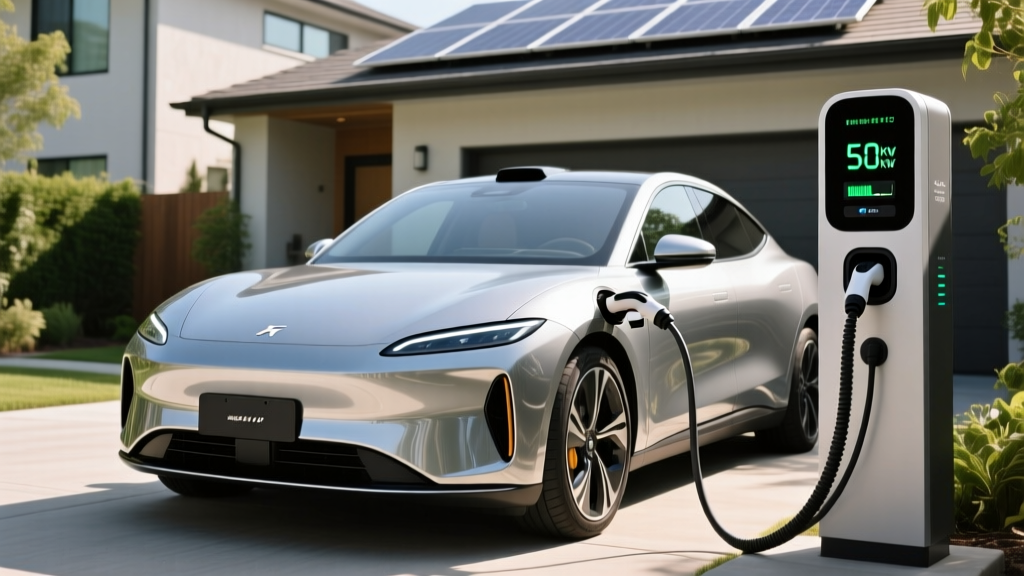
Yes — pairing a Level 2 charger with rooftop solar and a time-of-use rate is the lowest-cost charging setup available. Smart chargers like the Emporia Vue and ChargePoint Home Flex can be scheduled or modulated to charge when solar production exceeds home load, effectively driving your per-mile fuel cost near zero.
Is a 32A charger enough, or do I need 48A?
A 32A (7.7 kW) charger adds ~22–25 miles per hour — sufficient for commuters driving under 60 miles daily who can charge for 8–10 hours overnight. A 48A (11.5 kW) unit is the better long-term choice for larger batteries (90+ kWh trucks and SUVs), households with two EVs sharing one charger, or anyone wanting headroom for future vehicles.
Setting up reliable charging at home is a one-time investment that defines the daily experience and economics of EV ownership. Budget $1,500–$2,500 for a straightforward 48A install, confirm your panel capacity before buying equipment, choose a NACS-terminated charger if your vehicle is 2025 or newer, and enroll in your utility's EV time-of-use rate. Done right, you'll wake up every morning with a full "tank" at a fraction of gasoline's per-mile cost — and never visit a gas station again.