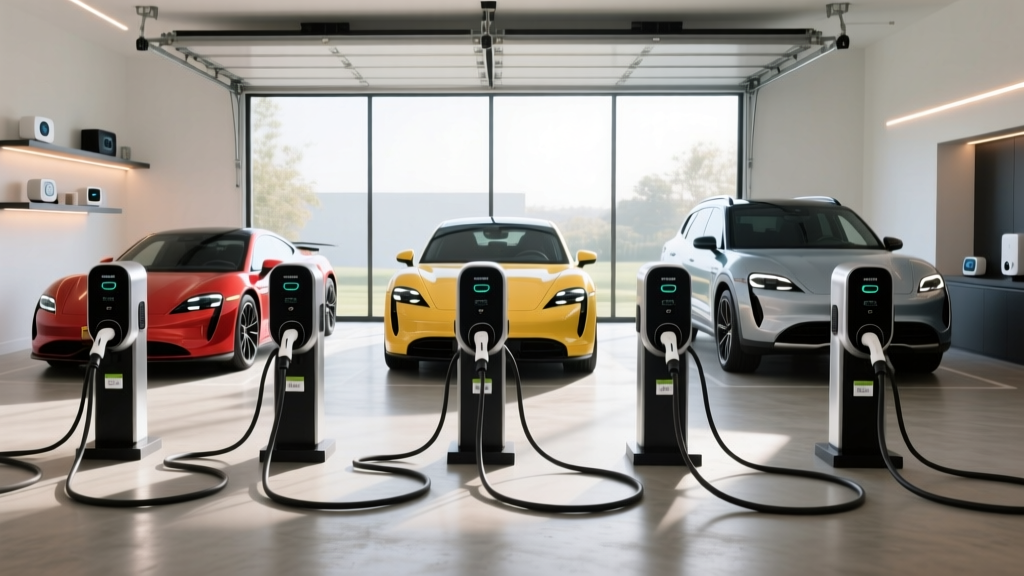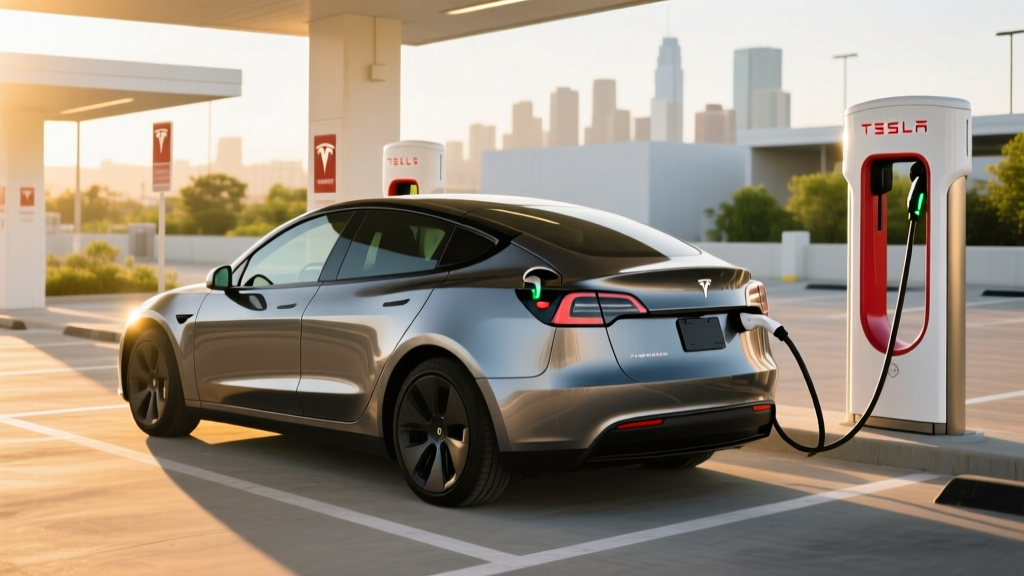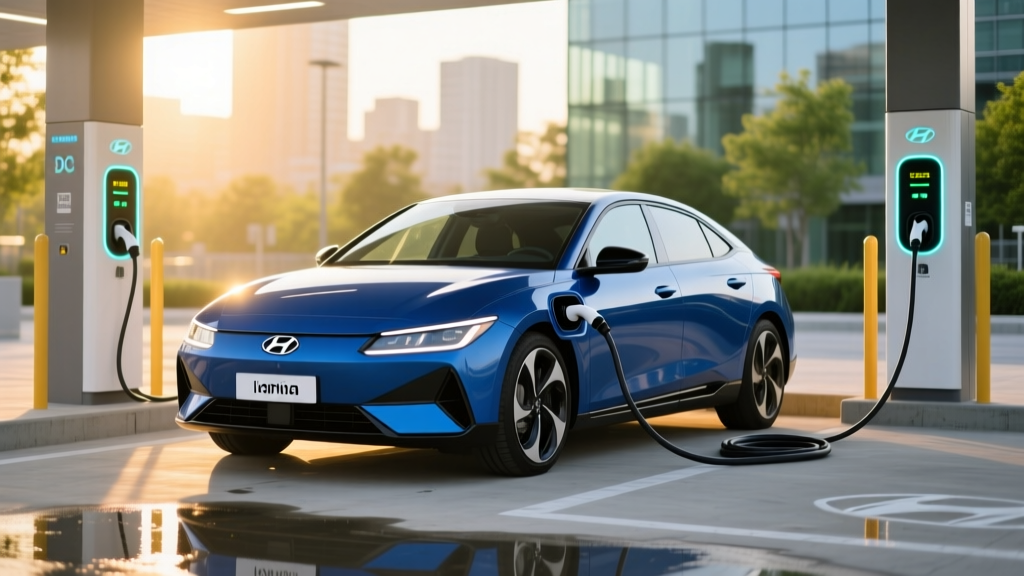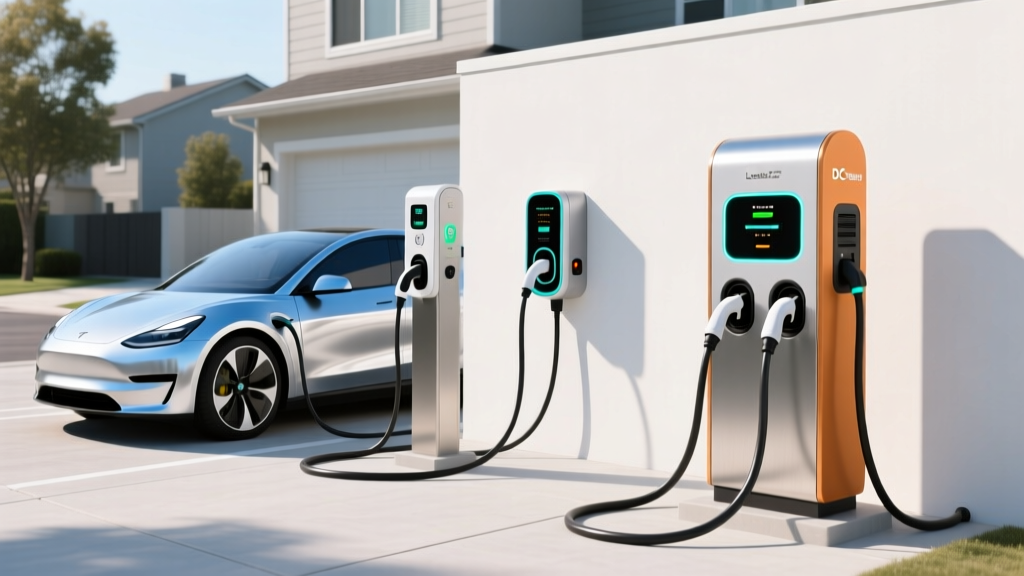
The single biggest decision a new EV owner makes isn't which car to buy — it's how to charge it at home. Pick the wrong setup and you'll spend hours tethered to a wall outlet; pick the right one and you'll wake up every morning with a full battery and a fuel cost that undercuts gas by two-thirds. Yet most buyers still stumble over the basics: What's the difference between Level 1, Level 2, and DC fast charging? How much does installation actually cost? And which connector does your car even use?
This guide breaks down the three charging levels by real-world speed, home electrical requirements, equipment picks, and cost-per-mile math — with the exact numbers you need to decide before you call an electrician.
The Critical Distinction: kW vs kWh
Before we compare chargers, let's eliminate the most common source of EV confusion. kW (kilowatts) measures power — the rate at which electricity flows into your battery, like water pressure from a hose. kWh (kilowatt-hours) measures energy — the total amount stored, like gallons in a bucket. A 77 kWh battery charged at 11.5 kW takes roughly 6.7 hours from empty to full (77 ÷ 11.5). A 250 kW DC fast charger can push that same amount of energy in about 20 minutes — but only while the battery accepts peak power. Confusing these two units is the fastest way to misjudge charging times.
Charging Levels Explained: Speed, Power, and Use Cases
Every EV sold in the U.S. supports three tiers of charging. Here's how they stack up in practice.
| Level | Voltage | Typical kW | Miles of Range / Hour | Best For |
|---|---|---|---|---|
| Level 1 | 120V AC | 1.0–1.4 kW | 3–5 mi/hr | Overnight top-ups, PHEVs, low-mileage drivers |
| Level 2 | 240V AC | 3.3–19.2 kW | 12–75 mi/hr | Daily home charging, most BEV owners |
| DC Fast (Level 3) | 200–900V DC | 50–350 kW | 150–1,200+ mi/hr (peak) | Road trips, quick top-ups away from home |
Real-world context: Those "miles per hour" figures assume a vehicle averaging 3–4 mi/kWh (typical for a midsize crossover like the Hyundai Ioniq 5 or Tesla Model Y). A heavier truck like the Ford F-150 Lightning, averaging closer to 2 mi/kWh, will add fewer miles per hour at the same kW rate.
Level 1: The Emergency Backup
Every EV ships with a Level 1 cord that plugs into a standard 120V household outlet. At 1.4 kW (12 amps on a 15-amp circuit), you'll recover about 4 miles of range per hour — roughly 40–50 miles over a 10-hour night. For plug-in hybrids with 25–40 miles of electric range (like the Toyota RAV4 Prime or Jeep Wrangler 4xe), Level 1 is often sufficient. For a 75+ kWh BEV battery, Level 1 is impractical as a daily solution: a full charge can take 50+ hours.
Level 2: The Home Standard
A 240V Level 2 station is what most EV owners install at home. The sweet spot for residential setups is a 40-amp circuit delivering 9.6 kW (32 amps continuous, per NEC 80% rule) or a 48-amp circuit delivering 11.5 kW. At 11.5 kW, a Tesla Model Y Long Range (75 kWh usable battery) charges from 10% to 80% in roughly 4.5 hours — more than enough for overnight recovery.
Some hardwired units push to 48 amps (11.5 kW) or even 80 amps (19.2 kW), but your vehicle's onboard charger sets the ceiling. The Hyundai Ioniq 5 accepts up to 10.9 kW on AC, so an 11.5 kW station is a perfect match. The Ford F-150 Lightning's onboard charger handles 19.2 kW, making it one of the few vehicles that can use the highest-output residential units.
DC Fast Charging: Road-Trip Power
DC fast chargers bypass the vehicle's onboard charger and feed high-voltage direct current straight into the battery. Peak speeds range from 50 kW (older CHAdeMO stations) to 350 kW (Electrify America and Tesla V4 Superchargers).
The catch: no EV sustains peak kW for the entire session. Charging follows a curve — power ramps up quickly from low states of charge, holds near peak between roughly 10–50%, then tapers significantly above 80% to protect battery health. A Hyundai Ioniq 5 with its 800V architecture peaks at ~240 kW and achieves a 10–80% charge in about 18 minutes. A Tesla Model 3 Long Range peaks at ~250 kW with a similar 10–80% time of roughly 25–30 minutes. Budget vehicles with smaller batteries or slower architectures (like the Chevy Equinox EV at ~150 kW peak) typically hit 10–80% in 30–40 minutes.
How Much Does It Cost to Install a Home EV Charger?
This is where sticker shock hits. The charger itself is often the cheapest part of the equation. Here's a realistic breakdown for a typical Level 2 home installation in 2026:
| Component | Typical Range | Notes |
|---|---|---|
| Level 2 charging station (hardware) | $300–$700 | 32A–48A smart chargers; premium units up to $1,000+ |
| Electrician labor (240V circuit run) | $400–$1,500 | Depends on distance from panel; short runs under $500 |
| Electrical permit | $50–$200 | Varies by municipality; some jurisdictions waive for simple installs |
| Panel upgrade (if needed) | $1,500–$4,000 | Required when existing panel lacks capacity; 100A→200A common |
| Conduit, wiring, breaker | $100–$400 | 6 AWG copper for 48A circuits; longer runs cost more |
| Total (no panel upgrade) | $850–$2,800 | Most homes with 200A panels fall in this range |
| Total (with panel upgrade) | $2,350–$6,800 | Homes with older 100A service or full panels |
The Panel-Upgrade Reality
If your home has a 100-amp electrical panel — common in houses built before 1990 — adding a 40-amp or 48-amp EV circuit may push total load beyond safe limits. A licensed electrician will perform a load calculation (NEC Article 220) to determine if an upgrade to 200 amps is necessary. This is the single biggest variable in installation cost and one that many online guides gloss over. Budget accordingly: get a quote that explicitly includes a load calculation before committing.
Some utilities and state programs offer rebates that offset panel upgrades. Check your local utility's EV program page — in some regions, rebates cover $500–$1,500 of the total cost.
Federal Tax Incentive for Home Charging
The IRS Alternative Fuel Vehicle Refueling Property Credit (IRC §30C) covers up to 30% of home charging equipment and installation costs, capped at $1,000 per year. Eligibility depends on your census tract meeting certain low-income or non-urban criteria. Consult a tax professional and verify current-year rules, as the credit's availability and tract eligibility maps are subject to legislative updates.
Connector Compatibility: NACS vs CCS1 vs CHAdeMO
The physical plug your EV uses determines which public chargers you can access — and whether you'll need an adapter. As of 2026, the connector landscape has shifted heavily toward NACS (North American Charging Standard), the connector Tesla pioneered and opened to other automakers starting in 2024.
| Connector | Brands Using It (Native) | Adapter Needed? |
|---|---|---|
| NACS (Tesla) | Tesla (all), Ford, GM, Rivian, Volvo, Polestar, Mercedes-Benz, Nissan (2025+), Honda (2025+), Fisker, BMW (2025+) | CCS→NACS adapter for legacy CCS stations ($150–$250) |
| CCS1 | Hyundai, Kia, Stellantis (some), Volkswagen (some legacy models) | NACS→CCS adapter for Tesla Superchargers ($200–$300) |
| CHAdeMO | Nissan Leaf (legacy), Mitsubishi Outlander PHEV (legacy) | No adapter available; CHAdeMO infrastructure declining |
What this means for home chargers: Most Level 2 home stations sold in 2026 ship with either a NACS connector or a universal J1772 connector (which all non-Tesla EVs used prior to the NACS transition). If you drive a NACS-equipped vehicle, buy a station with a native NACS cable. If you drive a CCS1 vehicle, a J1772 station works natively, or you can use a J1772-to-NACS adapter for future-proofing.
Charging Cost Per Mile: EV vs Gas
The economics of EV charging depend heavily on where and when you plug in. Here's how the math works across common scenarios, using a midsize EV averaging 3.5 mi/kWh (e.g., Tesla Model Y, Hyundai Ioniq 5):
| Scenario | Rate ($/kWh) | Cost per Mile (EV) | Equivalent Gas Cost per Mile* |
|---|---|---|---|
| Home charging (off-peak utility rate) | $0.08–$0.14 | $0.023–$0.040 | — |
| Home charging (standard residential rate) | $0.14–$0.20 | $0.040–$0.057 | — |
| Public Level 2 (workplace, retail) | $0.20–$0.35 | $0.057–$0.100 | — |
| DC fast charging (Electrify America, etc.) | $0.35–$0.55 | $0.100–$0.157 | — |
| Gas vehicle (28 MPG combined, $3.50/gal) | — | — | $0.125 |
*Gas calculation: $3.50 ÷ 28 MPG = $0.125/mile. Source: fueleconomy.gov average for compact SUVs.
The takeaway: Home off-peak charging costs roughly one-third to one-fifth what gas costs per mile. Even DC fast charging at peak rates is comparable to or slightly above gas costs — which is why home Level 2 charging is the economic foundation of EV ownership. If you can't charge at home, your cost advantage narrows significantly, though you still eliminate oil changes, emissions tests, and many mechanical maintenance items.
Charging Time Examples: 10% to 80% for Common EVs
Charging times vary by battery size, vehicle architecture, and ambient temperature. Here are representative 10–80% times for popular 2026 models at different charging levels:
| Vehicle (Battery kWh) | Level 2 (11.5 kW) | DC Fast (Peak kW) | DC 10–80% Time |
|---|---|---|---|
| Tesla Model 3 LR (75 kWh) | ~4.5 hrs | 250 kW | ~25–30 min |
| Hyundai Ioniq 5 (77.4 kWh) | ~4.7 hrs | 240 kW (800V) | ~18 min |
| Ford F-150 Lightning ER (131 kWh) | ~8.0 hrs (at 19.2 kW) | 150 kW | ~41 min |
| Chevy Equinox EV (85 kWh) | ~5.2 hrs | 150 kW | ~35–40 min |
| Toyota RAV4 Prime PHEV (18.1 kWh) | ~2.5 hrs (at 3.3 kW) | N/A (no DC fast) | — |
Cold-weather caveat: In sub-freezing temperatures, DC fast charging speeds can drop 20–40% unless the vehicle has active battery preconditioning. Tesla, Hyundai/Kia (800V models), and Ford all precondition automatically when you navigate to a charger. If your EV lacks this feature, expect slower sessions in winter.
Equipment Picks: Level 2 Home Chargers Worth Buying
Not all Level 2 stations are equal. Here are four proven options across price tiers, with the specs that actually matter:
Emporia Vue Level 2 Charger
- Power output: 48 amps / 11.5 kW (hardwired) or 40 amps / 9.6 kW (plug-in NEMA 14-50)
- Connector: J1772 (NACS adapter available)
- Cable length: 24 ft
- Smart features: Wi-Fi scheduling, energy monitoring, solar integration, load management
- Price: ~$399
- Best for: Budget-conscious buyers who want smart scheduling and energy tracking
ChargePoint Home Flex
- Power output: Up to 50 amps / 12 kW (adjustable via app, 16A–50A)
- Connector: J1772 or NACS (configurable at purchase)
- Cable length: 23 ft
- Smart features: Alexa integration, ChargePoint app scheduling, flexible amperage
- Price: ~$549–$649
- Best for: Flexibility — adjustable amperage works with older panels that can't support a full 48A circuit
Tesla Wall Connector
- Power output: 48 amps / 11.5 kW (hardwired, 60A circuit)
- Connector: Native NACS (J1772 adapter included for non-Tesla EVs)
- Cable length: 24 ft
- Smart features: Wi-Fi updates, power sharing between two units, Tesla app integration
- Price: ~$475
- Best for: Tesla owners or households with NACS-equipped vehicles seeking a clean, reliable unit
Grizzl-E Smart
- Power output: 40 amps / 9.6 kW (NEMA 14-50) or 48 amps / 11.5 kW (hardwired)
- Connector: J1772 or NACS
- Cable length: 24 ft
- Smart features: OCPP compatibility, EV Smart Charging app, extreme cold rated (-40°F)
- Price: ~$449–$549
- Best for: Cold-climate owners; built in Canada with rugged outdoor housing
Safety, Code, and Installation Requirements
A Level 2 charger installation is a permanent electrical modification. Cutting corners risks fire, insurance claim denial, or code violations. Here's what a proper installation requires:
- Dedicated circuit: Your charger must have its own breaker — no sharing with other appliances. A 48-amp charger requires a 60-amp breaker (NEC requires circuits rated at 125% of continuous load).
- GFCI protection: The 2020 NEC (Article 625.54) requires GFCI protection for all EV charging outlets rated 150V to ground or less and 50 amps or less. Hardwired installations may have different requirements depending on jurisdiction — your electrician will confirm local code.
- Outdoor rating: If your charger mounts outside, the unit must carry a NEMA 3R or NEMA 4 weatherproof rating. All four picks above are outdoor-rated.
- Wire gauge: 6 AWG copper for 48-amp circuits; 8 AWG for 40-amp circuits. Longer runs (over 50 feet from the panel) may require thicker wire to prevent voltage drop.
- Permit and inspection: Most municipalities require a permit for new 240V circuits. The inspection verifies wire gauge, breaker sizing, grounding, and GFCI compliance. Skipping this step can void home insurance coverage for electrical fires.
Never use an extension cord with an EV charger. If the cable doesn't reach your parking spot, move the charger location — not the cord.
Frequently Asked Questions
How fast will each charging level add range?
Level 1 adds 3–5 miles per hour, Level 2 adds 12–75 miles per hour depending on amperage and vehicle efficiency, and DC fast charging can add 150–1,200+ miles per hour at peak power. In practice, DC fast charging sessions are measured in minutes (18–40 minutes for 10–80%), not hours.
How much does it cost to install a home EV charger?
Expect $850–$2,800 for a standard Level 2 installation in a home with adequate panel capacity. If your home needs a panel upgrade from 100A to 200A, total costs rise to $2,350–$6,800. Always get a written quote that includes the load calculation, permit, equipment, and labor.
Which connector/charger is compatible with my EV?
Check your vehicle's charging port. Tesla, Ford, GM, Rivian, Volvo, and most 2025+ models from Honda, Nissan, and BMW use NACS. Hyundai, Kia, and some Volkswagen models still use CCS1. For home Level 2 charging, J1772 is the legacy universal standard and works with CCS1 vehicles natively; NACS vehicles require a J1772-to-NACS adapter (usually included with the car).
How much does charging cost per mile vs gas?
Home off-peak charging costs $0.02–$0.04 per mile for a typical EV — roughly one-third the cost of gas at $3.50/gallon and 28 MPG ($0.125/mile). Public DC fast charging at $0.45/kWh costs about $0.13/mile, comparable to gas. The savings advantage depends heavily on having access to home charging at residential electricity rates.
What electrical upgrades might I need?
The most common upgrade is a panel replacement from 100 amps to 200 amps ($1,500–$4,000) if your existing service can't handle the additional 40–60 amp load. Older homes may also need wiring updates (aluminum-to-copper), new grounding electrodes, or sub-panel installations if the main panel is full. A licensed electrician's load calculation will identify exactly what's needed before any work begins.
Can I use a NEMA 14-50 outlet instead of hardwiring?
Yes — a NEMA 14-50 outlet on a 50-amp breaker supports up to 40 amps continuous (9.6 kW), which covers most EVs adequately. Hardwired installations allow up to 48 amps (11.5 kW) and avoid the GFCI breaker requirement that some outlets need under NEC 625.54. Plug-in setups offer portability if you move; hardwired setups offer slightly higher speed and simpler code compliance.
Sources: U.S. EPA fueleconomy.gov, IRS §30C Refueling Property Credit, National Electrical Code (NFPA 70) Articles 220, 625.