The Charger Scat Pack Goes Electric — Here's How to Charge It
The Dodge Charger Daytona Scat Pack marks a seismic shift: Stellantis's first 800-volt, dual-motor electric muscle car wearing the legendary Scat Pack badge. With a targeted EPA range near 317 miles, up to 670 horsepower, and a 100.5 kWh (usable) battery pack, the electric Scat Pack delivers performance that would have been unthinkable a decade ago. But all that energy needs to get into the battery somehow — and the gap between "plugs in" and "charges optimally" is where real-world ownership is won or lost.
This guide breaks down exactly how to charge the electric Charger Scat Pack at home and on the road, including the electrical upgrades your house might need, the connectors involved as the industry shifts to NACS, what you'll actually pay per mile, and which Level 2 wall connectors earn our recommendation for 2026.
Charging Levels Explained: How Fast Each One Adds Range
Before picking equipment, you need to understand the three charging tiers and what they actually deliver in miles per hour. Note the critical distinction: kW (kilowatts) measures power — the rate energy flows into your battery. kWh (kilowatt-hours) measures energy — the total capacity of your battery, like gallons in a fuel tank. A 100.5 kWh battery charged at 11.5 kW takes roughly 8.7 hours from empty to full; at 150 kW, the math changes dramatically (though charge-curve taper prevents a simple linear calculation above 80% SoC).
| Level | Voltage / Amperage | Max Power (kW) | Miles of Range Added Per Hour | Best Use Case |
|---|---|---|---|---|
| Level 1 (120V) | 120V / 12A | ~1.4 kW | 3–5 mi/hr | Overnight top-up, emergencies |
| Level 2 (240V) | 240V / 32–48A | 7.7–11.5 kW | 21–35 mi/hr | Daily home charging |
| DC Fast Charge | 400–800V DC | Up to ~175 kW (peak) | ~500–700 mi/hr (at peak) | Road trips, rapid top-ups |
For the Charger Scat Pack's ~100.5 kWh battery, Level 1 is essentially useless for full recharges (it would take over 70 hours). Level 2 at 48A / 11.5 kW replenishes the pack from 10% to 100% in roughly 8–9 hours — ideal for overnight charging. DC fast charging from 10–80% takes approximately 27–32 minutes at a 150+ kW station, though the charge curve tapers significantly above 80% State of Charge (SoC) to protect battery longevity.
Home Charger Installation: Electrical Requirements and Costs
The single biggest variable in home EV charging isn't the charger itself — it's what your electrical panel can support. The Charger Scat Pack's onboard charger accepts up to 11.5 kW on Level 2, which requires a 240V circuit rated for at least 60 amps (to safely deliver 48A continuous, per National Electrical Code's 80% rule for continuous loads).
What Your Electrical Panel Needs
A 60A dedicated circuit requires two adjacent breaker slots in your panel and sufficient spare capacity. Most modern 200A panels can accommodate this if they aren't already near capacity. Homes with 100A service — common in pre-1980 construction — will almost certainly need a panel upgrade to 200A, which is the most expensive line item in any EV charging installation.
Key electrical requirements for a Scat Pack home charger:
- Circuit: Dedicated 60A double-pole breaker, 240V
- Wire: 6 AWG copper (or 4 AWG aluminum) THHN in conduit, or 6/2 NM-B for shorter indoor runs
- Outlet option: NEMA 14-50 receptacle (if using a plug-in charger) — requires GFCI breaker per NEC 2020+ in garages
- Hardwired option: Direct wire connection (no outlet) — preferred for 48A+ chargers; eliminates GFCI nuisance-trip risk
- Permit: Required in most jurisdictions; expect $50–$200 for an electrical permit
| Component | Typical Cost Range | Notes |
|---|---|---|
| Level 2 Charger (hardware) | $350–$700 | 40A–48A Wi-Fi-enabled units |
| Electrician labor (standard install) | $400–$1,200 | Depends on run length from panel to garage |
| Electrical permit | $50–$200 | Varies by municipality |
| Panel upgrade (100A → 200A) | $1,500–$3,500 | Only if needed; older homes |
| Total (no panel upgrade) | $800–$2,100 | Most homes with 200A service |
| Total (with panel upgrade) | $2,300–$5,600 | Older homes needing 200A service |
Always get a licensed electrician to perform a load calculation before committing to a 60A circuit. If your panel is tight, a 40A circuit (delivering 32A continuous / 7.7 kW) is a viable fallback that still adds ~25 miles of range per hour — enough to replenish 200+ miles overnight.
Connector Compatibility: NACS, CCS, and the Adapter Landscape
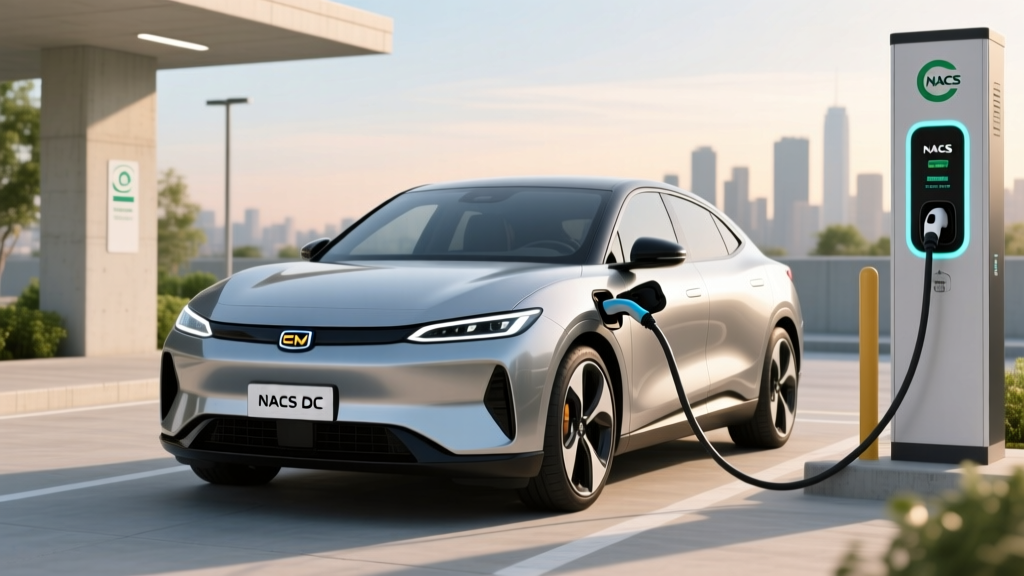
The Charger Daytona is built on Stellantis's STLA Large platform, which launched with the CCS1 (Combined Charging System) connector standard. However, the North American Charging Standard (NACS), developed by Tesla, has become the dominant connector going forward, with most automakers — including Stellantis — committing to NACS on future models.
| Connector | Charger Daytona Compatibility | Network Access |
|---|---|---|
| CCS1 | Native (built-in port) | Electrify America, EVgo, ChargePoint DC stations |
| NACS (Tesla) | Via CCS-to-NACS adapter (~$200–$250) | Tesla Supercharger network (16,000+ stalls in US) |
| J1772 (Level 2 AC) | Native (CCS port includes J1772 upper section) | All public Level 2 stations, home chargers |
| CHAdeMO | Not compatible (no adapter available) | Legacy Nissan/Mitsubishi network — declining |
Practical recommendation: Buy a CCS-to-NACS adapter from an approved manufacturer (Tesla, Lectron, or A2Z) to unlock the Supercharger network. Tesla's Supercharger infrastructure remains the most reliable DC fast-charging network in the US by a wide margin, and access to it dramatically reduces road-trip friction. For home Level 2 charging, any J1772 wall connector will plug directly into the Charger's port.
Cost to Charge: Per-Mile Economics vs. Gas
The Charger Scat Pack's efficiency lands around 2.8–3.2 kWh per mile (roughly 97 MPGe combined, per preliminary EPA data). That's thirstier than a compact EV like the Tesla Model 3, but the trade-off is 670 horsepower and a 4,900+ lb curb weight. Here's what that efficiency translates to in real dollars:
| Charging Scenario | Cost per kWh | Cost per Mile | Cost to "Fill" (10–80%) |
|---|---|---|---|
| Home (off-peak utility rate) | $0.08–$0.12 | $0.024–$0.036 | $5.60–$8.40 |
| Home (average US rate, ~$0.16) | $0.16 | $0.048 | $11.20 |
| Public Level 2 (ChargePoint, etc.) | $0.25–$0.40 | $0.075–$0.12 | $17.50–$28.00 |
| DC Fast Charge (EA, EVgo, Tesla) | $0.35–$0.55 | $0.10–$0.16 | $24.50–$38.50 |
| Gas equivalent (20 MPG, $3.40/gal) | — | $0.17 | ~$55+ (full tank) |
The math is clear: home charging on an off-peak or time-of-use rate plan makes the Scat Pack dramatically cheaper to "fuel" than any gas V8 it replaces. At $0.10/kWh, you're paying roughly 3 cents per mile — about one-fifth the cost of premium gasoline at 20 MPG. Even DC fast charging on road trips undercuts gas in most scenarios, though the gap narrows on networks charging $0.50+/kWh.
Pro tip: Enroll in your utility's EV time-of-use (TOU) rate plan. Charging between 11 PM and 6 AM at super-off-peak rates of $0.06–$0.09/kWh turns the Scat Pack into a bargain cruiser for daily commuting, despite its muscle-car appetite.
Charging Time Examples: 10–80% for the Scat Pack's Battery
The Charger Scat Pack's ~100.5 kWh usable battery means charging times scale with available power. Here are realistic 10–80% times (adding ~70 kWh) across common scenarios:
- Level 1 (120V, 1.4 kW): ~50 hours — impractical for full charges; useful only for maintaining SoC
- Level 2 (240V, 32A / 7.7 kW): ~9.1 hours — adequate overnight charge for most daily needs
- Level 2 (240V, 48A / 11.5 kW): ~6.1 hours — full overnight replenishment even after heavy driving days
- DC Fast (150 kW station, sustained ~120 kW average): ~35 minutes — realistic road-trip stop
- DC Fast (350 kW station, 800V architecture, sustained ~175 kW avg): ~24–28 minutes — best-case scenario on compatible infrastructure
The Charger Daytona's 800-volt architecture is the key enabler for faster DC charging. Higher voltage means lower current for the same power, reducing heat and allowing the battery management system to accept higher charge rates for longer before tapering. On a 350 kW-capable Electrify America stall, expect the Scat Pack to sustain 150–175 kW from roughly 10% to 55% SoC, then taper progressively. This is why we quote 10–80% times rather than peak kW — the charge curve matters more than the headline number.
Recommended Level 2 Home Chargers for the Charger Scat Pack
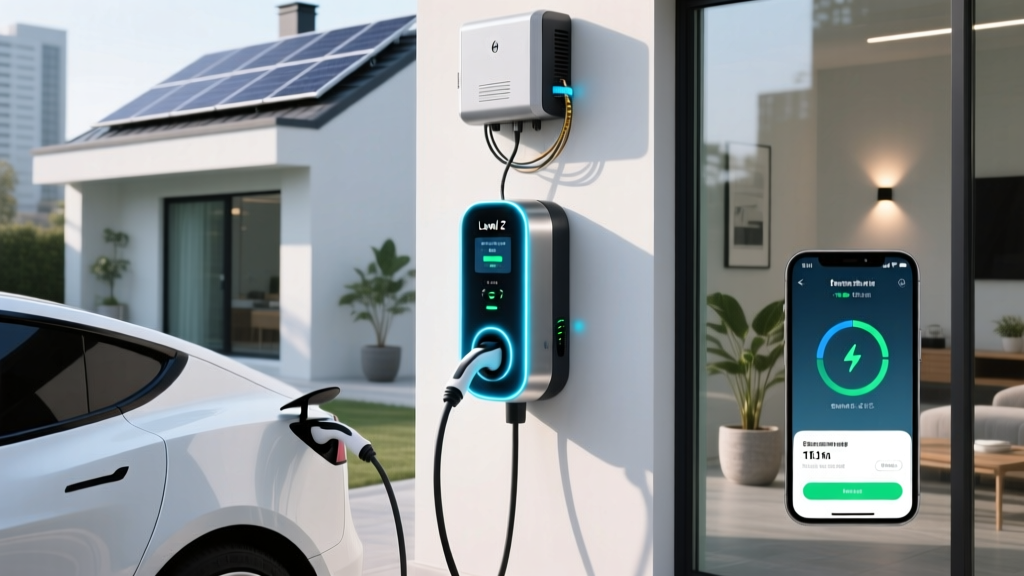
We've selected three wall connectors that pair well with the Scat Pack's 11.5 kW onboard charger, prioritizing build quality, smart features, cable length, and value. All use the J1772 connector (compatible with the Charger's CCS port) and support hardwired or NEMA 14-50 plug-in installation.
Emporia Level 2 Smart Charger
- Power: 48A / 11.5 kW (hardwired) or 40A / 9.6 kW (14-50 plug)
- Cable: 24 ft
- Smart features: Wi-Fi, app scheduling, energy monitoring, solar integration
- Price: ~$399
- Best for: Budget-conscious buyers wanting full smart features and energy tracking
ChargePoint Home Flex
- Power: Up to 50A / 12 kW (adjustable via DIP switches for 16A–50A)
- Cable: 23 ft
- Smart features: Wi-Fi, Alexa/Google integration, ChargePoint app, scheduled charging
- Price: ~$599
- Best for: Flexibility — adjustable amperage fits any panel capacity
Tesla Wall Connector (with J1772 adapter)
- Power: 48A / 11.5 kW (hardwired, 60A circuit)
- Cable: 24 ft
- Smart features: Wi-Fi, OTA updates, power sharing (link up to 6 units on one circuit)
- Price: ~$475 (charger) + ~$30 (Tesla J1772 adapter for non-Tesla EVs)
- Best for: Multi-EV households with both Tesla and CCS vehicles
For the Charger Scat Pack specifically, the ChargePoint Home Flex is our top pick. Its adjustable amperage means your electrician can set it to match your panel's capacity — 48A on a 60A circuit for maximum speed, or 32A on a 40A circuit if your panel is constrained. The 23-foot cable comfortably reaches from a wall-mounted position to the Charger's driver-side rear charge port in most garage configurations.
Safety, Code, and Installation Best Practices
EV charging is a continuous high-draw electrical load — your charger will pull maximum current for 6–10 hours straight. This is fundamentally different from an oven or dryer that cycles on and off. Proper installation is non-negotiable.
- NEC Article 625 governs EV charging equipment. Your installation must comply with local code as adopted by your jurisdiction.
- A GFCI breaker is required for receptacle-based (NEMA 14-50) installations in garages per NEC 2020+. Hardwired installations do not require GFCI. GFCI breakers for 50–60A circuits cost $80–$150 and can nuisance-trip — hardwiring avoids this.
- Outdoor installations require a charger rated NEMA 4 (weatherproof) and a GFI-protected circuit regardless of hardwired or plug-in.
- Never use an extension cord for EV charging. Never plug a Level 2 charger into a standard 120V outlet via adapter.
- If your home has aluminum wiring (common in 1965–1973 construction), your electrician must use aluminum-rated connectors and may need to upsize wire gauge.
Before installation, photograph your electrical panel (showing all breakers and the main rating) and share it with at least two licensed electricians for quotes. Ask specifically about a load calculation — this determines whether your panel can safely add a 60A continuous load. If the calculation shows insufficient headroom, options include a panel upgrade, a lower-amperage circuit (40A), or a smart load-management device like the Emporia VUE with automatic charger throttling when household demand peaks.
Frequently Asked Questions
How much does it cost to install a home EV charger for the Charger Scat Pack?
Expect $800–$2,100 for a standard Level 2 installation in a home with a 200A panel (charger + electrician + permit). If your home needs a panel upgrade from 100A to 200A service, total costs rise to $2,300–$5,600. Always get a load calculation first — you may be able to use a 40A circuit and avoid the upgrade entirely.
How fast will each charging level add range to the Scat Pack?
Level 1 (120V) adds 3–5 miles per hour. Level 2 (240V, 48A) adds approximately 30–35 miles per hour. DC fast charging at 150 kW can add 200+ miles in about 20 minutes during the peak portion of the charge curve. For daily driving, Level 2 at home is the primary charging method — DC fast charging is reserved for road trips.
Which connector and charger is compatible with the Charger Daytona?
The Charger Daytona uses a CCS1 port, which incorporates J1772 for AC Level 2 charging. Any J1772 Level 2 home charger will work natively. For DC fast charging at Tesla Superchargers, you'll need a CCS-to-NACS adapter (~$200–$250). CHAdeMO is not compatible and has no adapter path.
How much does charging cost per mile compared to gas?
At home on an average US electricity rate of $0.16/kWh, the Scat Pack costs roughly $0.048 per mile. On off-peak utility rates ($0.08–$0.10/kWh), that drops to $0.024–$0.03 per mile. A comparable gas muscle car at 20 MPG with premium fuel at $3.40/gallon costs $0.17 per mile — roughly 3.5 to 7 times more expensive per mile than home-charged electricity.
What electrical upgrades might my home need?
The most common upgrade is a panel capacity increase from 100A to 200A service ($1,500–$3,500), required in older homes that can't spare 60A of continuous capacity. Other potential needs include: running new conduit from the panel to the garage (adds $200–$800 depending on distance), upgrading the meter base if your utility requires it, and installing a whole-home surge protector (recommended, ~$150–$300). Consult a licensed electrician for a site-specific assessment — NEC Article 625 governs EV charging installations.
Does the Charger Scat Pack qualify for the federal EV tax credit?
As of current IRS §30D rules, eligibility depends on MSRP caps ($55,000 for sedans), buyer income limits ($150K single / $300K joint), and battery critical-mineral and component sourcing requirements. The Charger Daytona Scat Pack's MSRP is expected to exceed the $55,000 sedan cap, which may disqualify it from the new-vehicle credit. The point-of-sale transfer option allows eligible buyers to apply the credit as an immediate price reduction at the dealer. Always verify current-year eligibility with a tax professional before purchasing.