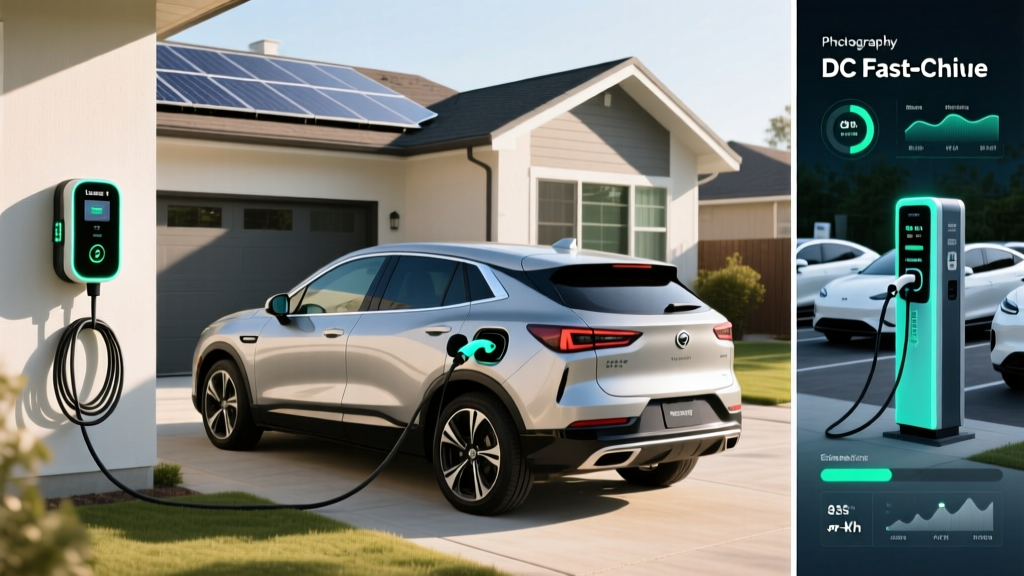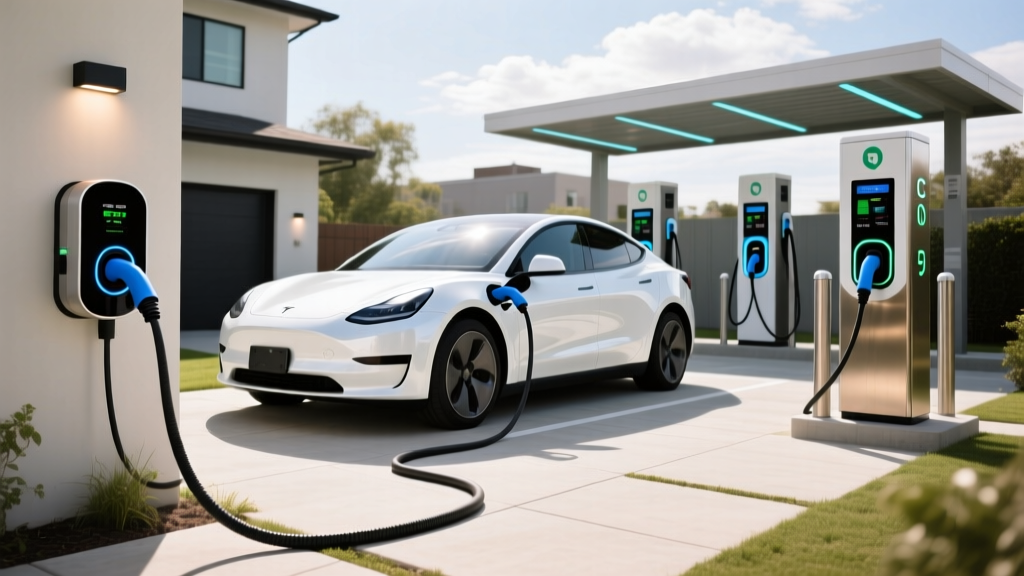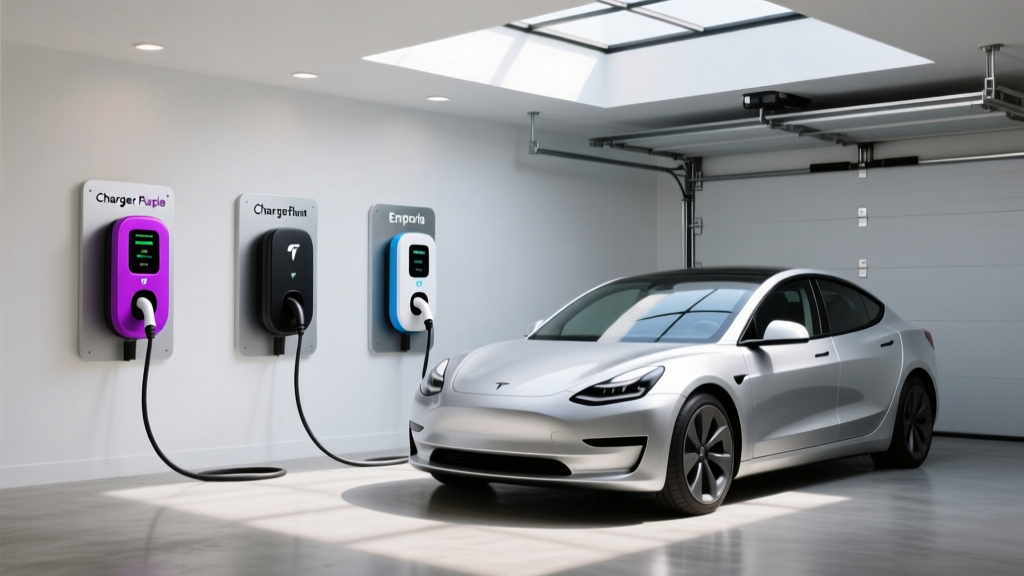
If you have been browsing EV forums or Instagram ads lately, you have likely seen the Charger Purple — a sleek, violet-anodized Level 2 wallbox that has carved out a niche among Tesla owners and NACS-curious buyers who want something visually distinct from the usual black-and-white charge points. But aesthetics only get you so far. What really matters is whether this 48-amp charger can reliably replenish your battery, how much it will cost to install, and whether it plays nicely with your EV's connector.
This guide breaks down everything you need to know about the Charger Purple and its top competitors, from electrical requirements and installation costs to real-world charging speeds and the cost-per-mile math that makes home charging such a compelling alternative to gas.
Understanding EV Charging Levels: Speeds in kW and Miles Per Hour
Before evaluating any specific charger, you need a firm grasp of the three charging levels and what they deliver. The single most important distinction in EV literacy is between kW (kilowatts), which measures power or charge rate, and kWh (kilowatt-hours), which measures energy or battery capacity. Think of kW as the width of the pipe and kWh as the size of the tank.
| Level | Voltage | Max Power (kW) | Miles of Range Added Per Hour | Typical Use Case |
|---|---|---|---|---|
| Level 1 | 120V AC | 1.4–1.9 kW | 3–5 mi/hr | Overnight trickle, PHEVs, emergency |
| Level 2 | 240V AC | 3.3–19.2 kW | 12–75 mi/hr | Home daily charging, workplace, hotels |
| DC Fast Charge | 400–900V DC | 50–350+ kW | 150–1,000+ mi/hr (peak) | Road trips, highway corridors |
For most EV owners, Level 2 is the sweet spot. A 48-amp Level 2 charger like the Charger Purple delivers up to 11.5 kW on a 60-amp dedicated circuit, adding roughly 35–44 miles of range per hour depending on your vehicle's efficiency. That means a 75 kWh battery (like the one in a Tesla Model Y Long Range) can go from 10% to 80% in about 5–6 hours — perfect for overnight replenishment.
Charger Purple vs. the Competition: Equipment Compared
The Charger Purple entered the market as a boutique alternative to mainstream Level 2 chargers, targeting buyers who want NACS-native compatibility and a distinctive look. Here is how it stacks up against the established players in 2026.
Charger Purple (48A)
- Power Output: 11.5 kW (48A / 240V)
- Connector: NACS (native Tesla plug)
- Cable Length: 24 ft
- Smart Features: Wi-Fi, app scheduling, energy tracking, OTA updates
- Outdoor Rating: NEMA 4 (weatherproof)
- Price: ~$549
- Best For: Tesla/NACS-equipped EVs, design-conscious garages
ChargePoint Home Flex (50A)
- Power Output: 12.0 kW (50A / 240V)
- Connector: J1772 (NACS adapter included in 2026 kit)
- Cable Length: 23 ft
- Smart Features: Wi-Fi, Alexa, ChargePoint network, flex amperage dial
- Outdoor Rating: NEMA 4
- Price: ~$599
- Best For: Mixed-fleet households, adjustable amperage for older panels
Emporia Vue Smart Charger (48A)
- Power Output: 11.5 kW (48A / 240V)
- Connector: J1772 (NACS adapter available)
- Cable Length: 24 ft
- Smart Features: Wi-Fi, integrates with Emporia energy monitor, solar-aware scheduling
- Outdoor Rating: NEMA 4
- Price: ~$399
- Best For: Solar-panel owners, budget-conscious buyers
Tesla Wall Connector (48A)
- Power Output: 11.5 kW (48A / 240V)
- Connector: NACS (native) + J1772 adapter in box
- Cable Length: 24 ft
- Smart Features: Wi-Fi, OTA updates, power sharing (link up to 6 units)
- Outdoor Rating: NEMA 3R
- Price: ~$475
- Best For: Tesla loyalists, multi-EV garages with power sharing
The Charger Purple's main selling point is its native NACS plug and distinctive industrial design. If you drive a Ford F-150 Lightning, Rivian R1S, or any 2025+ model that has switched to the NACS port, this charger works without an adapter. However, if your EV still uses the CCS1 or J1772 port (most 2024 and older non-Tesla models), you will need a NACS-to-J1772 adapter — typically $150–$250 from brands like Lectron or A2Z.
Home Installation: Electrical Requirements, Costs, and Panel Upgrades
Buying the charger is the easy part. Installation is where complexity — and cost — can escalate. A 48-amp charger like the Charger Purple requires a dedicated 60-amp circuit on a 240V line (the National Electrical Code requires the circuit breaker to be rated at 125% of the continuous load: 48A × 1.25 = 60A).
What Your Electrician Will Assess
- Panel capacity: Most modern homes have a 200-amp main panel. If your existing loads (HVAC, electric oven, dryer, water heater) already consume 160A+ of calculated load, adding a 60A EV circuit may require a panel upgrade to 300–400 amps or the installation of a sub-panel.
- Conduit and wire run: The distance from your panel to the charger location determines wire gauge (typically 6 AWG copper for 60A) and whether conduit must be run through walls, crawl spaces, or along exterior surfaces. Longer runs = higher labor and material costs.
- Permits: Nearly all jurisdictions require an electrical permit for a new 240V circuit. Your electrician typically pulls this, and the work must pass inspection.
- GFCI protection: The 2023 NEC (and updated 2026 adoptions) requires GFCI protection for all 240V EV charging outlets. Hardwired chargers (which the Charger Purple supports) may not require GFCI breakers in some jurisdictions, saving $50–$100 on the breaker itself.
| Component | Simple Install (panel nearby, short run) | Complex Install (long run, sub-panel) | Full Panel Upgrade |
|---|---|---|---|
| Charger unit (Charger Purple 48A) | $549 | $549 | $549 |
| Electrical permit | $75–$200 | $100–$300 | $150–$400 |
| Wire, conduit, breaker, materials | $150–$300 | $400–$800 | $300–$600 |
| Electrician labor (2–8 hrs @ $85–$150/hr) | $170–$500 | $500–$1,200 | $800–$2,000 |
| Panel upgrade (if needed) | $0 | $0 | $2,000–$4,500 |
| Total Estimated Cost | $944–$1,549 | $1,549–$2,849 | $3,799–$8,049 |
Federal Tax Credit for Home Charging Equipment
Under the IRS Alternative Fuel Vehicle Refueling Property Credit (Form 8911), you may claim 30% of the cost of home charging equipment and installation, up to $1,000. This credit is separate from the §30D new-vehicle credit. However, it is subject to census-tract eligibility requirements — the property must be located in a qualifying non-urban or low-income census tract. Consult a tax professional and verify your address eligibility before counting on this credit.
Connector Compatibility: Will It Fit Your EV?
The North American charging connector landscape has consolidated dramatically since 2023, when Ford and GM adopted Tesla's NACS standard. By 2026, nearly every new EV sold in the U.S. ships with a NACS charge port. But millions of CCS1 and J1772-equipped EVs remain on the road, and adapter needs are a real consideration.
| Connector | Brands Using It (Native) | Adapter Needed for Charger Purple (NACS) |
|---|---|---|
| NACS (Tesla standard) | Tesla, Ford, GM, Rivian, Volvo, Polestar, Hyundai/Kia (2025+), BMW, Mercedes (2025+) | None — direct plug |
| CCS1 | Most 2024 and older non-Tesla EVs (VW ID.4, older Hyundai/Kia, older BMW iX) | NACS-to-CCS1 adapter (~$150–$250) |
| J1772 (Level 2 only) | All non-Tesla EVs for AC charging (legacy standard) | NACS-to-J1772 adapter (~$100–$200) |
| CHAdeMO | Nissan Leaf (legacy, discontinued in U.S.) | No reliable NACS-to-CHAdeMO adapter exists; use CHAdeMO public stations |
The Charger Purple ships with a native NACS plug. If you drive a 2025+ Ford, GM, Rivian, or Hyundai/Kia model, you will plug in directly. If your EV has a CCS1 port, you will need a NACS-to-CCS1 adapter for Level 2 home charging. These adapters are readily available but add cost and a connection point that must be kept clean and dry.
The Cost to Charge: Home vs. Public vs. Gas
The economic case for home charging is overwhelming when you run the numbers. Here is a realistic cost-per-mile comparison for a typical mid-size EV with an efficiency rating of 3.5 miles per kWh (roughly 28.5 kWh/100mi — close to a Tesla Model Y or Hyundai Ioniq 5).
| Scenario | Rate ($/kWh) | Cost Per Mile | Annual Cost (12,000 mi) |
|---|---|---|---|
| Home Level 2 (off-peak utility rate) | $0.08–$0.12 | $0.023–$0.034 | $274–$411 |
| Home Level 2 (standard residential rate) | $0.14–$0.18 | $0.040–$0.051 | $480–$617 |
| Public Level 2 (ChargePoint, EVgo) | $0.25–$0.49 | $0.071–$0.140 | $857–$1,680 |
| DC Fast Charge (Electrify America, Tesla Supercharger) | $0.30–$0.55 | $0.086–$0.157 | $1,029–$1,886 |
| Gas vehicle (28 MPG combined, $3.40/gal) | $3.40/gal | $0.121 | $1,457 |
At off-peak residential rates (available through time-of-use plans from most utilities), home EV charging costs roughly $0.03 per mile — about one-quarter the cost of a 28-MPG gas car at $3.40 per gallon. Even at standard residential rates, you are saving 60–75% per mile compared to gasoline.
Public DC fast charging, however, erodes those savings significantly. At $0.48/kWh (a common Electrify America rate in 2026), you are paying $0.14 per mile — essentially matching a fuel-efficient gas car. The financial case for EVs depends heavily on home charging access.
Charging Time Examples for Common Battery Sizes
How long will a Charger Purple (11.5 kW) actually take to charge your EV? Here are real-world estimates for popular 2026 models, calculated from 10% to 80% State of Charge.
| Vehicle | Usable Battery (kWh) | Max AC Acceptance | 10–80% on Charger Purple (11.5 kW) | 10–80% on DC Fast (peak) |
|---|---|---|---|---|
| Tesla Model Y Long Range | 75 kWh | 11.5 kW | ~4.5 hours | ~25 min (250 kW peak) |
| Ford F-150 Lightning (Extended Range) | 131 kWh | 19.2 kW | ~8.0 hours | ~41 min (150 kW sustained) |
| Hyundai Ioniq 5 (Long Range AWD) | 77.4 kWh | 10.9 kW | ~4.7 hours | ~18 min (240 kW peak, 800V architecture) |
| Chevrolet Equinox EV (3RS) | 85 kWh | 11.5 kW | ~5.2 hours | ~30 min (150 kW peak) |
| Toyota bZ4X | 64 kWh | 7.2 kW | ~4.0 hours (limited by onboard charger) | ~30 min (150 kW peak) |
Safety, Code, and Installation Best Practices
EV chargers draw sustained high current for hours — a duty cycle far more demanding than a dryer or oven, which cycle on and off. This makes proper installation non-negotiable.
Critical Safety Requirements
- Dedicated circuit: Your EV charger must have its own dedicated breaker — never shared with other appliances. A 48A charger needs a 60A breaker; a 40A charger needs a 50A breaker.
- Hardwired vs. plug-in: Hardwired installations (no plug) eliminate the NEMA 14-50 outlet as a failure point and may not require a GFCI breaker in some jurisdictions. Plug-in installations using a NEMA 14-50 receptacle offer portability but require a GFCI breaker under NEC 2023/2026, adding $50–$125 to the breaker cost.
- Outdoor rating: If your charger is mounted outside or in an open carport, it must carry a NEMA 4 (weatherproof) or NEMA 3R (rainproof) rating. The Charger Purple carries NEMA 4, making it suitable for full outdoor exposure.
- Cable management: A 24-foot cable is heavy when bundled. Use a wall-mounted cable organizer or retractable reel to prevent tripping hazards and connector damage.
- Surge protection: Consider a whole-home surge protector ($200–$400 installed) to safeguard your charger and EV from voltage spikes, especially in areas with frequent lightning or unstable grid power.
Always hire a licensed electrician experienced with EV charger installations. Ask for references, verify their license with your state board, and confirm they pull the required permits. According to NFPA's National Electrical Code, improper EV charger wiring is a fire risk — this is not a DIY project.
Frequently Asked Questions
How much does it cost to install a home EV charger?
For a Charger Purple or comparable 48A Level 2 charger, expect to pay $944–$1,549 for a simple installation where your electrical panel is close to the charger location and has adequate capacity. Complex installations with long wire runs or sub-panel additions range from $1,549–$2,849. If your home needs a full panel upgrade (common in pre-2000 homes with 100A service), total costs can reach $3,799–$8,049.
How fast will each charging level add range?
Level 1 (120V) adds 3–5 miles per hour — suitable for plug-in hybrids with small batteries but impractical for full EVs. Level 2 (240V, 48A) adds 35–44 miles per hour and can fully replenish most EVs overnight. DC fast charging adds 150–1,000+ miles per hour at peak rates, with 10–80% sessions taking 18–41 minutes depending on the vehicle and charger power.
Which connector and charger is compatible with my EV?
For 2025+ models from Tesla, Ford, GM, Rivian, Volvo, Polestar, and Hyundai/Kia, the NACS connector is standard — the Charger Purple plugs in directly. For older models with CCS1 ports, you need a NACS-to-CCS1 adapter ($150–$250). Check your vehicle's charge port or consult fueleconomy.gov for your specific model's connector type.
How much does charging cost per mile vs. gas?
Home charging at off-peak rates costs roughly $0.02–$0.03 per mile, compared to $0.12 per mile for a 28-MPG gas vehicle at $3.40/gallon. Even at standard residential rates ($0.14–$0.18/kWh), EV charging costs $0.04–$0.05 per mile. Public DC fast charging at $0.30–$0.55/kWh narrows the gap to $0.09–$0.16 per mile.
What electrical upgrades might I need?
The most common upgrade is a panel capacity increase from 100A or 150A to 200A or 300A, costing $2,000–$4,500. Other potential needs include a sub-panel ($500–$1,500), a new conduit run for long wire distances ($300–$800 in additional labor and materials), or a GFCI breaker for plug-in installations ($50–$125). Your electrician's load calculation will determine what is required.