If you drive an electric vehicle along the Interstate 26 corridor — stretching from Charleston, South Carolina through Asheville, North Carolina and into Tennessee — the phrase "charger on 26" has probably crossed your mind more than once. Whether you are mapping a road trip, commuting between cities, or considering a home charger installation near the I-26 corridor, understanding your charging options is the difference between a stress-free drive and a stranded afternoon.
This guide breaks down every charging layer that matters: DC fast-charging availability along I-26, home Level 2 installation requirements and costs, connector compatibility across brands, and the real cost-per-mile math versus gasoline. All figures reflect 2026 pricing, current vehicle specs, and the latest connector standards.
Understanding EV Charging Levels: Speeds That Actually Matter
Before evaluating specific stations or equipment, you need a clear picture of the three charging levels and what they deliver in practical terms. The critical distinction: kW (kilowatts) measures power — how fast energy flows into your battery. kWh (kilowatt-hours) measures energy capacity — how much your battery holds. Think of kW as the width of a hose and kWh as the size of the bucket.
| Level | Voltage | Power (kW) | Miles of Range Added Per Hour | Typical Use Case |
|---|---|---|---|---|
| Level 1 | 120V AC | 1.0–1.4 kW | 3–5 mi/hr | Overnight top-off, PHEVs, low-mileage commutes |
| Level 2 | 240V AC | 3.3–19.2 kW | 12–75 mi/hr | Home daily charging, workplace, hotels, shopping centers |
| DC Fast Charge | 400–800V DC | 50–350 kW | 150–1,200+ mi/hr (peak) | Road trips, rapid top-ups, highway corridors like I-26 |
A few real-world caveats: DC fast-charging speeds peak at a low state of charge (typically 10–30% SoC) and taper significantly above 80%. A station advertising "350 kW" may only deliver that rate for a few minutes before throttling down. On a typical 75 kWh battery, expect a 10–80% session in roughly 18–28 minutes at a 150–250 kW charger, and 35–50 minutes at a 50 kW unit.
DC Fast Chargers on I-26: What's Actually Available
The I-26 corridor has seen significant charging infrastructure growth through 2025 and 2026, driven by both private networks and federal NEVI (National Electric Vehicle Infrastructure) funding. Here is what you will find at major waypoints:
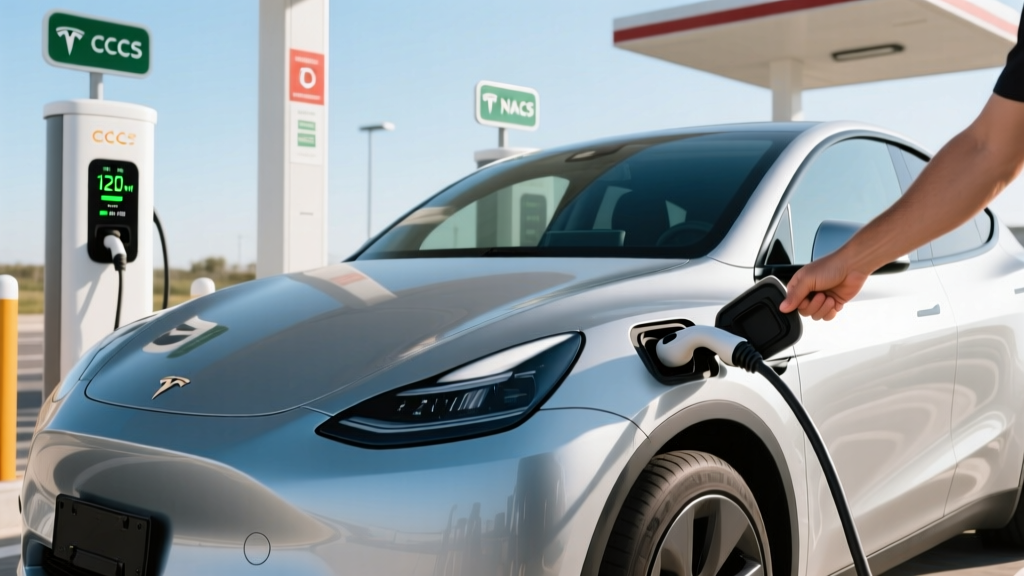
- Charleston, SC (Mile 0–20): Multiple Electrify America and Tesla Supercharger stations with 150–350 kW CCS and NACS connectors. The Tanger Outlets EA station offers eight stalls at up to 350 kW.
- Columbia, SC (Mile ~110): Electrify America at the Harbison shopping area (350 kW capable), plus Tesla Superchargers at Columbiana Centre. Several ChargePoint and EVgo locations fill gaps.
- Spartanburg/Greenville, SC (Mile ~170–200): Growing cluster of EA, Tesla, and independent operators. The Greenville Tesla Supercharger (V3, 250 kW) added NACS-native stalls in 2025.
- Asheville, NC (Mile ~240): Electrify America at the Asheville Outlets (350 kW), multiple Tesla Superchargers, and ChargePoint destinations downtown. Mountain elevation gains westbound reduce range — plan accordingly.
- Johnson City/Kingsport, TN (Mile ~300–320): More limited options. A 150 kW EA station and a Tesla Supercharger provide coverage, but spacing is wider. Pre-charge before this stretch.
For real-time station status, use PlugShare or the native navigation in your vehicle. Network uptime varies — Electrify America and Tesla lead in reliability, while smaller operators may have more frequent out-of-service stalls.
Home Level 2 Charger Installation: Requirements and Costs
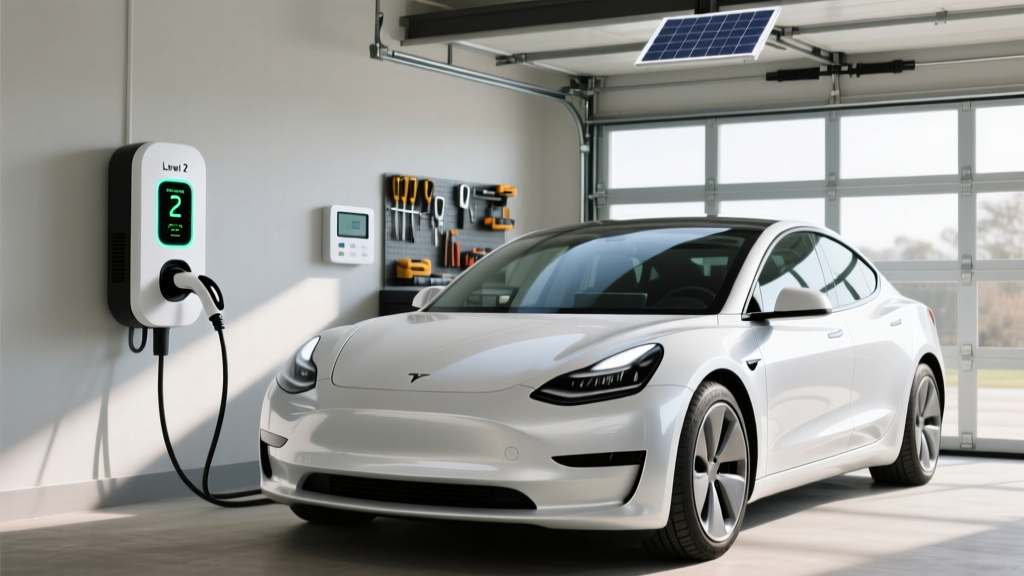
For I-26 corridor residents, a home Level 2 charger transforms EV ownership. You wake up to a full battery every morning, and your cost per mile drops to a fraction of gasoline. But installation is not as simple as plugging in an appliance.
Electrical Requirements
A typical Level 2 home charger requires a dedicated 240V circuit, most commonly at 40 amps (delivering up to 9.6 kW) or 48 amps (up to 11.5 kW). Hardwired installations can support up to 80 amps (19.2 kW) on newer chargers, though most homes and vehicles do not need this.
Your home's electrical panel must have sufficient spare capacity. A 200-amp panel with moderate existing loads can usually accommodate a 40–50 amp EV circuit. Older homes with 100-amp service or panels already near capacity may require a panel upgrade to 200 amps — a significant added cost.
Installation Cost Breakdown
| Component | Simple Install (Panel Nearby) | Complex Install (Long Run / Panel Upgrade) |
|---|---|---|
| Level 2 Charger (Equipment) | $350–$700 | $350–$700 |
| Electrician Labor | $300–$800 | $1,000–$2,500 |
| Electrical Permit | $50–$150 | $50–$200 |
| Panel Upgrade (if needed) | $0 | $1,500–$3,500 |
| Conduit, Wiring, Misc. | $100–$300 | $300–$800 |
| Total Estimated Range | $800–$1,950 | $3,200–$7,700 |
The wide range reflects real variability. A garage with the panel on an adjacent wall might cost under $1,000 total. A detached garage 80 feet from the panel, requiring trenching and a sub-panel, can push past $5,000. Always get at least two quotes from licensed electricians, and verify they have EV charger installation experience.
Safety and Code Considerations
The National Electrical Code (NEC) requires a dedicated circuit for EV charging — you cannot share it with other appliances. Outdoor installations require a charger rated for outdoor use (NEMA 4 or NEMA 4X enclosure) and, in many jurisdictions, a GFCI (Ground Fault Circuit Interrupter) breaker. Your electrician should pull a permit and schedule an inspection; unpermitted work can void your homeowner's insurance coverage in the event of an electrical fire.
Connector Compatibility: NACS, CCS, and CHAdeMO in 2026
The connector landscape has shifted dramatically. As of 2026, nearly all new EVs sold in North America use the NACS (North American Charging Standard) connector, originally developed by Tesla and now adopted industry-wide. Here is what you need to know by brand:
| Brand | Native Connector | Adapter Needed for Non-Native Stations? |
|---|---|---|
| Tesla (all models) | NACS | CCS adapter included or available (~$250) for non-Tesla DCFC |
| Ford (Mustang Mach-E, F-150 Lightning) | NACS (2025+) | CCS adapter needed for older CCS-only stations |
| GM (Equinox EV, Blazer EV, Silverado EV, Cadillac Lyriq) | NACS (2025+) | Same as Ford — CCS adapter for legacy stations |
| Hyundai/Kia (Ioniq 5/6, EV6, EV9) | NACS (2025+) | CCS adapter for legacy stations |
| Rivian (R1S, R1T) | NACS | CCS adapter available |
| Volkswagen (ID.4, ID.7) | NACS (2025+) | CCS adapter for legacy stations |
| BMW (iX, i4, i5) | CCS1 (transitioning to NACS) | NACS adapter for Tesla Superchargers |
| Nissan (Leaf, Ariya) | CHAdeMO (Leaf) / NACS (Ariya 2025+) | Leaf owners: limited CHAdeMO network; adapters scarce |
If you drive a 2024 or earlier CCS-equipped vehicle, you will need a CCS-to-NACS adapter (typically $200–$300) to access Tesla Superchargers, which now accept non-Tesla vehicles at many locations. Check Tesla's NACS compatibility page for the latest supported vehicles.
Cost to Charge: Home vs. Public vs. Gasoline
One of the strongest arguments for EV ownership along the I-26 corridor is cost. Electricity prices in South Carolina, North Carolina, and Tennessee are below the national average, making home charging especially economical.
| Scenario | Rate | Cost per Mile (at 3 mi/kWh efficiency) |
|---|---|---|
| Home Level 2 — Off-Peak (SC, ~$0.10/kWh) | $0.10/kWh | $0.033/mile |
| Home Level 2 — Standard Rate (NC, ~$0.13/kWh) | $0.13/kWh | $0.043/mile |
| Public Level 2 (ChargePoint, typical) | $0.20–$0.35/kWh | $0.067–$0.117/mile |
| DC Fast Charge (Electrify America, ~$0.48/kWh) | $0.48/kWh | $0.16/mile |
| DC Fast Charge (Tesla Supercharger, ~$0.35/kWh) | $0.35/kWh | $0.117/mile |
| Gasoline Vehicle (28 MPG combined, $3.10/gal) | $3.10/gallon | $0.111/mile |
At home on off-peak rates, you are paying roughly one-third the cost of gasoline per mile. Even DC fast charging on the road is competitive with gas at current fuel prices, though it is the most expensive EV charging option. For road trips along I-26, a mix of home charging and strategic DC fast stops keeps your per-mile cost well below a comparable gasoline vehicle.
For a 75 kWh battery charged from 10–80% (52.5 kWh delivered):
- Home off-peak ($0.10/kWh): ~$5.25 per session
- Public DCFC ($0.48/kWh): ~$25.20 per session
- Tesla Supercharger ($0.35/kWh): ~$18.38 per session
Recommended Home Level 2 Chargers for 2026
Not all Level 2 chargers are equal. Here are four proven units covering different budgets and needs, all available with NACS connectors for 2025+ vehicles:
Tesla Wall Connector (Gen 4)
- Power Output: Up to 11.5 kW (48A) on a 60A circuit
- Connector: NACS native
- Cable Length: 24 feet
- Smart Features: Wi-Fi connectivity, OTA firmware updates, power sharing (link multiple units on one circuit), scheduled charging via Tesla app
- Price: ~$475
- Best For: Tesla owners and NACS-native vehicle owners who want a clean, reliable, no-nonsense charger
ChargePoint Home Flex (2nd Gen)
- Power Output: Up to 12 kW (50A) configurable from 16A–50A
- Connector: NACS or J1772 (select at purchase)
- Cable Length: 23 feet
- Smart Features: Wi-Fi, Alexa integration, detailed energy tracking, flexible amperage to match your circuit
- Price: ~$599
- Best For: Multi-EV households needing adjustable amperage and detailed app data
Emporia Level 2 EV Charger
- Power Output: Up to 11.5 kW (48A)
- Connector: NACS or J1772
- Cable Length: 24 feet
- Smart Features: Wi-Fi, solar integration (pair with Emporia Vue energy monitor), time-of-use scheduling, load management
- Price: ~$399
- Best For: Budget-conscious buyers and solar-panel owners who want energy-aware charging
Grizzl-E Smart (United Chargers)
- Power Output: Up to 10 kW (40A)
- Connector: NACS or J1772
- Cable Length: 24 feet
- Smart Features: Wi-Fi, OCPP compatibility, adjustable amperage, rugged outdoor-rated enclosure (NEMA 4X)
- Price: ~$449
- Best For: Outdoor installations in the Southeast's humid climate — built like a tank
Charging Time Examples: What to Expect for Common Battery Sizes
Charge times depend on battery capacity, the vehicle's onboard charger limit (for Level 2), and the DC fast-charge curve. Here are real-world benchmarks for popular 2026 EVs:
- Tesla Model Y (75 kWh battery, NACS): Level 2 at 11.5 kW — 0–100% in ~7 hours. DC fast at 250 kW peak — 10–80% in ~22 minutes.
- Hyundai Ioniq 5 (77.4 kWh, NACS): Level 2 at 10.9 kW — 0–100% in ~7.5 hours. DC fast at 240 kW peak (800V architecture) — 10–80% in ~18 minutes.
- Ford Mustang Mach-E Extended Range (91 kWh usable, NACS): Level 2 at 10.5 kW — 0–100% in ~9 hours. DC fast at 150 kW peak — 10–80% in ~33 minutes.
- Chevrolet Equinox EV (85 kWh, NACS): Level 2 at 11.5 kW — 0–100% in ~8 hours. DC fast at 190 kW peak — 10–80% in ~28 minutes.
These times assume preconditioned batteries (the vehicle has warmed or cooled the battery to optimal charging temperature before arrival). In cold weather — relevant for the mountain stretches of I-26 near Asheville in winter — add 10–20% to DC fast-charge times if the battery is not preconditioned.
Frequently Asked Questions
How much does it cost to install a home EV charger?
For a straightforward installation with a nearby 200-amp panel, expect $800–$1,950 including equipment, electrician labor, and permit. If your home needs a panel upgrade or a long wiring run, costs can reach $3,200–$7,700. Get multiple quotes and confirm your electrician is experienced with EV charger circuits.
How fast will each charging level add range?
Level 1 (120V) adds 3–5 miles per hour. Level 2 (240V) adds 12–75 miles per hour depending on amperage and your vehicle's onboard charger. DC fast charging adds 150–1,200+ miles per hour at peak rates, but tapers above 80% SoC. For daily driving, Level 2 at home covers virtually all needs overnight.
Which connector and charger is compatible with my EV?
If you bought a 2025 or newer EV from nearly any major brand, it likely has a NACS connector natively. Older CCS vehicles can use adapters to access Tesla Superchargers. Nissan Leaf owners are on the CHAdeMO standard, which has limited and declining DC fast-charger availability. Check your owner's manual or the EPA's fueleconomy.gov vehicle listings for your specific model's connector type.
How much does charging cost per mile vs. gas?
Home charging at Southeast electricity rates ($0.10–$0.13/kWh) costs roughly $0.03–$0.04 per mile — about one-third the cost of gasoline at $3.10/gallon in a 28 MPG vehicle ($0.11/mile). Even public DC fast charging at $0.35–$0.48/kWh is competitive with gasoline per mile.
What electrical upgrades might I need?
The most common upgrade is a panel increase from 100 amps to 200 amps ($1,500–$3,500), required if your existing panel lacks spare capacity for a dedicated 40–50 amp EV circuit. Some homes also need a new conduit run from the panel to the garage or carport, particularly for detached structures. A licensed electrician can assess your panel's load calculation during a site visit.
Is there a tax credit for home charger installation?
The federal Alternative Fuel Vehicle Refueling Property Credit (IRC §30C) was reinstated under the Inflation Reduction Act, offering up to $1,000 (30% of cost) for home charger equipment and installation through 2032, but only for installations in qualifying census tracts. Check the IRS §30C page for eligibility details and consult a tax professional before claiming.