If you have ever sat at a public charging stall watching your battery percentage crawl upward while the car next to you rockets from 10% to 80% in 18 minutes, you know the difference between a fast charger and a furious owner. The EV charging landscape in 2026 is faster and more accessible than ever — but only if you understand the numbers behind the plug. This guide cuts through marketing hype to give you the exact kW rates, charging times, installation costs, and equipment specs you need to charge efficiently at home and on the road.
The kW vs. kWh Distinction Every EV Owner Must Know
Before we talk speed, let's eliminate the single most common source of EV confusion. kW (kilowatts) measures power — the rate at which electricity flows into your car, like water pressure from a hose. kWh (kilowatt-hours) measures energy — the total amount stored in your battery, like gallons in a tank. A 75 kWh battery charged at 11 kW (Level 2) takes roughly 7 hours from empty. That same battery at a 150 kW DC fast charger can go from 10% to 80% in about 25 minutes. Confusing these two units leads to wildly wrong expectations, so keep this distinction front of mind throughout this guide.
Charging Levels Explained: How Fast Will Each Level Add Range?
EV charging falls into three tiers. Each delivers dramatically different speeds, and understanding these tiers is the foundation for every decision you will make about equipment and daily routine.
| Level | Voltage / Amperage | Power (kW) | Miles of Range Added Per Hour | Typical Use Case |
|---|---|---|---|---|
| Level 1 | 120V / 12A | 1.4 kW | 3–5 mi/hr | Overnight top-up, PHEVs, emergency |
| Level 2 | 240V / 32–48A | 7.7–11.5 kW | 25–44 mi/hr | Daily home charging, workplace |
| DC Fast Charging | 400–800V DC | 50–350 kW | 150–1,200+ mi/hr (peak) | Road trips, rapid top-up |
A practical example: the 2026 Hyundai Ioniq 5 (84 kWh usable battery, NMC chemistry) gains roughly 30 miles of range per hour on a 48A Level 2 home charger. On a 350 kW DC fast charger, it peaks at 240 kW and adds approximately 180 miles in just 18 minutes (10–80% SoC). But remember that DC fast charging follows a charge curve — peak kW is only sustained between roughly 10–55% SoC. Above 80%, the rate tapers sharply to protect battery health, which is why most road-trip strategies target 10–80% charges rather than filling to 100%.
How Much Does It Cost to Install a Home EV Charger?
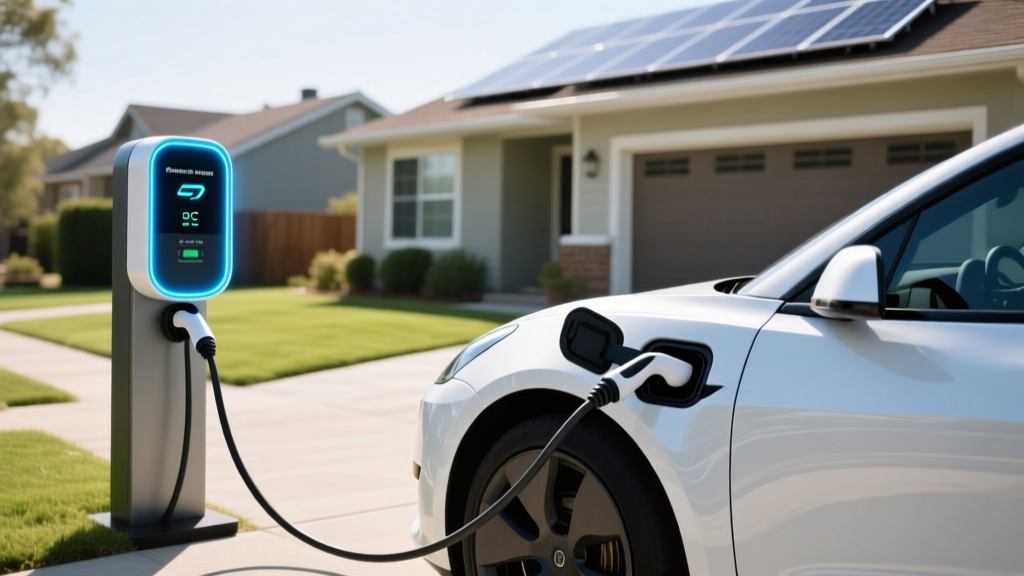
Home Level 2 charging is where 80–90% of all EV charging happens, and it is by far the cheapest way to fuel your car. But installation costs vary enormously depending on your home's electrical panel, the distance from panel to garage or driveway, and local permit requirements.
| Cost Component | Typical Range | Notes |
|---|---|---|
| Level 2 Charger Equipment | $350–$750 | 40A–48A smart charger, 240V, NACS or J1772 |
| Electrician Labor | $500–$2,000 | Depends on run length, conduit, wall type |
| Electrical Permit | $50–$250 | Varies by municipality |
| Panel Upgrade (if needed) | $1,500–$4,000 | 100A to 200A service upgrade for older homes |
| Total (no panel upgrade) | $900–$3,000 | Most homes with 200A service |
| Total (with panel upgrade) | $2,400–$7,000 | Older homes with 100A or less |
What Electrical Upgrades Might I Need?
A 48A Level 2 charger requires a dedicated 60A circuit on a 240V line (the National Electrical Code requires circuits to be rated at 125% of the continuous load: 48A × 1.25 = 60A). If your home has a 200A electrical panel with spare capacity, your electrician will likely run a new 6/3 NM-B or THHN in conduit from the panel to your garage or exterior wall. If your panel is older, already near capacity, or only rated for 100A, you may need a service upgrade — this is the single biggest variable in installation cost.
Some homeowners opt for a 32A charger on a 40A circuit, which reduces the electrical demand and can avoid a panel upgrade entirely. You sacrifice about 10 miles of range per hour of charging, but for most daily driving (30–50 miles), a 32A charger fully replenishes overnight.
Safety and Code Considerations
Every Level 2 installation must meet NEC Article 625 requirements. Key points your electrician will address:
- Dedicated circuit: Your EV charger must have its own breaker — no shared circuits with dryers or HVAC.
- GFCI protection: Required for all outdoor receptacles and recommended for indoor garage installations per 2023 NEC updates.
- NEMA 14-50 vs. hardwired: A NEMA 14-50 outlet offers portability, but hardwired installations avoid the GFCI breaker requirement in some jurisdictions and eliminate the risk of a loose plug connection over time.
- Outdoor rating: If your charger is mounted outside, ensure the unit carries a NEMA 4 or IP65 weather-resistance rating.
Always have a licensed electrician perform the installation and pull the required permit. Unpermitted work can void homeowner insurance and create fire risk.
Connector Compatibility: Which Plug Fits Your EV?
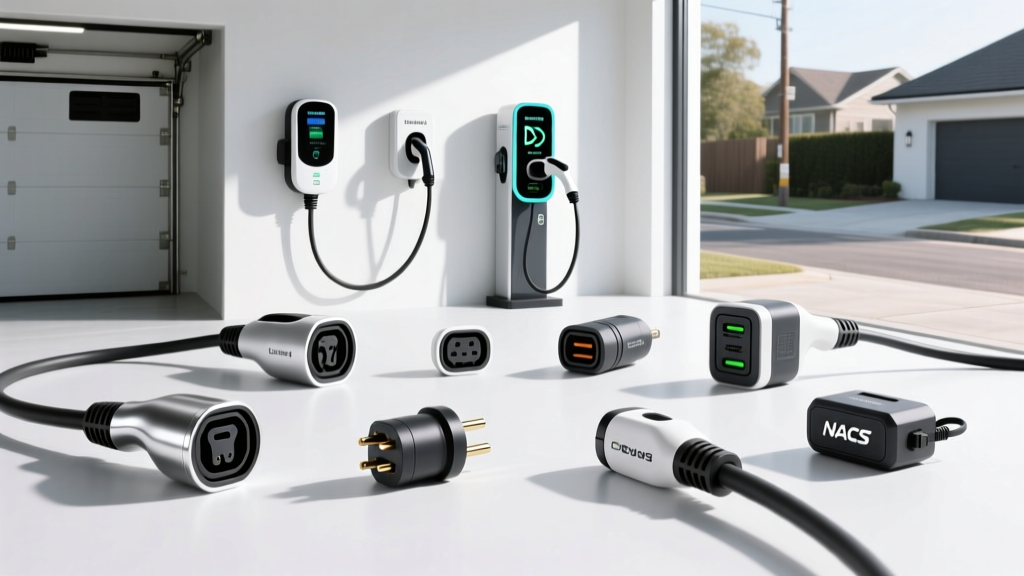
The connector landscape has shifted dramatically. As of 2026, the NACS (North American Charging Standard) — originally developed by Tesla — has been adopted by nearly every major automaker for new vehicles. Here is where things stand:
| Connector | Brands Using It (2026 Models) | Adapter Needed? |
|---|---|---|
| NACS (Tesla-style) | Tesla, Ford, GM, Rivian, Volvo, Polestar, Hyundai, Kia, BMW, Mercedes-Benz, Honda, Nissan (new models) | No — native on most 2025+ models |
| CCS1 (Combo) | Older VW ID.4, Audi e-tron (pre-2025), some Stellantis models | CCS-to-NACS adapter for Tesla Superchargers ($150–$250) |
| CHAdeMO | Nissan Leaf (legacy), Mitsubishi Outlander PHEV | Limited DC fast network; adapters scarce |
If you own a 2024 or earlier EV with a CCS1 port, you will likely need a CCS-to-NACS adapter to access Tesla's Supercharger network, which remains the most reliable DC fast charging infrastructure in North America with over 25,000 stalls. Ford, GM, and Rivian owners received complimentary or discounted adapters through their manufacturers. Check your automaker's owner portal for eligibility.
For home Level 2 charging, most chargers ship with a J1772 connector (the legacy standard). If your EV has a NACS port, you will need either a J1772-to-NACS adapter (typically included with the car) or a charger that natively ships with a NACS plug — several 2026 models now offer this option.
How Much Does Charging Cost Per Mile vs. Gas?
This is where EV ownership economics become compelling — or frustrating, depending on how and where you charge. Here are real 2026 cost scenarios based on the national average electricity rate of $0.17/kWh and a vehicle efficiency of 3.0 miles per kWh (typical for a mid-size crossover like the Tesla Model Y or Hyundai Ioniq 5):
| Charging Scenario | Cost per kWh | Cost per Mile | Annual Cost (12,000 mi) |
|---|---|---|---|
| Home, off-peak (utility time-of-use) | $0.09–$0.12 | $0.03–$0.04 | $360–$480 |
| Home, standard rate | $0.17 | $0.057 | $680 |
| Public Level 2 (ChargePoint, EVgo L2) | $0.25–$0.39 | $0.08–$0.13 | $960–$1,560 |
| DC Fast Charging (Electrify America, Tesla) | $0.32–$0.56 | $0.11–$0.19 | $1,320–$2,280 |
| Gas equivalent (28 MPG combined, $3.40/gal) | — | $0.12 | $1,440 |
The takeaway: home charging on an off-peak rate plan is roughly one-third the cost of fueling a comparable gas car. But if you rely exclusively on DC fast charging at public stations, your per-mile cost can actually exceed gas. This is why home Level 2 installation is the single highest-ROI investment in EV ownership. According to fueleconomy.gov, the average EV driver who charges at home saves $800–$1,100 annually compared to a 28 MPG gas vehicle.
Charging Time Examples: 10–80% for Common Battery Sizes
Here is what to expect in real-world conditions for popular 2026 EV models. All times assume optimal battery temperature (preconditioned) and a charger capable of delivering the vehicle's peak rate:
| Vehicle | Battery (kWh usable) | Peak DC Rate (kW) | 10–80% Time | Level 2 at 11.5 kW (0–100%) |
|---|---|---|---|---|
| Tesla Model Y Long Range | 75 kWh | 250 kW | ~22 min | ~7.5 hrs |
| Hyundai Ioniq 5 (Long Range) | 84 kWh | 240 kW | ~18 min | ~8.5 hrs |
| Ford F-150 Lightning (Extended) | 131 kWh | 150 kW | ~42 min | ~12.5 hrs |
| Chevrolet Equinox EV | 85 kWh | 150 kW | ~30 min | ~8.5 hrs |
| BMW i4 eDrive40 | 81 kWh | 200 kW | ~26 min | ~8 hrs |
Note that 800V-architecture vehicles (Hyundai Ioniq 5, Kia EV6, Porsche Taycan, Lucid Air) sustain higher charge rates longer than 400V platforms, which is why the Ioniq 5's 18-minute 10–80% time beats vehicles with similar battery sizes on 400V systems.
Equipment Recommendations: Top Home Chargers for 2026
Here are four proven Level 2 chargers that represent the best value and performance across different needs. All are UL-listed and support the latest connectivity standards.
Tesla Wall Connector (Gen 4)
- Power: 11.5 kW (48A, 240V)
- Connector: NACS native
- Cable length: 24 ft
- Smart features: Wi-Fi, OTA updates, load sharing, Powerwall integration
- Price: ~$475
- Best for: NACS-equipped EVs, Tesla ecosystem homes
Emporia Vue Smart EV Charger
- Power: 11.5 kW (48A, 240V)
- Connector: J1772 (NACS adapter available)
- Cable length: 24 ft
- Smart features: Solar integration, energy monitoring, time-of-use scheduling
- Price: ~$399
- Best for: Budget-conscious buyers, solar homes
ChargePoint Home Flex
- Power: Up to 12 kW (50A, 240V) — configurable down to 16A
- Connector: J1772 (NACS adapter sold separately)
- Cable length: 23 ft
- Smart features: App scheduling, Alexa integration, flexible amperage
- Price: ~$699
- Best for: Homes with limited panel capacity (dial down amps)
Grizzl-E Smart
- Power: 10 kW (40A, 240V)
- Connector: J1772 or NACS (select at purchase)
- Cable length: 24 ft
- Smart features: OCPP protocol, adjustable amperage, outdoor-rated (IP67)
- Price: ~$449
- Best for: Outdoor installations, extreme climates (-40°F rated)
All four chargers require a dedicated circuit sized to 125% of their maximum amperage. The ChargePoint Home Flex stands out for its configurable amperage — if your panel is tight on capacity, you can set it to 32A or 24A via DIP switches, potentially avoiding a costly panel upgrade while still adding 25+ miles of range per hour.
Federal and State Incentives for Home Charger Installation
The federal Alternative Fuel Vehicle Refueling Property Credit (IRS Form 8911) covers 30% of the cost of home EV charger equipment and installation, up to a maximum of $1,000. This credit applies to both the charger hardware and electrician labor, but eligibility depends on your census tract meeting certain low-income or non-urban criteria as defined by the IRS. Check the IRS website for the current qualifying tract map.
Many states and utilities stack additional rebates on top. For example, several utilities offer $250–$500 rebates for installing a smart Level 2 charger, and some provide free or discounted time-of-use electricity plans that dramatically lower your per-kWh cost. Consult your local utility's EV program page before purchasing equipment — some rebates require specific charger models or pre-approval.
Frequently Asked Questions
Can I charge my EV on a regular 120V outlet?
Yes, but slowly. Level 1 charging at 120V delivers about 1.4 kW, adding 3–5 miles of range per hour. This works for plug-in hybrids with small batteries (10–20 kWh) or for BEV owners who drive less than 30 miles daily and can leave the car plugged in for 10+ hours overnight. For any BEV with a 60+ kWh battery, Level 1 is impractical as a primary charging method — a full charge would take 50+ hours.
Do I need a Tesla Wall Connector if I don't own a Tesla?
Not necessarily, but it is now a viable option. Since most 2025+ EVs from Ford, GM, Hyundai, Kia, Rivian, and others ship with NACS ports, the Tesla Wall Connector (Gen 4) is compatible with nearly every new EV. It offers excellent build quality, Wi-Fi connectivity, and competitive pricing at ~$475. If your EV still has a CCS or J1772 port, you will need an adapter, and a native J1772 charger like the ChargePoint Home Flex may be more convenient.
Why does my DC fast charging slow down above 80%?
Lithium-ion batteries experience increased internal resistance at higher states of charge. To prevent lithium plating and thermal damage, the battery management system (BMS) progressively reduces the charge rate above ~55% SoC, with a steep taper above 80%. This is why manufacturers quote 10–80% times rather than 0–100%. Charging from 80% to 100% on a DC fast charger can take as long as the 10–80% portion. For battery longevity, reserve 100% charges for when you genuinely need the full range.
Is it cheaper to charge at home or at public stations?
Home charging is almost always cheaper. At the national average residential rate of $0.17/kWh (or $0.09–$0.12 on off-peak plans), you will pay $0.03–$0.06 per mile. Public DC fast chargers from networks like Electrify America and EVgo charge $0.32–$0.56/kWh, putting your cost at $0.11–$0.19 per mile — sometimes more expensive than gasoline. Use public DC fast charging for road trips, not daily fueling.
Will charging my EV at home trip my breaker or overload my panel?
Not if installed correctly. A licensed electrician will perform a load calculation on your panel per NEC Article 220 to ensure the new circuit does not exceed your service capacity. If your 200A panel already has significant loads (electric range, dryer, HVAC), the electrician may recommend a lower-amperage charger or a panel upgrade. Smart chargers with load-management features (like the Tesla Wall Connector's load-sharing mode) can dynamically adjust draw to stay within panel limits.
How long do home EV chargers last?
Quality Level 2 chargers from reputable brands (Tesla, ChargePoint, Emporia, Grizzl-E) typically last 8–15 years. Most carry a 3-year warranty. The primary failure points are the cable (physical wear), the connector pins (arcing from repeated insertion under load), and internal relay contacts. Hardwired units tend to outlast plug-in units because they eliminate the NEMA receptacle as a potential failure point.
Sources: U.S. Department of Energy / fueleconomy.gov, IRS Alternative Fuel Vehicle Refueling Property Credit, NFPA National Electrical Code. All pricing and specifications reflect 2026 model-year data and are subject to change. Consult a licensed electrician and tax professional for advice specific to your home and financial situation.