If you've been searching for charger pictures to figure out which plug fits your EV, what a home wall connector looks like, or how to tell a DC fast charger from a Level 2 pedestal, you're not alone. The EV charging landscape in 2026 has consolidated around the North American Charging Standard (NACS), but CCS1 and CHAdeMO hardware is still everywhere — and the visual differences matter when you're pulling into an unfamiliar station at 8% state of charge.
This guide walks you through every major charger type, connector, and home setup you'll encounter, with exact power numbers, installation costs, and per-mile charging economics. No vague "fast charging" claims — just the kW, kWh, and dollars you need to make decisions.
Charging Levels Explained: Speeds, Power, and What You'll See
Before we identify specific hardware, let's anchor the three charging levels. The single most important distinction in EV literacy: kW (kilowatts) measures power — how fast energy flows, while kWh (kilowatt-hours) measures energy — the total amount stored in your battery. A 84 kWh battery charged at 11.5 kW takes roughly 7.3 hours from empty. Confusing these two is the most common mistake new EV owners make.
| Level | Voltage | Power (kW) | Miles of Range Added per Hour | Typical Use Case |
|---|---|---|---|---|
| Level 1 | 120V AC | 1.0–1.4 kW | 3–5 miles | Overnight trickle; emergency; PHEVs |
| Level 2 | 240V AC | 3.3–19.2 kW | 12–75 miles | Home daily charging; workplace; public destinations |
| DC Fast Charge | 400–900V DC | 50–400 kW | 150–1,200 miles (equivalent rate) | Road trips; highway corridors; rapid top-ups |
Real-world context: A Level 2 home charger at 11.5 kW (the most common hardwired setup on a 60A circuit) will add roughly 40–45 miles of range per hour for a midsize SUV like the Hyundai Ioniq 5 or Tesla Model Y. That means a typical 60 kWh daily driving consumption is replenished in about 1.5 hours — more than enough for overnight charging.
DC fast charging reality check: Peak kW numbers are not sustained. A vehicle rated for 250 kW peak charging will typically sustain that rate only between roughly 10–40% state of charge, then taper. Expect a 10–80% session on a 250 kW-capable vehicle to take 18–25 minutes, not the theoretical minimum. Above 80%, charging slows dramatically to protect battery health — this is the charge curve taper, and it's physics, not a flaw.
Connector Identification: NACS, CCS1, and CHAdeMO
By 2026, nearly every new EV sold in North America uses the NACS (North American Charging Standard) connector, originally developed by Tesla and opened as a standard in late 2022. The major automakers — Ford, GM, Rivian, Hyundai, Kia, BMW, and others — have all transitioned to NACS for their 2025–2026 model-year vehicles.
| Connector | Visual Description | Used By (2026 Models) | Legacy Vehicles Still Using | Adapter Availability |
|---|---|---|---|---|
| NACS (J3400) | Compact, slim 5-pin design; no locking tabs | Tesla (all), Ford, GM, Rivian, Hyundai/Kia (2025+), BMW, Mercedes, Volvo | — | NACS-to-CCS adapters widely available (~$150–$250) |
| CCS1 (Combo) | Larger, bulkier; J1772 top + 2 DC pins below; locking tabs | Few new 2026 models | 2024 and earlier VW ID.4, Ford Mustang Mach-E, Chevy Bolt, most pre-2025 EVs | CCS-to-NACS adapters from Tesla, Lectron, A2Z (~$150–$200) |
| CHAdeMO | Round, large connector; separate from J1772 AC inlet | Discontinued for new vehicles | Nissan Leaf (all years), Mitsubishi Outlander PHEV (older) | Limited; CHAdeMO stations declining |
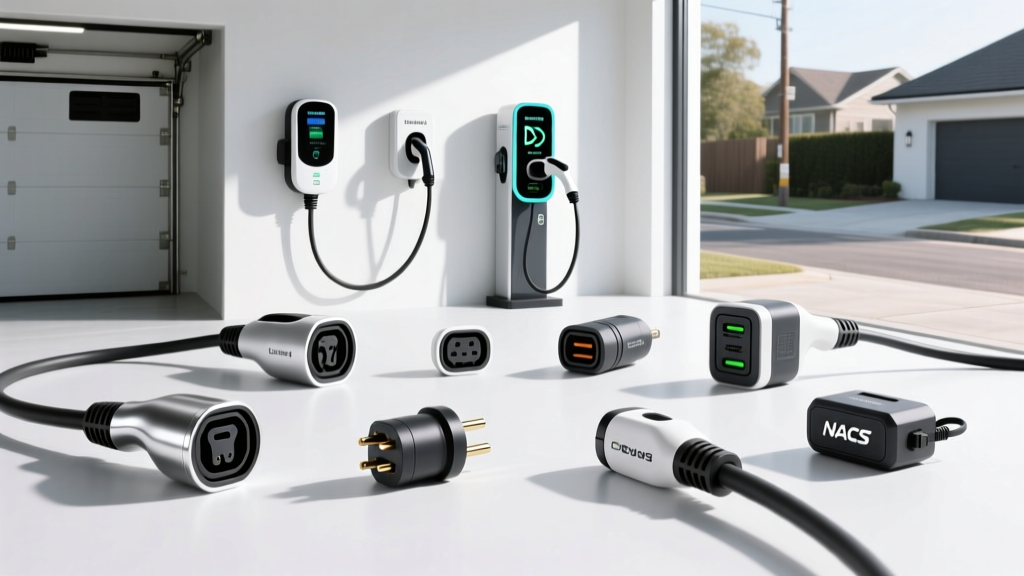
Key takeaway for charger pictures identification: If the plug is small and slim with a clean 5-pin layout, it's NACS. If it's noticeably bulkier with two large DC pins beneath the standard J1772 AC pins and has side locking tabs, it's CCS1. CHAdeMO is unmistakably round and large — you'll primarily see it at older Nissan Leaf charging stations.
If you own a CCS1-equipped vehicle from 2023–2024 (such as a VW ID.4 or early Ford Mach-E), you'll need a CCS-to-NACS adapter to access Tesla Supercharger stations, which now number over 25,000 across North America. Ford and Rivian began providing these adapters with vehicle purchases; aftermarket options from Lectron and A2Z EV are also available.
Home Charger Installation: Costs, Electrical Requirements, and Upgrades
Installing a Level 2 home charger is the single highest-impact upgrade for EV ownership. Here's what's involved electrically and financially.
Electrical Requirements
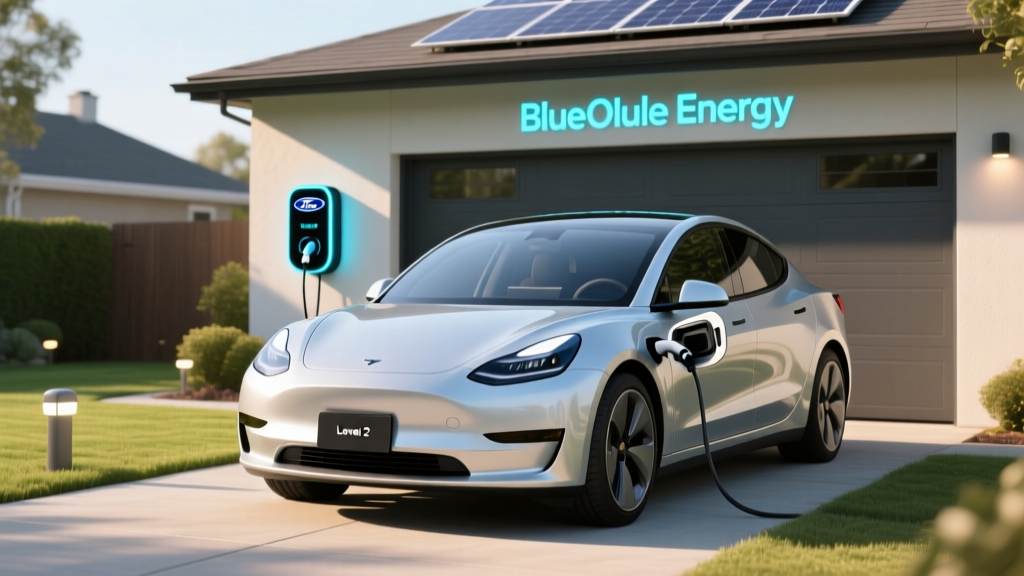
A typical Level 2 home charger runs on a 240V dedicated circuit. The most common configurations:
- 48A charger on a 60A circuit: The sweet spot for most homes. Requires 6 AWG copper wire. Delivers 11.5 kW — enough to fully charge a 75–84 kWh battery overnight.
- 40A charger on a 50A circuit: Slightly slower at 9.6 kW. Uses 8 AWG wire. Adequate for most daily driving needs.
- 32A charger on a 40A circuit: Delivers 7.7 kW. Common for plug-in (NEMA 14-50 outlet) setups rather than hardwired.
- 80A charger on a 100A circuit: Maximum home charging (19.2 kW). Requires 2 AWG wire and a robust electrical panel — typically only for high-mileage drivers or large-battery trucks like the Ford F-150 Lightning (extended range).
Hardwired vs. plug-in (NEMA 14-50): Hardwired installations are preferred for 48A+ chargers because the National Electrical Code (NEC) requires a GFCI breaker for receptacle outlets, which can cause nuisance tripping with high-draw EV chargers. Hardwired connections bypass this requirement and are generally more reliable. If you choose a NEMA 14-50 outlet for portability, ensure your electrician installs a high-quality industrial-grade receptacle (Hubbell or Bryant) — consumer-grade outlets have shown overheating issues under sustained EV loads.
Panel Upgrade: The Hidden Cost
This is where many homeowners get surprised. If your home has a 100A electrical panel (common in homes built before 1990), adding a 60A dedicated circuit for EV charging may exceed your panel's capacity. A licensed electrician will perform a NEC Article 220 load calculation to determine if your existing panel can handle the additional draw.
If a panel upgrade is required — typically from 100A to 200A — expect to add $1,500–$3,500 to your project cost. In some cases, a smart panel or load-management device (such as the Emporia VUE or Span smart panel) can avoid a full upgrade by dynamically sharing capacity between the charger and other home loads.
| Cost Component | Low-End Estimate | Typical Range | High-End (Complex Install) |
|---|---|---|---|
| Level 2 Charger Equipment (48A, hardwired, smart) | $350 | $450–$650 | $700 |
| Electrician Labor (run conduit, wire, mount) | $400 | $600–$1,200 | $2,000+ |
| Permit & Inspection | $50 | $100–$250 | $400 |
| Panel Upgrade (if needed: 100A → 200A) | $0 | $0 (not needed) | $1,500–$3,500 |
| Total Project Cost | $800 | $1,150–$2,100 | $4,600+ |
For the simplest scenario — a garage with the electrical panel on the same wall, short wire run, existing 200A panel — you can be charging at home for under $1,000 all-in. For a detached garage with a 60-foot conduit run and a panel upgrade, costs can exceed $4,000. Always get at least two quotes from licensed electricians, and confirm they have EV charger installation experience.
Federal incentive note: The §30D alternative fuel vehicle refueling property credit may cover up to 30% of home charger equipment and installation costs (capped at $1,000), but eligibility depends on census tract requirements and is subject to change. Check the IRS guidelines and consult a tax professional for your specific situation.
Equipment Recommendations: Top Home Chargers for 2026
Based on sustained real-world use, reliability data, and feature sets, here are the home Level 2 chargers worth considering:
ChargePoint Home Flex (NACS)
- Power Output: Up to 12 kW (50A circuit) or up to 11.5 kW (48A on 60A circuit)
- Connector: NACS (native); CCS adapter included in some bundles
- Cable Length: 18 ft or 24 ft options
- Smart Features: Wi-Fi connected, ChargePoint app scheduling, Alexa integration, energy tracking, load sharing between two units
- Price: ~$550–$650 (unit only)
- Best For: Flexible amperage settings (dial from 16A to 50A to match your circuit); excellent app ecosystem
Tesla Wall Connector (NACS)
- Power Output: Up to 11.5 kW (48A on 60A circuit)
- Connector: NACS native
- Cable Length: 24 ft
- Smart Features: Wi-Fi, over-the-air updates, power sharing with additional Wall Connectors, integrated Tesla app monitoring
- Price: ~$420–$475
- Best For: Tesla owners and any NACS-equipped vehicle; best price-to-performance ratio; cleanest physical design
Emporia Level 2 EV Charger
- Power Output: Up to 11.5 kW (48A on 60A circuit)
- Connector: NACS (2025+ models); CCS available for older stock
- Cable Length: 24 ft
- Smart Features: Deep energy monitoring via Emporia VUE integration, solar-aware scheduling, time-of-use optimization, load management
- Price: ~$350–$400
- Best For: Budget-conscious buyers who want smart energy management; solar-home integration
Grizzl-E Smart (United Chargers)
- Power Output: Up to 10 kW (40A on 50A circuit)
- Connector: NACS or CCS1 options
- Cable Length: 24 ft
- Smart Features: OCPP-compatible, adjustable amperage (16A–40A), built-in load balancing, rugged outdoor rating (NEMA 4X)
- Price: ~$450–$550
- Best For: Outdoor installations in harsh climates (Canadian-engineered); no-nonsense durability
Charging Cost Per Mile: Home vs. Public vs. Gas
One of the most compelling arguments for home charging is the per-mile cost advantage. Here's how the economics break down in 2026, using a midsize EV averaging 3.0 miles per kWh (roughly 112 MPGe — representative of vehicles like the Tesla Model Y or Hyundai Ioniq 5):
| Charging Scenario | Rate ($/kWh) | Cost per Mile | Annual Cost (12,000 mi) |
|---|---|---|---|
| Home — Off-Peak Utility Rate | $0.08–$0.12 | $0.027–$0.040 | $320–$480 |
| Home — Standard Residential Rate | $0.14–$0.18 | $0.047–$0.060 | $560–$720 |
| Public Level 2 (ChargePoint, EVgo L2) | $0.25–$0.40 | $0.083–$0.133 | $1,000–$1,600 |
| DC Fast Charging (Electrify America, Tesla Supercharger) | $0.32–$0.52 | $0.107–$0.173 | $1,280–$2,080 |
| Gas Vehicle (28 MPG combined, $3.40/gal) | — | $0.121 | $1,457 |
The bottom line: If you charge primarily at home on off-peak rates, your fuel cost is roughly one-quarter to one-third what a comparable gas vehicle costs. Even exclusive DC fast charging is competitive with gas on a per-mile basis in most states — though it erodes the cost advantage significantly. The real savings come from home charging.
For time-of-use (TOU) utility plans, scheduling your charger to run between 11 PM and 6 AM can drop your effective rate to $0.06–$0.09/kWh in many regions. Most smart chargers (ChargePoint, Tesla, Emporia) support scheduled charging natively through their apps.
Charging Time Examples: How Long Does a Session Actually Take?
Charging times depend on your battery's usable capacity (in kWh), the charger's sustained power output (in kW), and the charge curve. Here are realistic 10–80% session times for common 2026 EV battery sizes:
| Vehicle (Representative) | Usable Battery (kWh) | Peak DC Rate (kW) | 10–80% on 350 kW Charger | 10–80% on 150 kW Charger | 0–100% on 11.5 kW Home L2 |
|---|---|---|---|---|---|
| Compact EV (e.g., Chevy Equinox EV) | 65 kWh | 190 kW | ~22 min | ~30 min | ~5.7 hrs |
| Midsize SUV (e.g., Tesla Model Y) | 75 kWh | 250 kW | ~18 min | ~28 min | ~6.5 hrs |
| Midsize SUV (e.g., Hyundai Ioniq 5) | 77 kWh | 240 kW | ~18 min | ~29 min | ~6.7 hrs |
| Large SUV (e.g., Rivian R1S) | 106 kWh | 220 kW | ~32 min | ~42 min | ~9.2 hrs |
| Pickup (e.g., Ford F-150 Lightning Ext.) | 112 kWh | 170 kW | ~40 min | ~50 min | ~9.7 hrs |
Cold-weather caveat: Battery temperatures below 50°F (10°C) significantly slow DC fast charging unless the vehicle preconditioned the battery. Most modern EVs automatically precondition when you navigate to a charger in the vehicle's nav system — always use this feature in cold weather. Without preconditioning, a 20-minute 10–80% session can stretch to 40+ minutes in freezing temperatures.
According to fueleconomy.gov, real-world range also drops 15–30% in cold weather (below 30°F) due to cabin heating demands and increased battery resistance. If your EV is EPA-rated at 310 miles, plan for roughly 220–260 miles of usable range in winter highway driving.
Safety, Code, and Installation Best Practices
EV charging draws sustained high current for hours — unlike most household appliances that cycle on and off. This places unique demands on your electrical system. Here are the critical safety considerations:
- Dedicated circuit: Your EV charger must be on its own dedicated circuit — never shared with other appliances. A 48A charger requires a 60A breaker with no other loads on that circuit.
- GFCI protection: The 2020 NEC (and later) requires GFCI protection for receptacle-based EV charging (NEMA 14-50 outlets). Hardwired chargers are exempt from this requirement, which is another reason hardwired is preferred.
- Outdoor rating: If your charger is installed outside, ensure it carries a NEMA 4 or NEMA 4X rating (weatherproof and corrosion-resistant). Most quality chargers (Tesla Wall Connector, Grizzl-E, ChargePoint Home Flex) meet this standard.
- Wire gauge and conduit: Your electrician should size wire per NEC Table 310.16 for the circuit amperage and ambient temperature. For a 60A circuit, 6 AWG copper THHN in conduit is standard; aluminum SER cable (4 AWG) is a cost-effective alternative for longer runs.
- Permit and inspection: Virtually all jurisdictions require an electrical permit for a new 240V circuit. The inspection ensures proper wire sizing, breaker rating, grounding, and torque on connections. Never skip this — it protects your home and is required for insurance coverage in the event of a fire.
- Cable management: A 24-foot charging cable is heavy. Plan for a cable holster or retractor to keep the connector off the ground and protected from weather and vehicle tires.
Frequently Asked Questions
How much does it cost to install a home EV charger?
For a straightforward installation — a 48A hardwired Level 2 charger on a new 60A/240V circuit with the panel nearby and no upgrade needed — expect to pay $1,150–$2,100 total (equipment + electrician + permit). If your home needs a panel upgrade from 100A to 200A, add $1,500–$3,500. Complex installs with long conduit runs to a detached garage can push total costs to $3,000–$4,600+.
How fast will each charging level add range?
Level 1 (120V) adds 3–5 miles per hour. Level 2 (240V, 11.5 kW typical) adds roughly 40–45 miles per hour for a midsize EV. DC fast charging at 150+ kW can add 150–300+ miles in a 20–30 minute session, though the charge curve tapers significantly above 80% state of charge.
Which connector/charger is compatible with my EV?
If your EV is a 2025–2026 model year from a major manufacturer (Tesla, Ford, GM, Hyundai, Kia, Rivian, BMW, Volvo, Mercedes), it almost certainly uses NACS. If it's a 2024 or older model (VW ID.4, Chevy Bolt, older Mach-E, Hyundai Ioniq 5 pre-2025), it likely uses CCS1. The Nissan Leaf uses CHAdeMO. Check your owner's manual or look at the charge port: NACS is compact and slim; CCS1 is larger with two DC pins below the J1772 section; CHAdeMO is round and bulky.
How much does charging cost per mile vs gas?
Home charging on off-peak rates costs roughly $0.03–$0.04 per mile — about one-quarter the cost of a 28 MPG gas vehicle at $3.40/gallon ($0.12/mile). Public DC fast charging at $0.35–$0.50/kWh costs $0.11–$0.17 per mile, which is comparable to or slightly more than gas. The savings advantage of EVs is maximized with home charging.
What electrical upgrades might I need?
The most common upgrade is a panel upgrade from 100A to 200A service, needed if your existing panel lacks capacity for a new 60A circuit after the NEC load calculation. Some homes may also need service lateral upgrades (the wire from the utility to your meter) if the utility connection is undersized. Smart load-management devices can sometimes avoid a full panel upgrade by dynamically sharing power between the charger and other circuits.
Can I use a NACS charger with my older CCS1 EV?
Yes. CCS-to-NACS adapters are available from Tesla ($175), Lectron (~$150), and A2Z EV (~$160). These allow CCS1-equipped vehicles to charge at Tesla Supercharger stations. Verify your vehicle's firmware supports the adapter — most 2023–2024 CCS1 vehicles from Ford, GM, and Rivian received OTA updates enabling Supercharger compatibility.