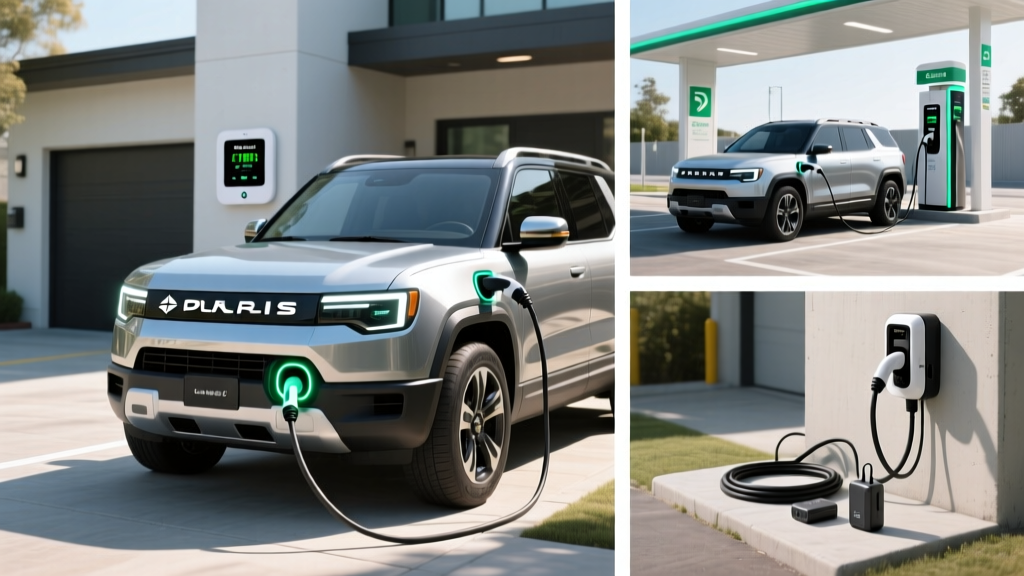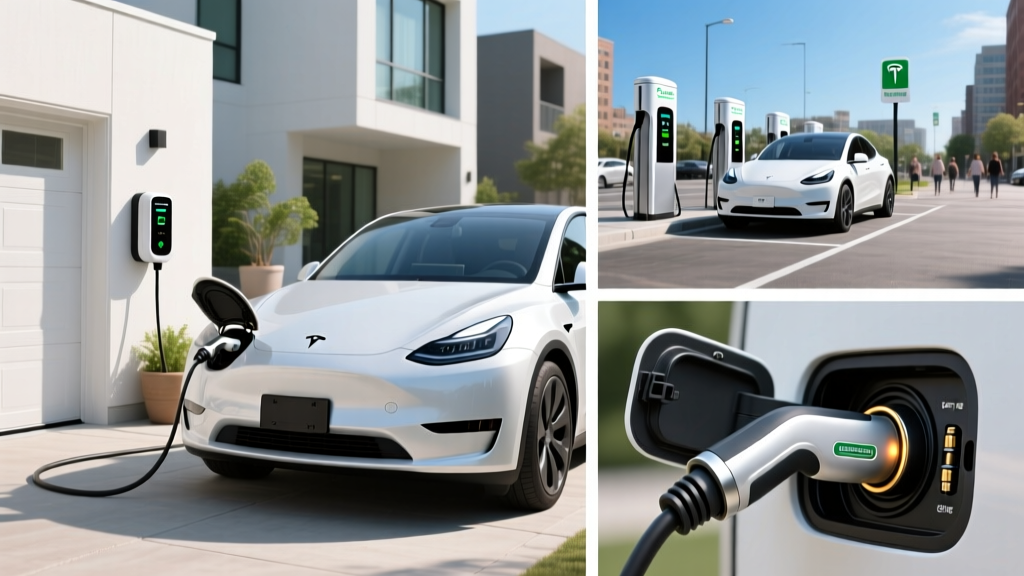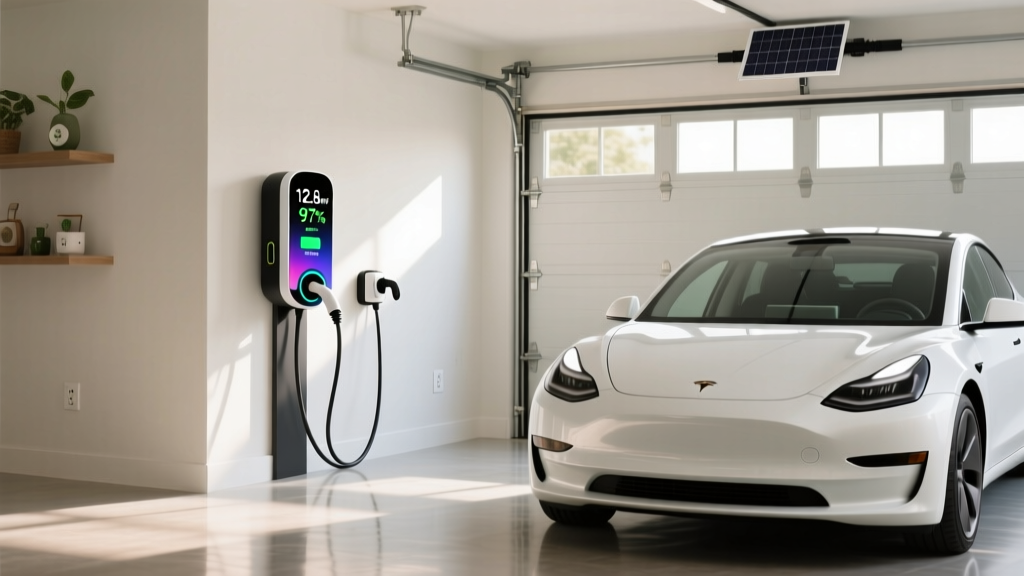
If you've just ordered an electric coupe — whether it's a Tesla Model 3 Performance, BMW i4 M50, Porsche Taycan, or Hyundai Ioniq 6 — the single biggest ownership advantage is fueling at home. But setting up a proper Level 2 charger for your charger coupe requires navigating electrical specs, connector compatibility, and installation costs that vary wildly by home. This guide gives you exact numbers: kW speeds, installation price ranges, equipment recommendations, and the real cost-per-mile compared to gasoline.
Charging Levels Explained: How Fast Each Adds Range
The most common mistake new EV owners make is confusing kW (kilowatts — the rate of power flow, like water pressure) with kWh (kilowatt-hours — the total energy stored, like gallons in a tank). Your coupe's battery is measured in kWh; your charger's speed is measured in kW. Higher kW means faster charging, but only up to the limit your car's onboard charger or battery management system allows.
| Level | Voltage | Power (kW) | Miles of Range Per Hour | Typical Use |
|---|---|---|---|---|
| Level 1 | 120V AC | 1.0–1.9 kW | 3–5 mi/hr | Overnight trickle; emergency top-ups |
| Level 2 (Home/Public AC) | 240V AC | 3.3–19.2 kW | 12–75 mi/hr | Daily home charging; workplace; destinations |
| DC Fast Charging (Level 3) | 400–800V DC | 50–350 kW | 150–1,000+ mi/hr (peak) | Road trips; rapid top-ups at highway stations |
For a typical charger coupe with a 75–100 kWh battery, Level 1 is essentially useless for daily needs — it would take 40+ hours to fill an 80 kWh pack. Level 2 at home is where 80–90% of all EV charging happens. DC fast charging is reserved for road trips and should be used strategically because frequent high-power DC sessions can accelerate battery degradation over time.
Home Level 2 Installation: Electrical Requirements and Real Costs
Installing a dedicated Level 2 home charger for your coupe is the single best investment in EV ownership. But costs vary enormously depending on your home's electrical panel, the distance from panel to charger location, and local permit requirements.
Electrical Requirements
A standard Level 2 home charger runs on a 240-volt circuit — the same voltage as your electric dryer or oven. The most common residential setup is a NEMA 14-50 outlet rated for 50 amps, which delivers up to 40 amps of continuous current (the National Electrical Code requires circuits to be rated 125% above continuous load). This supports chargers up to 9.6 kW (40A × 240V).
For faster charging, a 60-amp circuit supports 48A continuous (11.5 kW), and an 80-amp circuit supports 64A continuous (15.4 kW). However, most coupes — including the BMW i4 (11 kW onboard charger) and Tesla Model 3 (11.5 kW onboard charger) — can't accept more than 11.5 kW on AC anyway, so oversizing beyond a 60A circuit usually offers no benefit unless you plan to charge two vehicles simultaneously.
Installation Cost Breakdown
| Component | Simple Install (Near Panel) | Complex Install (Far Run / Upgrade) |
|---|---|---|
| Level 2 Charger Equipment | $350–$700 | $500–$800 |
| Electrician Labor (2–6 hrs @ $85–$150/hr) | $170–$400 | $500–$900 |
| Electrical Materials (wire, conduit, breaker) | $50–$150 | $200–$600 |
| Permit Fees | $50–$150 | $100–$300 |
| Panel Upgrade (if needed: 100A → 200A) | N/A | $1,500–$3,500 |
| Total Estimated Cost | $620–$1,400 | $2,800–$6,100 |
The biggest cost variable is whether your electrical panel has capacity. Homes built before 1990 often have 100-amp panels that are already near capacity. Adding a 40A or 50A EV circuit may require a panel upgrade to 200 amps, which is a major expense. A licensed electrician can perform a load calculation to determine if your panel can handle the additional draw. Per the National Electrical Code, you need a dedicated circuit — you cannot share with other large appliances.
Connector Compatibility: NACS, CCS1, and CHAdeMO
The connector landscape has shifted dramatically. As of 2025–2026, the North American Charging Standard (NACS), developed by Tesla, has been adopted by nearly every major automaker. But your specific charger coupe may still use CCS1 or require an adapter.
| Connector | Brands Using It (2026) | Home Charger Availability |
|---|---|---|
| NACS (Tesla plug) | Tesla, Ford, GM, Rivian, Volvo, Polestar, Hyundai/Kia (new models), Mercedes-Benz | Tesla Wall Connector, ChargePoint Home Flex (NACS), Emporia Level 2 |
| CCS1 (Combo) | BMW, Volkswagen, Porsche, Audi, some Hyundai/Kia carryover models, Stellantis | ChargePoint Home Flex, Emporia Level 2, EnelX JuiceBox |
| CHAdeMO | Nissan Leaf (legacy), Mitsubishi Outlander PHEV | Essentially discontinued for home equipment |
If you own a BMW i4, Porsche Taycan, or Volkswagen ID.7 — coupes that retained CCS1 through 2025–2026 — you'll need a CCS1-compatible home charger or a NACS-to-CCS adapter if you want to use Tesla Superchargers. Tesla sells an official adapter (~$250) and third-party options from Lectron and A2Z are available for ~$150–$200. For home charging, most Level 2 units now ship with either a NACS or CCS1 connector, and some (like the ChargePoint Home Flex) offer both.
How Much Does Charging Cost Per Mile vs. Gasoline?
The economics of charging a coupe depend heavily on where and when you charge. Home charging during off-peak hours is dramatically cheaper than public DC fast charging — and both are usually cheaper than gasoline.
| Scenario | Rate / Cost | Cost Per Mile (3.0 mi/kWh Coupe) |
|---|---|---|
| Home Off-Peak (Time-of-Use rate) | $0.08–$0.14/kWh | $0.03–$0.05/mile |
| Home Standard Rate (national avg.) | $0.16/kWh | $0.05/mile |
| Public Level 2 (ChargePoint, EVgo) | $0.25–$0.49/kWh | $0.08–$0.16/mile |
| DC Fast Charging (Electrify America, Tesla) | $0.30–$0.55/kWh | $0.10–$0.18/mile |
| Gasoline Sports Coupe (25 MPG, $3.40/gal) | $3.40/gallon | $0.14/mile |
| Gasoline Sports Coupe (25 MPG, $4.00/gal) | $4.00/gallon | $0.16/mile |
At the national average electricity rate of roughly $0.16/kWh (per EIA data), a coupe achieving 3.0 miles per kWh (about 100 MPGe combined — typical for a performance sedan/coupe like the BMW i4 or Tesla Model 3) costs roughly $0.05 per mile at home. Compare that to a gasoline coupe getting 25 MPG at $3.40/gallon: $0.14 per mile. That's nearly a 65% savings on fuel, translating to roughly $1,080 saved annually at 12,000 miles per year.
However, if you rely exclusively on public DC fast charging at $0.48/kWh, your cost rises to $0.16/mile — essentially matching gasoline. The economics only work in your favor with consistent home or workplace charging.
Charging Time Examples for Common Coupe Battery Sizes
Here's what charging looks like in practice for three popular electric coupe battery sizes, from a 10% state of charge (SoC) to 80%:
| Battery (kWh Usable) | Example Coupe | Level 2 @ 11.5 kW | DC Fast (Peak kW) | DC 10–80% Time |
|---|---|---|---|---|
| 65 kWh | Tesla Model 3 RWD | ~5.0 hours | 170 kW | ~25 minutes |
| 81 kWh | BMW i4 eDrive40 | ~6.3 hours | 205 kW | ~31 minutes |
| 93 kWh | Porsche Taycan (Performance Battery Plus) | ~7.2 hours | 270 kW (800V) | ~22 minutes |
Best Home Chargers for Your Electric Coupe (2026 Picks)
We evaluated Level 2 home chargers based on power output, connector options, cable length, smart features, build quality, and price. Here are three that cover the most common coupe-ownership scenarios:
Tesla Wall Connector (NACS)
Power: Up to 11.5 kW (48A @ 240V)
Connector: NACS (native Tesla plug)
Cable: 24 feet
Smart Features: Wi-Fi, OTA updates, power-sharing for dual installs, access control
Price: ~$475
Best For: Tesla Model 3, Model S, and any NACS-equipped coupe (Ford Mustang Mach-E, new Hyundai/Kia models)
ChargePoint Home Flex
Power: Up to 12 kW (50A @ 240V) — configurable down to 16A
Connector: Available in NACS or CCS1 (J1772 adapter included)
Cable: 23 feet
Smart Features: Wi-Fi, app scheduling, Alexa integration, flexible amperage settings
Price: ~$699 (NACS) / ~$649 (CCS1/J1772)
Best For: BMW i4, Porsche Taycan, VW ID-series — any CCS1 coupe owner who wants a premium, flexible unit
Emporia Level 2 EV Charger
Power: Up to 11.5 kW (48A @ 240V)
Connector: NACS or J1772/CCS1 versions
Cable: 24 feet
Smart Features: Wi-Fi, energy monitoring (pairs with Emporia VUE home energy monitor), scheduling, solar integration
Price: ~$399
Best For: Budget-conscious coupe owners who want energy monitoring and solar-aware charging
Regardless of which unit you choose, ensure it's UL-listed (not just "tested to UL standards" — look for the actual UL mark) and rated for your installation environment. Outdoor-rated units carry a NEMA 4 or IP65 rating and can withstand rain, dust, and temperature extremes.
Safety, Code, and Permit Considerations
EV charger installation is electrical work that requires adherence to the National Electrical Code (NEC) and local building codes. Key requirements include:
- Dedicated circuit: Your Level 2 charger must have its own breaker — no sharing with outlets, lights, or appliances.
- GFCI protection: NEC 2020 and later requires GFCI (Ground Fault Circuit Interrupter) protection for all EV charging outlets. Hardwired chargers with built-in ground-fault protection may satisfy this; plug-in units via NEMA 14-50 outlets require a GFCI breaker (add ~$50–$100 to material costs).
- Outdoor rating: If your charger is installed outside (garage exterior, carport, driveway), the unit must carry a NEMA 4 or IP65+ rating. The electrical box and conduit must also be rated for wet locations.
- Permit requirement: Most jurisdictions require an electrical permit for a new 240V circuit. Permit fees typically range from $50–$300. Your electrician usually pulls the permit and schedules inspection. Skipping the permit can void home insurance coverage for electrical fires.
- Wire gauge: A 50A circuit requires 6 AWG copper wire (or 4 AWG aluminum); a 60A circuit requires 4 AWG copper. Longer wire runs may need upsizing to prevent voltage drop.
According to NFPA's NEC guidelines, improper EV charger installation is a fire risk. Always use a licensed electrician — DIY 240V work is dangerous and typically violates code for anything beyond plugging into an existing outlet.
Frequently Asked Questions
How much does it cost to install a home EV charger?
A straightforward Level 2 installation (panel has capacity, short wire run, no panel upgrade) typically costs $620–$1,400 total, including equipment, electrician labor, materials, and permit. If your home needs a 200A panel upgrade or has a long wire run through finished walls, expect $2,800–$6,100. Always get 2–3 quotes from licensed electricians.
How fast will each charging level add range to my coupe?
Level 1 (120V) adds roughly 3–5 miles per hour — essentially overnight trickle charging. Level 2 (240V, 40–48A) adds 25–40 miles per hour for most coupes, enough to fully replenish overnight. DC fast charging at 150–350 kW can add 100–200+ miles in 15–20 minutes, but only up to ~80% SoC before tapering slows the rate dramatically.
Which connector and charger is compatible with my EV coupe?
Check your vehicle's charge port. Tesla and most 2025+ Ford, GM, Rivian, Hyundai, and Kia models use NACS. BMW, Porsche, Volkswagen, and Audi coupes typically use CCS1. If your home charger doesn't match your car's connector, you'll need an adapter — but adapters add a point of failure and may slightly reduce charging speed. Match your charger to your car's native connector when possible.
How much does charging cost per mile compared to gas?
At the national average home electricity rate of ~$0.16/kWh, a coupe averaging 3.0 mi/kWh costs about $0.05/mile. A comparable gasoline coupe at 25 MPG and $3.40/gallon costs $0.14/mile. That's roughly a 65% fuel savings — about $1,080/year at 12,000 miles. However, exclusive reliance on public DC fast charging ($0.30–$0.55/kWh) erases most or all of that advantage.
What electrical upgrades might I need for a home charger?
The most common upgrade is a panel capacity increase from 100A to 200A service, needed in older homes where the existing panel is near capacity. This costs $1,500–$3,500. You may also need a new breaker slot (if your panel is full), upgraded service wiring from the utility, or a smart load-management device to avoid the panel upgrade entirely. A licensed electrician's load calculation is the definitive answer — don't guess.