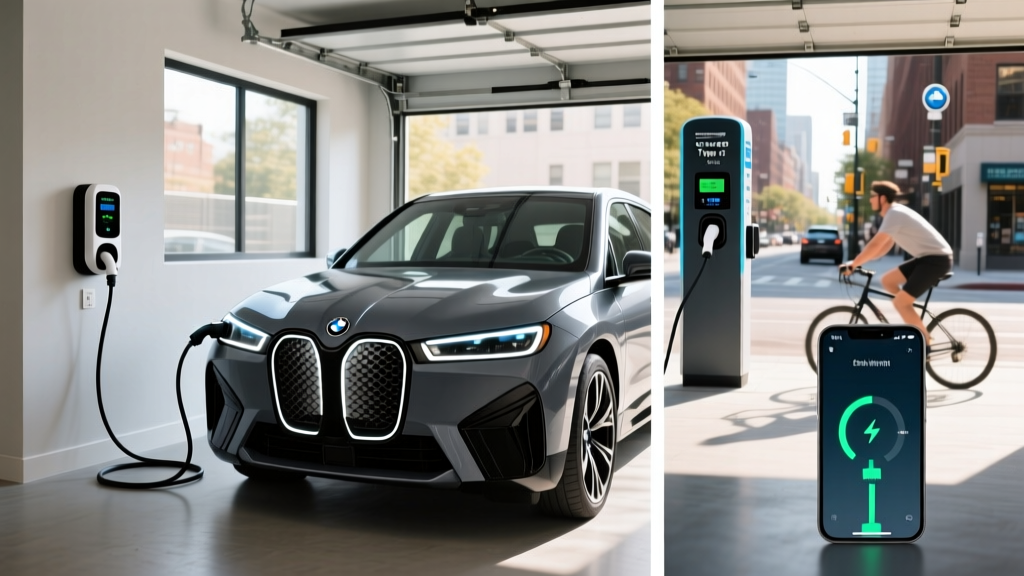
If you've just ordered an EV—or you're tired of relying on public stations—a ChargePoint Level 2 charger is one of the most popular home-charging upgrades on the market. But before you click "buy," you need clarity on three things: what your home's electrical panel can actually support, how fast a Level 2 unit will replenish your specific battery, and what the total installed cost will be once you factor in the electrician, permit, and potential panel upgrade.
This guide breaks down ChargePoint's current home lineup (the Home Flex and its successor models available in 2026), walks through the electrical math that determines your charge rate, and gives you the exact numbers you need to budget a safe, code-compliant installation.
Level 1 vs Level 2 vs DC Fast: What Each Adds Per Hour
The single most important distinction in EV charging is between kW (kilowatts — the rate of power delivery) and kWh (kilowatt-hours — the amount of energy stored in your battery). Think of kW as the diameter of the hose and kWh as the size of the bucket. A ChargePoint Level 2 charger delivers power measured in kW; your EV's battery capacity is measured in kWh.
Here's how the three charging levels compare in real-world terms:
| Level | Voltage | Typical kW Output | Miles of Range Added Per Hour | Best For |
|---|---|---|---|---|
| Level 1 | 120V (standard outlet) | 1.0–1.4 kW | 3–5 mi/hr | Overnight top-ups, PHEVs, low-mileage drivers |
| Level 2 (e.g., ChargePoint Home Flex) | 240V (dryer-style circuit) | 3.3–11.5 kW | 12–45 mi/hr | Daily home charging for most BEV owners |
| DC Fast Charging | 400V–800V DC | 50–350 kW | 150–300+ mi in 20–30 min | Road trips, quick top-ups away from home |
For a typical 75 kWh battery (like the one in a Tesla Model Y or Hyundai Ioniq 5), a ChargePoint Home Flex configured at 48 amps (11.5 kW) will add roughly 37–45 miles of range per hour of charging. That means a full 10–80% charge takes approximately 5–6 hours—perfect for overnight replenishment. By contrast, Level 1 on a standard 120V outlet would take well over 48 hours for the same 10–80% session, which is why most BEV owners consider Level 2 the practical minimum.
ChargePoint Home Flex: Specs, Power Output, and Smart Features
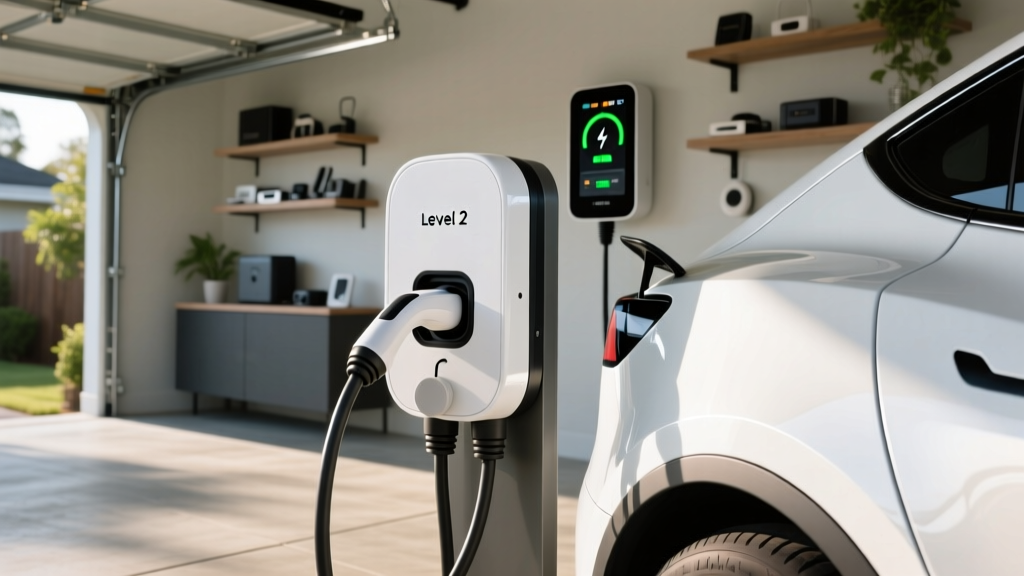
The ChargePoint Home Flex remains ChargePoint's flagship residential unit in 2026. It's a configurable Level 2 charger, meaning you (or your electrician) set the amperage at install time to match your circuit capacity. Here are the key specifications:
- Adjustable amperage: 16A, 24A, 32A, 40A, or 48A (configurable via internal DIP switch)
- Power output: 3.8 kW (16A) up to 11.5 kW (48A) on a 240V circuit
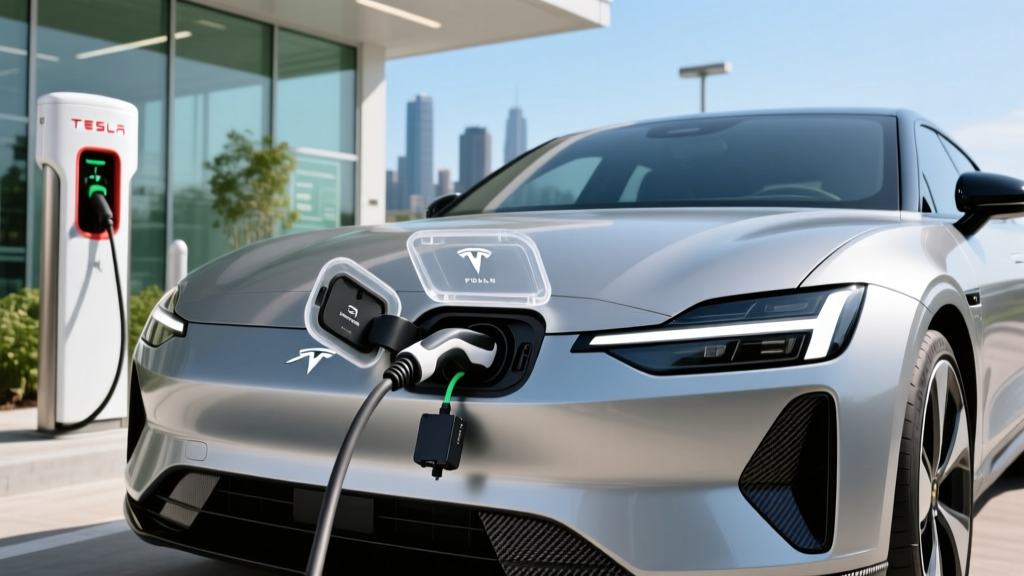
- Connector: J1772 (standard for all non-Tesla EVs); Tesla owners use the included J1772-to-NACS adapter or Tesla's own Mobile Connector
- Cable length: 23 feet (flexible, rated for indoor/outdoor use)
- Smart features: Wi-Fi connected, ChargePoint app scheduling, Alexa integration, energy-use tracking, off-peak rate optimization
- NEMA rating: NEMA 4 (suitable for outdoor mounting in rain, snow, and dust)
- Equipment price: Approximately $549–$649 (varies by retailer and promotions)
The Home Flex's amperage flexibility is its biggest selling point. If your panel can only spare a 30-amp breaker, you configure the unit at 24A (5.8 kW). If you have a 60-amp circuit available, you max it out at 48A (11.5 kW). This makes it viable for a wider range of homes than fixed-amperage competitors.
Electrical Requirements: What Your Panel Needs to Support a ChargePoint Charger
Before purchasing any Level 2 charger, you need to understand your home's electrical capacity. Here's the framework:
Circuit and Breaker Sizing
The National Electrical Code (NEC) requires that continuous loads (and EV charging qualifies) use no more than 80% of a circuit's rated capacity. This means:
- 48A charging (11.5 kW): Requires a 60-amp breaker and 6 AWG copper wire
- 40A charging (9.6 kW): Requires a 50-amp breaker and 8 AWG copper wire
- 32A charging (7.7 kW): Requires a 40-amp breaker and 8 AWG copper wire
- 24A charging (5.8 kW): Requires a 30-amp breaker and 10 AWG copper wire
- 16A charging (3.8 kW): Requires a 20-amp breaker and 12 AWG copper wire
Panel Capacity: Do You Need an Upgrade?
Most modern homes have a 200-amp main service panel. To determine if you have room for a new 60-amp EV circuit, an electrician will perform a load calculation per NEC Article 220. This accounts for existing loads (HVAC, electric range, dryer, water heater) and determines remaining capacity.
If your home has a 100-amp panel (common in pre-1980 construction) or you're already near capacity with existing appliances, a panel upgrade to 200 amps may be necessary. This is the single biggest variable in installation cost.
Hardwired vs. NEMA Outlet
The ChargePoint Home Flex supports both installation methods:
- Hardwired: Directly connected to a junction box. Preferred for 48A installs and outdoor mounts. No plug to maintain.
- NEMA 14-50 outlet: A 50-amp receptacle (the same type used for electric ranges). Allows you to unplug and take the charger when you move. Limits you to 40A (9.6 kW) charging due to NEC 80% rule on a 50A breaker.
If you choose a NEMA 14-50 outlet, ensure your electrician installs a commercial-grade receptacle (Hubbell, Bryant, or Cooper) rated for daily EV plugging. Consumer-grade outlets from big-box stores have shown overheating issues under sustained EV-charging loads.
How Much Does It Cost to Install a ChargePoint Level 2 Charger at Home?
Installation costs vary dramatically based on your home's electrical infrastructure, the distance from your panel to the charging location, and local labor rates. Here's a realistic breakdown:
| Component | Simple Install (panel near garage) | Complex Install (long run or panel upgrade) |
|---|---|---|
| ChargePoint Home Flex unit | $549–$649 | $549–$649 |
| Electrician labor (2–8 hours) | $400–$800 | $1,200–$3,000 |
| Electrical materials (wire, conduit, breaker) | $100–$300 | $300–$800 |
| Permit and inspection | $50–$200 | $100–$300 |
| Panel upgrade (if needed) | $0 | $1,500–$4,000 |
| Total installed cost | $1,100–$1,950 | $3,650–$8,750 |
Key cost drivers to ask your electrician about:
- Wire run distance: Every foot of 6 AWG copper wire adds material cost. A panel on the opposite side of the house from your garage can add $500–$1,500.
- Conduit requirements: Outdoor runs and unfinished basements typically require EMT or PVC conduit, adding labor and materials.
- Trenching: If your garage is detached, underground trenching for conduit can add $1,000–$3,000.
- Local utility rebates: Many utilities offer $250–$1,000 rebates for Level 2 charger installation, sometimes covering the entire electrical work cost. Check with your provider before scheduling.
Connector Compatibility: Will a ChargePoint Work With Your EV?
The ChargePoint Home Flex ships with a J1772 connector, which is the universal Level 2 standard for all EVs sold in North America—except Tesla. Here's how connector compatibility breaks down by brand:
| EV Brand / Model | Native Connector | Adapter Needed? |
|---|---|---|
| Tesla Model 3, Y, S, X (2025+) | NACS (native) | Yes — J1772-to-NACS adapter (included with vehicle or ~$95 from Tesla) |
| Ford F-150 Lightning, Mustang Mach-E (2025+) | NACS (native) | Yes — J1772-to-NACS adapter |
| Rivian R1T, R1S | NACS (native) | Yes — J1772-to-NACS adapter |
| Hyundai Ioniq 5, Ioniq 6, Kia EV6, EV9 | CCS1 (J1772 DC combo) | No — J1772 portion works natively for Level 2 |
| Chevrolet Equinox EV, Blazer EV, Silverado EV | NACS (native, 2025+) | Yes — J1772-to-NACS adapter |
| BMW i4, i5, iX, VW ID.4 | CCS1 | No — J1772 Level 2 works natively |
| Nissan Leaf (older models) | CHAdeMO (DC) + J1772 (Level 2) | No — J1772 works natively |
As of 2025–2026, most major automakers have transitioned to the NACS (North American Charging Standard) connector originally developed by Tesla. However, for Level 2 home charging, the physical difference is straightforward: NACS-equipped vehicles simply use a small J1772-to-NACS adapter. This adapter is typically included with the vehicle or available from the manufacturer. The charging speed is unaffected.
ChargePoint has also announced NACS-native versions of its Home Flex for 2026, which will eliminate the adapter requirement for Tesla, Ford, Rivian, and GM owners. If you exclusively drive a NACS-equipped vehicle, waiting for the NACS-native unit may be worthwhile.
Cost to Charge: Home vs. Public vs. Gas Per Mile
One of the strongest arguments for home Level 2 charging is the cost advantage over both public charging and gasoline. Here's how the math works out in 2026:
| Charging/Fuel Method | Rate | Cost Per Mile (at 3.5 mi/kWh or 28 MPG) |
|---|---|---|
| Home Level 2 (national avg. electricity, off-peak) | $0.10–$0.15/kWh | $0.03–$0.04/mile |
| Home Level 2 (national avg. electricity, standard rate) | $0.15–$0.20/kWh | $0.04–$0.06/mile |
| Public Level 2 (ChargePoint network, avg.) | $0.25–$0.49/kWh | $0.07–$0.14/mile |
| DC Fast Charging (Electrify America, EVgo, avg.) | $0.35–$0.65/kWh | $0.10–$0.19/mile |
| Gasoline (28 MPG combined, $3.40/gal) | $3.40/gallon | $0.12/mile |
| Gasoline (28 MPG combined, $4.00/gal) | $4.00/gallon | $0.14/mile |
For a driver covering 12,000 miles per year in an EV averaging 3.5 miles per kWh (a reasonable figure for vehicles like the Tesla Model Y or Hyundai Ioniq 5):
- Home charging at $0.13/kWh: ~$445/year in electricity
- Gas at $3.40/gal, 28 MPG: ~$1,457/year in fuel
- Annual savings from home charging: ~$1,012
At those rates, a $1,500 Level 2 installation pays for itself in roughly 18 months through fuel savings alone. If your utility offers time-of-use (TOU) rates and you schedule charging during off-peak hours (typically 10 PM–6 AM), the savings widen further.
Charging Time Examples: How Long Does a ChargePoint Level 2 Take?
Real-world charging times depend on your battery's usable capacity (kWh), your onboard charger's maximum acceptance rate, and the amperage your Home Flex is configured for. Here are examples for popular 2026 EVs:
- Tesla Model Y (75 kWh usable, 11.5 kW onboard charger): At 48A / 11.5 kW, a 10–80% charge (~52.5 kWh) takes approximately 4.5–5 hours.
- Hyundai Ioniq 5 (77.4 kWh usable, 10.9 kW onboard charger): At 48A, limited by the car's 10.9 kW onboard charger, 10–80% (~54 kWh) takes roughly 5 hours.
- Ford F-150 Lightning Extended Range (131 kWh usable, 19.2 kW onboard charger): At 48A / 11.5 kW (charger-limited), 10–80% (~92 kWh) takes approximately 8 hours—still feasible overnight.
- Chevrolet Equinox EV (85 kWh usable, 11.5 kW onboard charger): At 48A, 10–80% (~60 kWh) takes about 5.2 hours.
- BMW i4 eDrive40 (81.5 kWh usable, 11 kW onboard charger): At 48A, limited to 11 kW, 10–80% (~57 kWh) takes roughly 5.2 hours.
For context, most EV owners charge from 20–30% to 80% each night, which takes 3–4 hours on a 48A ChargePoint Home Flex. You rarely need to charge from near-empty to full at home.
Level 2 Charger Alternatives: How the ChargePoint Home Flex Compares
ChargePoint Home Flex
- Max output: 11.5 kW (48A)
- Connector: J1772 (NACS version announced)
- Cable: 23 ft
- Smart features: Wi-Fi, app scheduling, Alexa, energy tracking
- Price: ~$549–$649
- Best for: Flexibility across panel sizes; robust app ecosystem
Tesla Wall Connector
- Max output: 11.5 kW (48A)
- Connector: NACS native (J1772 adapter available)
- Cable: 24 ft
- Smart features: Wi-Fi, Tesla app, power-sharing between units
- Price: ~$475
- Best for: Tesla-exclusive households; lowest equipment cost
Emporia Vue Level 2
- Max output: 11.5 kW (48A)
- Connector: J1772
- Cable: 24 ft
- Smart features: Wi-Fi, app, energy monitoring, solar integration
- Price: ~$399
- Best for: Budget-conscious buyers; solar-panel households
The ChargePoint Home Flex's advantage is its amperage configurability and its mature app ecosystem, which integrates with utility TOU programs and provides detailed charging history. The Tesla Wall Connector is cheaper but less useful for non-Tesla households without an adapter. The Emporia Vue undercuts both on price but has a less polished app.
Safety, Code, and Best Practices for Your Installation
A Level 2 charger is a high-draw, continuous-load appliance. Cutting corners on installation creates fire risk and may void your homeowner's insurance. Here's what to insist on:
- Dedicated circuit: Your EV charger must have its own dedicated breaker. Never share a circuit with other appliances.
- GFCI protection: NEC 2020 and later require GFCI (Ground Fault Circuit Interrupter) protection for outdoor receptacles. Hardwired installations may not require a GFCI breaker (the unit itself provides ground-fault protection), but your local inspector's interpretation prevails.
- Permit and inspection: Every jurisdiction requires an electrical permit for a new 240V circuit. The inspection ensures your installation meets NEC and local code. Skipping this step risks insurance denial in the event of a fire.
- Outdoor rating: The ChargePoint Home Flex is NEMA 4 rated, meaning it handles rain, sleet, and dust. However, mounting it under an eave or in a carport extends its lifespan in harsh climates.
- Cable management: A 23-foot cable on a garage floor collects dirt, moisture, and tripping hazards. Install a cable holster or retractor ($25–$50) to keep the connector clean and accessible.
Frequently Asked Questions
Can I install a ChargePoint Home Flex myself?
If you choose the hardwired option, you need a licensed electrician—most jurisdictions require it by code, and DIY hardwired work will fail inspection. If you already have a NEMA 14-50 outlet installed by an electrician (for a dryer or range), you can plug in the Home Flex yourself using its NEMA 14-50 cord. However, we recommend professional installation regardless, to ensure proper grounding, torque specs, and breaker sizing.
Will a ChargePoint Level 2 charger work with a Tesla?
Yes. The Home Flex outputs via a J1772 connector, and Tesla vehicles accept J1772 Level 2 charging through a small adapter (typically included with the car or available from Tesla for approximately $95). Charging speed is identical to using a Tesla Wall Connector. In 2026, ChargePoint is also offering a NACS-native version that plugs directly into Tesla vehicles without an adapter.
How fast will a 40-amp vs. 48-amp ChargePoint charge my EV?
At 40 amps (9.6 kW), you'll add roughly 30–35 miles of range per hour. At 48 amps (11.5 kW), you'll add roughly 37–45 miles per hour. For an overnight session of 8 hours, the difference is approximately 240–280 miles vs. 296–360 miles of range. If your panel supports a 60-amp breaker, the 48A configuration is worth the marginal wire-cost increase.
Does the ChargePoint Home Flex qualify for a tax credit?
Yes, under the IRS §30C Alternative Fuel Vehicle Refueling Property Credit, you may claim 30% of the combined equipment and installation cost, up to a maximum credit of $1,000. This credit has eligibility requirements based on your census tract and is claimed on your federal tax return (Form 8911). It is not a point-of-sale discount. Consult a tax professional to confirm eligibility for your address.
What if my home only has a 100-amp electrical panel?
A 100-amp panel can often support a Level 2 charger at reduced amperage (16A or 24A) if your load calculation shows sufficient headroom. However, if you have electric heat, an electric range, and an electric dryer, you may need a panel upgrade to 200 amps to safely add a 40A or 48A EV circuit. A panel upgrade typically costs $1,500–$4,000. Some utilities offer rebates to offset this cost.
Can I use the ChargePoint app to schedule charging during off-peak hours?
Yes. The ChargePoint app allows you to set charging schedules, delay charging until a specific time (e.g., 11 PM when off-peak rates begin), and receive notifications when charging is complete. You can also set a target state of charge if your vehicle supports it. Scheduling is the single most effective way to reduce your per-mile charging cost.