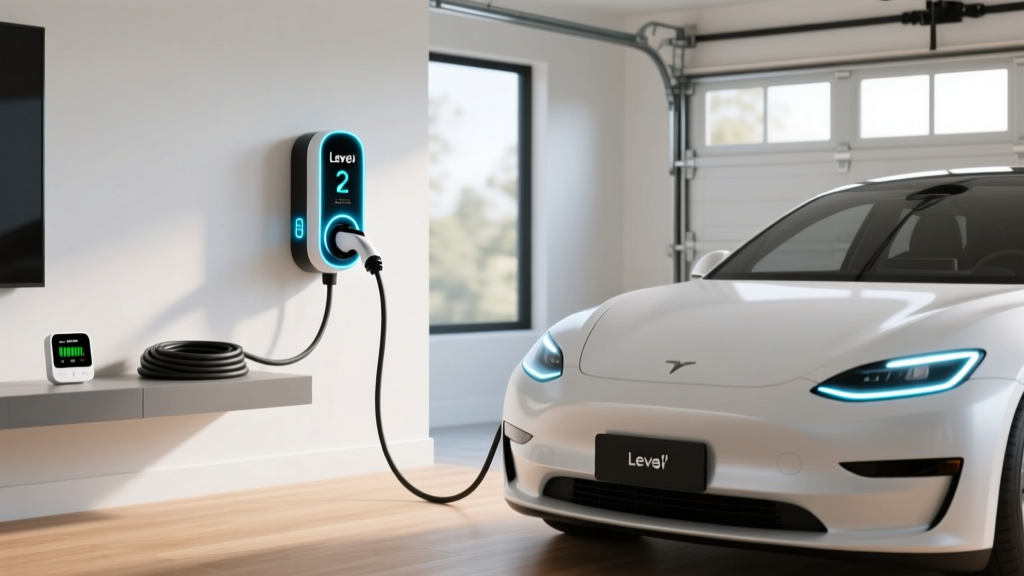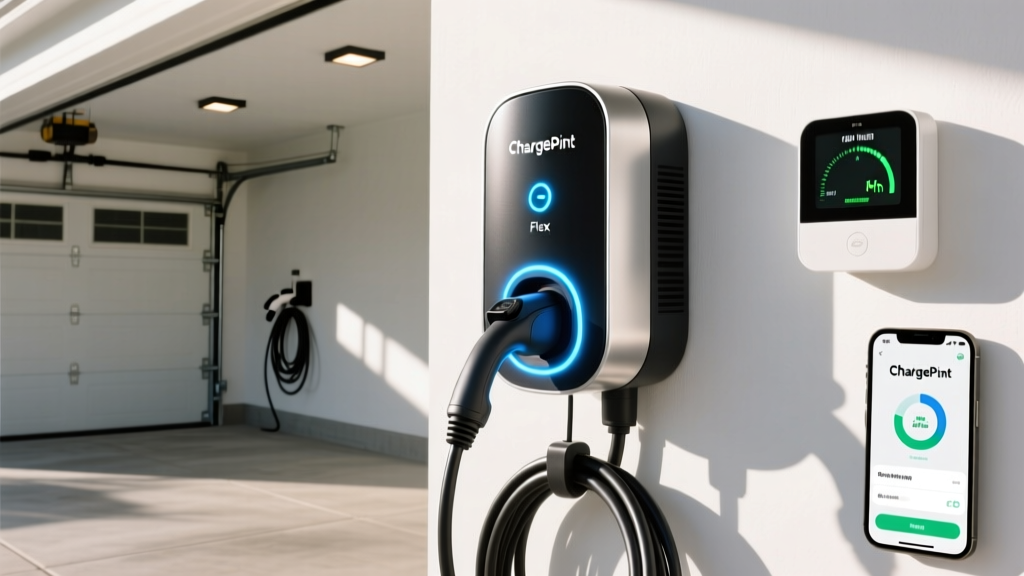
If you're shopping for a Level 2 home charging station, the ChargePoint Home Flex consistently appears on shortlists — and for good reason. It's a configurable, smart-enabled wall unit that can deliver up to 12 kW (50 amps) of continuous power on a 240-volt circuit, making it one of the most versatile residential chargers on the market. But before you click "buy," you need to understand the electrical requirements, the real installation costs, and whether your home's panel can handle the load.
This guide breaks down exactly what the ChargePoint Home Flex delivers, what it costs to install in 2026, and how it compares to the broader Level 2 charging landscape. We'll also clarify the single most common source of EV-charging confusion: the difference between kW (power, or how fast energy flows) and kWh (energy, or how much your battery holds). Think of kW as the width of a hose and kWh as the size of the bucket.
Understanding EV Charging Levels: What Speed Are You Actually Getting?
Every EV owner needs to internalize three charging tiers. The numbers below assume typical passenger EVs averaging 3–4 miles per kWh.
| Level | Voltage | Max Power (kW) | Miles of Range Added per Hour | Typical Use Case |
|---|---|---|---|---|
| Level 1 | 120V AC | 1.4 kW (12A) | 3–5 mi/hr | Overnight trickle, emergency top-off, PHEVs with small batteries |
| Level 2 | 240V AC | 7.2–19.2 kW (30–80A) | 20–60+ mi/hr | Daily home charging, workplace, destination charging |
| DC Fast Charge | 400–800V DC | 50–350 kW | 150–1,000+ mi/hr (peak) | Road trips, highway corridors, commercial fleets |
The ChargePoint Home Flex operates at Level 2. On a 60-amp breaker (which allows 50 amps of continuous draw per the National Electrical Code's 80% rule), it delivers up to 12 kW. On a 40-amp breaker, it delivers 9.6 kW. You configure the amperage via dip switches during installation — the unit itself is rated for up to 50A continuous.
For context, a 12 kW charge rate adds roughly 36–44 miles of range per hour to a typical EV like the Tesla Model Y or Hyundai Ioniq 5. That means a depleted 75 kWh battery pack reaches 80% in about 5 hours — more than enough for overnight replenishment.
ChargePoint Home Flex: Specs, Connector Options, and Smart Features
The Home Flex ships in two connector variants to match the current North American landscape:
- J1772 connector — the universal standard for all non-Tesla EVs using CCS1 (combined charging). This includes Ford, Hyundai, Kia, GM, BMW, Rivian, Volkswagen, and others.
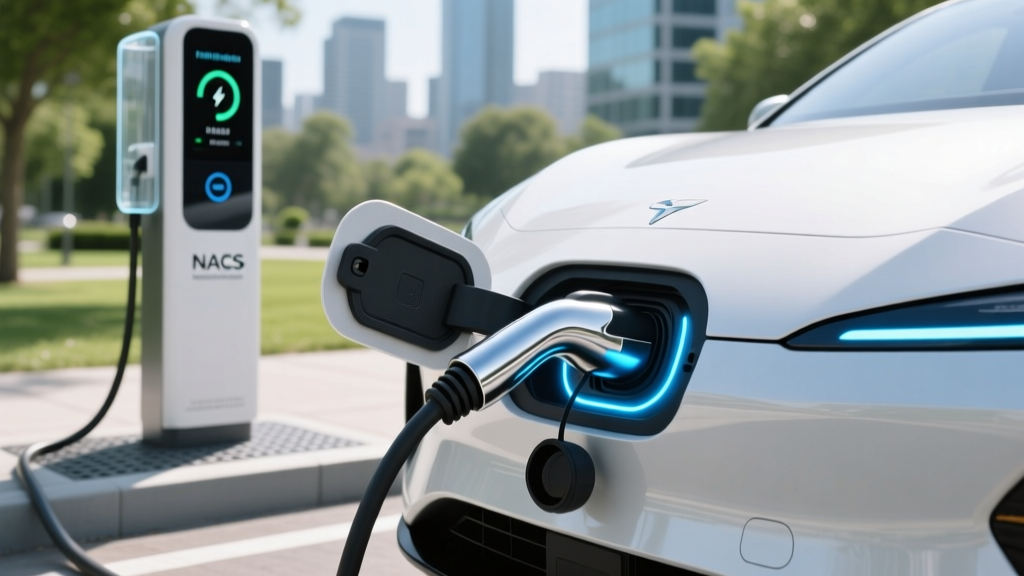
- NACS (North American Charging Standard) connector — the Tesla-native plug now adopted by Ford, GM, Rivian, and most major automakers for 2025+ models.
If your EV uses a different connector than the charger you buy, adapters solve the mismatch. Tesla sells a J1772-to-NACS adapter (included with most Tesla vehicles), and ChargePoint's NACS model works with legacy CCS1 vehicles via a NACS-to-CCS adapter. Below is a compatibility reference:
| Your EV's Port | ChargePoint Home Flex Model to Buy | Adapter Needed? |
|---|---|---|
| NACS (Tesla, 2025+ Ford/GM/Rivian) | NACS variant | None for NACS vehicles; NACS-to-CCS adapter for older CCS1 cars |
| CCS1 / J1772 (most non-Tesla EVs) | J1772 variant | None; Tesla owners use their included J1772-to-NACS adapter |
| CHAdeMO (Nissan Leaf, older Mitsubishi) | J1772 variant | CHAdeMO-to-J1772 adapters are rare and expensive (~$300+); consider a dedicated CHAdeMO unit instead |
- Max output: 12 kW (50A continuous on 60A breaker) or 9.6 kW (40A on 50A breaker)
- Voltage: 240V single-phase, hardwired or NEMA 14-50 plug
- Cable length: 23 feet (standard) — reaches most garage parking spots
- Wi-Fi connected: ChargePoint app for scheduling, energy tracking, and utility rate optimization
- Indoor/outdoor rated: NEMA 4 enclosure for exterior mounting
- ENERGY STAR certified
- Price: ~$649 (J1772) / ~$699 (NACS) MSRP before any utility rebates
The app's scheduled charging feature is particularly valuable if your utility offers time-of-use (TOU) rates. You can set the charger to begin only after 10 PM, when electricity drops to off-peak pricing — often $0.08–$0.12/kWh versus $0.25–$0.35/kWh during peak evening hours.
Home Installation: Electrical Requirements, Panel Upgrades, and Real Costs
The sticker price of the charger is only part of the equation. Professional installation by a licensed electrician is where costs vary most — and where older homes frequently encounter surprises.
What Your Electrician Will Evaluate
The ChargePoint Home Flex at 50 amps continuous requires a dedicated 60-amp, 240-volt circuit. If you opt for 40A continuous (still a very capable 9.6 kW), you need a dedicated 50-amp circuit. Your electrician will perform a load calculation on your main electrical panel to determine if there's enough spare capacity.
Best case: You have a 200-amp panel with available breaker spaces and sufficient load headroom. The electrician runs 6 AWG copper wire (for 60A) from the panel to your garage or exterior wall, installs the breaker, mounts the unit, and pulls the permit. Total time: 2–4 hours.
Worst case: You have an older 100-amp or 150-amp panel that's already near capacity. Adding a 60-amp EV circuit would exceed the panel's rated load. You'll need a panel upgrade to 200 amps, which is a significant project involving the utility company, new meter hardware, and potentially new service drop wires.
| Component | Simple Install (200A panel, short run) | Complex Install (long wire run, subpanel) | Panel Upgrade Required |
|---|---|---|---|
| ChargePoint Home Flex unit | $649–$699 | $649–$699 | $649–$699 |
| Electrical permit | $50–$150 | $50–$200 | $100–$300 |
| Electrician labor (2–4 hrs @ $85–$150/hr) | $170–$600 | $600–$1,500 | $1,500–$3,000+ |
| Wire, conduit, breaker, materials | $100–$300 | $300–$800 | $200–$500 |
| Panel upgrade (if needed) | — | — | $2,000–$5,000 |
| Estimated Total | $969–$1,749 | $1,600–$3,199 | $4,449–$9,499 |
According to data aggregated by the U.S. Department of Energy, most Level 2 home installations fall in the $1,000–$2,500 range when no panel upgrade is required. If you're in that panel-upgrade territory, check whether your utility offers a rebate or whether a smart electrical panel add-on (like SPAN or Lumin) can manage loads without a full upgrade.
Hardwired vs. NEMA 14-50 Plug
The Home Flex supports both installation methods. Hardwiring is generally preferred for 50A/60A circuits because it eliminates the receptacle as a potential failure point, avoids the NEC requirement for a GFCI breaker on receptacles (which can cause nuisance tripping with EV chargers), and is required by code in some jurisdictions for circuits above 50 amps. A NEMA 14-50 plug offers portability if you plan to take the charger when you move — but it limits you to 40A continuous (9.6 kW).
Charging Time: How Long Does the ChargePoint Home Flex Actually Take?
Charging time depends on your EV's battery capacity (measured in kWh) and its onboard charger's maximum AC acceptance rate. Here's where many buyers get tripped up: your car limits Level 2 speed, not just the charger. If your EV's onboard charger maxes out at 11.5 kW (like the Tesla Model Y), feeding it 12 kW from the Home Flex won't make it charge faster — the car simply draws what it can accept.
| Vehicle (2025–2026 MY) | Battery Capacity (usable kWh) | Onboard Charger Max | Effective Charge Rate | 10–80% Time |
|---|---|---|---|---|
| Tesla Model Y Long Range | ~75 kWh | 11.5 kW | 11.5 kW | ~4 hr 30 min |
| Hyundai Ioniq 5 (Long Range) | ~77.4 kWh | 10.9 kW | 10.9 kW | ~4 hr 55 min |
| Ford F-150 Lightning (Extended) | ~131 kWh | 19.2 kW | 12 kW (charger-limited) | ~7 hr 40 min |
| Chevrolet Equinox EV | ~85 kWh | 11.5 kW | 11.5 kW | ~5 hr 10 min |
| Toyota bZ4X | ~71.4 kWh | 7.4 kW | 7.4 kW (car-limited) | ~6 hr 45 min |
That Toyota bZ4X row illustrates the point: even with a 12 kW charger on the wall, the bZ4X's 7.4 kW onboard charger caps its Level 2 speed. Always check your vehicle's onboard charger spec before deciding whether a 50A circuit is worth the extra cost over a 40A setup.
For daily driving, most EV owners use only 20–30% of their battery between charges. A typical commute consuming 20 kWh replenishes in under two hours on the Home Flex — well within any overnight window.
Cost to Charge: Home vs. Public vs. Gas — The Per-Mile Math
This is where EV ownership economics either shine or disappoint, depending entirely on where and when you charge.
| Scenario | Electricity/Fuel Cost | Vehicle Efficiency | Cost Per Mile |
|---|---|---|---|
| Home Level 2, off-peak TOU rate | $0.10/kWh | 3.5 mi/kWh (120 MPGe) | $0.029 |
| Home Level 2, standard residential rate | $0.16/kWh | 3.5 mi/kWh | $0.046 |
| Home Level 2, high-cost state (CA/MA peak) | $0.32/kWh | 3.5 mi/kWh | $0.091 |
| Public Level 2 (ChargePoint network, typical) | $0.25–$0.49/kWh | 3.5 mi/kWh | $0.071–$0.14 |
| DC Fast Charge (Electrify America, 350 kW) | $0.43–$0.58/kWh | 3.5 mi/kWh (with charging losses) | $0.12–$0.17 |
| Gas vehicle (28 MPG combined) | $3.40/gal | 28 MPG | $0.121 |
| Gas vehicle (22 MPG, truck/SUV) | $3.40/gal | 22 MPG | $0.155 |
The takeaway: home charging at off-peak rates is 4–5x cheaper per mile than gasoline. Even at standard residential rates, you're paying roughly a third of what a gas car costs. But if you rely exclusively on public DC fast charging at $0.48–$0.58/kWh, your per-mile cost can actually exceed a fuel-efficient gas car. This is why a home charger like the ChargePoint Home Flex isn't just a convenience — it's the core of EV economics.
According to fueleconomy.gov, the average 2025 EV achieves roughly 100–130 MPGe combined, translating to 3.0–3.8 miles per kWh. Use your specific vehicle's kWh/100mi figure (displayed in the instrument cluster) for precise personal calculations.
Alternative Level 2 Chargers: How the Competition Compares
The ChargePoint Home Flex is excellent, but it's not the only option. Here's how it stacks up against other leading residential Level 2 chargers in 2026:
Emporia Vue / Emporia Level 2 Charger
- Max output: 11.5 kW (48A continuous, 60A breaker)
- Connector: J1772 (NACS adapter available)
- Cable: 24 ft
- Smart features: Energy monitoring, solar integration, TOU scheduling
- Price: ~$399
- Best for: Solar-panel owners who want to charge exclusively from excess generation
Tesla Wall Connector (Gen 4)
- Max output: 11.5 kW (48A continuous, 60A breaker)
- Connector: NACS native
- Cable: 24 ft
- Smart features: Wi-Fi updates, load sharing between multiple units, Powerwall integration
- Price: ~$450
- Best for: Tesla-only households (J1772 adapter included for guest vehicles)
Grizzl-E Smart
- Max output: 10 kW (40A continuous, 50A breaker)
- Connector: J1772
- Cable: 24 ft
- Smart features: Basic app, OCPP compatible, adjustable amperage
- Price: ~$499
- Best for: Cold-climate durability (rated to -40°F) and simple, robust design
ChargePoint Home Flex ★
- Max output: 12 kW (50A continuous, 60A breaker)
- Connector: J1772 or NACS (choose at purchase)
- Cable: 23 ft
- Smart features: ChargePoint app, Alexa/Google Home, detailed energy reports, utility demand-response programs
- Price: ~$649–$699
- Best for: Maximum configurability, dual-connector ecosystem, and integration with the largest public charging network app
The ChargePoint Home Flex's primary advantage is its 50A continuous rating — most competitors top out at 48A. That extra 2 amps (about 0.5 kW) matters little in practice, but the unit's dual-connector availability and deep app integration with ChargePoint's public network make it a strong pick for households that may own both a Tesla and a non-Tesla EV over time.
Safety, Permits, and Electrical Code: What You Must Get Right
EV chargers draw sustained, high-current loads for hours at a time — a fundamentally different duty cycle than a dryer or oven that cycles on and off. This makes code compliance non-negotiable.
- Dedicated circuit: The Home Flex must be on its own dedicated breaker — never shared with other appliances. A 60A breaker for 50A continuous operation, or a 50A breaker for 40A continuous.
- NEC 80% rule: Continuous loads (defined as operating for 3+ hours) cannot exceed 80% of the breaker rating. This is why a "50-amp charger" requires a 60-amp breaker.
- GFCI considerations: The 2023 NEC requires GFCI protection on 240V receptacles rated 50A or less. Hardwiring avoids this requirement entirely and eliminates nuisance trips. If you must use a NEMA 14-50 receptacle, ensure your electrician uses an EV-rated GFCI breaker (standard GFCI breakers can false-trip with EVSE ground-check signals).
- Outdoor rating: The Home Flex carries a NEMA 4 rating, meaning it's sealed against rain, splashing, and windblown dust. It can be mounted on an exterior wall without an additional weatherproof enclosure.
- Permit: Virtually all jurisdictions require an electrical permit for a new 240V circuit. Permit fees typically run $50–$200. Your electrician usually pulls this on your behalf, and an inspector will verify the installation. Do not skip the permit — unpermitted electrical work can void homeowners insurance and create liability in the event of a fire.
- Wire gauge: 6 AWG copper for 60A circuits, 8 AWG for 50A circuits (in most installations; long runs may require upsizing to compensate for voltage drop).
The National Fire Protection Association's NEC Article 625 governs EV charging equipment specifically. A qualified electrician will know these requirements, but it's worth verifying that your installer has EV-charging experience — the sustained-load profile is different from typical residential work.
Utility Rebates and Federal Incentives for Home Charger Installation
Before you pay full price, investigate available incentives:
- Utility rebates: Many electric utilities offer $250–$1,000 rebates for purchasing and installing a smart Level 2 charger — particularly models on their approved list (the ChargePoint Home Flex is widely approved). Some utilities provide the charger itself at a steep discount in exchange for enrollment in a managed-charging program that allows the utility to briefly reduce charge rate during peak demand.
- Federal tax credit (IRC §30C): The Alternative Fuel Vehicle Refueling Property Credit covers 30% of the cost of home EV charging equipment and installation, up to $1,000. However, this credit is subject to census-tract eligibility requirements — it's primarily available in low-income or non-urban census tracts. Check your address against the IRS eligibility map before counting on it.
- State and local incentives: Programs vary significantly. Some states (California, Colorado, New York) offer additional rebates or tax credits for charger installation. Consult your state energy office or the Alternative Fuels Data Center for current programs in your jurisdiction.
Frequently Asked Questions
How much does it cost to install a ChargePoint Home Flex charger?
Expect $1,000–$1,800 for a straightforward installation on an existing 200-amp panel with a short wire run. Complex installations with long conduit runs or subpanel additions typically cost $1,600–$3,200. If your home requires a full panel upgrade from 100A to 200A, total project cost can reach $4,500–$9,500 including the panel work. Always get two or three quotes from licensed electricians.
Can I install the ChargePoint Home Flex myself?
Technically, yes, if you have electrical experience — but you should not. A 240V, 50–60A circuit carries lethal current and requires code-compliant wire sizing, torque-spec terminations, and a permitted inspection. DIY mistakes on high-amperage circuits are a leading cause of residential electrical fires. Budget for professional installation.
Will the ChargePoint Home Flex work with my Tesla?
Yes. Buy the NACS variant for a native Tesla connection, or buy the J1772 variant and use the J1772-to-NACS adapter that Tesla includes with every vehicle. Both configurations deliver full charging speed.
Is 50 amps (12 kW) overkill for my EV?
Possibly. If your EV has a smaller battery (under 60 kWh) or a lower onboard charger limit (7.4 kW or 10.9 kW), you'll never use the full 12 kW. A 40A/9.6 kW configuration on a 50A breaker may save money on wire gauge and still charge your vehicle at its maximum rate. Check your vehicle's onboard charger specification before paying for a 60A circuit.
How does the ChargePoint Home Flex handle power outages?
The unit will stop charging during an outage and automatically resume when power returns, picking up where it left off. If you pair it with a home battery system (like a Tesla Powerwall or Enphase IQ), the ChargePoint app can be configured to charge only from battery backup during outages — though at reduced amperage to avoid depleting the battery too quickly.
What's the difference between kW and kWh, and why does it matter here?
kW (kilowatts) measures power — the rate at which electricity flows. The ChargePoint Home Flex delivers up to 12 kW. kWh (kilowatt-hours) measures energy — the total amount stored in your battery. A 75 kWh battery charged at 12 kW would theoretically fill in 6.25 hours (75 ÷ 12), though real-world charging losses and tapering add roughly 10–15% to that time. Confusing these two units is the most common mistake new EV owners make when estimating charge times.