ChargePoint DC Fast Charging: What EV Owners Actually Need to Know
ChargePoint operates one of North America's largest public charging networks, with over 30,000 DC fast charging ports across the U.S. as of early 2026. But "DC fast charging" covers a wide range — from 50 kW legacy stations to 350 kW Express Plus sites. Understanding the real-world speeds, connector compatibility, and per-kWh pricing is essential before you rely on ChargePoint (or any public DC network) for road trips or daily top-ups.
This guide breaks down ChargePoint's DC fast charging capabilities against home Level 2 charging, covering exact charge speeds in kilowatts (kW), installation costs for a home setup, connector compatibility across 2026 model-year EVs, and what you'll actually pay per mile compared to gasoline.
Charging Levels Explained: Speed, Power, and Range Added Per Hour
Every EV owner uses a mix of three charging levels. Here's how they stack up in real-world output:
| Level | Voltage | Power (kW) | Miles of Range Added Per Hour | Typical Use Case |
|---|---|---|---|---|
| Level 1 (120V) | 120V AC | 1.0–1.4 kW | 3–5 miles | Overnight trickle, PHEVs, emergencies |
| Level 2 (240V) | 240V AC | 3.3–19.2 kW | 12–75 miles | Home daily charging, workplace, hotels |
| DC Fast Charging | 200–900V DC | 50–350 kW | 120–1,000+ miles/hr (peak) | Road trips, quick top-ups, fleet depots |
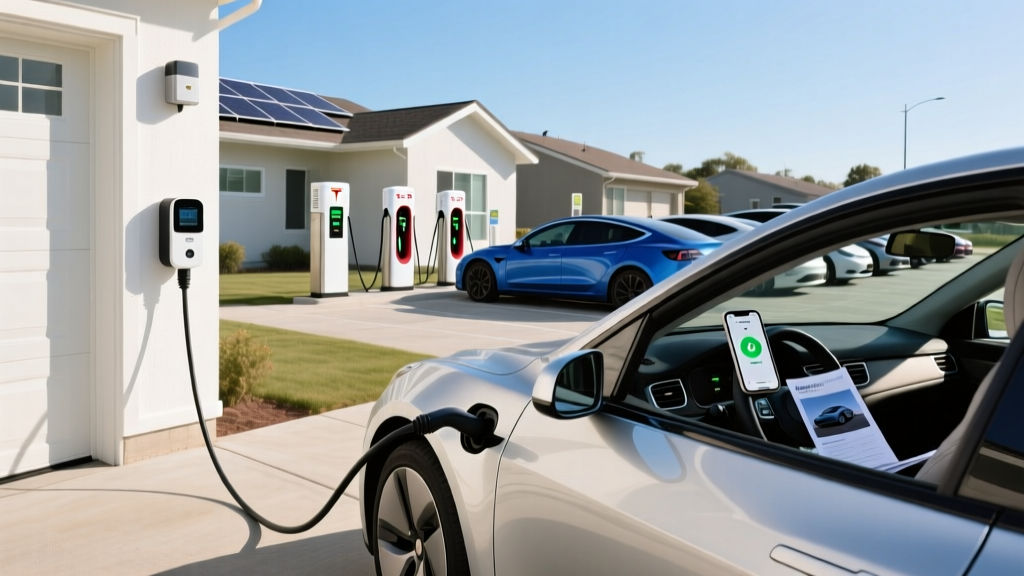
ChargePoint's DC fast charging portfolio spans the full range. Their Express Plus stations deliver up to 350 kW per stall on vehicles that support 800V architectures (Hyundai Ioniq 5, Kia EV6, Porsche Taycan, Lucid Air). Their older 62.5 kW and 125 kW stations remain common at retail locations and highway rest areas.
Real-world caveat: Peak kW ratings are not sustained rates. Most EVs charge at peak speed only between roughly 10% and 40% State of Charge (SoC), then taper significantly. A vehicle rated for 240 kW peak might average 130–150 kW across a 10–80% session. Battery temperature, ambient conditions, and the station's available power all affect actual throughput.
10–80% Charging Times: How Fast Does ChargePoint DC Fast Charging Really Deliver?
The 10–80% metric is the industry standard because charging above 80% slows dramatically to protect battery health (the "charge curve taper"). Here's what to expect at ChargePoint DC fast stations with common 2026 battery sizes:
| Vehicle (2026) | Battery (kWh) | Peak Charge Rate | At 350 kW Station | At 125 kW Station | At 50 kW Station |
|---|---|---|---|---|---|
| Tesla Model Y (NACS) | 75 kWh usable | ~250 kW | ~22 min | ~35 min | ~75 min |
| Hyundai Ioniq 5 | 77.4 kWh usable | ~240 kW (800V) | ~18 min | ~38 min | ~82 min |
| Ford F-150 Lightning Ext. Range | 131 kWh usable | ~150 kW | ~42 min | ~55 min | ~140 min |
| Chevrolet Equinox EV | 85 kWh usable | ~150 kW | ~32 min | ~45 min | ~90 min |
| BMW iX xDrive50 | 105.2 kWh usable | ~200 kW | ~30 min | ~48 min | ~110 min |
These times assume the battery is preconditioned — warmed to optimal temperature before arrival. Without preconditioning (common in cold weather or when the vehicle hasn't navigated to the charger), add 5–15 minutes as the battery heats up before accepting peak power.
Which Connector Is Compatible with Your EV?
Connector standards shifted significantly in 2024–2025 when most major automakers adopted the North American Charging Standard (NACS), originally developed by Tesla. As of 2026, here's where things stand:
| Connector | Brands Using It (2026) | ChargePoint Compatibility | Adapter Needed? |
|---|---|---|---|
| NACS (Tesla-style) | Tesla, Ford, GM, Rivian, Volvo, Polestar, Hyundai/Kia (select), BMW, Nissan (new models) | Newer ChargePoint Express Plus stations include NACS cables; older CCS-only stations require adapter | CCS-to-NACS adapter for legacy stations (~$200–$250) |
| CCS1 | Legacy models, some 2024–2025 vehicles pre-switch, VW ID.4 (some trims) | Most ChargePoint DC stations have CCS1 cables | NACS-to-CCS adapter if your car is NACS and station is CCS-only |
| CHAdeMO | Nissan Leaf (discontinued in U.S. after 2025), Mitsubishi Outlander PHEV (legacy) | Limited — some older ChargePoint stations retain CHAdeMO cables | No adapter widely available; CHAdeMO is being phased out |
Practical advice for 2026 buyers: If you're purchasing a new EV, confirm it ships with NACS. If you own a 2023–2025 CCS-equipped vehicle from a brand that switched (Ford, GM, Rivian), request the manufacturer's complimentary NACS adapter — most programs are still active. For ChargePoint DC fast charging specifically, download the ChargePoint app and filter stations by connector type before routing.
Cost to Charge: ChargePoint DC Fast Charging vs Home Level 2 vs Gasoline
Charging costs vary enormously depending on where and when you plug in. Here are realistic 2026 scenarios:
| Scenario | Rate ($/kWh) | Cost for 60 kWh (typical 200-mi refill) | Cost Per Mile |
|---|---|---|---|
| Home Level 2 — off-peak utility rate | $0.08–$0.14 | $4.80–$8.40 | $0.024–$0.042 |
| Home Level 2 — standard residential rate | $0.13–$0.20 | $7.80–$12.00 | $0.039–$0.060 |
| ChargePoint DC fast — typical pricing | $0.35–$0.55 | $21.00–$33.00 | $0.105–$0.165 |
| ChargePoint DC fast — peak/urban pricing | $0.55–$0.69 | $33.00–$41.40 | $0.165–$0.207 |
| Gasoline vehicle (28 MPG avg, $3.40/gal) | $3.40/gal | $24.28 (for 200 mi) | $0.121 |
The takeaway: Home charging at off-peak rates is 3–5x cheaper per mile than gasoline. ChargePoint DC fast charging at typical rates is roughly comparable to or slightly more expensive than gas on a per-mile basis. The economics strongly favor home Level 2 charging for daily use, with DC fast charging reserved for road trips where convenience outweighs cost.
ChargePoint pricing is set by the station owner (retailer, fleet operator, municipality), not by ChargePoint directly. Always check the per-kWh rate displayed in the app or on the station screen before initiating a session. Some stations also charge idle fees of $0.10–$0.50/minute if you remain plugged in after reaching your charge limit.
Home Level 2 Charger Installation: Electrical Requirements and Costs
If you're considering home Level 2 charging as your primary setup — which most EV owners should — here's what the installation involves.
Electrical Requirements
- Circuit: A dedicated 240V circuit, typically 40A or 50A (supporting 32A or 40A continuous charging, respectively — NEC requires circuits rated at 125% of continuous load)
- Wiring: 6 AWG copper wire for 50A circuits; 8 AWG for 40A circuits
- Outlet vs hardwired: NEMA 14-50 outlet (50A) offers portability; hardwired connections allow higher amperage (60A/80A) and avoid GFCI breaker requirements that can trip with some chargers
- Panel capacity: Your electrical panel must have sufficient spare capacity. A 200A panel with existing high-draw appliances (electric range, dryer, HVAC) may need a load calculation before adding 40–50A of EV charging
Do You Need a Panel Upgrade?
Homes with 100A service or heavily loaded 200A panels may need an upgrade to 200A or 400A. This is the single largest variable in installation cost. Homes built after 2000 with 200A panels often have sufficient headroom. Older homes, homes with electric heat, or homes that have added major appliances over time are more likely to need an upgrade.
A licensed electrician will perform a NEC Article 220 load calculation to determine whether your panel can handle the additional circuit. Some jurisdictions now allow automated load management devices (like the Emporia VUE or Span smart panel) to avoid a full panel upgrade by dynamically limiting charger draw when other circuits are active.
Installation Cost Breakdown
| Component | Simple Install (panel nearby, no upgrade) | Complex Install (long run, panel upgrade) |
|---|---|---|
| Level 2 charger equipment | $400–$750 | $500–$1,200 |
| Electrician labor (2–8 hours) | $300–$800 | $800–$2,500 |
| Electrical permit | $50–$150 | $50–$200 |
| Panel upgrade (if needed) | $0 | $1,500–$4,000 |
| Conduit, wiring, misc. materials | $100–$300 | $300–$800 |
| Total | $850–$2,000 | $3,150–$8,700 |
The federal Alternative Fuel Vehicle Refueling Property Credit (IRC §30C) covers 30% of home charging equipment and installation costs, up to $1,000, for installations in eligible census tracts. Check irs.gov for current eligibility maps and rules, as these are updated annually.
Equipment Recommendations: Top Level 2 Chargers for 2026
ChargePoint Home Flex
- Power output: Up to 12 kW (50A circuit) or 9.6 kW (40A circuit), configurable via DIP switch
- Connector: NACS (2025+ models) or J1772 with included NACS adapter
- Cable length: 23 feet
- Smart features: Wi-Fi, ChargePoint app scheduling, Alexa integration, energy reports
- Price: ~$599–$699
- Best for: ChargePoint ecosystem users who want app-based scheduling and utility integration
Tesla Wall Connector
- Power output: Up to 11.5 kW (48A on a 60A hardwired circuit)
- Connector: NACS native; J1772 adapter included for non-Tesla EVs
- Cable length: 24 feet
- Smart features: Wi-Fi, over-the-air updates, power-sharing between two units, Tesla app
- Price: ~$475
- Best for: Tesla owners or mixed-Tesla households; highest value-to-performance ratio
Emporia Level 2 EV Charger
- Power output: Up to 11.5 kW (48A hardwired) or 9.6 kW (40A)
- Connector: J1772 (NACS adapter available separately)
- Cable length: 24 feet
- Smart features: Wi-Fi, Emporia app, detailed energy monitoring, solar integration, time-of-use scheduling
- Price: ~$399–$499
- Best for: Budget-conscious buyers who want granular energy data and solar/home battery integration
For DC fast charging at home — a niche but growing segment — the EPA's fueleconomy.gov database can help you determine whether your vehicle's peak charge rate justifies the $3,000–$7,000 cost of residential DC equipment (like the United Chargers Grizzl-E Smart DC). For most owners, a 40–48A Level 2 unit charging overnight is the practical choice.
Safety and Electrical Code Considerations
EV charging places a sustained high-amperage load on your electrical system — unlike an oven or dryer that cycles on and off, a Level 2 charger can draw maximum current for 6–10 hours straight. This makes code compliance non-negotiable:
- Dedicated circuit: Your EV charger must be on its own dedicated circuit — never shared with other outlets or appliances (NEC Article 625)
- GFCI protection: The 2020 NEC requires GFCI protection for outdoor receptacles used for EV charging. However, many EV charger manufacturers recommend hardwired installations to avoid nuisance GFCI trips caused by the charger's internal ground-fault detection conflicting with the breaker
- Outdoor rating: If installing outdoors, the charger must carry a NEMA 4 or NEMA 4X rating (protection against rain, ice, and dust). All three chargers recommended above carry outdoor ratings
- Permit and inspection: Virtually all jurisdictions require an electrical permit and post-installation inspection for EV charger circuits. Skipping this risks insurance claim denial in the event of an electrical fire
- Cable management: Use a wall-mounted cable organizer to prevent the cord from lying on the ground where it can be driven over, tripped on, or degraded by standing water
Frequently Asked Questions
How much does it cost to install a home EV charger?
A straightforward Level 2 installation with adequate panel capacity costs $850–$2,000 including equipment, electrician labor, and permit. If your home needs a panel upgrade (100A to 200A), total costs can reach $3,150–$8,700. The federal §30C credit may offset up to $1,000 (30% of costs) depending on your census tract.
How fast will each charging level add range?
Level 1 (120V) adds 3–5 miles per hour. Level 2 (240V, 40–48A) adds 25–45 miles per hour for most EVs. ChargePoint DC fast charging at 150 kW adds approximately 150–250 miles in a 20-minute session, depending on battery size and charge curve. At 350 kW with a compatible 800V vehicle, you can add 200+ miles in 15 minutes.
Which connector and charger is compatible with my EV?
For 2026 model-year vehicles, NACS is the dominant standard (Tesla, Ford, GM, Rivian, Hyundai/Kia, BMW, Volvo, and more). CCS1 persists on some 2023–2025 models. CHAdeMO is effectively discontinued in the U.S. Check your vehicle's charge port and the NHTSA or manufacturer spec sheet for confirmation. For public ChargePoint DC stations, filter by connector in the app before navigating.
How much does charging cost per mile vs gas?
Home Level 2 charging at off-peak rates costs $0.02–$0.04 per mile — roughly one-quarter the cost of gasoline at $3.40/gal and 28 MPG ($0.12/mile). ChargePoint DC fast charging at typical public rates ($0.35–$0.55/kWh) costs $0.10–$0.17 per mile, which is comparable to or slightly above gasoline. The savings case for EVs depends heavily on access to affordable home charging.
What electrical upgrades might I need?
If your home has a 100A electrical panel, a panel upgrade to 200A is almost certainly required ($1,500–$3,000). Even with a 200A panel, homes with electric heat, electric dryer, electric range, and central A/C may need a load calculation to confirm capacity. A licensed electrician can assess this during a site visit. Some utilities offer free or discounted pre-installation assessments.
Is ChargePoint DC fast charging reliable for road trips?
ChargePoint's DC fast network reliability has improved since 2023, with uptime rates reported above 90% at Express Plus locations. However, reliability varies by site owner and maintenance schedule. For critical road trips, plan routes with backup charging options using PlugShare or A Better Routeplanner alongside the ChargePoint app. Stations at high-traffic highway corridors tend to have better uptime than standalone retail locations.