If you own a Tesla or are considering one, you have likely asked: can you charge a Tesla at any charging station? The short answer is almost — but not quite — every station. Tesla vehicles use the North American Charging Standard (NACS) connector, which as of 2026 has become the dominant plug across North America. However, compatibility depends on the station's connector type, the adapter you carry, and the charging level available. This guide maps out exactly where you can plug in, what you need in your trunk, and what it costs.
Understanding Charging Levels: Speeds That Matter
Before evaluating station compatibility, you need to understand the three charging levels and how they translate to real range added. Power is measured in kW (kilowatts), while energy stored in your battery is measured in kWh (kilowatt-hours). Confusing the two is the most common EV mistake — kW is the rate of flow (like water pressure), kWh is the tank size.
| Level | Voltage | Max Power (kW) | Miles of Range Added Per Hour | Typical Use Case |
|---|---|---|---|---|
| Level 1 | 120V AC | 1.4 kW | 3–5 mi/hr | Emergency / overnight trickle |
| Level 2 | 240V AC | 7.2–19.2 kW | 20–75 mi/hr | Home daily, workplace, shopping |
| DC Fast Charge | 400–800V DC | 50–350 kW | 150–1,000+ mi/hr (peak) | Road trips, highway corridors |
For a Tesla Model Y Long Range (75 kWh usable battery, EPA-rated 310 miles), a Level 1 plug adds roughly 4 miles per hour — enough only for low-mileage drivers. A 48-amp Level 2 home charger delivers about 11.5 kW, adding roughly 44 miles per hour. On a 250 kW Tesla Supercharger V4, you can recover from 10% to 80% in approximately 18–22 minutes depending on battery temperature and state of charge.
Connector Compatibility: Where Can a Tesla Actually Plug In?
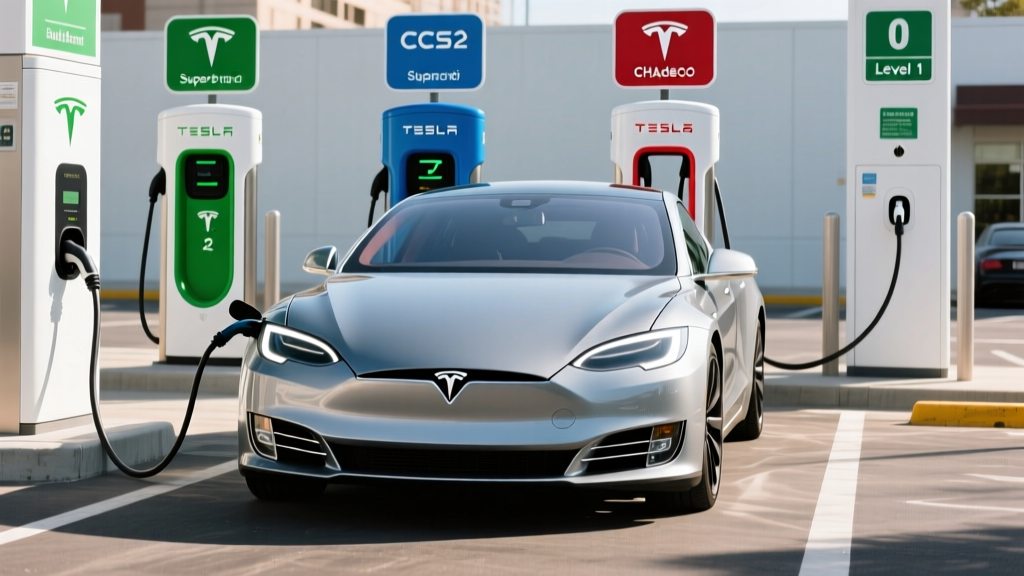
The connector landscape has shifted dramatically. Tesla's proprietary plug became the NACS standard (SAE J3400) in late 2022, and by 2025–2026, most major automakers — Ford, GM, Rivian, Hyundai, Kia, BMW, and others — have adopted it. This means Tesla drivers now have access to the broadest charging network in North America, but some legacy stations still require adapters.
| Connector Type | Network / Source | Tesla Native? | Adapter Needed? |
|---|---|---|---|
| NACS (Tesla) | Tesla Supercharger & Destination | Yes | No |
| NACS (Tesla) | Electrify America, EVgo, ChargePoint (new 2025+ stations) | Yes | No |
| CCS1 | Legacy Electrify America, EVgo, ChargePoint stations | No | Yes — CCS-to-NACS adapter (~$175–$250) |
| CHAdeMO | Older Nissan Leaf-era stations | No | Yes — CHAdeMO-to-NACS adapter (~$300–$450, limited availability) |
| J1772 | Level 2 public stations (hotels, malls, workplaces) | No | Yes — J1772-to-NACS adapter (included with Tesla) |
Every Tesla ships with a J1772-to-NACS adapter in the trunk, covering virtually all public Level 2 stations. For DC fast charging on legacy CCS1 networks, you will need to purchase a CCS-to-NACS adapter separately. Tesla sells an official adapter for approximately $250 through their shop, and third-party options from Lectron and A2Z are available for $175–$200. CHAdeMO stations are increasingly rare and are being phased out across North America — investing in a CHAdeMO adapter is rarely worth it unless you regularly visit areas with no other options.
Home Charger Installation: Requirements and Real Costs
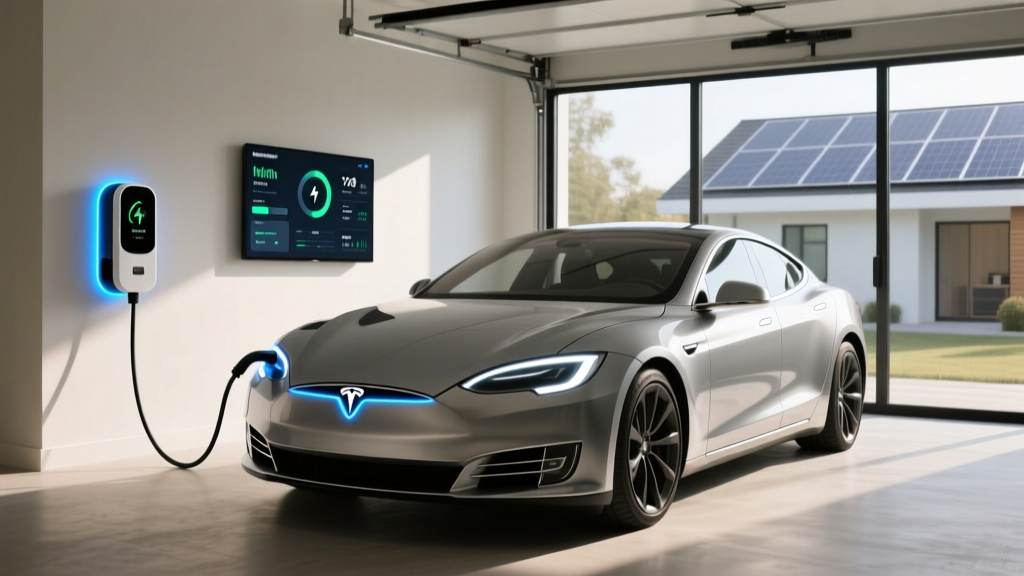
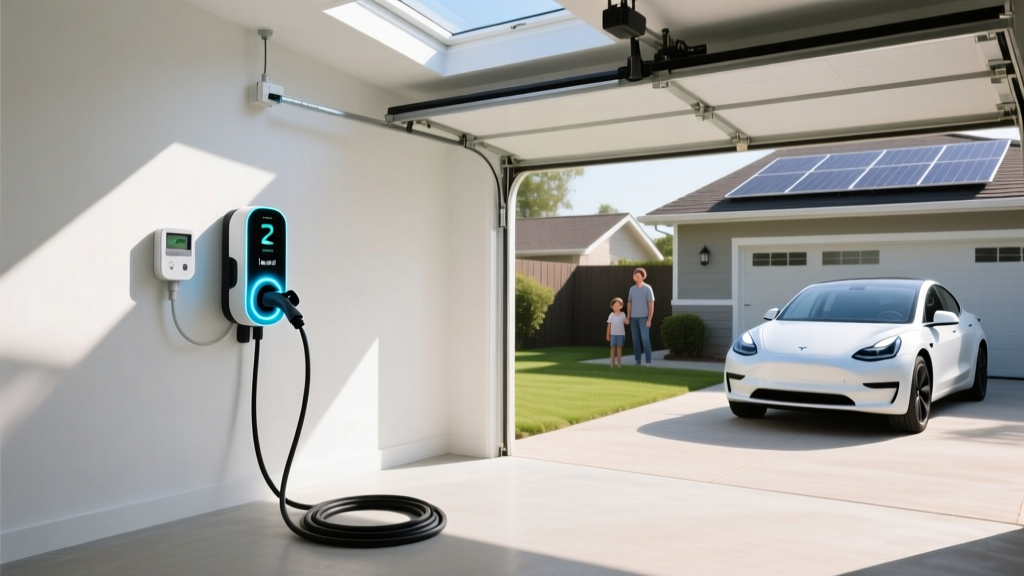
Most Tesla owners do the majority of their charging at home on a Level 2 circuit. Installing a dedicated 240V outlet or hardwired charger is the single best investment for daily EV convenience, but costs vary widely based on your home's electrical panel.
Electrical Requirements
A typical Level 2 home charger runs on a 240V dedicated circuit. The most common configurations:
- NEMA 14-50 outlet: 50-amp circuit, delivers up to 40 amps continuous (9.6 kW). Supports the Tesla Mobile Connector or any plug-in Level 2 unit.
- Hardwired 60-amp circuit: Delivers up to 48 amps continuous (11.5 kW). Required for the Tesla Wall Connector at full output. No outlet — the charger is wired directly into your panel.
- Hardwired 80-amp circuit: Delivers up to 64 amps continuous (15.4 kW). Requires a panel with sufficient capacity and heavier-gauge wire (typically #4 AWG copper or #2 aluminum).
Your home's main electrical panel must have enough spare capacity to support the new circuit. A licensed electrician will perform a load calculation per NEC Article 220 to determine if your panel can handle the additional draw.
Panel Upgrade Considerations
Homes with 100-amp main panels often cannot support a 60-amp EV circuit without a panel upgrade to 200 amps. This is one of the most overlooked costs in home charging. A panel upgrade typically runs $1,500–$3,500 depending on your utility, local code, and whether a service lateral replacement is needed. Homes already on 200-amp panels usually have sufficient headroom.
| Component | Cost Range | Notes |
|---|---|---|
| Level 2 Charger Equipment | $350–$700 | Tesla Wall Connector ~$475; ChargePoint Home Flex ~$600 |
| Electrician Labor (standard install) | $500–$1,500 | Depends on run length from panel to garage |
| Electrical Permit | $50–$300 | Varies by municipality |
| Panel Upgrade (if needed) | $1,500–$3,500 | 100A to 200A upgrade |
| Total (no panel upgrade) | $900–$2,500 | Most homes with 200A panels |
| Total (with panel upgrade) | $2,400–$6,000 | Older homes with 100A service |
Always hire a licensed electrician familiar with EV charger installs. The circuit must be dedicated (not shared with other appliances), and outdoor installations require a GFCI breaker per NEC 2023 code plus a NEMA 4-rated (weatherproof) enclosure or outlet cover.
Charging Cost: Per Mile vs. Gasoline
One of the strongest arguments for Tesla ownership is fuel cost savings, but the math depends heavily on where and when you charge. Electricity rates vary by state, utility, and time-of-use (TOU) plan.
| Scenario | Rate ($/kWh) | Cost for 75 kWh Fill | Cost Per Mile (310 mi range) | Gas Equivalent (25 MPG, $3.50/gal) |
|---|---|---|---|---|
| Home (off-peak TOU) | $0.09–$0.13 | $6.75–$9.75 | $0.022–$0.031 | $0.140 |
| Home (standard rate) | $0.14–$0.20 | $10.50–$15.00 | $0.034–$0.048 | $0.140 |
| Public Level 2 | $0.25–$0.49 | $18.75–$36.75 | $0.060–$0.119 | $0.140 |
| Tesla Supercharger V4 | $0.28–$0.42 | $21.00–$31.50 | $0.068–$0.102 | $0.140 |
| Electrify America DC | $0.35–$0.55 | $26.25–$41.25 | $0.085–$0.133 | $0.140 |
Home charging on an off-peak TOU plan delivers the lowest cost per mile — often 4 to 6 times cheaper than gasoline. Even at public DC fast charger rates, a Tesla Model Y is typically cheaper per mile than a 25 MPG gas vehicle. However, frequent reliance on premium-priced public DC chargers can erode much of the savings advantage. The economics strongly favor home or workplace Level 2 charging as your primary strategy.
Equipment Recommendations: Home Chargers for Tesla Owners
Not all Level 2 chargers are equal. Here are the top picks for Tesla owners in 2026, based on power output, build quality, smart features, and value.
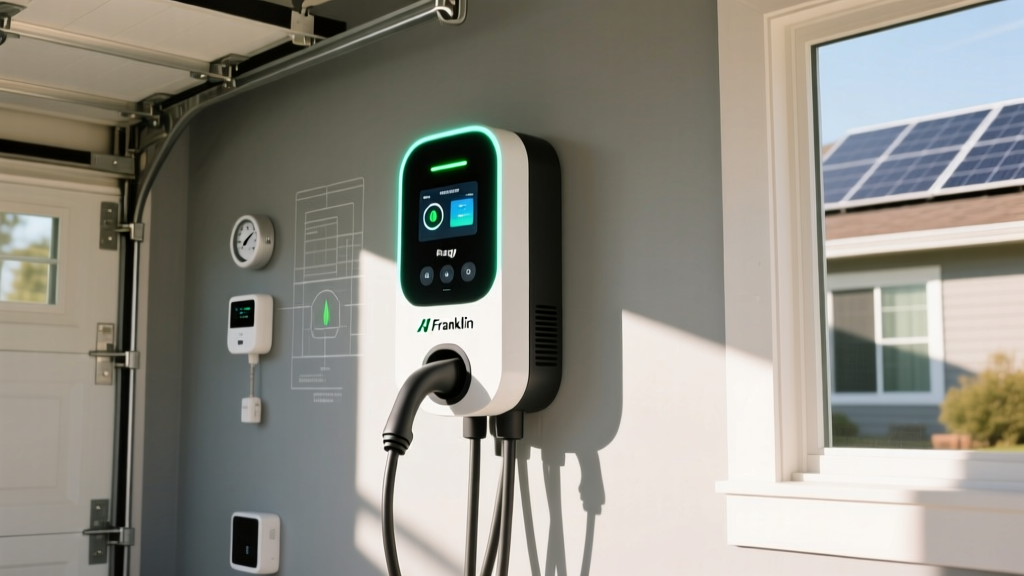
Tesla Wall Connector (Gen 4)
- Power Output: Up to 11.5 kW (48 amps) on a 60A circuit
- Connector: Native NACS — no adapter needed
- Cable Length: 24 feet
- Smart Features: Wi-Fi, OTA updates, Power Sharing (link multiple units on one circuit), Tesla app integration
- Price: ~$475
- Best For: Tesla-only households wanting seamless integration
ChargePoint Home Flex
- Power Output: Up to 12 kW (50 amps) on a 60A circuit; adjustable down to 16A
- Connector: NACS (2025+ models) or J1772 with included adapter
- Cable Length: 23 feet
- Smart Features: Wi-Fi, Alexa integration, scheduling, ChargePoint app with energy tracking
- Price: ~$599
- Best For: Multi-EV households or renters who may move (NEMA 14-50 plug version available)
Emporia Level 2 EV Charger
- Power Output: Up to 11.5 kW (48 amps) on a 60A circuit
- Connector: J1772 (use Tesla's included adapter) or NACS (2025+ model)
- Cable Length: 24 feet
- Smart Features: Wi-Fi, solar integration with Emporia Vue energy monitor, TOU scheduling
- Price: ~$399
- Best For: Budget-conscious buyers or homes with solar panels
DC Fast Charging Times: What to Expect on the Road
DC fast charging speed is not constant — it follows a charge curve. Your Tesla will pull peak power only at low states of charge (SoC), then taper as the battery fills to protect cell health. Here is what real-world 10–80% charging looks like for popular Tesla models:
| Model | Battery (kWh usable) | Peak DC Rate | 10–80% Time (V4 Supercharger) | 10–80% Time (150 kW CCS via adapter) |
|---|---|---|---|---|
| Model 3 Long Range | 75 kWh (NMC) | ~250 kW | ~18–20 min | ~30–33 min |
| Model Y Long Range | 75 kWh (NMC) | ~250 kW | ~19–22 min | ~31–35 min |
| Model S (2026) | 95 kWh (NMC) | ~250 kW | ~24–28 min | ~38–42 min |
| Cybertruck AWD | 123 kWh (NMC) | ~350 kW (800V) | ~18–22 min | ~45–50 min |
The Cybertruck's 800V architecture allows it to accept up to 350 kW at V4 Superchargers, making it one of the fastest-charging vehicles Tesla has produced. For Model 3 and Model Y, preconditioning the battery (navigating to a Supercharger in the Tesla nav system) warms the cells and can shave 3–5 minutes off your charge time, especially in cold weather.
Above 80% SoC, charging speed drops dramatically. Going from 80% to 100% can take as long as the 10–80% session. For road trips, plan to charge to 80% and move on — it is almost always faster to stop twice for shorter sessions than to wait for a full charge at one stop.
Safety, Code, and Installation Best Practices
EV charging draws sustained high current for hours — this is fundamentally different from brief appliance loads. Proper installation is critical for fire safety and long-term reliability.
- Dedicated circuit: Your EV charger must have its own breaker — never share with a dryer, oven, or HVAC system.
- GFCI protection: NEC 2023 and later require GFCI breakers for all EV outlet installations (NEMA 14-50 and similar). Hardwired chargers like the Tesla Wall Connector have built-in ground-fault protection and may not require a GFCI breaker (check local code).
- Wire gauge: A 60-amp circuit requires #6 AWG copper wire minimum. Longer runs (over 50 feet) may need #4 AWG to prevent voltage drop.
- Outdoor rating: If your charger is mounted outside, it must carry a NEMA 4 (or IP65+) weatherproof rating. The Tesla Wall Connector and ChargePoint Home Flex both meet this standard.
- Permit and inspection: Most jurisdictions require a permit for EV charger installation. Skipping this can void your homeowner's insurance in the event of an electrical fire. Expect an inspection after the work is complete.
Never use an extension cord with an EV charger. Never plug a Level 2 charger into a standard 120V outlet via an adapter. And if your electrician suggests using a dryer outlet splitter or "smart" load-sharing device to avoid a panel upgrade, get a second opinion — these workarounds carry real risk if not installed to exact code specifications.
Frequently Asked Questions
Can you charge a Tesla at any charging station?
Nearly any, yes. Teslas natively connect to all NACS-equipped stations — which now includes Tesla Superchargers and an expanding number of Electrify America, EVgo, and ChargePoint DC fast chargers. For legacy CCS1 stations, you will need a CCS-to-NACS adapter ($175–$250). For public Level 2 J1772 stations, Tesla includes a J1772 adapter with every vehicle. The only connector you cannot practically use is CHAdeMO, which is being phased out.
How much does it cost to install a home EV charger?
Expect $900–$2,500 for a standard installation (equipment, electrician labor, and permit) if your home already has a 200-amp electrical panel. If you need a panel upgrade from 100A to 200A, total costs range from $2,400–$6,000. Always get at least two quotes from licensed electricians who have EV charger installation experience.
How fast will each charging level add range?
Level 1 (120V) adds 3–5 miles per hour. Level 2 (240V, 48 amps) adds roughly 44 miles per hour for a Model Y. DC fast charging at a 250 kW Supercharger adds approximately 200 miles in 15 minutes at peak rate. Actual speeds depend on battery temperature, state of charge, and the specific vehicle model.
Which connector or charger is compatible with my EV?
All current Tesla vehicles (Model 3, Model Y, Model S, Model X, Cybertruck) use the NACS connector natively. Non-Tesla EVs from 2025 onward are increasingly shipping with NACS as well. If you own a non-Tesla EV with a CCS1 port, you can access Tesla Superchargers using a NACS-to-CCS adapter approved by your automaker. Check your vehicle's owner's manual or the Tesla Supercharger compatibility page for your specific model.
How much does charging cost per mile vs. gas?
Home charging on an off-peak electricity plan costs approximately $0.02–$0.05 per mile for a Tesla Model Y — roughly 3 to 7 times cheaper than a 25 MPG gas vehicle at $3.50/gallon ($0.14/mile). Public DC fast charging at $0.35–$0.55/kWh costs $0.07–$0.13 per mile, still competitive with or cheaper than gasoline. Your exact savings depend on local electricity rates, your driving efficiency, and how often you charge at home versus public stations.
What electrical upgrades might I need?
The most common upgrade is a panel replacement from 100 amps to 200 amps, required when your existing panel lacks capacity for a dedicated 50–60 amp EV circuit. Older homes (pre-1990s) are most likely to need this. Your electrician will perform a NEC Article 220 load calculation. Some utilities offer rebates of $200–$500 toward panel upgrades that support EV charging — check with your local provider. You may also qualify for the federal Alternative Fuel Vehicle Refueling Property Credit, which covers up to 30% of home charging equipment and installation costs (capped at $1,000), subject to census-tract eligibility per IRS guidelines.