What Is a CCS Combo Charger and Why Does It Matter?
If you own or are shopping for a non-Tesla electric vehicle, you have almost certainly encountered the CCS Combo connector — formally called CCS1 in North America. The Combined Charging System merges the standard J1772 AC plug with two additional high-power DC pins below it, creating a single port that handles everything from overnight Level 2 home charging to 350 kW DC fast charging at highway rest stops.
As of 2026, the CCS landscape is shifting fast. Ford, GM, Rivian, Volvo, and Polestar have adopted Tesla's NACS connector for new vehicles, while Hyundai, Kia, BMW, Volkswagen, and Stellantis brands continue shipping CCS1-equipped models. That means millions of CCS-port EVs are on the road, and understanding how to charge them — at home and in public — is essential for ownership satisfaction.
This guide breaks down CCS Combo charging across every level: what equipment you need, what installation actually costs, which adapters solve the NACS migration problem, and how charging costs compare to gasoline.
Charging Levels Explained: Speeds in kW and Miles Per Hour
Before evaluating any CCS Combo charger, you need clarity on the three charging tiers. The single most important distinction: kW (kilowatts) measures power — the rate of energy flow, while kWh (kilowatt-hours) measures energy — the total capacity stored in your battery. Think of kW as the width of a hose and kWh as the size of the bucket.
| Level | Voltage | Max Power (kW) | Miles of Range Added per Hour | Typical Use Case |
|---|---|---|---|---|
| Level 1 | 120V AC | 1.4–1.9 kW | 3–5 mi/hr | Emergency / trickle top-up |
| Level 2 | 240V AC | 7.2–19.2 kW | 20–65 mi/hr | Home & workplace daily charging |
| DC Fast Charge | 400–800V DC | 50–350 kW | 150–1,200 mi/hr (peak) | Road trips, highway corridors |
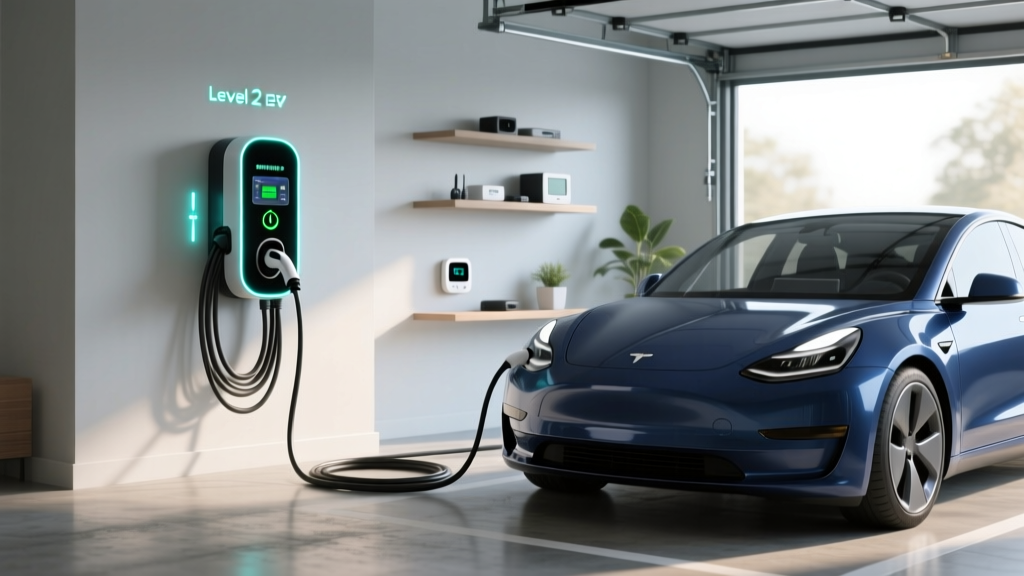
A CCS Combo port handles all three. At home, you plug in a Level 2 station using the upper J1772 portion of the connector. At a public DC fast charger, the full CCS1 plug — both upper and lower sections — engages to deliver high-voltage direct current straight to the battery.
Home Level 2 CCS Charging: Electrical Requirements and Installation Costs
Most CCS-equipped EVs accept between 7.2 kW and 11.5 kW on Level 2 AC power. The Hyundai Ioniq 5, for example, has an 11 kW onboard charger; the Volkswagen ID.4 accepts up to 11 kW on 2025+ models. Your home charger should match or slightly exceed your vehicle's onboard charger rating — the car will only draw what it can accept.
Electrical Requirements
A typical 48-amp Level 2 home charger requires a dedicated 60-amp, 240-volt circuit. The National Electrical Code (NEC) mandates that continuous loads (which EV charging qualifies as) cannot exceed 80% of the circuit breaker rating — hence 48A continuous draw on a 60A breaker. For a 40A charger, you need a 50A circuit.
Key requirements for a safe, code-compliant CCS Combo home installation:
- Dedicated circuit: No shared outlets or appliances on the same breaker
- GFCI protection: Required for outdoor installations per NEC 2023+ and many local codes
- NEMA 14-60 outlet or hardwired: Hardwired connections are preferred for 48A+ chargers and avoid the derating that plug-in models require
- Outdoor rating: If mounted outside, the charger must carry a NEMA 4 or IP65 weather-resistance rating
- Permit: Most jurisdictions require an electrical permit ($50–$200) and a post-install inspection
What Electrical Upgrades Might I Need?
Older homes with 100-amp electrical panels often lack the spare capacity for a 60A EV circuit. A licensed electrician will perform a load calculation to determine available headroom. If your panel is near capacity, you may need:
- Panel upgrade (100A → 200A): $1,500–$4,000 installed. This is the biggest variable in home charging costs.
- Smart panel or load-management device: Products like the Emporia Smart Panel or Span Drive can dynamically allocate power, sometimes avoiding a full panel upgrade for $500–$1,500.
- Service upgrade from the utility: In rare cases, the utility drop itself may need upgrading. Costs vary widely by utility.
| Component | Low End | High End | Notes |
|---|---|---|---|
| Level 2 Charger (40–48A) | $350 | $750 | Varies by brand, smart features, cable length |
| Electrician Labor (run 240V circuit) | $400 | $1,500 | Depends on distance from panel, wall/floor penetration |
| Electrical Permit | $50 | $200 | Varies by municipality |
| Panel Upgrade (if needed) | $1,500 | $4,000 | 100A → 200A service panel replacement |
| Total (no panel upgrade) | $800 | $2,450 | Most homes with 200A panels fall in this range |
| Total (with panel upgrade) | $2,300 | $6,450 | Older homes with 100A panels |
Always hire a licensed electrician familiar with EV charging installs. The U.S. Department of Energy maintains resources on home charging best practices and qualified installer locators.
Connector Compatibility: CCS1, NACS, CHAdeMO, and Adapters
The connector landscape in 2026 is fragmented but manageable. Here is how each standard maps to current EV brands:
| Connector | Brands Using It (2026) | AC Charging | DC Fast Charging |
|---|---|---|---|
| CCS1 (Combo) | Hyundai, Kia, BMW, VW, Audi, Porsche, Mercedes, Stellantis (Jeep, Chrysler), Subaru, Toyota (bZ4X) | J1772 upper section | CCS lower DC pins, up to 350 kW |
| NACS (Tesla) | Tesla, Ford, GM, Rivian, Volvo, Polestar, Fisker, Lucid (adapter available) | Native NACS AC | Native NACS DC, up to 250+ kW at Superchargers |
| CHAdeMO | Nissan Leaf (legacy only — discontinued) | J1772 (separate port) | CHAdeMO, up to 100 kW |
Adapter Solutions for CCS Owners
If you own a CCS-equipped EV but want access to Tesla's Supercharger network — which now numbers over 30,000 stalls globally with open-access NACS posts — adapters are your bridge:
- CCS-to-NACS DC Adapter: Sold by Tesla ($195), Lectron (~$180), and A2Z (~$160). Allows CCS vehicles to charge at NACS Superchargers at up to 150–250 kW depending on the adapter and vehicle.
- J1772-to-NACS AC Adapter: For Level 2 destination charging at NACS-only locations. Typically $100–$150.
- NACS-to-CCS Adapter: For NACS-equipped vehicles needing to use CCS DC fast chargers. Offered by Ford and GM as accessories ($200–$250).
When buying an adapter, verify it carries UL or ETL certification. Uncertified adapters can void warranty coverage and pose fire risks.
DC Fast Charging with CCS Combo: Speeds, Networks, and 10–80% Times
The CCS Combo connector truly shines at DC fast chargers, where it can deliver up to 350 kW on compatible vehicles. Here are real-world 10–80% charging times for popular CCS-equipped EVs:
| Vehicle | Battery (kWh usable) | Peak DC Rate (kW) | 10–80% Time | Best Network |
|---|---|---|---|---|
| Hyundai Ioniq 5 (2026) | 77.4 kWh (NMC) | 240 kW | ~18 min | Electrify America, EVgo |
| Kia EV6 GT-Line (2026) | 77.4 kWh (NMC) | 240 kW | ~18 min | Electrify America, EVgo |
| BMW iX xDrive50 (2026) | 105.2 kWh (NMC) | 200 kW | ~31 min | Electrify America |
| VW ID.4 Pro S (2026) | 82 kWh (NMC) | 175 kW | ~28 min | Electrify America (incl. free charging period) |
| Hyundai Ioniq 6 SE (2026) | 77.4 kWh (NMC) | 240 kW | ~18 min | Electrify America, EVgo |
These times assume a preconditioned battery (the vehicle's navigation routes through a charger and warms the pack) and a charger capable of delivering the vehicle's peak rate. In practice, arriving at a charger with a cold battery can double these times.
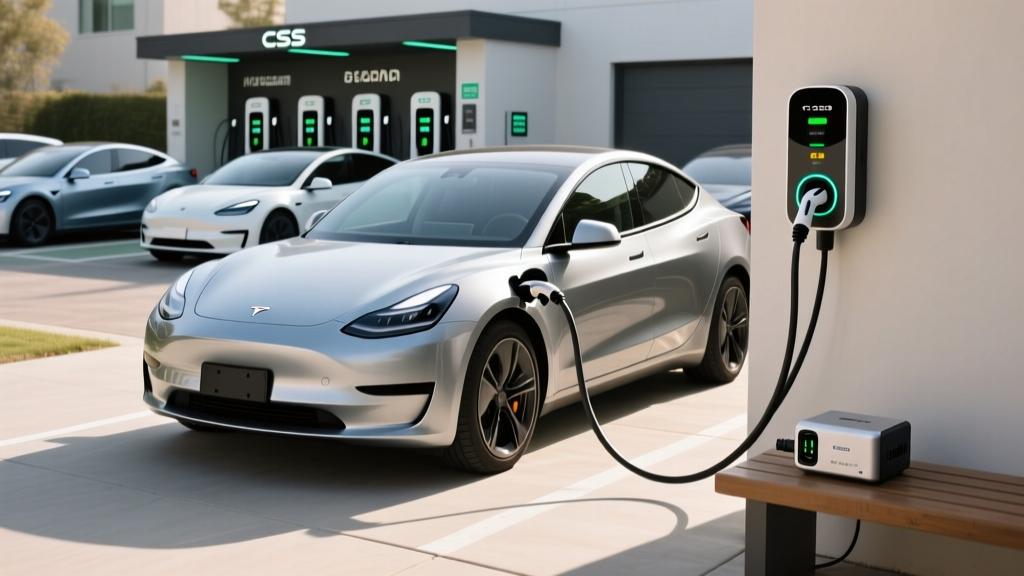
Major DC fast-charging networks supporting CCS1 include Electrify America (800+ stations, CCS standard on all stalls), EVgo (900+ stations, CCS + NACS), and ChargePoint Express (growing CCS coverage). Use apps like PlugShare or A Better Routeplanner to verify CCS connector availability at specific stations before road-tripping.
Cost to Charge: Home vs. Public vs. Gasoline
One of the strongest arguments for EV ownership is fuel cost savings — but the actual number depends heavily on where and when you charge. Here is a breakdown using national averages for early 2026:
| Scenario | Avg. $/kWh | Cost per Mile (at 3.5 mi/kWh) | Annual Cost (12,000 mi) |
|---|---|---|---|
| Home, off-peak utility rate | $0.08–$0.14 | $0.023–$0.040 | $275–$480 |
| Home, standard residential rate | $0.14–$0.20 | $0.040–$0.057 | $480–$685 |
| Public Level 2 (ChargePoint, workplace) | $0.20–$0.35 | $0.057–$0.100 | $685–$1,200 |
| DC Fast Charger (EA, EVgo) | $0.35–$0.55 | $0.100–$0.157 | $1,200–$1,885 |
| Gasoline (25 MPG avg, $3.40/gal) | — | $0.136 | $1,632 |
At a typical 3.5 miles per kWh efficiency (common for midsize crossovers like the Ioniq 5 or ID.4), home charging on an off-peak rate delivers fuel costs roughly 75–80% lower than a 25 MPG gasoline vehicle. Even exclusive DC fast charging costs roughly the same per mile as gasoline — and most EV owners do 80%+ of their charging at home.
According to fueleconomy.gov, the 2026 Hyundai Ioniq 5 achieves 114 MPGe combined, translating to roughly 3.4–3.8 mi/kWh depending on trim and driving conditions.
Best CCS-Compatible Home Chargers: 2026 Equipment Picks
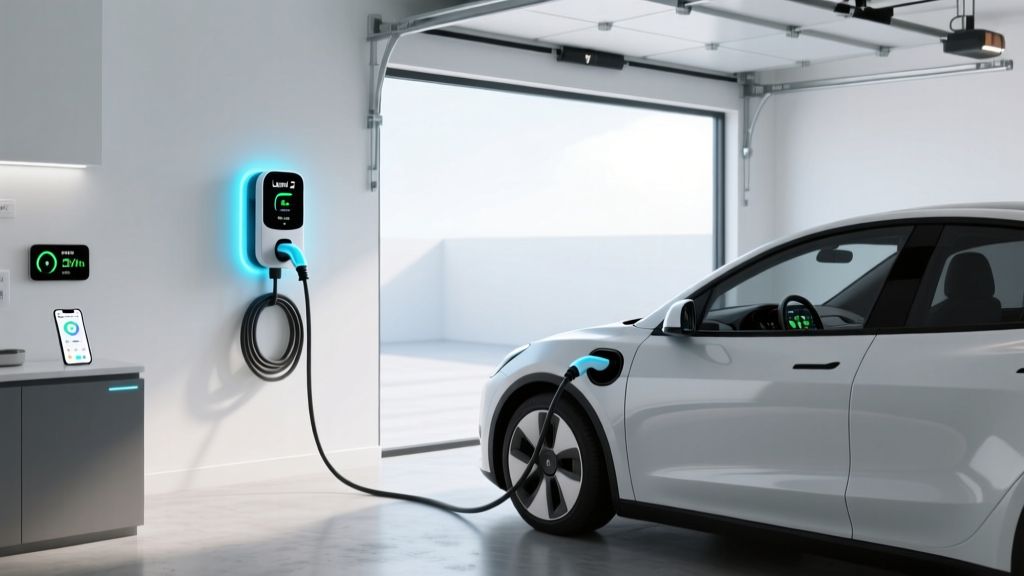
Every CCS-equipped EV uses a standard J1772 connector for Level 2 AC charging, which means any quality Level 2 station will work. Here are top picks for home installations, all with J1772 connectors compatible with CCS1 vehicles:
ChargePoint Home Flex (2nd Gen)
- Power Output: Up to 12 kW (50A) on a 60A circuit; adjustable down to 16A
- Connector: J1772 (compatible with all CCS1 vehicles)
- Cable Length: 23 feet
- Smart Features: Wi-Fi, Alexa integration, scheduled charging, energy tracking via app
- Price: ~$549 (charger only)
- Best For: Flexible amperage for homes with limited panel capacity
Emporia Vue Level 2 Charger
- Power Output: Up to 11.5 kW (48A) on a 60A circuit
- Connector: J1772
- Cable Length: 24 feet
- Smart Features: Real-time energy monitoring, solar integration, load management with Emporia panel monitor
- Price: ~$399 (charger only)
- Best For: Solar-equipped homes and budget-conscious buyers wanting energy visibility
Grizzl-E Smart
- Power Output: Up to 10 kW (40A) on a 50A circuit
- Connector: J1772
- Cable Length: 24 feet
- Smart Features: OCPP-compatible, app scheduling, firmware updates, built-in load balancing
- Price: ~$449 (charger only)
- Best For: Canadian and cold-climate owners (rated to -40°F), rugged outdoor installs
Wallbox Pulsar Plus
- Power Output: Up to 11.5 kW (48A) on a 60A circuit
- Connector: J1772
- Cable Length: 25 feet
- Smart Features: Wi-Fi + Bluetooth, Power Sharing (two chargers on one circuit), compact form factor
- Price: ~$599 (charger only)
- Best For: Multi-EV households needing dual-charger load sharing
All of these chargers are UL-listed, support hardwired or NEMA 14-50 plug-in installation, and work with every CCS1-equipped vehicle. For homes that also host NACS vehicles (Ford, Tesla), consider a dual-standard setup or keep a J1772-to-NACS adapter on hand.
CCS Combo Charger FAQ
How much does it cost to install a home EV charger for my CCS vehicle?
For most homes with a 200-amp electrical panel, expect $800–$2,450 total (charger + electrician + permit). If your home has a 100-amp panel and needs an upgrade, the total rises to $2,300–$6,450. The charger itself costs $350–$750; labor and materials for running a dedicated 240V circuit account for the rest.
How fast will each charging level add range to my CCS-equipped EV?
Level 1 (120V) adds 3–5 miles per hour — adequate only for overnight trickle charging of small batteries. Level 2 (240V, 48A) adds 25–40 miles per hour for most CCS crossovers, fully replenishing a 77 kWh battery in 7–8 hours. DC fast charging at 150–240 kW adds 150–300 miles in a 20-minute session (10–80% SoC).
Which connector and charger is compatible with my CCS EV?
All CCS1 vehicles use the J1772 connector for Level 2 AC charging and the full CCS Combo plug for DC fast charging. Any UL-listed Level 2 home charger with a J1772 plug will work. For public DC fast charging, look for stations with CCS1 connectors — Electrify America and EVgo have the widest CCS coverage. To use Tesla Superchargers, you need a CCS-to-NACS adapter.
How much does charging cost per mile compared to gas?
Home charging on off-peak rates costs roughly $0.02–$0.04 per mile, compared to $0.13–$0.14 per mile for a 25 MPG gas car at $3.40/gallon. That is a 70–85% fuel cost reduction. Even exclusive public DC fast charging ($0.35–$0.55/kWh) costs roughly the same as gasoline per mile.
What electrical upgrades might I need for a home CCS charger?
The most common upgrade is a panel replacement from 100A to 200A service ($1,500–$4,000) in older homes. You will always need a dedicated 240V circuit (50A or 60A breaker) with proper gauge wiring. Outdoor installations require GFCI protection and a weather-rated (NEMA 4 / IP65) charger. Your electrician will perform a load calculation to determine if your existing panel has sufficient spare capacity.
Will CCS1 be phased out in favor of NACS?
CCS1 is not disappearing anytime soon. While many automakers are adopting NACS for future models, millions of CCS-equipped vehicles will remain on the road through the 2030s. Electrify America, EVgo, and ChargePoint continue installing CCS connectors alongside NACS. The Federal Highway Administration's NEVI program mandates that federally funded charging stations include CCS connectors, ensuring long-term infrastructure support.
Can I charge my CCS car at a Tesla Supercharger?
Yes, with a CCS-to-NACS adapter. Tesla has opened thousands of Supercharger stalls to non-Tesla EVs via its "Magic Dock" built-in adapter at select locations, or you can use a third-party CCS-to-NACS adapter (Lectron, A2Z, or Tesla's own adapter) at NACS-equipped open-access Superchargers. Charging speeds may be limited to 150 kW at older V2 stalls.