If you bought a non-Tesla EV before 2025, your car almost certainly has a CCS1 (Combined Charging System) port. But with nearly every major automaker migrating to the North American Charging Standard (NACS) — Tesla's connector, now adopted industry-wide — you may find yourself needing a CCS charging adapter to keep using your existing vehicle on the rapidly expanding Supercharger network, or vice versa.
This guide cuts through the connector confusion. We'll cover exactly which CCS adapter you need, how fast you can charge with one, what a home Level 2 installation costs in 2026, and how charging expenses stack up against gasoline.
The Connector Landscape: NACS, CCS1, and CHAdeMO Explained
North America currently has three DC fast-charging connector standards in active use. Understanding which one your car uses is the first step in determining whether you need a CCS charging adapter.
| Connector | Brands Using It | Status in 2026 |
|---|---|---|
| NACS (J3400) | Tesla, Ford, GM, Rivian, Volvo, Polestar, Mercedes-Benz, Nissan (new Ariya refresh), Hyundai/Kia (2025+ models) | Industry standard; dominant network access via Superchargers |
| CCS1 | Legacy VW ID.4, BMW i4/iX, older Hyundai Ioniq 5/Kia EV6, Audi e-tron, Porsche Taycan, Stellantis EVs | Still widely supported at Electrify America, EVgo; adapters available for NACS stations |
| CHAdeMO | Nissan LEAF (legacy), Mitsubishi Outlander PHEV (DC) | Declining; limited new station deployment |
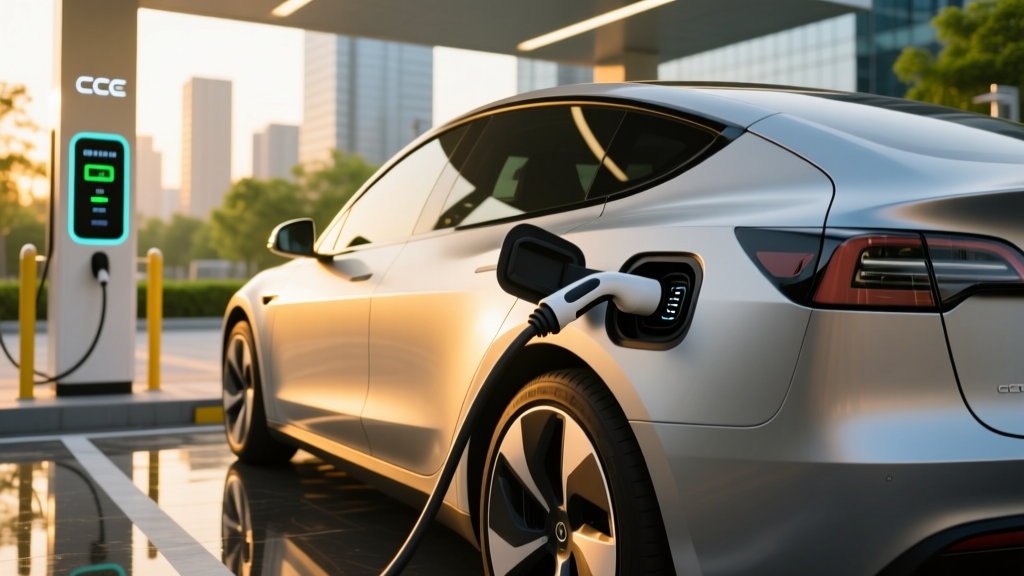
The adapter situation in plain terms: If your EV has a CCS1 port and you want to charge at a Tesla Supercharger (now open to non-Tesla vehicles), you need a NACS-to-CCS1 adapter. If your EV has a NACS port and you pull up to a station with only CCS1 cables, you need a CCS1-to-NACS adapter. Both directions exist, but they serve different owners.
Charging Levels: Speeds, kW, and Miles Per Hour
Before selecting an adapter or home charger, you need to understand the three charging levels and how they differ. Remember: kW (kilowatts) measures power — how fast energy flows into your battery. kWh (kilowatt-hours) measures energy — the total capacity of your battery. They are not interchangeable.
| Level | Voltage | Power (kW) | Miles of Range Added Per Hour | Typical Use Case |
|---|---|---|---|---|
| Level 1 | 120V AC | 1.0–1.4 kW | 3–5 miles | Emergency/trickle; overnight for PHEVs |
| Level 2 | 240V AC | 3.3–19.2 kW | 12–75 miles | Home daily charging; workplace; public AC |
| DC Fast Charge | 300–900V DC | 50–350 kW | 150–1,000+ miles (equivalent rate) | Road trips; 10–80% in 15–45 min |
Which CCS Charging Adapter Do You Actually Need?
Your adapter choice depends entirely on your vehicle's native port and the networks you plan to use.
Scenario A: CCS1 Port Vehicle → NACS Supercharger Access
You own a 2022–2024 VW ID.4, BMW i4, older Kia EV6, or similar. Ford, GM, and Rivian owners with CCS1 ports gained Supercharger access starting in 2024 using manufacturer-provided or approved adapters. In 2026, the key products are:
- Tesla CCS1-to-NACS Adapter (OEM): Rated for up to 250 kW DC. Priced around $195. Works at Superchargers and NACS-equipped third-party stations. Note: Tesla sells a version specifically for non-Tesla vehicles.
- A2Z EV CCS1-to-NACS Adapter: Third-party option rated at 300 kW DC / 48A AC. Typically $130–$170. Well-reviewed but verify UL or equivalent certification before purchasing.
- Lectron NACS-to-CCS1 Adapter: Rated up to 250 kW DC. Around $140–$160. Compact form factor.
Scenario B: NACS Port Vehicle → CCS1 Station Access
You own a 2025+ Ford F-150 Lightning, Tesla, or newer Hyundai/Kia with a native NACS port, but the nearest DC fast station only has CCS1 cables. You need a CCS1-to-NACS adapter (the reverse direction):
- Tesla CCS Combo 2 Adapter (for NACS vehicles): Allows NACS vehicles to use CCS1 chargers. ~$250. Rated for DC fast charging up to 250 kW.
- Lectron CCS1-to-NACS Adapter: ~$150–$180. Rated for 200 kW DC.
Critical adapter caveat: Adapters add a connection point, which means slightly higher electrical resistance. In practice, this rarely costs more than 1–2 kW of peak charging speed, but always seat the adapter firmly and check for heat after 10 minutes of DC fast charging. Never use an adapter that lacks a recognized safety certification (UL, TÜV, or ETL).
Home Level 2 Charging: Installation Costs and Electrical Requirements
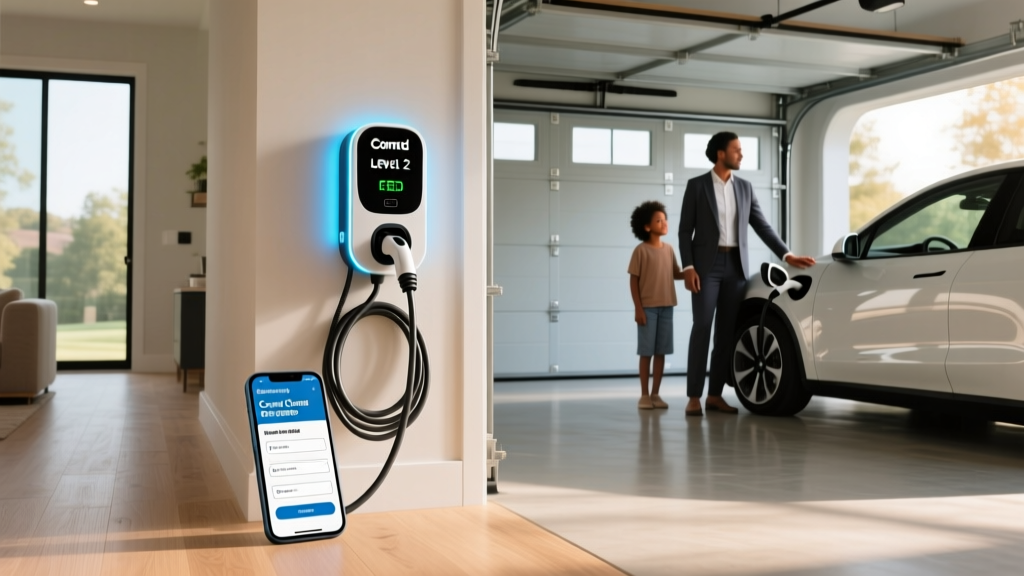
A home Level 2 charger is where most EV owners do 85–95% of their charging. Here's what a 2026 installation actually requires and costs.
Electrical Requirements
A typical Level 2 home charger requires a 240V dedicated circuit — the same voltage as your electric dryer or oven. The amperage determines your charging speed:
- 40A circuit → 32A continuous charging → 7.7 kW (adds ~25–30 miles/hour for most EVs)
- 50A circuit → 40A continuous → 9.6 kW (adds ~32–38 miles/hour)
- 60A circuit → 48A continuous → 11.5 kW (adds ~38–45 miles/hour)
National Electrical Code requires circuits to be rated at 125% of the continuous load. A 48A charger therefore needs a 60A breaker and appropriate wire gauge (typically 6 AWG copper for runs under 50 feet).
Panel Upgrade: The Cost Many Guides Ignore
If your home has a 100A electrical panel (common in homes built before 1990), adding a 40–60A EV circuit may exceed your panel's capacity. Signs you'll need an upgrade:
- Your panel is already near capacity (electric range, dryer, HVAC, water heater all running)
- You have a 100A main breaker
- Your utility service drop is rated below 150A
A panel upgrade from 100A to 200A typically costs $1,500–$3,500 including permits and utility coordination. Some homes need a full service upgrade to 300A or 400A, which can reach $4,000–$7,000. An alternative is an automatic load management system (like the Emporia V2i or Span smart panel), which dynamically reduces EV charging when other circuits draw heavily — potentially avoiding a panel upgrade entirely.
| Component | Low Estimate | High Estimate | Notes |
|---|---|---|---|
| Level 2 Charger (hardware) | $200 | $700 | Depends on brand, power output, smart features |
| Electrician labor | $500 | $2,000 | Varies by run length, conduit, wall material |
| Electrical permit | $50 | $250 | Required in most jurisdictions |
| Panel upgrade (if needed) | $1,500 | $3,500 | 100A → 200A service upgrade |
| Total (no panel upgrade) | $750 | $2,950 | Most homes with 200A panels |
| Total (with panel upgrade) | $2,250 | $6,450 | Older homes with 100A service |
Federal Tax Credit for Home Charging Equipment
The IRS §30C Alternative Fuel Vehicle Refueling Property Credit covers 30% of home EV charger hardware and installation costs, up to $1,000. Eligibility depends on your census tract meeting certain low-income or non-urban criteria. Check the IRS guidance and consult a tax professional — eligibility rules are location-specific and subject to change.
Recommended Home Level 2 Chargers for 2026
These are proven units we recommend based on power output, reliability, connector options, and smart features. Note: all NACS-equipped chargers below will charge CCS1 vehicles with the appropriate adapter.
ChargePoint Home Flex (2nd Gen)
- Power: Up to 12 kW (50A circuit) / configurable 16–50A
- Connector: NACS native (J1772 adapter included for legacy vehicles)
- Cable length: 23 feet
- Smart features: Wi-Fi, app scheduling, Alexa integration, energy reporting
- Price: ~$550
- Best for: Flexibility — adjustable amperage lets you match your circuit without buying a different unit
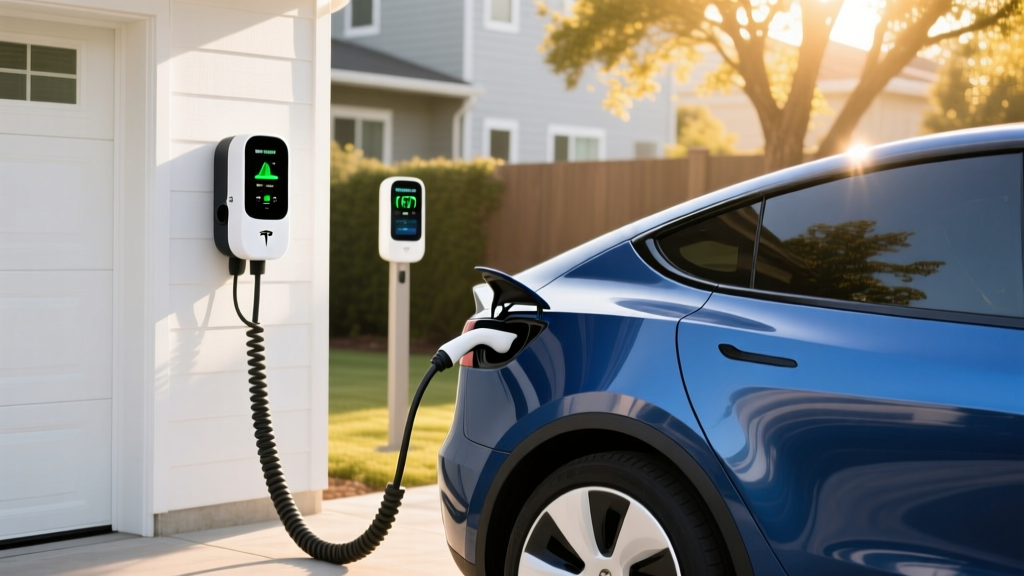
Wall Connector (Tesla, Gen 4)
- Power: Up to 11.5 kW (48A / 60A circuit)
- Connector: NACS native
- Cable length: 24 feet
- Smart features: Wi-Fi, OTA updates, Power-Share (two units on one circuit), access control
- Price: ~$475
- Best for: Tesla owners and NACS-native EVs; excellent build quality; power-sharing for two-car garages
Emporia Level 2 EV Charger
- Power: Up to 11.5 kW (48A / 60A circuit)
- Connector: J1772 (NACS adapter available separately)
- Cable length: 24 feet
- Smart features: Wi-Fi, energy monitoring, solar integration, Time-of-Use scheduling
- Price: ~$400
- Best for: Budget-conscious buyers who want full smart features and energy tracking
Ford Charge Station Pro
- Power: Up to 19.2 kW (80A / 100A circuit) — highest-output residential unit widely available
- Connector: NACS (2025+); CCS1 on 2022–2024 models
- Cable length: 25 feet
- Smart features: FordPass app, Intelligent Backup Power (with F-150 Lightning + Home Integration System)
- Price: ~$1,200 (hardware only; requires 100A circuit)
- Best for: F-150 Lightning owners wanting maximum speed and V2H backup power capability
Cost to Charge: Home vs. Public vs. Gasoline
The economics of EV charging depend heavily on where you charge. Here's how costs break down per kWh and per mile in 2026.
| Scenario | $/kWh (avg.) | Cost per mile (3.5 mi/kWh EV) | Equivalent gas price (at 28 MPG) |
|---|---|---|---|
| Home, off-peak utility rate | $0.09–$0.14 | $0.026–$0.040 | $0.73–$1.12/gal |
| Home, standard rate | $0.14–$0.20 | $0.040–$0.057 | $1.12–$1.60/gal |
| Public Level 2 (ChargePoint, etc.) | $0.20–$0.35 | $0.057–$0.100 | $1.60–$2.80/gal |
| DC Fast (Electrify America, EVgo) | $0.35–$0.55 | $0.100–$0.157 | $2.80–$4.40/gal |
| Tesla Supercharger (2026 avg.) | $0.28–$0.40 | $0.080–$0.114 | $2.24–$3.20/gal |
| Gasoline (US avg., 2026) | — | $0.11–$0.14 (at $3.10–$3.90/gal) | Baseline |
The takeaway: Home charging at off-peak rates remains 60–75% cheaper per mile than gasoline. Even DC fast charging on road trips is often comparable to or slightly cheaper than gas on a per-mile basis — though it varies by network and region. Check your utility's EV-specific Time-of-Use (TOU) plan; many offer rates as low as $0.06–$0.09/kWh overnight.
Charging Time Examples: 10–80% for Common Battery Sizes
Battery size and charger power determine your session length. These estimates assume an ideal charge curve with preconditioning active:
| Vehicle (Battery kWh) | Level 2 at 11.5 kW | DC Fast at 150 kW (avg.) | DC Fast at 250 kW (peak capable) |
|---|---|---|---|
| Tesla Model 3 RWD (57.5 kWh, LFP) | ~3.5 hours | ~28 minutes | ~22 minutes |
| Hyundai Ioniq 5 (84 kWh, NMC) | ~5.1 hours | ~32 minutes | ~18 minutes |
| Ford F-150 Lightning Ext. Range (131 kWh, NMC) | ~8.0 hours | ~50 minutes | ~38 minutes |
| Chevrolet Equinox EV (85 kWh, NMC) | ~5.2 hours | ~34 minutes | ~25 minutes |
Safety and Electrical Code Considerations
EV charging draws sustained high current for hours — far longer than most household appliances. This makes proper installation non-negotiable.
- Dedicated circuit: Your Level 2 charger must be on its own dedicated breaker. Never share the circuit with other appliances.
- GFCI protection: NEC 2020 and later require GFCI protection for EV charging outlets in garages. Hardwired units (no plug) often exempt from this requirement depending on jurisdiction — and hardwired installations avoid the nuisance-tripping issues some GFCI breakers cause with EV chargers.
- Outdoor rating: If your charger is installed outside, ensure it carries a NEMA 4 or IP55+ weather rating. All units recommended above are outdoor-rated.
- Cable management: Use a holster or cable wrap to keep the cord off the ground. A 24-foot cable lying on a garage floor is a tripping hazard and invites damage.
- Permit and inspection: Most municipalities require an electrical permit and post-installation inspection. Your electrician should pull this — if they suggest skipping it, find a different electrician.
Frequently Asked Questions
How much does it cost to install a home EV charger?
Most homes with an existing 200A electrical panel spend $750–$2,950 total (charger hardware, electrician labor, and permit). If your home needs a panel upgrade from 100A to 200A, expect $2,250–$6,450. The §30C federal tax credit can offset up to $1,000 of this cost if your census tract qualifies.
How fast will each charging level add range?
Level 1 (120V) adds roughly 3–5 miles per hour. Level 2 (240V) adds 12–75 miles per hour depending on amperage and your EV's onboard charger capacity. DC fast charging adds the equivalent of 150–1,000+ miles per hour at peak rate, though real sessions taper significantly above 50% SoC. A typical 10–80% DC fast session takes 18–50 minutes depending on battery size and charger power.
Which connector and charger is compatible with my EV?
Check your vehicle's charge port. If it's a 5-pin NACS connector (2025+ Tesla, Ford, GM, Rivian, Hyundai/Kia new models), buy a NACS home charger and use a CCS1-to-NACS adapter for legacy public stations. If it's CCS1 (most 2020–2024 non-Tesla EVs), buy a J1772 or NACS charger with an adapter, and get a NACS-to-CCS1 adapter for Supercharger access. CHAdeMO vehicles (Nissan LEAF) have limited adapter options and a shrinking public network.
How much does charging cost per mile vs. gas?
Home charging at off-peak rates costs roughly $0.03–$0.04 per mile — equivalent to gasoline at $0.85–$1.10 per gallon in a 28 MPG car. Public DC fast charging costs $0.10–$0.16 per mile, comparable to gas at $2.80–$4.50 per gallon. The more you charge at home, the greater your savings. See the cost table above for detailed comparisons.
What electrical upgrades might I need?
The most common upgrade is a panel replacement from 100A to 200A service ($1,500–$3,500). You may also need a new conduit run from your panel to the garage (adding $200–$800 depending on distance and wall material), or a smart load-management device if your panel is near capacity but you want to avoid a full upgrade. Have a licensed electrician perform a load calculation before committing to a circuit size.
Does using a CCS charging adapter reduce charging speed?
Minimally. A quality, certified adapter adds a small amount of electrical resistance, which may reduce peak DC fast-charging speed by 1–3 kW in some cases. In real-world sessions, this translates to roughly 30–90 seconds added to a 10–80% charge. The far bigger speed variable is battery temperature and State of Charge — always precondition your battery before a DC fast session.
Can I use a CCS adapter at Tesla Superchargers?
Yes, if you have a CCS1-port vehicle and a compatible NACS-to-CCS1 adapter. Tesla opened its Supercharger network to non-Tesla EVs via the Magic Dock (built-in adapter at select stalls) and by allowing approved third-party adapters. Confirm your vehicle's compatibility through the Tesla app before your first session, as some vehicles require a software handshake that not all adapters support.