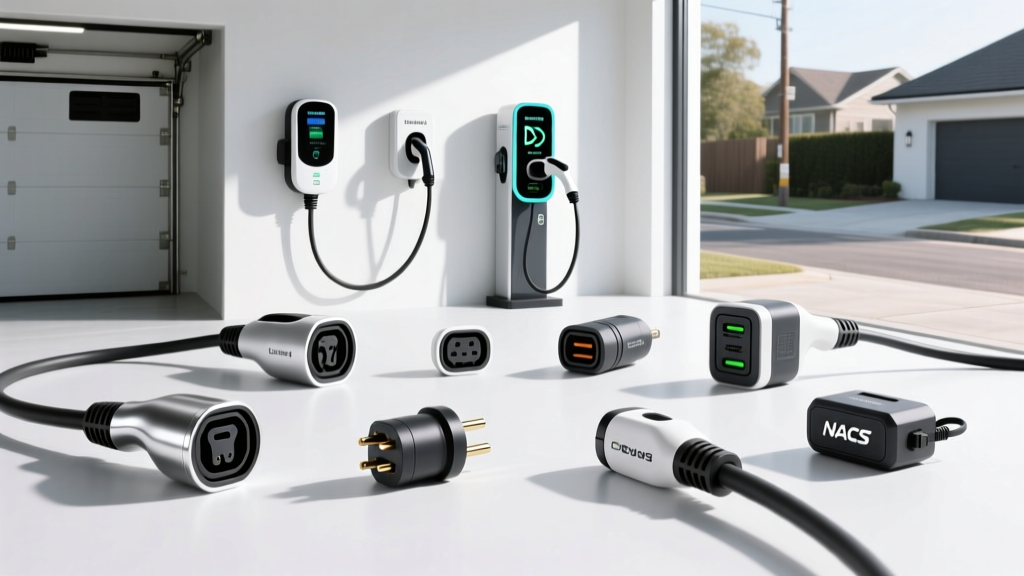
If your EV has a CCS1 port — common on models from Volkswagen, Hyundai, Kia, Ford, BMW, and General Motors — finding the right CCS car charger for home and public use requires navigating a rapidly shifting connector landscape. As of 2026, the North American Charging Standard (NACS) has largely overtaken CCS1 for new vehicle designs, but millions of CCS-equipped EVs remain on the road, and the public charging infrastructure still supports CCS at most DC fast-charging stations.
This guide covers everything you need to know: charging speeds at every level, real installation costs, connector compatibility and adapter options, per-mile charging economics, and specific charger hardware worth buying.
kW (kilowatts) measures power — how fast energy flows into your car. Think of it as the size of the water hose.
kWh (kilowatt-hours) measures energy — the total capacity of your battery. Think of it as the size of the water tank.
A 60 kWh battery charged at 10 kW takes roughly 6 hours. A 200 kW DC fast charger fills that same battery far faster, but only up to a point (more on charge curves below).
Charging Levels Explained: How Fast Will Each Add Range?
Every CCS-compatible EV can accept power at three distinct levels. The table below shows typical power outputs and the approximate range added per hour of charging, based on an average EV efficiency of 3–4 miles per kWh.
| Level | Voltage / Power (kW) | Connector | Miles of Range Added per Hour | Typical Use Case |
|---|---|---|---|---|
| Level 1 | 120V / 1.0–1.4 kW | J1772 (CCS1 upper portion) | 3–5 mi/hr | Overnight trickle, PHEVs, emergencies |
| Level 2 | 240V / 7.2–19.2 kW | J1772 (CCS1 upper portion) | 20–60 mi/hr | Daily home & workplace charging |
| DC Fast Charging | 400–900V / 50–350 kW | CCS1 (combo) or NACS | 150–1,000+ mi/hr (peak) | Road trips, rapid top-ups |
Real-World Charging Time Examples (10%–80% SoC)
DC fast charging doesn't deliver peak power for the entire session. The charge curve tapers significantly above 60–70% State of Charge (SoC) to protect battery cells from heat damage. Here's what actual sessions look like for common CCS1 battery sizes:
- Hyundai Ioniq 5 (77.4 kWh, 800V architecture): Peaks at ~235 kW on a 350 kW charger; 10–80% in approximately 18 minutes. The 800V system sustains higher power longer than 400V competitors.
- Volkswagen ID.4 (82 kWh, 400V): Peaks at ~170 kW; 10–80% in approximately 29 minutes. Power drops below 100 kW after ~65% SoC.
- Ford Mustang Mach-E Extended Range (91 kWh usable, 400V): Peaks at ~150 kW; 10–80% in approximately 38 minutes.
- BMW i4 eDrive40 (81.5 kWh, 400V): Peaks at ~200 kW; 10–80% in approximately 31 minutes.
CCS1, NACS, and CHAdeMO: Which Connector Does Your EV Use?
The connector on your EV determines which chargers you can plug into without an adapter. As of 2026, the North American market has three primary connector standards:
| Connector | Brands Using It (Native) | AC Charging (Level 1/2) | DC Fast Charging |
|---|---|---|---|
| CCS1 (Combo) | VW, Hyundai, Kia, Ford, BMW, GM (pre-2025 models), Rivian (pre-2025), Volvo/Polestar (pre-2025) | J1772 upper pins | CCS combo (J1772 + 2 DC pins) |
| NACS (Tesla standard) | Tesla (all), Ford (2025+), GM (2025+), Rivian (2025+), Volvo/Polestar (2025+), Hyundai (2025+) | Integrated AC pins | Same compact connector |
| CHAdeMO | Nissan Leaf (legacy), Mitsubishi Outlander PHEV (older) | J1772 (separate port) | CHAdeMO (round, 2-pin) |
Adapter Options for CCS1 Owners in a NACS World
With Tesla opening its Supercharger network and most automakers switching to NACS beginning in 2025, CCS1 owners need an adapter strategy:
- CCS1-to-NACS adapter: Several manufacturers (including Ford and Hyundai) offer or include adapters allowing CCS1-equipped vehicles to charge at NACS Superchargers. Expect to pay $200–$400 for a third-party UL-listed adapter. Verify that the adapter supports the full amperage your vehicle can accept (typically up to 600A DC).
- NACS-to-CCS1 adapter: For NACS-equipped vehicles needing to use legacy CCS DC fast chargers, adapters are available from brands like Lectron and AKEV ($150–$300).
- J1772-to-NACS adapter: Needed for NACS vehicles charging at J1772 Level 2 stations. Tesla includes one with new vehicles; aftermarket versions cost $50–$150.
For home Level 2 charging, all CCS1 vehicles accept the standard J1772 connector, which forms the upper portion of the CCS1 combo plug. This means any J1772 Level 2 home charger works with every CCS1 vehicle — no adapter required for daily home charging.
How Much Does It Cost to Install a Home CCS Car Charger?
A Level 2 home charger is the backbone of convenient EV ownership. Installation costs vary dramatically based on your home's electrical panel capacity, the distance from the panel to the charging location, and local permit requirements.
| Cost Component | Simple Install (panel nearby, 200A service) | Complex Install (long run, panel upgrade needed) |
|---|---|---|
| Level 2 Charger Equipment (32A–48A, 7.7–11.5 kW) | $350–$700 | $350–$700 |
| Electrician Labor (run 240V circuit, mount charger) | $400–$800 | $800–$2,000 |
| Electrical Permit | $50–$150 | $50–$200 |
| Electrical Panel Upgrade (100A → 200A, if needed) | $0 (not needed) | $1,500–$3,500 |
| Conduit, Wiring, Misc. Materials | $100–$300 | $300–$800 |
| Total Estimated Cost | $900–$1,950 | $3,000–$7,200 |
Electrical Requirements for a Level 2 CCS Home Charger
A typical 48-amp Level 2 charger requires a 240V dedicated circuit on a 60-amp breaker (the National Electrical Code requires circuits to be rated at 125% of the continuous load, so 48A × 1.25 = 60A). Key specifications:
- Voltage: 240V (split-phase, same as a dryer or oven circuit)
- Amperage: 40A or 60A breaker depending on charger rating
- Wire gauge: 6 AWG copper (for 60A) or 8 AWG (for 40A), run in conduit
- Dedicated circuit: The charger must have its own breaker — no sharing with other appliances
- GFCI protection: Required by NEC 2020+ for EV charging outlets (some chargers include built-in GFCI; hardwired installations may use a GFCI breaker)
- Outdoor rating: If installing outdoors, the charger must carry a NEMA 4 or IP55+ weatherproof rating
Level 2 CCS Car Charger Equipment: Top Picks for 2026
For CCS1 vehicles, any J1772 Level 2 charger is compatible. Here are proven units with strong track records for reliability, smart features, and build quality:
ChargePoint Home Flex
- Power Output: Up to 12 kW (50A) on a 60A circuit; adjustable down to 16A
- Connector: J1772 (compatible with all CCS1 vehicles)
- Cable Length: 23 feet
- Smart Features: Wi-Fi, app scheduling, energy tracking, Alexa integration
- Price: ~$550–$650
- Best For: Flexible amperage, reliable app, UL-listed
Emporia Level 2 EV Charger
- Power Output: Up to 11.5 kW (48A) on a 60A circuit
- Connector: J1772
- Cable Length: 24 feet
- Smart Features: Wi-Fi, real-time energy monitoring, solar integration, load management
- Price: ~$350–$450
- Best For: Budget-conscious buyers with solar panels
Grizzl-E Smart
- Power Output: Up to 10 kW (40A) on a 50A circuit
- Connector: J1772
- Cable Length: 24 feet
- Smart Features: OCPP-compatible, app control, adjustable amperage
- Price: ~$400–$500
- Best For: Extreme cold climates (-40°F rated), Canadian-built, robust warranty
Wallbox Pulsar Plus
- Power Output: Up to 11.5 kW (48A) on a 60A circuit
- Connector: J1772
- Cable Length: 25 feet
- Smart Features: Wi-Fi + Bluetooth, Power Sharing (two chargers on one circuit), compact design
- Price: ~$500–$600
- Best For: Small footprint, two-EV households
Hardwired vs. Plug-In: Chargers rated above 40A (10 kW) are often hardwired directly to the circuit rather than using a NEMA 14-50 outlet. Hardwiring eliminates the GFCI breaker requirement in some jurisdictions and provides a cleaner installation, but makes the charger non-portable. A NEMA 14-50 outlet offers flexibility if you move or want to use the outlet for other 240V tools.
Charging Cost per Mile: Home vs. Public vs. Gas
One of the strongest economic arguments for EV ownership is the per-mile fuel cost. Here's how CCS1 charging scenarios compare to gasoline at $3.50/gallon (national average, 2026) for a vehicle averaging 30 MPG combined:
| Charging Scenario | Cost per kWh | Cost to Fill 60 kWh Battery | Cost per Mile (at 3.5 mi/kWh) |
|---|---|---|---|
| Home (off-peak utility rate) | $0.08–$0.14 | $4.80–$8.40 | $0.023–$0.040 |
| Home (standard residential rate) | $0.14–$0.20 | $8.40–$12.00 | $0.040–$0.057 |
| Public Level 2 (workplace, retail) | $0.20–$0.35 | $12.00–$21.00 | $0.057–$0.100 |
| DC Fast Charging (Electrify America, EVgo) | $0.35–$0.55 | $21.00–$33.00 | $0.100–$0.157 |
| Gasoline (30 MPG, $3.50/gal) | — | — | $0.117 |
The bottom line: Home charging at off-peak rates costs roughly one-third to one-quarter what gasoline costs per mile. Even DC fast charging at premium public rates is comparable to or slightly cheaper than gasoline. The savings compound: a driver covering 12,000 miles/year saves $600–$1,100 annually by charging at home versus buying gas.
Many utilities offer time-of-use (TOU) plans that drop electricity rates to $0.06–$0.10/kWh during overnight hours (typically 11 PM–6 AM). Scheduling your CCS car charger to run during these windows maximizes savings. According to the U.S. Department of Energy's fueleconomy.gov, EV owners who charge primarily at home save an average of $700–$1,000 per year compared to gas.
Public CCS1 DC Fast Charging: Networks and Reliability
CCS1 remains the most widely available DC fast charging connector at non-Tesla public stations in 2026. Major networks supporting CCS1 include:
- Electrify America: 50–350 kW CCS chargers at ~900+ stations nationwide. Pricing: $0.31–$0.48/kWh depending on location and membership tier.
- EVgo: 50–350 kW CCS chargers at ~1,100+ stations. Pricing: $0.36–$0.48/kWh; subscription plans available.
- ChargePoint: Growing network of 62.5–400 kW CCS chargers. Pricing varies by site host.
- Tesla Supercharger (with adapter): CCS1 vehicles can access select Supercharger stations using a CCS-to-NACS adapter. Pricing: $0.25–$0.40/kWh. Check the Tesla app for stations with "Magic Dock" CCS adapters built in.
For real-time station availability and pricing, the Alternative Fuels Data Center maintains a comprehensive, searchable database of all public charging stations in the U.S., filterable by connector type.
Safety, Electrical Code, and Smart Features
EV charging involves sustained high-current draw — often for 6–10 hours at a time. Safety is non-negotiable. Key considerations:
- UL Listing: Only purchase chargers that are UL-listed or ETL-listed. Uncertified chargers from overseas marketplaces may lack critical safety protections (overcurrent, ground fault, thermal cutoff).
- Dedicated circuit: Never share an EV charger circuit with other appliances. The sustained load can cause nuisance tripping or overheating on shared circuits.
- GFCI protection: NEC Article 625 requires ground-fault protection for EV charging. Hardwired chargers with internal GFCI may not require a GFCI breaker; plug-in units using a NEMA 14-50 outlet typically do.
- Outdoor installation: Chargers mounted outdoors must carry a NEMA 4 (watertight) or IP55+ rating. Verify that the connector holster provides a drip loop for the cable.
- Load management: If your panel is near capacity, some chargers (Emporia, Wallbox) offer dynamic load management that monitors total household draw and reduces charging power to prevent panel overload — avoiding the need for a costly panel upgrade.
- Permit and inspection: Most jurisdictions require an electrical permit for a new 240V circuit. The inspection verifies proper wire gauge, breaker sizing, grounding, and GFCI compliance. Skipping the permit risks insurance denial in the event of a fire.
Frequently Asked Questions
How much does it cost to install a home EV charger?
A straightforward Level 2 installation (200A panel, short wire run, no panel upgrade) costs $900–$1,950 including equipment, electrician labor, and permit. Complex installations requiring a panel upgrade or long conduit runs can reach $3,000–$7,200. The IRS §30C credit offers up to $1,000 (30% of cost) for home EV charger installation in eligible census tracts — check IRS.gov for current eligibility maps.
Can I use a Tesla Supercharger with my CCS1 vehicle?
Yes, with a CCS1-to-NACS adapter. Ford and Hyundai provide adapters for eligible models. Tesla's "Magic Dock" built-in adapter is available at select Supercharger stations, allowing CCS1 vehicles to plug in without a separate adapter. Always verify compatibility in the Tesla app before traveling.
What electrical upgrades might I need for a Level 2 charger?
Homes with 100A service or older panels may need a panel upgrade to 200A ($1,500–$3,500). An electrician will perform a load calculation considering all existing circuits. If your panel has spare capacity and at least two unused breaker slots, you likely won't need an upgrade. Some utilities offer rebates for panel upgrades tied to EV adoption.
Is a 32A or 48A charger better for my CCS car?
It depends on your vehicle's onboard charger capacity. The Hyundai Ioniq 5 accepts up to 10.9 kW AC (48A × 240V ≈ 11.5 kW), so a 48A charger maximizes its AC speed. The VW ID.4 accepts up to 11 kW AC. A 32A charger (7.7 kW) is sufficient if your vehicle's onboard charger is limited to 7.2 kW or if your electrical panel can't support a 60A circuit.
How much does charging cost per mile vs gas?
Home charging at off-peak rates ($0.08–$0.14/kWh) costs $0.023–$0.040 per mile for an EV averaging 3.5 mi/kWh. Gasoline at $3.50/gallon in a 30 MPG vehicle costs $0.117 per mile. That's a savings of $0.077–$0.094 per mile, or roughly $900–$1,100 per year at 12,000 miles driven annually. Even public DC fast charging ($0.35–$0.55/kWh) is comparable to or slightly cheaper than gasoline per mile.
Do I need a smart charger, or will a basic unit work?
A basic (non-smart) charger works perfectly for charging. Smart features — Wi-Fi scheduling, energy monitoring, utility TOU integration, and load management — are valuable if you want to optimize costs on a time-of-use rate plan, track energy usage, or manage two chargers on a single circuit. If you charge overnight on a flat rate, a basic unit saves $100–$200 upfront with no practical downside.